Hella Haasse, James Joyce, Eriek Verpale, Michel Marc Bouchard

De Nederlandse schrijfster Hella Haasse werd geboren op 2 februari 1918 in Batavia. Zie ook mijn blog van 2 februari 2007 en ook mijn blog van 2 februari 2008 en ook mijn blog van 2 februari 2009.

Uit: Heren van de thee

„Verborgen in de diepten van het woud ruiste een waterval. Zij gingen op het geluid af en kwamen bij een stroom die breder en woester was dan de andere riviertjes. Hij begreep dat dit de Tjisondari moest zijn; de steile oever aan de overkant leek hem de natuurlijke grens van de plantage. Maar Djengot, die de omgeving kende, hield vol dat dit niet zo was. Zij liepen langs de Tjisondari totdat zij een plek vonden waar zij wadend en springend van steen op steen konden oversteken. Inderdaad ontdekte hij nog oude tuinen waarvan hij het bestaan niet had vermoed, en enkele min of meer open plekken die geschikt leken voor nieuwe veldjes.
Het liefst was hij dadelijk naar de top van de Goenoeng Tiloe geklommen, om vandaar de omvang van zijn gebied te kunnen schatten – nog had hij geen flauw idee hoe hij de grenzen van de her en der over de berghelling verspreide koffietuinen in kaart moest brengen. Landmeten zou zijn eerste taak zijn. Hij had daar echter deskundige hulp bij nodig. De talloze ravijnen, onbruikbaar voor aanplant, vormden moeilijk te becijferen enclaves.

(…)

Er trok een wolk voor de zon, de eerste van de gestaag rijzende wal die later in de middag in een stortbui uiteen zou breken. Dat het op Gamboeng zo vaak en zo hevig zou regenen, had hij niet voorzien. Die regen en de eenzaamheid (hij had nu in bijna drie maanden geen woord Nederlands gehoord of gesproken) waren de schaduwzijden van zijn Eldorado. Hij dacht soms met een vleug zelfspot aan de grenzeloze verrukking die hem had bevangen toen hij voor de eerste maal op de bergkam stond. Nog beleefde hij dergelijke ogenblikken van puur geluk, wanneer na noodweer bij de uitgang van het druipende oerwoud, of ’s ochtends als hij zijn deur opendeed, het grandioze panorama van de Pantjoer, de Patoeha en de Tambagroejoeng zich voor hem ontvouwde, de Gedeh op de achtergrond, in schakeringen van blauw en violet zichtbaar was, terwijl vlakbij de drietoppige Goenoeng Tiloe zich machtig verhief. Hij ervoer telkens weer dat dit landschap – al meende hij het nu beter te kennen omdat hij het in alle richtingen doorkruist had – zich als het ware terugtrok in een niet te doorgronden eigen bestaan. Hij begreep ook waarom voor de mensen die hier woonden elke boom, steen en bergstroom bezield was, een wezen met een naam, een bijzondere macht.“

Hella_Haasse

Hella Haasse (Batavia, 2 februari 1918)


De Ierse schrijver James Joyce werd geboren in Dublin op 2 februari 1882. Zie ook mijn blog van 2 februari 2007 en mijn blog van 16 juni 2006 en ook mijn blog van 2 februari 2008 en ook mijn blog van 2 februari 2009.

Uit: A Portrait of the Artist as a Young Man

“Et ignotas animum dimittit in artes.”
ovid, metamorphoses, viii., 18.

ONCE UPON a time and a very good time it was there was a moocow coming down along the road and this moocow that was down along the road met a nicens little boy named baby tuckoo. . . .
His father told him that story: his father looked at him through a glass: he had a hairy face.
He was baby tuckoo. The moocow came down the road where Betty Byrne lived: she sold lemon platt.
O, the wild rose blossoms
On the little green place.
He sang that song. That was his song.
O, the green wothe botheth.
When you wet the bed, first it is warm then it gets cold. His mother put on the oilsheet. That had the queer smell.
His mother had a nicer smell than his father. She played on the piano the sailor’s hornpipe for him to dance. He danced:

Tralala lala,
Tralala tralaladdy,
Tralala lala,
Tralala lala.

Uncle Charles and Dante clapped. They were older than his father and mother but Uncle Charles was older than Dante.
Dante had two brushes in her press. The brush with the maroon velvet back was for Michael Davitt and the brush with the green velvet back was for Parnell. Dante gave him a cachou every time he brought her a piece of tissue paper.
The Vances lived in number seven. They had a different father and mother. They were Eileen’s father and mother. When they were grown up he was going to marry Eileen. He hid under the table.
His mother said:
—O, Stephen will apologise.
Dante said:
—O, if not, the eagles will come and pull out his eyes—

Pull out his eyes,
Apologise,
Apologise,
Pull out his eyes.

Apologise,
Pull out his eyes,
Pull out his eyes,
Apologise.

The wide playgrounds were swarming with boys. All were shouting and the prefects urged them on with strong cries. The evening air was pale and chilly and after every charge and thud of the foot-ballers the greasy leather orb flew like a heavy bird through the grey light. He kept on the fringe of his line, out of sight of his prefect, out of the reach of the rude feet, feigning to run now and then. He felt his body small and weak amid the throng of players and his eyes were weak and watery. Rody Kickham was not like that: he would be captain of the third line all the fellows said.“

James_Joyce_Statue

James Joyce (2 februari 1882 – 13 januari 1941)
Standbeeld in Zürich, Zwitserland


De Vlaamse dichter en schrijver Eriek Verpale werd geboren op 2 februari 1952 te Zelzate. Zie ook mijn blog van 2 februari 2007 en ook mijn blog van 2 februari 2008 en ook mijn blog van 2 februari 2009.


Uit: Katse nachten


„Ik leg de hoorn neer, neem mijn sigaretten en begeef mij naar een aangrenzend vertrek (’t drukkerskot) alwaar ik haastig in De Standaard begin te bladeren. En daar staat het. In de nacht van eergisteren op gisteren is in de Brugse St-Lucaskliniek op 21-jarige leeftijd de veelbelovende Vlaamse dichter Jotie T’Hooft overleden. Een overdosis. Ik vouw de krant dicht en ga voor het raam staan: achter mijn rug hoor ik de Marchands ratelen, telefoons rinkelen en buiten worden lege goederenwagons gerangeerd. T’Hooft is dood.
Ik heb weinig van hem gelezen en ontmoet heb ik Jotie eigenlijk maar één keer: op een donkere namiddag in december, in Gent, op een of andere redactievergadering. Buiten was het al zo donker dat het wel leek alsof al het nacht was. Het redactielokaal was niet veel meer dan een krottig hok en ook daar was alles duister, zó duister dat ik bij de begroeting “Dag juffrouw” tegen Jotie zei. Ik hield hem voor een meisje. Maanden later stuurde hij nog een briefje waarin hij me in het Zwarte Huis uitnodigde om eens over de Baal Sjem Tov te spreken maar ik moest wel mijn eigen bokes meebrengen.
Ik ben nooit gegaan.“


Verpale

Eriek Verpale (Zelzate, 2 februari 1952)


De Zwitserse schrijfster Monica Camuglia werd geboren op 2 februari 1960 in St. Gallen. Zie ook mijn blog van 11 januari 2010.


Uit: IRRTUM 2012


Eine Stunde vor Mitternacht, das Jahr 2013 beginnt in 59 Minuten und 20 Sekunden. Steht dieses eine Jahr tatsächlich für den Beginn einer neuen Epoche?

Ein Glas Limoncello in der einen, eine Zigarette in der anderen Hand wiege ich in der Hängematte, die zwischen zwei weiß verputzten Säulen aufgespannt ist. Die beiden Säulen stützen auch das Dach der kleinen, liebevoll eingerichteten und fürsorglich gepflegten Veranda vor unseren beiden Schlafzimmern. Das Bistro und die acht Schlafräume der schmucken Pension sind auf vier verschiedene Terrassen verteilt und fügen sich so perfekt in die Wölbungen des Hanges, sodass ihre

Größe von außen betrachtet unterschätzt wird. Der steile Hang reicht vom
vulkanischen Grat bis hinab zum pechschwarzen Meer nach Filicudi Porto. Aus dieser etwas erhobenen Perspektive wirken die Schiffe auf dem Meer wie Spielzeug; und doch erreichen wir über den Fußpfad durch den Kakteenwald den Badestrand in zwanzig Minuten. Mein Blick schweift am Dach vorbei nach oben; der Himmel ist übersät mit funkelnden Punkten, nur der Mond versteckt sich noch hinter dem Krater. Sobald er zum Vorschein kommt, verwandelt sich das dunkle Wasser in einen Teppich goldener

Plättchen. Eines von der Sorte Wunder, die nur in der Poesie angemessen gewürdigt werden.

So wie es aussieht, muss ich um Mitternacht alleine auf das neue Jahr anstoßen. Nathan ist erschöpft und vor einer Stunde in einen tiefen Schlaf gefallen. Das ist völlig in Ordnung. Außerdem habe ich so ein fantastisches inneres Gefühl, das ich auch gut alleine auskosten kann. Morgen um elf werde ich das Schiff nach Hause nehmen und zu Lia, meiner Tochter zurück- kehren. Sie ist bei ihrem Vater in Zürich. Nathan bleibt noch ein paar Tage.”


Camuglia

Monica Camuglia (St. Gallen, 2 februari 1960)


De Canadese toneelschrijver Michel Marc Bouchard werd geboren op 2 februari 1958 in Saint Coeur-de-Marie, Quebec. Zie ook mijn blog van 2 februari 2009.


Uit: La Contre-Nature de Chrysippe Tanguay, écologiste


“Encore au lit? Debout! Il y a une heure que vous devriez être dans la grande salle en train d’y laver les planchers. Laïos, debout! Qui a couché avec vous? Qui a couché avec vous? Mon dieu! Quelle puanteur!v Quelle orgie! J’aurais les mains en sang que vous ne comprenderiez rien encore. Savez-vous ce que la Bible raconte à ce sujet? Diane/La Religieuse.

(…)


:”Quand la police est arrivée, y t’ont trouvé caché dans le placard. Y ont dessiné le profil d’Alice, ta femme, avec un craie. T’as pris la craie pis sur le profil, t’as dessiné les yeux, la bouche, les seins, le ventre d’Alice. T’as rajouté un pénis, des testicules, pis t’a écrit sur le ventre “Sébastien”. Après tu t’es mis à brailler devant ton chef d’oeuvre. Y a un photographe du journal où tu travaillais qu’y a mis sa main sur ton épaule pis y t’a dit; Braille pas chum, à c’t’heure, t’es une vedette!” LAÏOS.“


Michel_Marc_Bouchard

Michel Marc Bouchard (Saint Coeur-de-Marie, 2 februari 1958)


Zie voor nog meer schrijvers van de 2e februari ook mijn vorige twee blogs van vandaag.
 

James Dickey, Santa Montefiore, Xuân Diệu, Ayn Rand, William Rose Benét

De Amerikaanse dichter en schrijver James Dickey werd geboren op 2 februari 1923 in Atlanta, Georgia. Zie ook mijn blog van 2 februari 2007 en ook mijn blog van 2 februari 2008 en ook mijn blog van 2 februari 2009.


Uit: The Shark’s Parlor


„Memory: I can take my head and strike it on a wall on Cumberland Island
Where the night tide came crawling under the stairs came up the first
Two or three steps and the cottage stood on poles all night
With the sea sprawled under it as we dreamed of the great fin circling
Under the bedroom floor. In daylight there was my first brassy taste of beer
And Payton Ford and I came back from the Glynn County slaughterhouse
With a bucket of entrails and blood. We tied one end of a hawser
To a spindling porch-pillar and rowed straight out of the house
Three hundred yards into the vast front yard of windless blue water
The rope out slithering its coil the two-gallon jug stoppered and sealed
With wax and a ten-foot chain leader a drop-forged shark-hook nestling.
We cast our blood on the waters the land blood easily passing
For sea blood and we sat in it for a moment with the stain spreading
Out from the boat sat in a new radiance in the pond of blood in the sea
Waiting for fins waiting to spill our guts also in the glowing water.
We dumped the bucket, and baited the hook with a run-over collie pup. The jug
Bobbed, trying to shake off the sun as a dog would shake off the sea.
We rowed to the house feeling the same water lift the boat a new way,
All the time seeing where we lived rise and dip with the oars.
We tied up and sat down in rocking chairs, one eye on the other responding
To the blue-eye wink of the jug. Payton got us a beer and we sat“


Dickey

James Dickey (2 februari 1923 – 19 januari 1997)


De Britse schrijfster Santa Montefiore (eig. Santa Palmer-Tomkinson) werd geboren op 2 februari 1970 in Hampshire. Montefiore is de dochter van Charles Palmer-Tomkinson. Haar vader vertegenwoordigde zijn land met skiën op Olympisch niveau tijdens de Olympische Winterspelen van 1964. Voordat ze Spaans en Italiaans leerde aan de Universiteit van Exeter, werkte ze een jaar op een Argentijnse ranch. Voordat ze terug kwam naar het Verenigd Koninkrijk woonde ze in de jaren negentig een tijd in Buenos Aires. Vier van haar boeken spelen zich af in Argentinië.


Uit: The Gypsy Madonna


„It all began on a snowy January day. January is bleak in New York. The trees are bare, the festivities over, the Christmas tree lights taken down for another year. The wind that races down the streets is edged with ice. I walked briskly with my hands in my coat pockets. Head down, eyes to the ground, lost in thought: nothing particular, just
the business of the day. I tried not to think of my mother. I am an avoider. If something gives me pain I don’t think about it. If I don’t think about it, it isn’t happening. If I can’t see it, it isn’t there, right? My mother had been dead a week. The funeral was over. Only the journalists pestered like flies, determined to find out why an uncatalogued, unknown Titian of such importance had only now come to light. Didn’t they understand that I knew as little as they did? If they were grappling in the dark, I was floundering
in space.

I reached my office. A redbrick building in the West Village with an antique shop on the ground floor. Zebedee Hapstein, the eccentric clockmaker, toiled against a discordant orchestra of ticking in his workshop next door. I fumbled in my pocket for the key. My fingers were numb. I had forgotten to wear gloves. For a moment I looked at my reflection in the glass“.


SantaMontefiore

Santa Montefiore (Hampshire, 2 februari 1970)


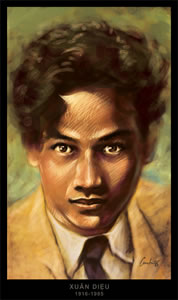
De Viëtnamese dichter Xuân Diệu werd geboren op 2 februari 1916 in Gò Bồi, gemeente Tùng Giản. Zie ook mijn blog van 2 februari 2007 en ook mijn blog van 2 februari 2009.


Say It


“I am deeply in love, dear, is that not enough?
“How greedy you are, and demanding too!
“You already know, for I’ve told you I love you.
“Why insist on me repeating old stuff so oft?


You love me deeply, but is that enough?
If you are in love, but you just keep it inside
And not show it, then words are empty,
And beauty is as cold as marble.


I have an immense desire, did you know?
And absolute, too. I’m in constant search of you.
If today’s truth is truth no longer tomorrow,
How can, my dear, love ever be old too?


Be deeply in love, but that is still not enough.
You’ve got to say love, hundreds, no, thousands of times.
Be so loving that every night is one of spring,
And birds and butterflies freed in the love garden.


Say it, you must say it, you must.


With words that dwell privy in your eyes and your brows
With joy, bashfulness, and ecstasy at dusk,
With head cuddling, smile on your lips, and grasping arms,
With wordless intensity, what else do I know!


Just make sure you don’t stay frigid as ice
Or be unmoved beside one burning with desire,
Nor be as placid as still water in the pond.
Be deeply in love, but that is still not enough.


Vertaald door Thomas D. Le


XuanDieu

Xuân Diệu (2 februari 1916 – 18 december 1985)


De Amerikaanse schrijfster van Russische komaf Ayn Rand (eig. Alissa “Alice” Zinovievna Rosenbaum) werd geboren in Sint-Petersburg op  2 februari 1905. Zie ook mijn blog van 2 februari 2007 en ook mijn blog van 2 februari 2009.


Uit: The Anthem


„We look ahead, we beg our heart for guidance in answering this call no voice has spoken, yet we have heard. We look upon our hands. We see the dust of centuries, the dust which hid the great secrets and perhaps great evils. And yet it stirs no fear within our heart, but only silent reverence and pity.

May knowledge come to us! What is the secret our heart has understood and yet will not reveal to us, although it seems to beat as if it were endeavoring to tell it?

I am. I think. I will.

My hands . . . My spirit . . . My sky . . . My forest . . . This earth of mine. . . . What must I say besides? These are the words. This is the answer.

I stand here on the summit of the mountain. I lift my head and I spread my arms. This, my body and spirit, this is the end of the quest. I wished to know the meaning of things. I am the meaning. I wished to find a warrant for being. I need no warrant for being, and no word of sanction upon my being. I am the warrant and the sanction.

It is my eyes which see, and the sight of my eyes grants beauty to the earth. It is my ears which hear, and the hearing of my ears gives its song to the world. It is my mind which thinks, and the judgement of my mind is the only searchlight that can find the truth. It is my will which chooses, and the choice of my will is the only edict I must respect.

Many words have been granted me, and some are wise, and some are false, but only three are holy: “I will it!”

Whatever road I take, the guiding star is within me; the guiding star and the loadstone which point the way. They point in but one direction. They point to me.“


ayn_rand

Ayn Rand (2 februari 1905 – 6 maart 1982)


De Amerikaanse dichter en uitgever William Rose Benét werd geboren op 2 febrari 1886 in Fort Hamilton, Brooklyn, New York. Zie ook mijn blog van 2 februari 2009.


The Falconer of God


I flung my soul to the air like a falcon flying.

I said, “Wait on, wait on, while I ride below!

I shall start a heron soon

In the marsh beneath the moon —

A strange white heron rising with silver on its wings,

Rising and crying

Wordless, wondrous things;

The secret of the stars, of the world’s heart-strings,

The answer to their woe.

Then stoop thou upon him, and grip and hold him so!”


My wild soul waited on as falcons hover.

I beat the reedy fens as I trampled past.

I heard the mournful loon

In the marsh beneath the moon.

And then — with feathery thunder — the bird of my desire

Broke from the cover

Flashing silver fire.

High up among the stars I saw his pinions spire.

The pale clouds gazed aghast

As my falcon stoopt upon him, and gript and held him fast.


My soul dropt through the air — with heavenly plunder? —

Gripping the dazzling bird my dreaming knew?

Nay! but a piteous freight,

A dark and heavy weight

Despoiled of silver plumage, its voice forever stilled, —

All of the wonder

Gone that ever filled

Its guise with glory. Oh, bird that I have killed,

How brilliantly you flew

Across my rapturous vision when first I dreamed of you!


Yet I fling my soul on high with new endeavor,

And I ride the world below with a joyful mind.

I shall start a heron soon

In the marsh beneath the moon —

A wondrous silver heron its inner darkness fledges!

I beat forever

The fens and the sedges.

The pledge is still the same — for all disastrous pledges,

All hopes resigned!

My soul still flies above me for the quarry it shall find.


Bennet

William Rose Benét (2 februari 1886 – 4 mei 1950)
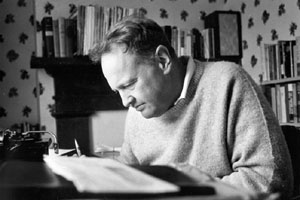
Hier zittend links temidden van vele collega’s in de Gotham Book Mart, 1948

Gostan Zarian, Ludwig Eichrodt, Johann Ch. Gottsched, Michael Öchsner

De Armeense schrijver Gostan Zarian werd geboren op 2 februari 1885 in Shemakha, voormalige hoofdstad van Azerbeidzjan. Zie ook mijn blog van 2 februari 2009.


Uit: The Ship On The Mountain (Vertaald door Shant Norashkharian)


When his eyes started to get used to the darkness, pictures from the wall of the altar stared at him. Slowly they awakened and grew larger. The wall flashed out long bodies, chiseled faces, deep-fallen black eyes, untidy beards, and bony, unnatural hands, which, creeping over the ravaged chests squeezed some worn-out books.

Herian’s eyes met their eyes.

Fierce, huge, phosphorous eyes.

The pictures, leaving the wall, were advancing toward him inconspicuously.

Herian stepped back.

At that instant, something hanging from the roof moved. Perhaps it was a bat or… He looked up. He saw nothing. He looked at the pictures, as their enlarged eyes dominated him. They pushed his stare inward, they subdued it.

He could not move anymore. An uncertain battle started within him. His awareness became veiled, it lost its clarity.

A pair of candles blinked, washed a few shadows as they shimmered, and died.

The darkness became even deeper. And, suddenly, from the depth of the church, he heard footsteps. Herian turned around and was astonished. In front of him stood Peter Mark.

Mark, the Armenian from India, whom he had met at the restaurant.

“Hello, Captain, hello…”

He stretched his tanned and hairy hand and greeted Herian warmly. The hand was cold, and the arm -Herian later remembered- unusually long.

“I saw you as you came inside and waited for you to finish your prayer…Truly, these are special places, with which to communicate, it is worthwhile to cross thousands of kilometers, as I have done…Special, momentous places…”

” My pleasure, Mr. Mark…I was not expecting…”

” I believe, that one must always, always expect…I was expecting to see you, as these pictures were expecting to see me and you…for centuries…the boundaries of the soul, Captain, no matter which way you choose to reach them, constantly expand and go farther, the depth of the soul is great and its potentialities are limitless…”

He smiled slowly under the nose and at that moment his face took the form of a mask which had come out of Indian wall-sculptures.“


Zarian

Gostan Zarian (2 februari 1885 – 11 december 1969)


De Duitse dichter Ludwig Eichrodt werd geboren op 2 februari 1827 in Durlach bij Karlsruhe. Zie ook mijn blog van 2 februari 2009.

In der Früh

Die Sonn ist aufgegangen,
Ich steh im Thau der Flur,
Die Glockenblumen prangen
Und schillern im Azur.

Die süßen Strahlen scheuchten
Die lange schwarze Nacht,
Und Wald und Wiesen leuchten
Wie funkelnder Smaragd.

Die Frühlingsnelken blühen
Wie glühender Rubin
Wie Diamanten sprühen
Die Tropfen im Jasmin.

Und von den Wasserfällen
Die Perle glänzend rollt,
Es blitzet aus den Quellen
Wie Silber und wie Gold.

O Liebste, wie beschenk ich
Mit all dem Schmuck dich gleich?
Durch dieses Liedchen denk ich
Mach ich mein Liebchen reich!


Ludwig_Eichrodt

Ludwig Eichrodt (2 februari 1827 – 2 februari 1892)
Monument in het Stadtpark van Lahr


De Duitse schrijver Johann Christoph Gottsched werd geboren in Juditten (bij Koningsbergen) op 2 februari 1700. Zie ook mijn blog van 2 februari 2009.


Uit: Der strenge Ehemann


„Karl der Achte, König in Frankreich, … schickte einen vornehmen Hofbedienten nach Deutschland, gewisse Reichsangelegenheiten zu besorgen. Die Reise ward sehr geschwinde fortgesetzt, und der Gesandte schonte sogar der Nacht nicht, den Befehl seines Herrn desto schleuniger zu vollziehen. Einen Abend kam er ganz spät an das Schloß eines Landjunkers, bei welchem er um Herberge bat. Es kostete viel Mühe, ehe er eingelassen ward; doch da der Edelmann hörte, daß es ein Bedienter seines Königs wäre, kam er ihm entgegen und entschuldigte die Grobheit seiner Leute, setzte aber hinzu, daß er um einiger übelgesinnten Anverwandten halber von seiten seiner Ehegattin dergleichen Vorsichtigkeit vonnöten hätte. Hierauf führte er den Gast herein und nahm ihn mit aller möglichen Ehrenbezeigung auf. Als es Essenszeit war, führte der Wirt diesen Fremden in einen schönen tapezierten Saal. Man trug auf, und alsbald kam unter den Tapeten das schönste Frauenzimmer von der Welt hervorgetreten, aber mit einem kahlbeschornen Haupte und in einem nach deutscher Manier gemachten schwarzen Trauerkleide. Man brachte das Handbecken, und als der Gast und Wirt sich gewaschen hatten, reichte man es dieser Dame, welche sich auch wusch und, ohne ein Wort zu sprechen, noch von jemandem angeredet zu werden, sich am Ende des Tisches niederließ. Der Fremde sah sie oft an und fand, daß sie bei ihrer großen Schönheit doch sehr blaß und ganz niedergeschlagen war.

Als sie etwas gegessen hatte, forderte sie zu trinken. Ein Bedienter brachte ihr solches, aber in einem Gefäße von wunderbarer Gestalt. Es war die Hirnschale von einem Menschen, darinnen die Augenlöcher mit silbernen Blechen vermacht waren. Sie trank zwei- oder dreimal daraus; und als sie satt war, stand sie auf, wusch wieder die Hände, machte dem Hausherrn einen Reverenz und verfügte sich wieder hinter die Tapeten, ohn’ ein einziges Wort zu sagen.“


Johann_Christoph_Gottsched_1744

Johann Ch. Gottsched (2 februari 1700 – 12 december 1766)


De Duitse dichter en leraar Michael Öchsner werd geboren op 2 februari 1816 in München. Zie ook mijn blog van 2 februari 2009.


Für Bayern


Gott mit dir du Land der Bayern
Deutsche Erde Vaterland!
Über deinen weiten Gauen
Ruhe deine Segenshand!
Er behüte deine Fluren
Schirme deiner Städte Bau
Und der Himmel dir erhalte
Seine Farben – Weiß und Blau.


Gott mit dir dem Bayernvolke
Daß wir unsrer Väter wert
fest in Eintracht und in Friede
bauen unseres Glückes Herd;
Daß der Freund da Hilfe finde
Wehrhaft uns der Gegner schau
Wo die Rauten-Banner wehen
Unsre Farben – Weiß und Blau!

Gott mit ihm dem Bayer-König
Vater Max aus Wittelsbach!
Über seinem Hause wölbe
Sich des Himmels schirmend Dach!
Gott erhalte uns den Herrscher
Volkes-Glück in jedem Gau
Reine Sitte deutsche Treue
Ew’ge Farben – Weiß und Blau.


Oechsner

Michael Öchsner (2 februari 1816 – 8 oktober 1893)