“There was a sky somewhere above the tops of the buildings, with stars and a moon and all the things there are in a sky, but they were content to think of the distant street lights as planets and stars. If the lights prevented you from seeing the heavens, then preform a little magic and change reality to fit the need. The street lights were now planets and stars and moon. ” (…)
“I think thats one of the problems with the world today, nobody knows who they are. everyone is running around looking for an identity, or trying to borrow one, only they dont know it. they actually think they know who they are and hat they are? theyre just a bunch of schleppers…who have no idea what a search for personal truth and identity really is, which would be alright if they didn’t get in your way, but they insist that they know everything and that if you dont live their way then youre not living properly and they want to take your space away…they actually want to somehow get into your space and live in it and change it or destroy it…they just cant believe that you know what you are doing and that you are happy and content with it. you see thats the problem right there. if they could see that then they wouldnt have to feel threatened and feel that they have to destroy you before you destroy them. they just cant get it through their philistine heads that you are happy where you are and dont want to have anything to do with them. my space is mine and thats enough for me.
De Amerikaanse schrijfster Lauren Groff werdgeboren op 23 juli 1978 in Cooperstown, New York. Ze studeerde af aan Amherst College en van de Universiteit van Wisconsin-Madison met een MFA in fictie. Groff publiceerde korte verhalen in de New Yorker, de Atlantic Monthly, Five Points, en Ploughshares en in de bloemlezingen Best New American Voices 2008, Pushcart Prize XXXII en Best American Short Stories 2007, 2010 and 2014. Veel van deze verhalen verschenen in haar verhalenbundel “Delicate Edible Birds”, die werd uitgebracht in januari 2009. Haar eerste roman “The Monsters of Templeton” werd gepubliceerd in 2008 en kwam meteen op de New York Times bestseller lijst. Hij werd ook genomineerd voor de Orange Prize voor nieuwe schrijvers in 2008, en werd uitgeroepen tot een van de beste boeken van 2008 door Amazon.com en de San Francisco Chronicle. De roman is een eigentijds verhaal over thuiskomen in Templeton, een verbeelding van Cooperstown, New York. Het verhaal wordt afgewisseld met stemmen van personages uit de geschiedenis van de stad en uit James Fenimore Cooper’s “The Pioneers”.Haar tweede roman “Arcadia” werd uitgebracht in maart 2012. “Arcadia” vertelt het verhaal van het eerste kind dat in een fictieve 1960 commune in de staat New York werd geboren. Hij kreeg lovende kritieken van de New York Times Sunday Book Review, The Washington Post en The Miami Herald. “Arcadia” werd ook erkend als een van de beste boeken van 2012 door The New York Times. Haar derde roman “Fates en Furies” werd uitgebracht in 2015. “Fates en Furies” is een portret van een huwelijk van 24-jaar vanuit twee invalshoeken, eerst die van de man en daarna die van de vrouw. Het werd genomineerd voor de 2015 National Book Award voor Fictie, de 2015 National Book Critics Circle Award voor fictie en kwam voor in tal van “Best of 2015” fictie lijsten.
Uit: Arcadia
“Bit is already moving when he wakes. It is February, still dark. He is five years old. His father is zipping Bit within his own jacket where it is warmest, and Abe’s heart beats a drum against Bit’s ear. The boy drowses as they climb down from the Bread Truck, where they live, and over the frosted ground of Ersatz Arcadia. The trucks and buses and lean-tos are black heaps against the night, their home until they can finish Arcadia House in the vague someday. The gong is calling them to Sunday Morning Meeting, somewhere. A river of people flows in the dark. He smells the bread of his mother, feels the wind carrying the cold from the Great Lake to the north, hears the rustling as the forest wakes. In the air there is excitement and low, loving greetings; there is small snow, the smoke from someone’s joint, a woman’s voice, indistinct. When Bit’s eyes open again, the world is softened with first light. The tufts of the hayfield push up from under trampled snow. They are in the Sheep’s Meadow and he feels the bodies closer now, massing. Handy’s voice rises from behind Bit and up toward all of Arcadia, the seven dozen true believers in the winter morning. Bit twists to see Handy sitting among the maroon curls of the early skunk cabbage at the lip of the forest. He turns back, pressing his cheek against the pulse in his father’s neck. Bit is tiny, a mote of a boy. He is often scooped up, carried. He doesn’t mind. From against the comforting strength of adults, he is undetected. He can watch from there, he can listen. Over Abe’s shoulder, far atop the hill, the heaped brick shadow of Arcadia House looms. In the wind, the tarps over the rotted roof suck against the beams and blow out, a beast’s panting belly. The half-glassed windows are open mouths, the full-glassed are eyes fixed on Bit. He looks away. Behind Abe sits the old man in his wheelchair, Midge’s father, who likes to rocket down the hill at the children, scattering them. The terror washes over Bit again, the loom and creak, the flash of a toothless mouth and the hammer-and-sickle flag as it flaps in passing. The Dartful Codger, Hannah calls the old man, with a twist to her mouth. The Zionist, others call him, because this is what he shouts for after sundown: Zion, milk and honey, land of plenty, a place for his people to rest. One night, listening, Bit said, Doesn’t the Dartful Codger know where he is? and Abe looked down at Bit among his wooden toys, bemused, saying, Where is he? and Bit said, Arcadia, meaning the word the way Handy always said it, with his round Buddha face, building the community with smooth sentences until the others can also see the fields bursting with fruits and grains, the sunshine and music, the people taking care of one another in love.“
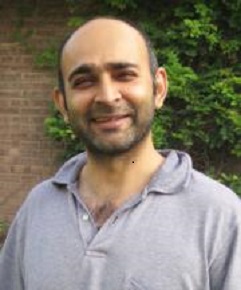
De Brits-Pakistaanse schrijver Mohsin Hamid werd geboren op 23 juli 1971 in Lahore, Pakistan.Hamid bracht een deel van zijn jeugd door in de Verenigde Staten, waar hij van zijn derde tot zijn negende jaar woonde, omdat zijn vader doceerde aan de Stanford University. Daarna verhuisde hij met zijn gezin terug naar Lahore, Pakistan, en bezocht hij in Lahore de Amerikaanse School. Op 18-jarige leeftijd ging Hamid terug naar de Verenigde Staten om zijn opleiding voort te zetten. Hij studeerde af aan Princeton University summa cum laude in 1993, na te hebben gestudeerd bij de schrijvers Joyce Carol Oates en Toni Morrison. Hamid schreef de eerste versie van zijn eerste roman voor een fictie workshop gegeven door Morrison. Vervolgens studeerde hij aan de Harvard Law School, studeerde af in 1997. Omdat hij ondernemingsrecht saai vond, betaald hij zijn studieleningen terug door enkele jaren als management consultant bij McKinsey & Company in New York City te werken. Hij mocht elk jaar drie maanden vrijaf nemen om te schrijven, en hij gebruikte deze tijd om zijn eerste roman “Moth Smoke” te voltooien. Hamid verhuisde naar Londen in de zomer van 2001, in eerste instantie van plan om slechts een jaar te blijven. Hoewel hij vaak terugging naar Pakistan om te schrijven, bleef hij 8 jaar in wonen en kreeg hij in 2006 ook de Britse nationaliteit. Hamid’s eerste roman werd gepubliceerd in 2000 en werd al snel een cult-hit in Pakistan en India. Het was ook finalist voor de PEN / Hemingway Award voor de beste eerste roman in de VS, en werd bewerkt voor televisie in Pakistan en als operette in Italië. Zijn tweede roman, “The Reluctant Fundamentalist”, vertelde het verhaal van een Pakistaanse man die besluit Amerika te verlaten na een mislukte liefdesrelatie en de terreur aanslagen van 9/11. Hij werd gepubliceerd in 2007 en werd met een miljoen exemplaren internationale bestseller. De roman werd genomineerd voor de Man Booker Prize, won een aantal prijzen, waaronder de Anisfield-Wolf Book Award en de Aziatische Amerikaanse Literary Award, en werd vertaald in meer dan 25 talen. Zijn derde roman, “How to Get Filthy Rich in Rising Asia”, verscheen in 2013.
Uit:Moth Smoke
“You sit behind a high desk, wearing a black robe and a white wig, tastefully powdered. The cast begins to enter, filing into this chamber of dim tube lights and slow-turning ceiling fans. Murad Badshah, the partner in crime: remorselessly large, staggeringly, stutteringly eloquent. Aurangzeb, the best friend: righteously treacherous, impeccably dressed, unfairly sexy. And radiant, moth-burning Mumtaz: wife, mother, and lover. Three players in this trial of intimates, witnesses and liars all. They are pursued by a pair of hawk-faced men dressed in black and white: both forbidding, both hungry, but one tall and slender, the other short and fat. Two reflections of the same soul in the cosmic house of mirrors, or uncanny co- incidence? It is impossible to say. Their eyes flick about them, their lips silently voice oratories of power and emotion. To be human is to know them, to know what such beings are and must be: these two are lawyers. A steady stream of commoners and nobles follows, their diversity the work of a skilled casting director. They take their places with a silent murmur, moving slowly, every hesitation well rehearsed. A brief but stylish crowd scene, and above it all you preside like the marble rider of some great equestrian statue. Then a pause, a silence. All eyes turn to the door. He enters. The accused: Darashikoh Shezad. A hard man with shadowed eyes, manacled, cuffed, disheveled, proud, erect. A man capable of anything and afraid of nothing. Two guards accompany him, and yes, they are brutes, but they would offer scant reassurance if this man were not chained. He is the terrible almost-hero of a great story: powerful, tragic, and dangerous. He alone meets your eyes. And then he is seated and it begins. Your gavel falls like the hammer of God. Perhaps a query (Where did I get this thing?) flashes through your mind before vanishing forever, like a firefly in the belly of a frog. But the die has been cast. There is no going back. The case is announced. The prosecutor rises to his feet, and his opening remarks reek of closure. ‘Milord,’ he says (and he means you), ‘the court has before it today a case no less clear than the task of the executioner. The accused has stretched out his neck beneath the heavy blade of justice, and there is no question but that this blade must fall. For he has blood on his hands, Milord. Young blood. The blood of a child. He killed not out of anger, not out of scheme or plan or design. He killed as a serpent kills that which it does not intend to eat: he killed out of indifference. He killed because his nature is to kill, because the death of a child has no meaning for him.”
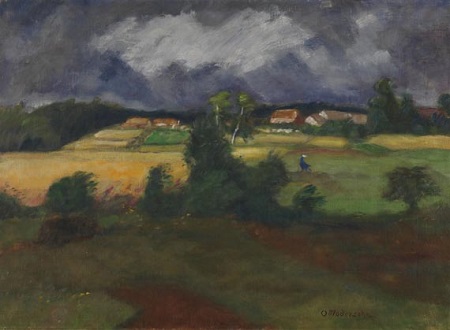
Gewitterlandschaft (Nach dem Gewitter) door Otto Modersohn, 1930
Storm and Sunlight
I In barns we crouch, and under stacks of straw, Harking the storm that rides a hurtling legion Up the arched sky, and speeds quick heels of panic With growling thunder loosed in fork and clap That echoes crashing thro’ the slumbrous vault. The whispering woodlands darken: vulture Gloom Stoops, menacing the skeltering flocks of Light, Where the gaunt shepherd shakes his gleaming staff And foots with angry tidings down the slope. Drip, drip; the rain steals in through soaking thatch By cob-webbed rafters to the dusty floor. Drums shatter in the tumult; wrathful Chaos Points pealing din to the zenith, then resolves Terror in wonderment with rich collapse.
II Now from drenched eaves a swallow darts to skim The crystal stillness of an air unveiled To tremulous blue. Raise your bowed heads, and let Your horns adore the sky, ye patient kine! Haste, flashing brooks! Small, chuckling rills, rejoice! Be open-eyed for Heaven, ye pools of peace! Shine, rain-bow hills! Dream on, fair glimpsèd vale In haze of drifting gold! And all sweet birds, Sing out your raptures to the radiant leaves! And ye, close huddling Men, come forth to stand A moment simple in the gaze of God That sweeps along your pastures! Breathe his might! Lift your blind faces to be filled with day, And share his benediction with the flowers.
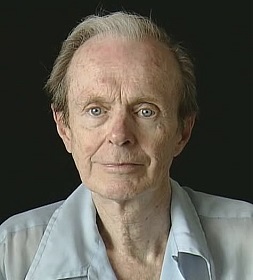
De Amerikaanse schrijfster Susan Eloise Hinton werd geboren op 22 juli 1948 in Tulsa, Oklahoma. Hinton schreef in de jaren 1960 een aantal bekroonde romans voor jongeren. Met haar eerste “The Outsider”, die verscheen in 1967, werd de 19-jarige op slag beroemd en men beschouwde haar meteen als de stem van de jeugd. Maar de druk van de verwachtingen leidde tot een drie jaar durende schrijfblokkade, die zij pas in 1971 overwon met “That Was Then, This Is Now”. In 1975 volgde de roman “Rumble Fish”, die net als The Outsider aan het begin van de jaren ’80 als een sjabloon voor films van Francis Ford Coppola diende, waarin veel acteurs van de zogenaamde “Brat Pack generatie” hun carrière begonnen. Matt Dillon speelde in “Rumble Fish” en ook in de filmversie van “Tex” de hoofdrol. In de eerste drie verfilmingen van haar boeken was Hinton ook zelf in een kleine rol te zien. In “The Outsider” speelde zij een verpleegkundige. Voor “Rumble Fish” schreef zij ook het scenario. Voor haar grote verdiensten voor de jeugdliteratuur ontving Hinton in 1988 de eerste Margaret A. Edwards Award van de American Library Association.
Uit: The Outsiders
“When I stepped out into the bright sunlight from the darkness of the movie house, I had only two things on my mind: Paul Newman and a ride home. I was wishing I looked like Paul Newman— he looks tough and I don’t— but I guess my own looks aren’t so bad. I have light-brown, almost-red hair and greenish-gray eyes. I wish they were more gray, because I hate most guys that have green eyes, but I have to be content with what I have. My hair is longer than a lot of boys wear theirs, squared off in back and long at the front and sides, but I am a greaser and most of my neighborhood rarely bothers to get a haircut. Besides, I look better with long hair. I had a long walk home and no company, but I usually lone it anyway, for no reason except that I like to watch movies undisturbed so I can get into them and live them with the actors. When I see a movie with someone it’s kind of uncomfortable, like having someone read your book over your shoulder. I’m different that way. I mean, my second-oldest brother, Soda, who is sixteen-going-on-seventeen, never cracks a book at all, and my oldest brother, Darrel, who we call Darry, works too long and hard to be interested in a story or drawing a picture, so I’m not like them. And nobody in our gang digs movies and books the way I do. For a while there, I thought I was the only person in the world that did. So I loned it. Soda tries to understand, at least, which is more than Darry does. But then, Soda is different from anybody; he understands everything, almost. Like he’s n ever hollering at me all the time the way Darry is, or treating me as if I was six instead of fourteen. I love Soda more than I’ve ever loved anyone, even Mom and Dad. He’s always happy-go-lucky and grinning, while Darry’s hard and firm and rarely grins at all. But then, Darry’s gone through a lot in his twenty years, grown up too fast. Sodapop’ll never grow up at all. I don’t know which way’s the best. I’ll find out one of these days. Anyway, I went on walking home, thinking about the movie, and then suddenly wishing I had some company. Greasers can’t walk alone too much or they’ll get jumped,“
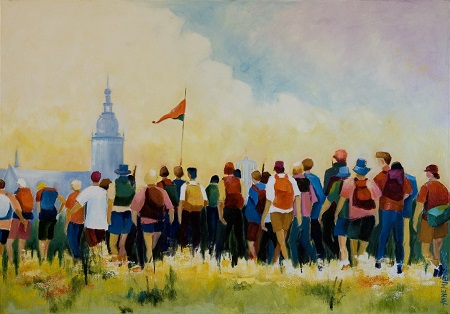
Wandelaars richting Nijmegen via de Oosterhoutse dijk door Annemieke Martinus-Claus, 2008
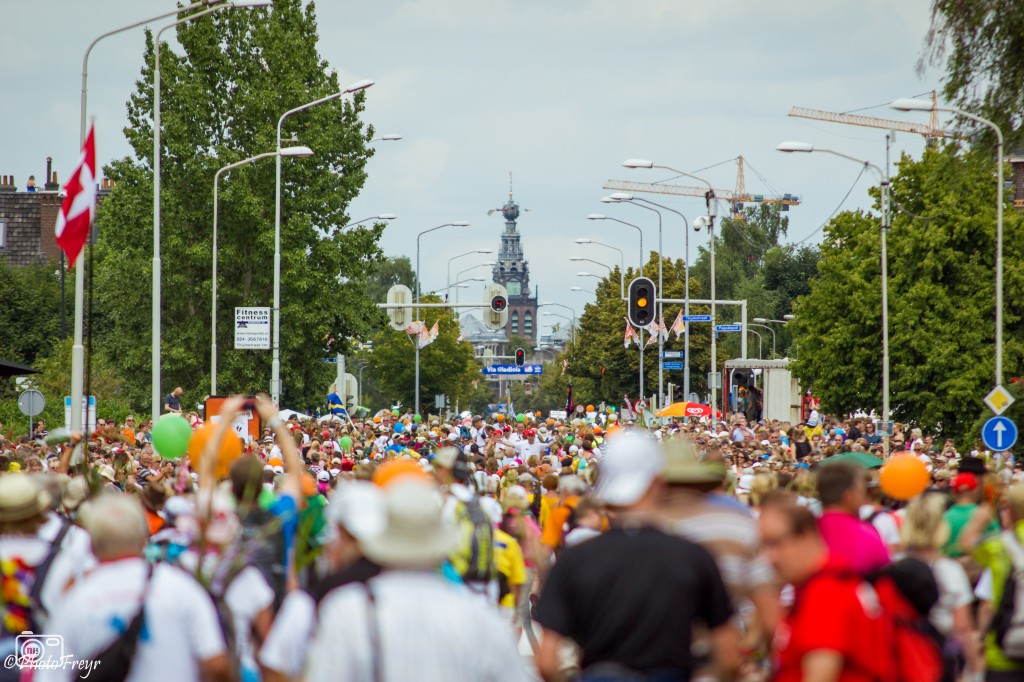
Met afstand heeft het niets te maken Het is kijken hoe zwaar je je lichaam kunt laten worden, hoeveel pijn ademen kan veroorzaken. Het is je ogen op de volgende bocht, rubber ruiken en teer trappen. Het is weg van wat dan ook.
Het is lopen en laten gaan.
Dennis Gaens (Susteren, 1982) Nijmegen tijdens de Vierdaagse. Dennis Gaens was in 2011 en 2012 stadsdichter van Nijmegen.
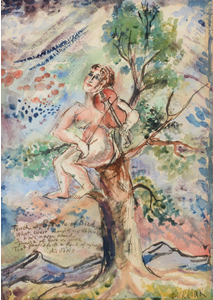
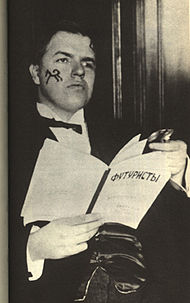
De Russisch-Amerikaanse dichter, schrijver en schilder David Davidovitsj Boerljoekwerd geboren in Semirotowschtschina, nabij Charkov, op 21 juli 1882. Samen met zijn broer Vladimir studeerde Boerljoek in 1902 af aan de Academie voor Schone Kunsten in München en later zette hij zijn studie voort aan de Hogeschool voor Schone Kunsten in Parijs. In 1907 keerde hij terug naar Rusland en nam daar deel aan talrijke avant-gardistische exposities en manifestaties. Eerste bekendheid kreeg hij door een bijdrage aan Kandinsky’s expressionistische almanak ”De blauwe ruiter” (1912) met zijn schilderij “De wilden van Rusland”. In dat jaar sloot hij zich ook aan bij de beweging van het futurisme en was (samen met onder andere Clebnikov, Majakovski en Igor Severjanin) co-auteur van het controversiële pamflet “Een kaakslag in het gezicht van de publieke smaak”, waarin afgerekend werd met de Russische literatuur tot dan toe en waarin het poëtische woord -met willekeurige, afgeleide woorden- centraal werd gesteld. In 1913-1914 organiseerde Boerljoek samen met Vladimir Majakovski en Vasili Kamenski een spraakmakende futuristische tournee door zeventien Russische steden, waarbij ze op extravagante wijze en met veel uiterlijk vertoon hun voor het publiek vaak onnavolgbare gedichten declameerden. In die periode gold Boerljoek als een soort mentor voor de jonge Majakovski en was hij van grote invloed op diens latere literaire carrière. Nadat Boerljoek -na een Bolsjewistische razzia tegen anarchisten- reeds eind 1918 vanuit Moskou was uitgeweken naar Siberië, verliet hij in 1920, teleurgesteld in de Russische Revolutie, de Sovjet-Unie. Hij reisde eerst naar Japan en emigreerde in 1922 naar de Verenigde Staten. Daar manifesteerde hij zich vooral als vitalistisch en expressief schilder (met een zekere verwantschap aan Van Gogh), maar hij bleef ook schrijven. Waardering genoten zijn autobiografische schetsen “Mijn voorvaderen; veertig jaar: 1890-1930”.
Teach us Spirit of Bird, 1930-1950
Teach us Spirit of Bird What sweet thoughts are thine have never heard Praise of love a wine That panted forth a flood of raptured divine
Everyone Is Young
Everyone is young, young, young, A hell-of-a-hunger in his stomach, So follow me! Behind my back! I cry a proud shout! A short speech! We will eat stones, grass, Sweets, acids, poisons! We will devour emptiness, Depth and height, Birds, fish, animals, monsters, Winds, clays, salt, the swell of the sea! Everyone is young, young, young, A hell-of-a-hunger in his stomach! Everything we meet on the road is a feast, Prepared for us! And we will eat it!
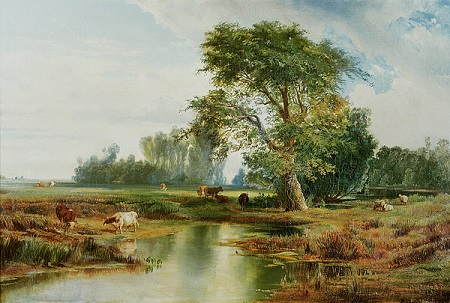
Ik zat waar zon op ’t warme water scheen En gele bloemen bloeiden aan de kant; Het grazend vee ging door de weiden heen, De zomerlucht hing walmend over ’t land.
De wilgen waren zilverbleek en stil Voor ’t stralend blauw, van wolk en nevel vrij; Een glazenmaker vloog, met lichtgetril Op ’t parelmoerig vleugelgaas, voorbij.
De schuwe vissen, in ’t koeldonker diep, Verschoten snel, of stonden lang op wacht, Waar d’aarde zich, in beeld, nog schoner schiep, Dromend de zomerdroom van eigen pracht.
En over ’t hooiland, waar een wagen stond Met vers-groen gras te geuren in de zon, En verder waar het drachtig korenblond Met brede golving boog ten horizon,
Tot waar een scheem’rend bos zich flauw verhief, De wereld wegsmolt in der hemelen gloed, Dreef mijn gedacht, hoe schoon de dag was, lief Uw schone ziel verlangend tegemoet.
O zomeravond, smachtend neergevlijd op ’t gele veld, in ’t Westen goudgetint… Teerkreunend ruisen van de avondwind, die langs de vlakte in zware weemoed glijdt… O melodie uit lang verleden tijd, waarvan ik zin noch woorden wedervind…
O rust, o stilte, blauwige avonddoom! Doorzichtig ligt ge op verre velden neer… Zo schouwt mijn geest de beelden van weleer door ’t wazig scheemren van een weke droom. ’t Verleden rimpelt, onbepaald en loom, – verzonken stad in ’t stilgevallen meer.
Verheerlijkt glinstren! onbereikbre trans! O vloeiend zilverlicht zo hoog verbreid… De zwoele nacht doortrilt uw majesteit, de aarde is een matte weerschijn van uw glans; zacht om mijn slapen vloeit uw stralenkrans; mijn zwellend harte vult de onmeetlijkheid.
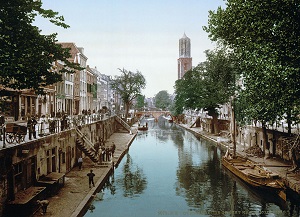
Prosper van Langendonck (15 maart 1862 – 7 november 1920) Brussel op een zomeravond. Prosper van Langendonck werd geboren in Brussel
Wat nog aan woorden
in mij wakker ligt
kan ik voor alle dag gebruiken
ik kan het bloed doen stollen
ik kan in andermans gedachten
wonen en er vruchten stelen
ik kan – als een hond geslagen –
huilen en ik kan spelend met vuur
mijzelf overwinnen
maar leven kan ik niet
het leven hangt buiten
het bereik van de klanken
zinnen en woorden
die ik als ledematen
lief heb gekregen
om een liefde die ik als zon op het water heb zien schijnen om een liefde die als licht op mijn huid staat te branden
Photomaton
Zo’n foto is nooit weg,
en ze kosten maar vier voor een gulden
Kijk, het lijkt (na drie minuten)
en we staan er nog op, ook.
Omgekeerd natuurlijk, ik zat links en op de foto’s zit ik rechts.
We zijn bruiner dan in werkelijkheid, en de schaafwond op mijn neus blitst overdreven.
Links voorop, dat ben jij. Ik kan nog niet zo goed wijs uit wat ik zie, o.a. een blikkerbril met donker glas en een baard met een snor boven regenjas. We kijken voorop, jij bovendien opzij- jij hebt de twee andere.
Ik lach, jij kijkt. Zo’n foto is nooit weg, tenslotte en wat is de moeilijkheid? Kleingeld, ooghoogte, de keuze uit witte achtergrond of donker gordijn. Kijken of het lijkt.