Tom Lanoye, Jeanette Winterson, Lolita Pille, Lernert Engelberts, Kristien Hemmerechts, David Rowbotham

De Belgische dichter en schrijver Tom Lanoye werd geboren te Sint-Niklaas op 27 augustus 1958. Zie ook mijn blog van 27 augustus 2010 en eveneens alle tags voor Tom Lanoye op dit blog.

Het is een magere troost

Het is een magere troost
dat alles moet verdwijnen

en ik je hoe dan ook op een keer
toch zou moeten missen, bij voorbeeld

door de dood. Ik hou van je, al
kunnen we waarschijnlijk niet meer
worden wat we vroeger waren of dachten
te zijn. Geen verhalen over afkeer,

over waanzin of grote trouw: ik
verlang naar toen terwijl
ik ouder word. Ik denk
nog veel aan jou.


In the mood

Daarnet, twee uur in de nacht alweer,
floepte de TV aan en daar stond ik,
in Madison Square Garden, tien jaar
jonger en goochelend als geeneen.

Door een onzichtbare massa opgezweept,
cirkelzaagde ik mijn assistente rats
in twee, de wekker die ik stuksloeg
werd niet heel en de konijnen vluchtten
naar de concurrentie. Het werd ze allemaal
teveel.

‘Kop op, ouwe jongen!’ Mijn hoofd
schoot door het scherm. ‘Zo zie je maar:
tien jaar geleden ging je ook al naar
de kloten. Encore, mijn beste, het kan er
alleen maar op verbeteren. Encore!’

Showmuziek werd ingezet, warm applaus, en
goedgebouwde vrienden die ik lang vergeten was,
dansten en swingden on the floor, als gek.

‘Welcome back, crazy Jack.
Welcome back.’


Kurma (schildpad)

Hoewel er geen bewijzen zijn. Misschien
als ik slaap, maar bij het minste geluid
verdwijnen zijn geschubde pootjes langs mijn
oren en mijn ogen, ze worden als het ware

in een schild gezogen. Zijn magere kop
raspt soms over mijn tong, en praat maar
zo vertraagd dat men het nauwelijks

verstaat: hij noemt mijn klieren
liefde en ik hou van hem. Ik ben

blij dat hij bestaat.
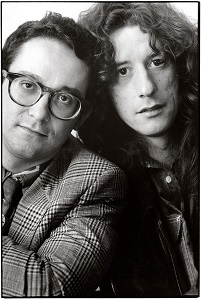
 
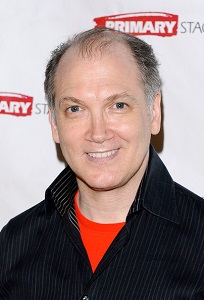
Tom Lanoye (Sint-Niklaas, 27 augustus 1958)
Hier met Herman Brusselmans (rechts) in 1989
Lees verder “Tom Lanoye, Jeanette Winterson, Lolita Pille, Lernert Engelberts, Kristien Hemmerechts, David Rowbotham”

Christopher Isherwood, Joachim Helfer, Guillaume Apollinaire, Jules Romains, Julio Cortázar

De Brits-Amerikaanse schrijver Christopher Isherwood werd geboren op 26 augustus 1904 in Disley in het graafschap Cheshire in Engeland. Zie ook mijn blog van 26 augustus 2010 en eveneens alle tags voor Christopher Isherwood op dit blog.

Uit: Mr Norris Changes Trains

“Mr Norris had two front doors to his flat. They stood side by side. Both had little round peep-holes in the centre panel and brightly polished knobs and brass nameplates. On the left-hand plate was engraved: Arthur Norris . Private. And on the right hand: Arthur Norris . Export and Import . […] I noticed immediately I was inside, [that] the Private side of the entrance hall was divided from the Export side only by a thick hanging curtain. “
(…)

“’Do you know what time we arrive at the frontier?’Looking back on the conversation, this question does not seem to me to have been particularly unusual. It is true that I had no interest in the answer; I wanted merely to ask something which might start us chatting, and which wasn’t, at the same time, inquisitive or impertinent. Its effect on the stranger was remarkable. I had certainly succeeded in arousing his interest. He gave me a long, odd glance, his features seemed to stiffen a little. It was the glance of a poker-player who guesses suddenly that his opponent hold a straight flush and that he had better be careful. At length he answered, speaking slowly and with caution:‘I’m afraid I couldn’t tell you exactly. In about an hour’s time, I believe. ‘His glance, now vacant for a moment, was clouded again. An unpleasant thought seemed to tease him like a wasp; he moved his head slightly to avoid it.”
(…)

“I must say that I have always felt that, in the deepest sense, we are all brothers. Class distinctions have never meant anything to me; and hatred of tyranny is in my blood. Even as a small child I could never bear injustice of any kind. It offends my sense of the beautiful. It is so stupid and unaesthetic. I remember my feelings when I was first unjustly punished by my nurse. It wasn’t the punishment itself which I resented; it was the clumsiness, the lack of imagination behind it. That, I remember, pained me very deeply.”

 
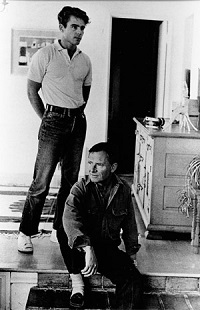
Christopher Isherwood (26 augustus 1904 – 4 januari 1986)
Hier met partner Don Bachardy (l) in 1962

Lees verder “Christopher Isherwood, Joachim Helfer, Guillaume Apollinaire, Jules Romains, Julio Cortázar”

Rashid Al-Daif


Onafhankelijk van geboortedata:

De Libanese schrijver Rashid Al-Daif werd in 1945 geboren in Ehden bij Zgharta in het noorden van Libanon in een christelijke maronitische familie. Hij studeerde Arabisch aan de Libanese Universiteit in Beiroet. In 1974 ontving hij zijn doctoraat in Parijs (Sorbonne). Van 1972-1974 doceerde hij Arabisch   als vreemde taal aan de Universiteit van Parijs. Van 1974 tot 2008 was hij hoogleraar Arabisch en letterkunde aan de Libanese Universiteit van Beiroet. In het zomersemester 1999 was hij visiting professor in Toulouse. Het boek “Die Verschwulung der Welt..Rede gegen Rede. Beirut-Berlin” van Rashid Al-Daif en Joachim Helfer baarde in de herfst van 2006 nogal wat opzien. Onder de titel “Audat al-almani ila ruschdih”i (“De terugkeer van de Duitsers tot de rede” of “Hoe de Duitser weer tot bezinning kwam”) had Rashid Al-Daif tevoren in Beiroet een verslag gepubliceerd over het privéleven van Joachim Helfer, zonder diens medeweten of toestemming. De vorm van de Duitse editie, waarin de tekst van Al-DaÏf onderbroken werd door ingevoegde commentaren en correcties van Helfer, leidde omgekeerd tot protest van Al-Daif, die meende dat het resultaat afbreuk deed aan de integriteit van zijn werk. Al-Daifs romans behandelen op humoristische wijze de tegenstellingen van de Libanese samenleving, die tussen traditie en moderniteit verscheurd wordt. Tegelijk wordt een gedifferentieerde reflectie op de sociale spanningen en het lijden, veroorzaakt door de burgeroorlog, ontwikkeld. Al- Da’ifs romans worden gerekend tot de stroming van de nouveau roman. Zij doen afstand van psychologische karakterisering en van een referentiekader. Een selectie van zijn poëtische werk werd in het Duits gepubliceerd in 2008 onder de titel „Ich werde die Dinge bei ihrem Namen nennen“. Rashid Al-Daif is een van de meest bekende Arabischtalige romanschrijvers van het heden. Zijn werk werd in vele talen vertaald. 

Uit: Ich werde die Dinge bei ihrem Namen nennen (Vertaald door Leslie Tramontini)

„Ich träumte, dass ein Fisch mit einer Tüte auf seinem Rücken, die ihn mit Wasser versorgt, aus dem Wasser an Land gekommen sei und lief und lief, bis er das Bett meines Sohnes erreichte. Mein Sohn schlief gerade, und so flüsterte der Fisch ihm etwas ins Ohr, woraufhin mein Sohn aufstand, seine Hand ergriff und mit dem Fisch zum Meer ging. Schreiend folgte ich ihnen, doch me)in Schrei verließ meine Kehle nicht – so wie es einem manchmal in einem Alptraum ergeht. Der Fisch hörte mich trotzdem und eilte schneller, bis er das Meer erreicht hatte und darin untertauchte. Mein Sohn tauchte hinter ihm unter. Mein Sohn konnte gut schwimmen und folgte ihm mit der Geschwindigkeit eines Fisches.
… Immer mehr entfernte er sich aus meinem Blickfeld, und noch immer verließ der Schrei meine Kehle nicht. Da erinnerte ich mich plötzlich, dass er einmal völlig erschreckt aufgewacht war und gerufen hatte. Ich war zu ihm gegangen und er hatte mir gesagt: Wer hat mir das Schwimmen beigebracht? Ich hatte ihm geantwortet, keiner habe ihm das Schwimmen beigebracht und er könne gar nicht gut schwimmen. Er meinte: Doch, ich bin doch gerade vom anderen Ufer geschwommen, wie ein Aal. Ich hatte gelächelt, ihn umarmt und den Duft seines Körpers tief eingeatmet, bis in die Lungenspitzen, und ihm gesagt: Schlaf,
mein Junge, du hast nur geträumt.

****

Kein einziges Mal, wenn mein Blick irgendwo auf den Globus fällt, sei es zuhause, in der Schule oder im Büro der Fluggesellschaft, kann ich es vermeiden, laut loszulachen, so wie einer, der unter den Achseln gekitzelt wird.“


(Rashid Al-Daif, Ehden, 1945)

Martin Amis, Charles Wright, Maxim Biller, Frederick Forsyth, Jògvan Isaksen, Johann Gottfried von Herder, Thea Astley

De Engelse schrijver Martin Amis werd geboren op 25 augustus 1949 in Cardiff, South Wales. Zie ook alle tags voor Martin Amis op dit blog en ook mijn blog van 25 augustus 2010.

Uit: Money

“I’d better give you the lowdown on Selina — and quick. That hot bitch, what am I letting her do to me?
Like many girls (I reckon), and especially those of the small, supple, swervy, bendy, bed-smart variety, Selina lives her life in hardened fear of assault, molestation and rape. The world has ravished her often enough in the past, and she thinks the world wants to ravish her again. Lying between the sheets, or propped at my side during long and anxious journeys in the Fiasco, or seated across the table in the deep lees of high-tab dinners, Selina has frequently refreshed me with tales of insult and violation from her childhood and teenage years — a musk-breathing, toffee-offering sicko on the common, the toolshed interrogations of sweat-soaked parkies, some lumbering retard in the alley or the lane, right up to the narcissist photographers and priapic prop-boys who used to cruise her at work, and now the scowling punks, soccer trogs and bus-stop boogies malevolently lining the streets and more or less constantly pinching her ass or flicking her tits and generally making no bones about the things they need to do… It must be tiring knowledge, the realization that half the members of the planet, one on one, can do what the hell they like with you.
And it must be extra tough on a girl like Selina, whose appearance, after many hours at the mirror, is a fifty—fifty compromise between the primly juvenile and the grossly provocative. Her tastes are strictly High Street too, with frank promise of brothelly knowhow and top-dollar underwear. I’ve followed Selina down the strip, when we’re shopping, say, and she strolls on ahead, wearing sawn-off jeans and a wash-withered T-shirt, or a frilly frock measuring the brink of her russety thighs, or a transparent coating of gossamer, like a condom, or an abbreviated school uniform … The men wince and watch, wince and watch. They buckle and half turn away. They shut their eyes and clutch their nuts. And sometimes, when they see me cruise up behind my little friend and slip an arm around her trim and muscular waist, they look at me as if to say — Do something about it, will you ? Don’t let her go about the place looking like that. Come on, it’s your responsibility.»


Martin Amis (Cardiff, 25 augustus 1949)

Lees verder “Martin Amis, Charles Wright, Maxim Biller, Frederick Forsyth, Jògvan Isaksen, Johann Gottfried von Herder, Thea Astley”

Howard Jacobson


De Britse schrijver Howard Jacobson werd geboren op 25 augustus 1942 in Manchester. Hij is opgegroeid in Prestwich en werd opgeleid aan Stand Grammar School in Whitefield, alvorens Engels te gaan studeren op Downing College, Cambridge. Hij doceerde gedurende drie jaar aan de Universiteit van Sydney voordat hij terugkeerde naar Engeland om les te geven aan Selwyn College in Cambridge. Zijn fictie, met name de vijf romans die hij heeft gepubliceerd sinds 1998, wordt vooral gekenmerkt door een discursieve en humoristische stijl. Terugkerende onderwerpen in zijn werk zijn man-vrouw verhoudingen en de Joodse ervaring in Groot-Brittannië in de midden-tot laat-20e eeuw. Jacobson is wel vergeleken met vooraanstaande Joods-Amerikaanse schrijvers als Philip Roth. Zijn roman The Mighty Walzer uit 1999 over een tiener tafeltenniskampioen, won de Bollinger Everyman Wodehouse Prize for comic writing. Hij speelt in het Manchester van de jaren 1950 en Jacobson, zelf als tiener een ping pong fan, geeft toe dat er meer dan een autobiografisch element in zit. Zijn romans Who’s Sorry Now uit 2002 en Kalooki Nights uit 2006 kwamen al eerder op de long list van de Man Booker Prize. Jacobson werkte ook als columnist voor The Independent en voor de televisie. Twee tv-programma’s waren Channel 4’s Howard Jacobson Takes on the Turner uit 2000 Why the Novel Matters uit 2002. Zie ook alle tags voor Howard Jacobson op dit blog.

Uit: Zoo Time

“Vanessa hated it when I started a new book. She saw it as me getting one over her who hadn’t started a new book because she hadn’t finished, or indeed started, the old one. But she also hated it when I hadn’t started a new book, because not starting a new book made me querulous and sexually unreliable. At least when I was writing a new book she knew where I was. The downside of that being that as soon as she knew where I was she wished I were somewhere else.
In fact, my question hid a lie; I hadn’t started a new book, not in the sense of starting writing a new book. I had mouth-written a hundred new books, I just didn’t believe in any of them. It wasn’t personal, it wasn’t only my books I didn’t believe in, it was books full stop. If I was over, it was because the book was over. But Vanessa wasn’t aware of the full extent of the crisis. She saw me trudge off to my study, heard the keys of my computer making their dead click and assumed I was still pouring forth my soul abroad like Keats’s logorrhoeic nightingale.
I even affected high spirits. ‘I’m sitting on top of the world,’ I sang, breaking for tea.
‘No you’re not,’ she shouted from her room.
She was contradictory to her soul. ‘I did it my way,’ I sang the morning after our wedding. ‘No you didn’t,’ she said, not even looking up from her newspaper.
If my singing irritated her, the sound of my writing drove her to the edge of madness. But so did the sound of my not writing. This was part of the problem of our marriage. The other part was me. Not what I did, what I was. The fact of me. The manness of me.
‘You, you, you,’ she said for the umpteenth time that night. It was like a spell; if she said the word often enough maybe I, I, I would vanish in a vapour of red wine.
We were out to dinner. We were always out to dinner. Along with everybody else. Dinner was all there was left to do.”


Howard Jacobson (Manchester, 25 augustus 1942)

John Green, Drs. P, Marion Bloem, Stephen Fry, Jorge Luis Borges, A. S. Byatt

De Amerikaanse schrijver John Green werd geboren in Indianapolis, Indiana, op 24 augustus 1977. Zie ook alle tags voor John Green op dit blog.

Uit: An Abundance of Katherines

“The morning after noted child prodigy Colin Singleton graduated from high school and got dumped for the 19th time by a girl named Katherine, he took a bath. Colin had always preferred baths; one of his general policies in life was never to do anything standing up that could just as easily be done lying down. He climbed into the tub as soon as the water got hot, and he sat and watched with a curiously blank look on his face as the water overtook him. The water inched up his legs, which were crossed and folded into the tub. He did recognize, albeit faintly, that he was too long, and too big, for this bathtub—he looked like a mostly grown person playing at being a kid.
As the water began to splash over his skinny but unmuscled stomach, he thought of Archimedes. When Colin was about four, he read a book about Archimedes, the Greek philosopher who’d discovered you could measure volume by water displacement when he sat down in the bathtub. Upon making this discovery, Archimedes supposedly shouted “Eureka! ” and then ran naked through the streets. The book said that many important discoveries contained a “Eureka moment.” And even then, Colin very much wanted to have some important discoveries, so he asked his mom about it when she got home that evening.
“Mommy, am I ever going to have a Eureka moment?”
“Oh, sweetie,” she said, taking his hand. “What’s wrong?”
“I wanna have a Eureka Moment,” he said, the way another kid might have expressed longing for a teenage mutant ninja turtle.
She pressed the back of her hand to his cheek and smiled, her face so close to his that he could smell coffee and make-up. “Of course, Colin baby. Of course you will.” But mothers lie. It’s in the job description.
Colin took a deep breath and slid down, immersing his head. I am crying, he thought, opening his eyes to stare through the soapy, stinging water. I feel like crying so I must be crying, but it’s impossible to tell because I’m underwater. But he wasn’t crying. Curiously, he felt too depressed to cry. Too hurt. It felt as if she’d taken the part that cried from him.”

 
John Green (Indianapolis, 24 augustus 1977)

Lees verder “John Green, Drs. P, Marion Bloem, Stephen Fry, Jorge Luis Borges, A. S. Byatt”

Sascha Anderson, Linton Kwesi Johnson, Johan Fabricius, Paulo Coelho, Arthur West, Alexander McCall Smith

De Duitse dichter en schrijver Sascha Anderson werd geboren op 24 augustus 1953 in WeimarZie ook mijn blog van 24 augustus 2010 en eveneens alle tags voor Sascha Anderson op dit blog.


Eine Harzreise

gebettet in bulgarische tanzmusik
durchraste ich acht tode
floh nackt und leicht und pass pardon

für ungestellte fragen
erfand ich salomon nochmal
und leerte meinen magen
am nächsten morgen im zugigen klo
kotzte ich pfefferminz pur

unter die harzbahn auf die gleise
in die deutsche natur
was treibt mich immer wieder fort
aus mir und an die grenzen
das denken ist ein schwarzes loch

in meinen existenzen
so halt ich das thema und dieses den leib
am orte dem provinziellen
komposthaufen für das glück
das idiomaterielle

saatgut für den grossen vergleich
wer ist der schönste im grab
wer hat nach dieser nabelschnur
den endlich sichersten sarg
in eiche ulme stahlbeton

als asche in die vier winde
ein abdruck deiner 3. zähne
in einer verschimmelten rinde
ein fingerabdruck in der kartei
der kaffeesatz in der tasse

das bleibt ach ach ich geh komm mit
wenn ich uns jetzt verlasse
zwischen den dörfern elend und sorge
vergällts mir die dichterei ganz
die wirklichen grenzen bewirken nur

einen hängenden schwanz
erhebend ist die deutsche geschichte
so ineinandergekrallt
die grenze ein erleuchtendes zeichen
für den fliehenden wald

die da paarweise im sperrgebiet hocken
sich belauern beschützen bewahren
den heiligen familien winken
die sonntags harzquerbahn fahren
Was ist der Mensch? ein dudelsack

für den dialektischen marsch
der mit dem kopf nur wackeln kann
und brüllen mit dem arsch
die gleise fliehen südwärts den harz
da flieh ich mit ganz vorn

in nordhausen gibts einen guten schnaps
nordhäuser doppelkorn

 
Sascha Anderson (Weimar, 24 augustus 1953)

Lees verder “Sascha Anderson, Linton Kwesi Johnson, Johan Fabricius, Paulo Coelho, Arthur West, Alexander McCall Smith”

Charles Busch, Albert Alberts, Ilija Trojanow, Willy Russell, Gustav Ernst

De Amerikaanse schrijver en acteur Charles Busch werd geboren op 23 augustus 1954 in New York. Zie ook alle tags voor Charles Busch op dit blog.

Uit: The Divine Sister

“My husband, Morris, was an explorer and surprisingly, a man of faith. To prove to me the existence of God, he took me on a voyage to the ancient Island of Crete. We traveled to the dark corner of the island, far away from any tourists. I wore a Bill Blass safari jacket with a stand up collar and matching slacks. Morris wanted me to observe the life cycle of the species Sepia Officinalis, otherwise known as the cuttle fish. Yes, I saw them hatched from their mothers, small yet sinister creatures with eight arms and two tentacles. Their shells iridescent and jewel-like. Did you know that the large, staring black eyes of the cuttle fish are fully developed before birth, allowing them to hunt their prey even before hatching? And hunt their prey they did. I saw them move together as one as they stalked and ultimately devoured a terrified octopus, its ink spreading through the water in grim black floating sentences. I said, “Morris, take me away from here. I have seen enough.” “No, Margaret, we must stay. We must stay. We must now see them die to feed the more superior species.” And so we stayed. I removed my jacket and slacks, revealing a Schiaparelli pink bathing suit. We saw the great dolphin leap from the sea and snatch a generation of cuttle fish into its hideous gaping mouth. Morris shouted, “We are looking at the face of God! It is His will to create such divine perfection.” I replied, “If that is your God, then He is a cruel one and I’ll have none of Him.” We returned to our hotel in silence. With an over powering dread of the unknown, I slipped into a turquoise silk Galanos. I found Morris standing on our balcony, hypnotized by the sea. And then, without a warning, he grasped his heart and fell to the ground. I knew at that very instant he was dead. And now, when I look upon the ocean, despite its glorious magnitude, all I see is debris, debris, debris. An endless trail of debris.
Is that an answer to your question? »


Charles Busch (New York, 23 augustus 1954)

Lees verder “Charles Busch, Albert Alberts, Ilija Trojanow, Willy Russell, Gustav Ernst”

Ephraïm Kishon, William Henley, Edgar Lee Masters, Theobald Hock, Andrei Pleşu, Aleksander Grin

De Hongaars/Israëlische schrijver Ephraïm Kishon werd op 23 augustus 1924 in Boedapest geboren. Zie ook alle tags voor Ephraïm Kishon op dit blog.

Uit: Picassos süße Rache (Vertaald door Ephraim Kishon en Brigitte Sinhuber)

„Nach so vielen sarkastischen Seiten, kommt meine Behauptung vermutlich überraschend, daß ich eigentlich gar nichts gegen moderne Kunst habe. Ich plädiere nur dafür, die Schmier- und Schrott-Produktionen neu zu definieren. Wenn die geschätzten Handwerker dieser Branche zugäben, lediglich recht nette Muster für Tapeten, Vorhänge und Krawatten zu entwerfen, oder die Müllhaufen als Witz gemeint wären, dann könnten sie von mir aus ruhig so weitermachen. Leider gibt es aber einen Berufsstand, der dann seine Existenzberechtigung verlieren würde.
Ich spreche natürlich von den Päpsten der modernen Kunst, den ehrenwerten Kritikern, die alles tun, damit die Sache nicht auffliegt. Keiner der Päpste würde jemals zugeben, daß seine Religion ein Irrglaube ist. So behaupten auch die Jungs der Moderne nach dem Beuys’schen Dogma steif und fest, daß alles und jedes auf der Welt Kunst sei. Außer dieses Buch, natürlich. Von mir aus kann also jeder schmieren und basteln, was er will, wenn nur der Bürgermeister dafür nicht in mein Portemonnaie greifen muß. Und mir selbst sollen die hochgeschätzten Herren Kritiker mit dem Zeug vom Leibe bleiben. Vor allem aus gesundheitlichen Gründen.
Das Hauptwerk des wichtigsten Vertreters des abstrakten Expressionismus, Franz Kline, kann ich zum Beispiel noch verhältnismäßig ruhig betrachten (Blutdruck 85 zu 140). Dann aber lese ich leichtsinnigerweise nachfolgende Kritik aus berufener Feder darüber, und mein Blut gerät in Wallung (105 zu 170): »Fünf breite schwarze Pinselstriche schwimmen auf einem reich strukturierten roséfarbenen Grund. Kline ließ sich von technischen Zeichnungen anregen, vor allem von halbfertigen oder zerstörten Bauträgern, Eisenbahnen, Gerüsten und Brücken.“


Ephraïm Kishon (23 augustus 1924 – 29 januari 2005)
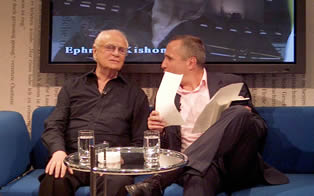
Hier geïnterviewd door Klaus Urban(l) in 2001

Lees verder “Ephraïm Kishon, William Henley, Edgar Lee Masters, Theobald Hock, Andrei Pleşu, Aleksander Grin”

Annie Proulx, Dorothy Parker, Willem Arondeus, Krijn Peter Hesselink, Jeroen Theunissen, Gorch Fock

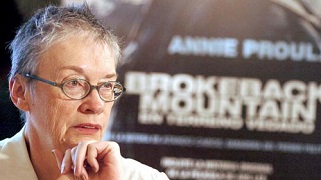
De Amerikaanse schrijfster en journaliste Annie Proulx werd geboren op 22 augustus 1935 in Norwich, Connecticut. Zie ook alle tags voor Annie Proulx op dit blog.

Uit: Brokeback Mountain

“They found a bar and drank beer through the afternoon, Jack telling Ennis about a lightning storm on the mountain the year before that killed forty-two sheep, the peculiar stink of them and the way they bloated, the need for plenty of whiskey up there. He had shot an eagle, he said, turned his head to show the tail feather in his hatband. At first glance Jack seemed fair enough with his curly hair and quick laugh, but for a small man he carried some weight in the haunch and his smile disclosed buckteeth, not pronounced enough to let him eat popcorn out of the neck of a jug, but noticeable. He was infatuated with the rodeo life and fastened his belt with a minor bull-riding buckle, but his boots were worn to the quick, holed beyond repair and he was crazy to be somewhere, anywhere else than Lightning Flat.
Ennis, high-arched nose and narrow face, was scruffy and a little cave-chested, balanced a small torso on long, caliper legs, possessed a muscular and supple body made for the horse and for fighting. His reflexes were uncommonly quick and he was farsighted enough to dislike reading anything except Hamley’s saddle catalog.


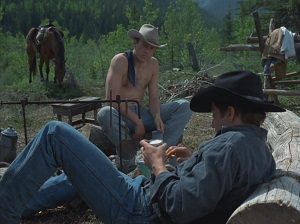
Scène uit de film Brokeback Mountain uit 2005


The sheep trucks and horse trailers unloaded at the trailhead and a bandy-legged Basque showed Ennis how to pack the mules, two packs and a riding load on each animal ring-lashed with double diamonds and secured with half hitches, telling him, “Don’t never order soup. Them boxes a soup are real bad to pack.” Three puppies belonging to one of the blue heelers went in a pack basket, the runt inside Jack’s coat, for he loved a little dog. Ennis picked out a big chestnut called Cigar Butt to ride, Jack a bay mare who turned out to have a low startle point. The string of spare horses included a mouse-colored grullo whose looks Ennis liked. Ennis and Jack, the dogs, horses and mules, a thousand ewes and their lambs flowed up the trail like dirty water through the timber and out above the tree line into the great flowery Meadows and the coursing, endless wind.
They got the big tent up on the Forest Service’s platform, the kitchen and grub boxes secured. Both slept in camp that first night, Jack already bitching about Joe Aguirre’s sleep-with-the-sheep-and-no-fire order, though he saddled the bay mare in the dark morning without saying much. Dawn came glassy orange, stained from below by a gelatinous band of pale green. The sooty bulk of the mountain paled slowly until it was the same color as the smoke from Ennis’s breakfast fire. The cold air sweetened, banded pebbles and crumbs of soil cast sudden pencil-long shadows and the rearing lodgepole pines below them massed in slabs of somber malachite.”


Annie Proulx (Norwich, 22 augustus 1935)

Lees verder “Annie Proulx, Dorothy Parker, Willem Arondeus, Krijn Peter Hesselink, Jeroen Theunissen, Gorch Fock”