So much of life in the world is waiting, that This day was no exception, so we waited All morning long and into the afternoon. I spent some of the time remembering Dante, who did the voyage in the mind Alone, with no more nor heavier machinery Than the ghost of a girl giving him guidance; And wondered if much was lost to gain all this New world of engine and energy, where dream Translates into deed. But when the thing went up It was indeed impressive, as if hell Itself opened to send its emissary In search of heaven or ’the unpeopled world’ (thus Dante of doomed Ulysses) ‘behind the sun.’ So much of life in the world is memory That the moment of the happening itself— So much with noise and smoke and rising clear To vanish at the limit of our vision Into the light blue light of afternoon— Appeared no more, against the void in aim, Than the flare of a match in sunlight, quickly snuffed. What yet may come of this? We cannot know. Great things are promised, as the promised land Promised to Moses that he would not see But a distant sight of, though the children would. The world is made of pictures of the world, And the pictures change the world into another world We cannot know, as we knew not this one.
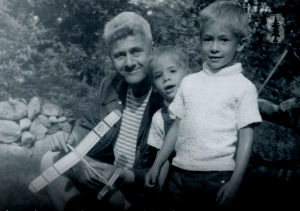
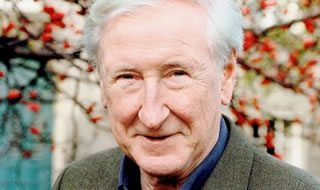
Howard Nemerov (29 februari 1920 – 5 juli 1991) Hier met zijn zoontjes Jeremy en Alexander rond 1967
„These are the caps from the bottles of Scarpia’s Bitter Black Ale that you and I drank in Al’s backyard that night. I can see the stars bright and prickly and our breathing steamy in the cold, you in your team jacket and me in that cardigan of Al’s I always borrow at his house. He had it waiting, clean and folded, when I went upstairs with him to give him his present before the guests arrived. “I told you I didn’t want a present,” Al said. “The party was enough I told you, without the obligatory-” “It’s not obligatory,” I said, having used the same vocabulary flash cards with Al when we were freshmen. “I found something. It’s perfect. Open it.” He took the bag from me, nervous. “Come on, happy birthday.” “What is it?” “Your heart’s desire. I hope. Open it. You’re driving me crazy.” Rustle rustle rip, and he sort of gasped. It was very satisfying. “Where did you find this?” “Does it not,” I said, “I mean exactly, look like what the guy wears in the party scene in Una settimana straordinaria?” He smiled into the slender box. It was a necktie, dark green with modern diamond shapes stitched into it in a line. It’d been in my sock drawer for months, waiting. “Take it out,” I said. “Wear it tonight. Does it not, exactly?” “When he gets out of the Porcini XL 10,” he said, but he was looking at me. “Your absolute favorite scene in any movie. I hope you love it.”
“So it all went into the box and the box went into my closet with some shoes on top of it I never wear. Every last souvenir of the love we had, the prizes and the debris of this relationship, like the glitter in the gutter when the parade has passed, all the everything and whatnot kicked to the curb. I’m dumping the whole box back into your life, Ed, every item of you and me. I’m dumping this box on your porch, Ed, but it is you, Ed, who is getting dumped. The thunk, I admit it, will make me smile. A rare thing lately. Lately I’ve been like Aimeé Rondelé in The Sky Cries Too, a movie, French, you haven’t seen. She plays an assassin and dress designer, and she only smiles twice in the whole film. Once is when the kingpin who killed her father gets thrown off the building, which is not the time I’m thinking of. It’s the time at the end, when she finally has the envelope with the photographs and burns it unopened in the gorgeous ashtray and she knows it’s over and lights a cigarette and stands in that perfect green of a dress watching the blackbirds swarm and flurry around the church spire. I can see it. The world is right again, is the smile. I loved you and now here’s back your stuff, out of my life like you belong, is the smile. I know you can’t see it, not you, Ed, but maybe if I tell you the whole plot you’ll understand it this once, because even now I want you to see it. I don’t love you anymore, of course I don’t, but still there’s something I can show you. You know I want to be a director, but you could never truly see the movies in my head and that, Ed, is why we broke up.”
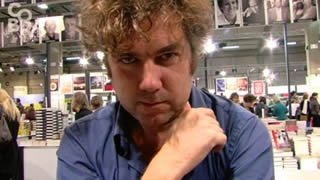
De Vlaamse schrijver Bart Koubaa (pseudoniem van Bart van den Bossche) werd geboren op 28 februari 1968 in Eeklo. Zie ook alle tags voor Bart Koubaa op dit blog.
Uit: De leraar
“Er is nog bitter weinig waarmee ik de leerlingen kan boeien. Het grootste deel schrijft en spreekt gebrekkig Nederlands en kan met moeite lezen. Ik toon nooit documentaires die ondertiteld zijn. Sinds de uitbreiding van Europa hoor ik meer en meer Engels in de klas, zo’n pseudo-Hollywoodtaaltje met veel fuck en shit en asshole en Angela Jolie… toch krijg ik de laatste jaren meer en meer taalgevangenen in de klas. Ze zijn gefrustreerd omdat ze te oud zijn om bij mij op de banken te zitten en kennen wel degelijk het verschil tussen een werkwoord en een cirkel maar begrijpen me niet als ik hen vraag de werkwoorden in een zin te omcirkelen. Zij die in het Nederlands zijn grootgebracht, spreken een ander Nederlands dan ik hun moet aanleren, een dialect waarmee je iets voor elkaar kunt krijgen, geen systeem om mee te denken. Elk van hen wendt alle middelen aan om zich te verduidelijken, want in de meeste gevallen eindigt een poging in een communicatiestoornis, een misverstand met alle frustraties van dien. Pubers voelen zich sowieso onbegrepen, laat staan als ze zich niet kunnen uitdrukken. Zich uitdrukken doen ze op hun manier, of daar nu politie aan te pas komt of niet. Het is te nemen of te laten want ze weten maar al te goed dat de directie niet snel iemand van school zal verwijderen omdat leerlingenaantallen voor een school even belangrijk zijn als kijkcijfers voor een televisiezender… ze zeggen dat we trots mogen zijn op ons onderwijssysteem. Neem de tram als de school uit is en je zult zien hoe trots je kunt zijn. Ik veralgemeen niet, mijn taal is alleen te arm, maar ze is alles wat ik heb.’
Angelangt bei der Verteidigung der Verfassung.
Keine Metapher jetzt zum Winter der kommt!
Letzte Sonne auf betonierter Erde:
nicht zu beschreiben. Mit diesem Wahnsinn
sind wir verwandt ohne Frage.
Wald nun, und Bäume, ein Fest der Zynik.
Leises Grollen hinter den Bergen, vor der Stadt.
Funken sprühen dort, wo geschweißt wird,
mit Maske, aus Not, für kein Wunschkind mehr.
Krieg ist nur ein anderes Wort.
Und wie viele Blätter fallen erst gar nicht mehr!
Wieviel Papier an den Litfaßsäulen:
prophetische Hinweise auf die zwanziger Jahre.
Nach welchem Knochen springst du, Enkelkind,
sind sie nicht vergeben?
Wie viele alte Männer, denen ich nicht verzeih,
daß ich sie nicht verstehen soll,
Trümmerväter, Trümmermütter, endlich satt
und mitverschluckt alle Erinnerung an morgen.
Die letzten der Geschichte ziehen das Holzbein an,
stemmen sich mit Stöcken von der Weltbank hoch,
legen die Binde um den Arm.
Erzähl mir was vom Krieg!“
“Love was in the air, so both of us walked through love on our way to the corner. We breathed it in, particularly me: the air was also full of smells and birds, but it was the love, I was sure, that was tumbling down to my lungs, the heart’s neighbors and confidants. Andrea was tall and angry. I was a little bit shorter. She smoked cigarettes. I worked in a store that sold things. We always walked to this same corner, Thirty — seventh and what’s — it, Third Avenue, in New York, because it was easier to get a cab there, the entire time we were in love.
“You must be nervous,” she said when we’d walked about two puffs.
“Yes,” I said. “I am nervous. I’ve never been to a reading of a will. I didn’t even know they still did things like this, read wills. I thought it was, I don’t know, a movie thing. In a movie. Do you think everybody will be dressed up?”
“Who cares?” Andrea said. She threw down her cigarette and ground it out with the heel of her shoe like a new kind of halfhearted dance. “Look,” she said, and shaded her eyes with her hand for a minute like she was actually looking at something. I turned my head to see. “I just mean, look,” she said, cupping my head with her hand. “The expression I mean. Look, I’m trying to be nice, but I’m scatterbrained right now, if you know what I mean. I’m frightened by your behavior. I woke up this morning and you said good morning and I said good morning, what do you feel like doing today and you said well I sort of have to do this thing and I said what thing and you said go to the reading of my father’s will and Isaid what are you talking about and then you told me your dad died. This morning. I mean, he died two weeks ago but that’s when you told me. That’s when you told me. I’m trying to think that you just must be in shock that your dad died but it’s very, very, very, very, very, very difficult.”
“Nur einer in diesem Ubahnzug läßt ein Rätsel bestehen. (…) Voller Gefühl sieht er finster drein. Wir haben den gleichen Weg. Er komme aus Süddeutschland, wo er arbeite, zum Wochenende nach Berlin, wo er wohne. Er macht einen militärischen Gruß und sagt: »Diesen hier! Vier Jahre freiwillig. Im Jahr verdiene ich 25 000 Mark. 6000 gebe ich für die Flüge oder Bahnfahrten aus. Am Wochenende muß ich eben zu meiner Frau!« (…)
Der Vermissende ist der Idiot. Das höchste der Gefühle anderer für ihn ist Mitgefühl – was ihn rasend macht.”
(…)
“Und dann (…) gehe ich nach Hause und was sehe ich? Ich sehe das Modell eines Fernsehbeitrags über das Modell einer Demonstration. Was wirklich ist, rutscht, wie üblich, hinten weg, und in der Hauptsache wird das gesagt, was an anderer Stelle auch schon gesagt worden ist. So geht das Tag für Tag. Nicht die Ereignisse, sondern die Modelle werden wiederholt. (…) In diesen Modellen sollen wir bleiben wie in einem Hamsterrad, denn in ihnen bleibt nichts wirklich; nur die Simulation.”
„Columbus kidnapped ten of his friendly Taino hosts and carried them off to Spain, where they could be introduced to the white man’s ways. One of them died soon after arriving there, but not before he was baptized a Christian. The Spaniards were so pleased that they had made it possible for the first Indian to enter heaven that they hastened to spread the good news throughout the West Indies.
The Tainos and other Arawak people did not resist conversion to theEuropeans’ religion, but they did resist strongly when hordes of these bearded strangers began scouring their islands in search of gold and precious stones. The Spaniards looted and burned villages; they kidnapped hundreds of men, women, and children and shipped them to Europe to be sold as slaves. Arawak resistance brought on the use of guns and sabers, and whole tribes were destroyed, hundreds of thousands of people in less than a decade after Columbus set foot on the beach of San Salvador, October 12, 1492.
Communications between the tribes of the New World were slow, and news of the Europeans’ barbarities rarely overtook the rapid spread of new conquests and settlements. Long before the English-speaking white men arrived in Virginia in 1607, however, the Powhatans had heard rumors about the civilizing techniques of the Spaniards. The Englishmen used subtler methods. To ensure peace long enough to establish a settlement at Jamestown, they put a golden crown upon the head of Wahunsonacook, dubbed him King Powhatan, and convinced him that he should put his people to work supplying the white settlers with food. Wahunsonacook vacillated between loyalty to his rebellious subjects and to the English, but after John Rolfe married his daughter, Pocahontas, he apparently decided that he was more English than Indian.“
Which brought him here, more terribly than bullets.
Once a boy hummed a popular marching song,
Once a novice hand flapped the salute;
The voice was choked the lifted hand fell,
Shot through the wrist by those of his own side.
From their numb harvest all would flee, except
For discipline drilled once in an iron school
Which holds them at the point of a revolver.
Yet when they sleep, the images of home
Ride wishing horses of escape
Which herd the plain in a mass unspoken poem.
Finally, they cease to hate: for although hate
Bursts from the air and whips the earth like hail
Or pours it up in fountains to marvel at,
And although hundreds fell, who can connect
The inexhaustible anger of the guns
With the dumb patience of these tormented animals?
Clean silence drops at night when a little walk
Divides the sleeping armies, each
Huddled in linen woven by remote hands.
When the machines are stilled, a common suffering
Whitens the air with breath and makes both one
As though these enemies slept in each other’s arms.
Only the lucid friend to aerial raiders,
The brilliant pilot moon, stares down
Upon the plain she makes a shining bone
Cut by the shadow of many thousand bones.
Where amber clouds scatter on no-man’s-land
She regards death and time throw up
The furious words and minerals which kill life.
In memoriam M.A.S
There are some days the happy ocean lies
Like an unfingered harp, below the land.
Afternoon guilds all the silent wires
Into a burning music for the eyes
On mirrors flashing between fine-strung fires
The shore, heaped up with roses, horses, spires
Wanders on water tall above ribbed sand.
The motionlessness of the hot sky tires
And a sigh, like a woman’s from inland,
Brushes the instrument with shadowy hand
Drawing across those wires some gull’s sharp cry
Or bell, or shout, from distant, hedged-in, shires;
These, deep as anchors, the hushing wave buries.
Then from the shore, two zig-zag butterflies
Like errant dog-roses cross the bright strand
Spiralling over waves in dizzy gyres
Until the fall in wet reflected skies.
They drown. Fishermen understand
Such wings sunk in such ritual sacrifice.
Remembering legends of undersea, drowned cities.
What voyagers, oh what heroes, flamed like pyres
With helmets plumed have set forth from some island
And them the seas engulfed. Their eyes
Distorted to the cruel waves desires,
Glitter with coins through the tide scarcely scanned,
While, far above, that harp assumes their sighs.
Stephen Spender (28 februari 1909 – 16 juli 1995)
De Belgische-Franse dichter, schrijver, essayist, dramaturg en scenarioschrijver Luc Dellisse werd geboren op 28 februari 1953 in Brussel. Hij studeerde filosofie en letteren aan de universiteit van Leuven. In 1996 vestigde hij zich in Frankrijk. Daar studeerde hij vervolgens aan de Sorbonne en aan de lÉcole supérieure de réalisation audiovisuelle (Esra). In 1999 werd hij Frans staatsburger.
Uit: Le testament belge
„J’aimais l’existence légère, et le tragique réduit à rien, en attendant la mort, le plus tard possible. Je vivais dans un pays qui prenait tout au sérieux, qui n’avait pas eu de XVIIIe siècle, qui confondait la légèreté avec la sécheresse de coeur.
Entre ce pays et moi, aucune tendresse n’était possible. Je me changeais en passe-muraille, vingt fois par jour, pour le traverser comme un mur de fumée. De son côté, il veillait à ce que je ne possède rien, que je ne sois rien, que mon nom soit silence. Tout cela sans affres et même dans un certain confort. Nous vivions ainsi une paix séparée, qui n’empêchait pas, de temps à autre, les coups droits.
Ce pays s’appelait la Belgique ; c’était un royaume ; il pratiquait la paix sociale et l’indifférence civique ; en ce sens, il n’était pas trop difficile d’y survivre et de vaquer à ses fins dernières ; à condition d’être sans espoir.
Pour survivre il fallait quand même un peu d’argent et un peu de chaleur humaine, bon an, mal an. Je m’y attachais avec obstination. Les résultats étaient intermittents. Je n’existais dans les yeux de personne. Sans le pacte secret qui se noue parfois, la nuit, entre une femme et un homme, j’aurais été un paria. Peut-être même n’aurais-je pas eu de corps. Mon esprit aurait fini par exploser en plein vol.
Tout cela durait depuis quarante ans. Ma vie au jour le jour, dans l’invisibilité, ne m’assurait que le strict minimum vital. J’étais conscient de n’avoir aucune place dans la société. Je me réfugiais dans l’éternité, raturant sur mes genoux des fragments de poèmes qui paraissaient de loin en loin dans des revues plus obscures que la mort. Je m’en tirais par accident, sans jamais exercer de profession précise. Vivant entre trois ou quatre villes, j’étais de passage dans chacune d’elles et citoyen nulle part.“
“„Es ist noch nie alles erzählt worden. Interessant wäre doch eine Geschichte des Niegesagten. Jeder Mensch trägt Wissen mit sich herum, das er nicht weitererzählt. Ein Kompendium des Nicht-Weitererzählten, eine Sammlung der normalen Geschehnisse macht mir in der Vorstellung größte Lust. Nur könnte dieses Werk niemals nur ein Mensch schreiben. Man kann ihn wohl nicht schreiben, sondern nur denken: Den Gesellschaftsroman in dem Sinne, dass die ganze Gesellschaft an ihm mitgeschrieben hat, und Thema sind die Sachverhalte, die die Menschen einander aus Liebe, Scham, Angst oder Eigensinn nie weitererzählt haben!“
Well, you were right—the only way to really look at Italy is to stop gaping at all the Catholicism and just sit down and have some coffee. For the past couple of hours I’ve just been sitting and sipping. It’s our last day in Verona, and my parents of course want to visit one hundred thousand more art galleries so they can come home with a painting to point at, but I’m content to just sit in a square and watch people in gorgeous shoes walk by. It’s an outdoor cafe, of course.
The sun is just radiant. If it weren’t for my sunglasses I’d be squinting. I tried to write a poem the other day called “Italian Light” but it wasn’t turning out so well and I wrote it on the hotel stationery so the maid threw it out by mistake. I wonder if Dante was ever suppressed by his cleaning lady. So in any case after much argument with my parents over whether I appreciated them and Italy and all my opportunities or not, I was granted permission—thank you, O Mighty Exalted Ones—to sit in a cafe while they chased down various objets d’art. I was just reading and people-watching for a while, but eventually I figured I’d better catch up on my correspondence. With all the caffeine in me it was either that or jump in the fountain like a Fellini movie I saw with Natasha once. You know Natasha, right, Natasha Hyatt? Long hair, dyed jet-black, sort of vampy-looking? “
Daniel Handler (San Francisco, 28 februari 1970)
De Franse schrijfster Raphaële Billetdoux werd geboren op 28 februari 1951 in Neuilly sur Seine. Zij schreef o.a. Mes nuits sont plus belles que vos jours, waar zij in 1985 de Prix Renaudot voor kreeg. Het boek werd verfilmd met in de hoofdrollen Sophie Marceau enJacques Dutronc.
Uit: C’est fou, une fille…
“Je t’aime parce que, avec toi, je suis moi, je peux être moi. Je t’aime parce que, avec toi, je ne suis plus moi, je peux, ne plus, être moi. S’ils avaient pu tout de suite, lorsque, après s’être unis, ils s’étaient lancés à ouvrir la bouche, entendre la dissonance qui mit leurs anges dos à dos, ils eussent su que les ennemis non pas viendraient du dehors, qu’ils occupaient la place déjà ; qu’on en comptait deux, pas plus.”
Raphaële Billetdoux (Neuilly sur Seine, 28 februari 1951)
De Franse dichter, schrijver, dramaturg en regisseur Marcel Pagnol werd geboren op 28 februari 1895 in Aubagne, Bouches-du-Rhône. Zie ook alle tags voor Marcel Pagnol op dit blog.
Uit: LE CHÂTEAU DE MA MÈRE
“Dans les pays du centre et du nord de la France, dès les premiers jours de septembre, une petite brise un peu trop fraîche va soudain cueillir au passage une jolie feuille d’un jaune éclatant qui tourne et glisse et virevolte, aussi gracieuse qu’un oiseau… Elle précède de bien peu la démission de la forêt, qui devient rousse, puis maigre et noire, car toutes les feuilles se sont envolées à la suite des hirondelles, quand l’automne a sonné dans sa trompette d’or.
Mais dans mon pays de Provence, la pinède et l’oliveraie ne jaunissent que pour mourir, et les premières pluies de septembre, qui lavent à neuf le vert des ramures, ressuscitent le mois d’avril. Sur les plateaux de la garrigue, le thym, le romarin, le cade et le kermès gardent leurs feuilles éternelles autour de l’aspic toujours bleu, et c’est en silence au fond des vallons, que l’automne furtif se glisse: il profite d’une pluie nocturne pour jaunir la petite vigne, ou quatre pêchers que l’on croit malades, et pour mieux cacher sa venue il fait rougir les naïves arbouses qui l’ont toujours pris pour le printemps.
C’est ainsi que les jours des vacances toujours semblables à eux-mêmes, ne faisaient pas avancer le temps, et l’été déjà mort n’avait pas une ride.
Je regardai autour de moi, sans rien comprendre.
“Qui t’a dit que c’est l’automne?”
–Dans quatre jours c’est saint Michel, et les sayres vont arriver. Ce n’est pas encore le grand passage — parce que, le grand passage, c’est la semaine prochaine, au mois d’octobre…”
Le dernier mot me serra le coeur. Octobre! LA RENTRÉE DES CLASSES! »
Marcel Pagnol (28 februari 1895 – 18 april 1974)
De Roemeense dichter Marin Sorescu werd geboren op 29 februari 1936 in Bulzeşti. Na zijn schoolopleiding volgde hij de militaire academie. Daarna studeerde hij aan de universiteit van Iaşi, waar hij in 1960 afstudeerde in moderne letteren. Zijn eerste boek Singur printre poeţi (“Eng: Alone Among Poets”), verscheen in 1964. Er volgden nog tien bundels. Ook schreef hij romans, essays en toneelstukken.
Superstition
My cat is washing herself
With the left paw
We shall have another war
For I notice Whenever she washes With her left paw International tension grows Considerably
How can she see The five continents? Maybe in her eyes The pythoness moves Who knows by heart All the world’s unpuntuated history.
I feel like crying When I think that both I And the heaven of souls bundled On my back Should depend in the last instance On a capricious cat
Go and catch mice Never again unleash World wars Fuck off You bitch.
Vertaald door Constantin Roman
Marin Sorescu ( Bulzeşti, 29 februari 1936)
De Australische dichter en schrijver Donald Bruce Dawe werd geboren op 28 februari 1930 in Fitzroy, Melbourne. Zijn schoolopleiding maakte hij niet af. Via een omweg kon hij wel in 1953 een tijdje studeren aan de universiteit in Melbourne. In 1954 werd hij katholiek. Zijn vele baantjes – arbeider, postbode, luchtmacht officier, leraar brachten hemin contact met allerlei mensen met een verschillende achtergrond. Hij debuteerde in 1962 met No Fixed Address. Behalve talrijke dichtbundels publiceerde hij in 1983 ook een verzameling short stories.
Homecoming
All day, day after day, they’re bringing them home,
they’re picking them up, those they can find, and bringing them home,
they’re bringing them in, piled on the hulls of Grants, in trucks, in convoys,
they’re zipping them up in green plastic bags,
they’re tagging them now in Saigon, in the mortuary coolness
they’re giving them names, they’re rolling them out of
the deep-freeze lockers — on the tarmac at Tan Son Nhut
At dawn she lay with her profile at that angle
Which, when she sleeps, seems the carved face of an angel.
Her hair a harp, the hand of a breeze follows
And plays, against the white cloud of the pillows.
Then, in a flush of rose, she woke, and her eyes that opened
Swam in blue through her rose flesh that dawned.
From her dew of lips, the drop of one word
Fell like the first of fountains: murmured
‘Darling’, upon my ears the song of the first bird.
‘My dream becomes my dream,’ she said, ‘come true.
I waken from you to my dream of you.’
Oh, my own wakened dream then dared assume
The audacity of her sleep. Our dreams
Poured into each other’s arms, like streams.
The Landscape near an Aerodrome
More beautiful and soft than any moth
With burring furred antennae feeling its huge path
Through dusk, the air-liner with shut-off engines
Glides over suburbs and the sleeves set trailing tall
To point the wind. Gently, broadly, she falls,
Scarcely disturbing charted currents of air.
Lulled by descent, the travellers across sea
And across feminine land indulging its easy limbs
In miles of softness, now let their eyes trained by watching
Penetrate through dusk the outskirts of this town
Here where industry shows a fraying edge.
Here they may see what is being done.
Beyond the winking masthead light
And the landing-ground, they observe the outposts
Of work: chimneys like lank black fingers
Or figures frightening and mad: and squat buildings
With their strange air behind trees, like women’s faces
Shattered by grief. Here where few houses
Moan with faint light behind their blinds,
They remark the unhomely sense of complaint, like a dog
Shut out and shivering at the foreign moon.
In the last sweep of love, they pass over fields
Behind the aerodrome, where boys play all day
Hacking dead grass: whose cries, like wild birds
Settle upon the nearest roofs
But soon are hid under the loud city.
Then, as they land, they hear the tolling bell
Reaching across the landscape of hysteria,
To where larger than all the charcoaled batteries
And imaged towers against that dying sky,
Religion stands, the church blocking the sun.
Uit: Was denken Jugendliche? Die Ergebnisse der neuen Shell-Studie
„Man kann auch Zweifel daran haben, ob die weite Altersspanne von 12 bis 24 Jahren eine taugliche Größe ist. Schwerwiegender finde ich, daß Jugendliche mit ausländischem Paß, die in Deutschland aufgewachsen sind, ausgeklammert werden. Warum, wird nicht klar benannt. Es handelt sich als
o um eine Untersuchung allein über eine Jugend mit deutschem Paß. Kein Wunder, daß die Realität der Ausländerfeindlichkeit außen vor bleibt.
Nach der Lektüre hatte ich den Eindruck, daß diese Jugendlichen gute Erwachsene werden oder schon sind. Sie haben radikal viel an dieser Gesellschaft auszusetzen. Und suchen ihren Frieden wie auch ihre politische Betätigung im überschaubaren privaten Bereich. Sie sind durch und durch kritisch und kommen, obwohl die Welt gegen sie zu stehen scheint, doch ganz gut klar.
Mit anderen Worten: Nur so fängt ein mündiger Bürger an, mündig oder, negativ gesagt, kritisch frustiert zu sein. Sosehr ich eine Jugendstudie las – es war eine Untersuchung über Menschen in Deutschland. In diesem Fall waren sie eher jünger.“
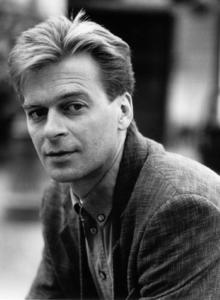
Bodo Morshäuser (Berlijn, 28 februari 1953)
Foto: Brigitte Friedrich
„Je vay bien jusques à ce second point, avec mon peintre : mais je demeure court en l’autre, et meilleure partie : car ma suffisance ne va pas si avant, que d’oser entreprendre un tableau riche, poly et formé selon l’art. Je me suis advisé d’en emprunter un d’Estienne de la Boitie, qui honorera tout le reste de cette besongne. C’est un discours auquel il donna nom : La Servitude volontaire : mais ceux qui l’ont ignoré, l’ont bien proprement dépuis rebatisé, Le Contre Un. Il l’escrivit par maniere d’essay, en sa premiere jeunesse, à l’honneur de la liberté contre les tyrans. Il court pieça és mains des gens d’entendement, non sans bien grande et meritee recommandation : car il est gentil, et plein ce qu’il est possible. Si y a il bien à dire, que ce ne soit le mieux qu’il peust faire : et si en l’aage que je l’ay cogneu plus avancé, il eust pris un tel desseing que le mien, de mettre par escrit ses fantasies, nous verrions plusieurs choses rares, et qui nous approcheroient bien pres de l’honneur de l’antiquité : car notamment en cette partie des dons de nature, je n’en cognois point qui luy soit comparable. Mais il n’est demeuré de luy que ce discours, encore par rencontre, et croy qu’il ne le veit oncques depuis qu’il luy eschappa : et quelques memoires sur cet edict de Janvier fameux par nos guerres civiles, qui trouveront encores ailleurs peut estre leur place. C’est tout ce que j’ay peu recouvrer de ses reliques (moy qu’il laissa d’une si amoureuse recommandation, la mort entre les dents, par son testament, heritier de sa Bibliotheque et de ses papiers) outre le livret de ses oeuvres que j’ay faict mettre en lumiere : Et si suis obligé particulierement à cette piece, d’autant qu’elle a servy de moyen à nostre premiere accointance.”
Michel de Montaigne (28 februari 1533 – 13 september 1592)
There are days when
one should be able
to pluck off one’s head
like a dented or worn
helmet, straight from
the nape and collarbone
(those crackling branches!)
and place it firmly down
in the bed of a flowing stream.
Clear, clean, chill currents
coursing and spuming through
the sour and stale compartments
of the brain, dimmed eardrums,
bleared eyesockets, filmed tongue.
And then set it back again
on the base of the shoulders:
well tamped down, of course,
the laved skin and mouth,
the marble of the eyes
rinsed and ready
for love; for prophecy?
No Music
I’ll tell you a sore truth, little understood
It’s harder to leave, than to be left:
To stay, to leave, both sting wrong.
You will always have me to blame,
Can dream we might have sailed on;
From absence’s rib, a warm fiction.
To tear up old love by the roots,
To trample on past affections:
There is no music for so harsh a song.
“There’s never been an opera about me, never in my entire life. Normally this wouldn’t bother me. There hasn’t been one about you, either, and besides, I’m still young. If my life were a play, this would be the last few minutes before the lights lowered and everything began. The audience would be milling around — the older couples in formal, non-funky suits with pearls hanging around the women’s necks like drops of semen, and the younger people in black shirts and jeans because the formality of theater is an elitist tyrannical paradigm and lots of people in the clothes they wore to work because, frankly, by the time they got home and jumped into the shower and changed their clothes they’d either be late, which they hate, or they’d be on time but so stressed out that they couldn’t really enjoy it, and frankly, if you’re going to pay that much for tickets what’s the use if you’re not going to enjoy it, so what they do is just wear some slightly dressier work clothes to work and then go right to the theater, locking the briefcase in the trunk and sometimes even having time for a cocktail or something, but not for dinner because they hate wolfing down dinner and rushing to the theater, it’s so stressful, they might as well go home and shower and change if they want to be stressed out before the show even starts.
This is some snatch of lobby-talk that Stan, the manager of the Pittsburgh Opera, overheard and never forgot. And never forgot to repeat. ?That’s our audience, Joseph,? he said to me. ?Just regular working folk. We have to create opera for them that’s not just interesting but fascinating, mesmerizing. So that they transcend all the stress about whether to change or where to have dinner or parking or whatever, and really hear the music. That’s what opera’s for. Do you have any more of those candies??”
De Engelse dichter, essayist en schrijver Stephen Spender werd geboren op 28 februari 1909 in Londen. Spender bezocht de Gresham’s School, Holt, University College School en University College, Oxford, waar hij W. H. Auden ontmoette. Spender maakte zijn opleiding niet af en ging naar Duitsland. In deze tijd was hij ook bevriend met Christopher Isherwood die ook al in Duitsland woonde tijdens de republiek van Weimar. Zijn autobiografie, World within world, is een herschepping van de politieke en sociale atmosfeer gedurende de jaren dertig. Evenals collega dichters als Auden en Isherwood en andere uitgesproken tegenstanders van het fascisme werd Spender afgekeurd voor militaire dienst tijdens WO II.
Van 1970 tot 1977 was Spender hoogleraar Engelse letterkunde aan University College in Londen.
Uit: World within world
“Often, during an air raid on London in 1940, I would hear a bomber diving downwards with a roar, as though its trajectory described a valley in the mountain-high air inhabited by aircraft. Then I would reassure myself by imagining that, in the whole area of the county of London, there were no more houses, but that the bomber was gyring and diving over an empty plain covered in darkness. This picture was both reassuring and exact: for it fixed my attention on my own smallness as a target compared with the immensity of London. And this was the reality. Only my fears were exposed.
If I thought of London as the London of my mind, and not as a geographical expanse, I only imagined places I knew and whose names occurred to me: Oxford Street, Piccadilly, St. Paul’s, Liverpool Street, Kensington, Paddington, Maida Vale, Hampstead, and so forth. And even these places were represented in my mind only by the names of a few familiar features, churches, streets and squares, and not by all the other streets and the innumerable buildings which I did not know.
Although the raids stopped, or happened only at rare intervals, this picture of the aeroplane over the huge plain with the people concealed in crevices, can be enlarged to a vision of the new phase of domination and threat by machine-power politics, which the world had now entered and which did not end with the peace. The aeroplane filled ever-widening circles in the minds of people beneath it; but the pilot and even the officers who commanded him at bases, their masters in governments and the vanquished and victors of the war, were diminished, until it seemed that they no longer had wills of their own, but were automata controlled by the mechanism of war.”
Stephen Spender (28 februari 1909 – 16 juli 1995)
De Franse schrijver, dramaturg en regisseur Marcel Pagnol werd geboren op 28 februari 1895 in Aubagne, Bouches-du-Rhône. Hij groeide op als kind van een basisschoolleraar in de Provence en in Marseille en hij wilde oorspronkelijk leraar Engels worden. Het succes van zijn vroege toneelstukken liet hem een andere weg inslaan. Populair werd hij met zijn stukken Marius (1929), Fanny (1931) en César (1936), die handelden over mensen in Marseille. Deze stukken werden ook verfilmd. In de jaren dertig hield Pagnol zich dan ook overwegend met film bezig: Angèle (1934), Regain (1937) und La Femme du Boulanger (1939).
Uit : Jazz (1974)
“L’intelligence, dans la nature, ce n’était qu’une pauvre petite lueur qui devait nous guider dans l’accomplissement des actes quotidiens. Nous lui avons donné, peu à peu, trop d’importance. Et nous sommes comme serait un homme qui porte une lampe dans un souterrain à la recherche d’un trésor. Soudain, la lampe fume, ou flamboie, ou ronfle, ou crépite. Alors, il s’arrête, il s’assied par terre, il fait monter ou descendre la mèche, il règle des éclairages. Et ce travail l’intéresse tant qu’il a oublié le trésor, qu’il finit par croire que le bonheur c’est de perfectionner une lampe et de faire danser des ombres sur un mur. Et il se contente de ces pauvres joies de lampiste, jusqu’au jour où il voit soudain que sa vie s’est passée à ce jeu puéril… Trop tard ! La mort déjà le tient à la gorge. L’intelligence, c’est la lampe. Le trésor, ce sont les joies de la vie. »
Marcel Pagnol 28 februari 1895 – 18 april 1974)
De Franse filosoof, schrijver en politicus Michel Eyquem de Montaigne werd geboren in Bordeaux op 28 februari 1533. In zijn belangrijkste werk, Essais (probeersels), neemt hij de mensheid en met name zichzelf als onderwerp van studie. Hij was daarmee de eerste die een psychologie van zichzelf schreef, in veel verschillende hoofdstukken van wisselende lengte. Hij bleef tot kort voor zijn dood hoofdstukken toevoegen en eerdere hoofdstukken wijzigen en uitbreiden. Montaigne wordt algemeen beschouwd als een sceptisch humanist.
Uit Essais (De la Tristesse)
« JE suis des plus exempts de cette passion, et ne l’ayme ny l’estime : quoy que le monde ayt entrepris, comme à prix faict, de l’honorer de faveur particuliere. Ils en habillent la sagesse, la vertu, la conscience. Sot et vilain ornement. Les Italiens ont plus sortablement baptisé de son nom la malignité. Car c’est une qualité tousjours nuisible, tousjours folle : et comme tousjours couarde et basse, les Stoïciens en defendent le sentiment à leurs sages.
Mais le conte dit que Psammenitus Roy d’Ægypte, ayant esté deffait et pris par Cambysez Roy de Perse, voyant passer devant luy sa fille prisonniere habillee en servante, qu’on envoyoit puiser de l’eau, tous ses amis pleurans et lamentans autour de luy, se tint coy sans mot dire, les yeux fichez en terre : et voyant encore tantost qu’on menoit son fils à la mort, se maintint en cette mesme contenance : mais qu’ayant apperçeu un de ses domestiques conduit entre les captifs, il se mit à battre sa teste, et mener un dueil extreme. »
Michel de Montaigne (28 februari 1533 – 13 september 1592)
De Ierse dichter John Montague werd geboren in New York op 28 februari 1929, maar hij groeide op in in Garvaghey, County Tyrone. Zijn vader, James Montague, een Ulster katholiek, was in 1925 naar de VS vertrokken om zich bij zijn broer te voegen. In 1933, gedurende de depressie, stuurde hij zijn drie zonen terug naar Ierland. In 1946 ging John Montague naar de universiteit van Dublin. Aangemoedigd door het voorbeeld van andere studenten, zoals Thomas Kinsella, begon hij zijn eerste gedichten te publiceren in Dublin Magazine, Envoy, en The Bell. In 1953 kreeg Montague een Fullbright Fellowship en ging hij naar Yale. In 1961 stelde hij zijn eerste dichtbundel samen. In dat jaar verhuisde hij ook naar Parijs, naar een klein appartement, een paar straten verwijderd van Samuel Beckett, die stilaan een goed drinkmaatje van hem werd. In 1964 verscheen zijn verhalenbundel Death of a Chieftain. In 1967 volgde zijn tweede poëziebundel A Chosen Light, in 1970 Tides. Vanaf begin jaren zeventig was Montague begonnen te schrijven aan zijn lange gedicht The Rough Field, dat in 1972 verscheen.
Outside Armagh Jail, 1971
Armagh. Its calm Georgian Mall.
A student’s memory of bell, the carillon
echoing from the new Cathedral, glooms
over the old walls and sleeping cannon,
the incongruously handsome Women’s Prison.
By the railings, two impassive R.U.C men.
I ring formally and ask for Bernadette:
an incredulous giggle and a slammed door
is the iron answer that I get.
Exposed on the steps like Seanchan,
I intone the scop stresses of my Derry poem.
Lines of suffering/lines of defeat.
One of the constables shifts his feet,
the other is grinning broadly. A secret
acolyt of poetry? I can hear him
rubbing his hands in the guardroom;
‘Boys, that was great crack! The Fenians
must be losing. This time they sent a lunatic.’
Irish Street Scene, with Lovers
A rainy quiet evening, with leaves that hang
Likes squares of silk from dripping branches.
An avenue of laurel, and the guttering cry
Of a robin that balances a moment,
Starts and is gone
Upon some furtive errand of his own.
A quiet evening, with skies washed and grey;
A tiredness as though the day
Swayed towards sleep,
Except for the reserved statement
Of rain on the grey-stone pavement –
Dripping, they move through this marine light,
Seemimg to swim more than walk,
Linked under the black arch of an umbrella
With its assembly of spokes like points of stars,
A globule of water slowly forming on each.
The world shrinks to the soaked, worn
Shield of cloth they parade beneath.
John Montague (New York, 28 februari 1929)
Daniel Handler werd geboren op 28 februari 1970 in San Francisco, Californië, U.S.A. Hij werd bekend als Amerikaans schrijver. Hij debuteerde met “The basic eight/1999” en had zijn tweede boek, “Watch your mouth/2000” over incest, al af toen de uitgevers zijn eerste boek nog steeds weigerden. De toon in zijn werk was zwartgallig, uit onvrede over de gebruikelijke literatuur, en een agent voor kinderboeken raadde hem aan om dezelfde basis te nemen om een boek voor kinderen te schrijven. Dit gebeurde onder het pseudoniem Lemony Snicket, en de 13-delige “Series of Unfortunate Events” werd een bestseller.
Uit: The End (A Series of Unfortunate Events, Book 13)
“The Baudelaire orphans would have been happy to see an onion, had one come bobbing along as they traveled across the vast and empty sea in a boat the size of a large bed but not nearly as comfortable. Had such a vegetable appeared, Violet, the eldest Baudelaire, would have tied up her hair in a ribbon to keep it out of her eyes, and in moments would have invented a device to retrieve the onion from the water. Klaus, the middle sibling and the only boy, would have remembered useful facts from one of the thousands of books he had read, and been able to identify which type of onion it was, and whether or not it was edible. And Sunny, who was just scarcely out of babyhood, would have sliced the onion into bite-sized pieces with her unusually sharp teeth, and put her newly developed cooking skills to good use in order to turn a simple onion into something quite tasty indeed. The elder Baudelaires could imagine their sister announcing “Soubise!” which was her way of saying “Dinner is served.”