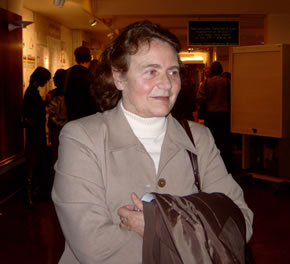
De Amerikaanse schrijver William Gibson werd geboren op 13 november 1914 in New York.
Gibson bezocht het City College of New York. In 1948 schreef hij zijn eerste boek, Dinny and the Witches, maar pas met de in 1954 met de roman The Cobweb boekte hij succes. In 1958 werd zijn eerste toneelstuk Two for the Seesaw uitgevoerd op Broadway. Er werden 750 voorstellingen van gegeven en het werd genomineerd voor een Tony Award. Robert Wise verfilmde het in 1962 met Robert Mitchum en Shirley MacLaine. 1959 volgde The Miracle Worker, zijn meest succesvolle werk. Het stuk, gebaseerd op het verhaal van Helen Keller, won in 1960 de Tony Award en werd 1959-1961 719 opgevoerd. Arthur Penn’s filmversie ervan met Anne Bancroft in de hoofdrol werd in 1962 bekroond met twee Oscars, Gibson was ook genomineerd voor zijn scenario. In 1964 werd hij nogmaals genomineerd voor een Tony voor de musical Golden Boy die hij in samenwerking met Clifford Odets had geschreven. Tot 2005 werden zes verdere stukken van Gibson uitgevoerd op Broadway, waaronder Cry of Players over het leven van de jonge William Shakespeare en Golda’s Balcony over Golda Meir.
Uit: The Miracle Worker
„ACT ONE
[It is night, and we are in a child’s crib, looking up: what we see are the crib railings and three faces in
lamplight, looking down. They have been through a long vigil, it shows in their tired eyes and disarranged
clothing. One is a gentlewoman in her twenties with a kindly and forbearing face, KATE KELLER; the
second is a dry elderly DOCTOR, stethoscope at neck, thermometer in fingers; the third is a dignified
gentleman in his forties with chin whiskers, CAPTAIN ARTHUR KELLER. Their dress is that of 1880, and
their voices are southern. The KELLERS’ faces are drawn and worried, until the DOCTOR speaks.]
DOCTOR
She’ll live.
[KATE closes her eyes.]
You’re lucky,Captain Keller. Tell you now, I thought she wouldn’t.
KELLER [heavily]
Doctor.Don’t spare us.Will she be all right?
DOCTOR
Has the constitution of a goat.Outlive us all. Especially if I don’t get some sleep.
[He removes his stethoscope, his face leaves the railing; we continue to hear him, but see
KELLER’S hand across the crib take and squeeze KATE’S.]
You run an editorial in that paper of yours,Captain Keller, wonders ofmodernmedicine,wemay not know what
we’re curing but we cure it.Well, call it acute congestion of the stomach and brain.
[KELLER moves after the DOCTOR, we hear them off-camera; we see only KATE’S tearfully happy
face hovering over us, her hand adjusting the blanket]
KELLER
I’ll see you to your buggy. I won’t undertake to thank you,Doctor-
DOCTOR [simultaneously]
Main thing is the fever’s gone. I’ve never seen a baby,more vitality, that’s the truth. Bymorning
she’ll be knocking down your fences again.
KELLER
Anything that you recommend us to do,we’ll do
DOCTOR
Might put up stronger fencing. Just let her getwell, she knows howto do it better than we do. Don’t poke at Providence, rule I’ve alwaysmade it a practice to-
[But throughout, their voices have been dying out of focus, and the image of KATE’s face has begun
to swim. Music steals in; we hear the music without distortion, but light and sound otherwise are
failing. KATE’s serene face smiles down with love, blurring in a halo of light, then is a spot, then is
gone. Darkness.]“
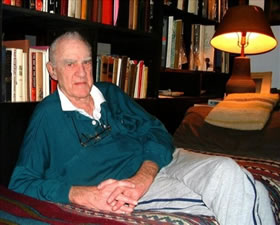
William Gibson (13 november 1914 – 25 november 2008)
Lees verder “William Gibson, Gérald Godin, Karl Jakob Hirsch, Robert Louis Stevenson, Esaias Tegnér” →