My gaze is clear like a sunflower. It is my custom to walk the roads Looking right and left And sometimes looking behind me, And what I see at each moment Is what I never saw before, And I’m very good at noticing things. I’m capable of feeling the same wonder A newborn child would feel If he noticed that he’d really and truly been born. I feel at each moment that I’ve just been born Into a completely new world…
I believe in the world as in a daisy, Because I see it. But I don’t think about it, Because to think is to not understand. The world wasn’t made for us to think about it (To think is to have eyes that aren’t well) But to look at it and to be in agreement.
I have no philosophy, I have senses… If I speak of Nature it’s not because I know what it is But because I love it, and for that very reason, Because those who love never know what they love Or why they love, or what love is.
To love is eternal innocence, And the only innocence is not to think…
The Keeper Of Sheep VI
To think about God is to disobey God, Since God wanted us not to know him, Which is why he didn’t reveal himself to us…
Let’s be simple and calm, Like the trees and streams, And God will love us, making us Us even as the trees are trees And the streams are streams, And will give us greenness in the spring, which is its season, And a river to go to when we end… And he’ll give us nothing more, since to give us more would make us less us.
COME swish around, my pretty punk, And keep me dancing still That I may stay a sober man Although I drink my fill.
Sobriety is a jewel That I do much adore; And therefore keep me dancing Though drunkards lie and snore. O mind your feet, O mind your feet, Keep dancing like a wave, And under every dancer A dead man in his grave. No ups and downs, my pretty, A mermaid, not a punk; A drunkard is a dead man, And all dead men are drunk.
A Dream Of Death
I DREAMED that one had died in a strange place Near no accustomed hand, And they had nailed the boards above her face, The peasants of that land, Wondering to lay her in that solitude, And raised above her mound A cross they had made out of two bits of wood, And planted cypress round; And left her to the indifferent stars above Until I carved these words: i{She was more beautiful than thy first love,} i{But now lies under boards.}
A Man Young And Old: I. First Love
Though nurtured like the sailing moon In beauty’s murderous brood, She walked awhile and blushed awhile And on my pathway stood Until I thought her body bore A heart of flesh and blood.
But since I laid a hand thereon And found a heart of stone I have attempted many things And not a thing is done, For every hand is lunatic That travels on the moon.
She smiled and that transfigured me And left me but a lout, Maundering here, and maundering there, Emptier of thought Than the heavenly circuit of its stars When the moon sails out.
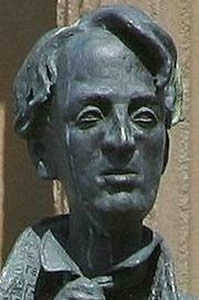
William Butler Yeats (13 juni 1865 – 28 januari 1939) Standbeeld in Sligo, County Sligo (detail)
De Nederlandse schrijver Thomas Heerma van Voss werd geboren in Amsterdam op 13 juni 1990. Thomas doorliep het Vossius Gymnasium, studeerde een jaar Engels in Londen en studeert sinds 2009 Nederlands aan de Universiteit van Amsterdam. In 2009 verscheen tevens zijn debuut De Allestafel, dat hij al op achttienjarige leeftijd schreef, bij uitgeverij Augustus,
Uit: De kraamafdeling
“Ze vragen zelden wie hij is of wat hij komt doen. De dame bij de receptie knikt hem hooguit vriendelijk toe. De eerste weken zei ze nog: ‘Bent u naar iemand op zoek?’ Maar inmiddels herkent ze zijn gezicht, ze weet dat hij hier dagelijks komt en dus de weg wel kent. Ook op de kraamafdeling wordt hij doorgaans met rust gelaten. Soms zegt een arts: ‘Kan ik u ergens mee helpen?’ Of: ‘De bezoekuren zijn al afgelopen, meneer.’ Dan verzint hij snel iets over een ernstig zieke zoon of een vrouw die net aan het bevallen is, geen arts die hem dan nog de deur durft te wijzen. Het is acht uur ’s ochtends. Leon staat voor de badkamerspiegel. Hij haalt een scheerapparaat over zijn wangen, smeert een paar klodders gel in zijn haar en propt zijn witte jas in zijn broek. De gebruikelijke voorbereiding. Ten slotte trekt hij zijn roodbruine trui aan, op zo´n manier dat er niets van de jas zichtbaar is. Met zijn Polaroid-toestel in de hand gaat hij naar buiten. Het is rustig op straat. Leon slaat een hoek om, en nog een. De afgelopen maanden heeft hij deze route dagelijks gelopen. Toch voelt het nog steeds niet helemaal vertrouwd, hij krijgt het idee dat er nog altijd iets onverwachts kan gebeuren, dat Samantha hem elk moment kan bellen: ‘Kom snel. Het is al bezig.’ Toen hij die woorden hoorde, een half jaar geleden, begon hij meteen te rennen. Hij sprintte zoals hij nog nooit in zijn leven had gedaan, midden over straat, door rode lichten, hij duwde mensen opzij en riep: ‘Weg, weg, mijn dochter wordt geboren.’ Hij wist al maanden dat het een meisje zou worden.
Uit: The Diary of a Young Girl (Vertaald door B. M. Mooyart-Doubleday)
„Tuesday, 11 April, 1944
Dear Kitty,
My head throbs, I honestly don’t know where to begin.
On Friday (Good Friday) we played Monopoly, Saturday afternoon too. These days passed quickly and uneventfully. On Sunday afternoon, on my invitation, Peter came to my room at half past four, at a quarter past five we went to the front attic, where we remained until six o’clock. There was a beautiful Mozart concert on the radio from six until a quarter past seven. I enjoyed it all very much, but especially the “Kleine Nachtmusik.” I can hardly listen in the room because I’m always so inwardly stirred when I hear lovely music.
On Sunday evening Peter and I went to the front attic together and, in order to sit comfortably, we took with us a few divan cushions that we were able to lay our hands on. We seated ourselves on one packing case. Both the case and the cushions were very narrow, so we sat absolutely squashed together, leaning against other cases. Mouschi kept us company too, so we weren’t unchaperoned.
Suddenly, at a quarter to nine, Mr. Van Daan whistled and asked if we had one of Dussel’s cushions. We both jumped up and went downstairs with cushion, cat, and Van Daan.
A lot of trouble arose out of this cushion, because Dussel was annoyed that we had one of his cushions, one that he used as a pillow. He was afraid that there might be fleas in it and made a great commotion about his beloved cushion! Peter and I put two hard brushes in his bed as a revenge. We had a good laugh over this little interlude!
Our fun didn’t last long. At half past nine Peter knocked softly on the door and asked Daddy if he would just help him upstairs over a difficult English sentence. “That’s a blind,” I said to Margot, “anyone could see through that one!” I was right. They were in the act of breaking into the warehouse. Daddy, Van Daan, Dussel, and Peter were downstairs in a flash. Margot, Mummy, Mrs. Van Daan, and I stayed upstairs and waited“.
„Sometime during my thirties the nickname and I mysteriously parted company, Stingo merely evaporating like a wan ghost out of my existence, leaving me indifferent to the loss. But Stingo I still was during this time about which I write. If, however, it is perplexing that the name is absent from the earlier part of this narrative, it may be understood that I am describing a morbid and solitary period in my life when, like the crazy hermit in the cave on the hill, I was rarely called by any name at all.
I was glad to be shut of my job–the first and only salaried position, excluding the military, of my life–even though its loss seriously undermined my already modest solvency. Also, I now think it was constructive to learn so early in life that I would never fit in as an office worker, anytime, anywhere. In fact, considering how I had so coveted the job in the first place, I was rather surprised at the relief, indeed the alacrity, with which I accepted my dismissal only five months later. In 1947 jobs were scarce, especially jobs in publishing, but a stroke of luck had landed me employment with one of the largest publishers of books, where I was made “junior editor”–a euphemism for manuscript reader. That the employer called the tune, in those days when the dollar was much more valuable tender than it is now, may be seen in the stark terms of my salary–forty dollars a week. After withholding taxes this meant that the anemic blue check placed on my desk each Friday by the hunchbacked little woman who managed the payroll represented emolument in the nature of a little over ninety cents an hour. But I had not been in the least dismayed by the fact that these coolie wages were dispensed by one of the most powerful and wealthy publishers in the world; young and resilient, I approached my job–at least at the very beginning–with a sense of lofty purpose; and besides, in compensation, the work bore intimations of glamour: lunch at “21,” dinner with John O’Hara, poised and brilliant but carnal-minded lady writers melting at my editorial acumen, and so on.”
Zie, hoe de beek langs enge boorden schiet, En ’t rozeblaadje met zich mede-draagt, Dat vrolijk langs de harde oever vliet, En draait en wendt, naar ’t aan zijn hart behaagt.
Dat andre zoekt de grauwe rots, waar niet Die domme beek zijn vrije wil belaagt; En toen ’t uit vrije keus te bersten stiet, Had het zich toch tot volgen niet verlaagd:
Tot iets wordt door zijn aard bestemd, wat leeft; Dat iets verrichten kán het, want het moet, En ’t voelt zich vrij in ’t slaaf-zijn van een wet:
Slaaf, wie zich tegen wat hij moet, verzet, Maar vrij de wil, van wie al willend doet De wil van wat geluk en vrede geeft!
Dorpsvesper
Heen is de dag – de nacht nog niet geboren En langs de bergen wademt avond-dauw De vogel laat een laatst geneurie horen In roerloze aandacht luistert de landouw
De zwerver daalt, in zielsgepeins verloren In ’t dal, en naar ’t gehucht van wit en grauw Daar klinken vrome tonen uit de toren – De star der liefde flinkert zilver-blauw
Het kerkje bracht, wie danken wilden, samen En wierook en gezang golft uit de poort En op het dankgebed zegt alles “amen” –
De zwerver schrijdt, in zoet gepeins, weer voort; Waar zoveel eensgezinden samenkwamen, Daar sterft de haat, en wordt geen klacht gehoord
Avond
Wanneer in ademloze schemerschijn De vleermuis zwijgend wiekt in lage kringen, En de aarde staart naar de eerste tintelingen Der zilvren spangen van het nachtgordijn;
Als dan door ’t loof der luistrende jasmijn De luwtjes geur’ge wiegeliedren zingen, En sluimer daalt op brede duivezwingen… Dan is het zalig, om alleen te zijn.
Dan is het zalig, ’t lachend oog te luiken, Waar fulpen rust op neerzijgt, die verkwikt, En leeft van ’t zoete liefdedromen sluiken.
O, driewerf zalig, wie het werd beschikt, Om in de zee der sluimring neer te duiken Als daar een lief gelaat hem tegenblikt!
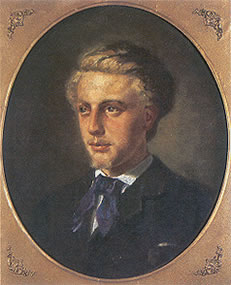
Jacques Perk (10 juni 1859 – 1 november 1881) Portret door Herman van der Voort in de Betouw. 1870
Een goudvis in de zandbak zwemt in de vijver bakt een jongen taart het water schrikt niet van de vorm het zand in golfjes ligt bedaard
Er zijn twaalf auto’s gepasseerd en een als voorbijganger verklede wandelaar het geeft niet van die jongen: hij heeft nog drie levens en het er zelf naar gemaakt
Wel heeft hij redelijk zacht haar en een vliegtuig nog niet geheel in elkaar, het is op de wielen en het verven na klaar, het moet ervan komen
dat het zweeft, hij weet hoe het vliegt en dat van de vorm het water niet schrikt. Misschien als er een scooter langskwam.
La gare
De avond ruikt licht naar gist, dan naar jou. Een lokomotief glijdt aan het station voorbij zonder trein. Er is geen verband. De hoogspanningsdraden tikken tegen de kou van de mist. Vanwaar opeens jouw hand als een dief door mijn haar – alsof een vrouw niet gewoon kan zijn.
En bij elkaar waren we de omgegooide stoelen van een plotseling verlaten tafel in ons slordig onverwacht in een kamer liggen waar dingen met omhaal niets meer bedoelen, nooit iets meer leven zou.
De liniaal van het spoor ligt langs de nacht, de herfst rook gister even naar jou.
Uit: Memoirs of Hadrian (Vertaald door Grace Frick, in samenwerking met de schrijfster)
”Whatever I had I chose to have, obliging myself only to possess it totally, and to taste the experience to the full. Thus the most dreary tasks were accomplished with ease as long as I was willing to give myself to them. Whenever an object repelled me, I made it a subject of study, ingeniously compelling myself to extract from it a motive for enjoyment. If faced with something unforeseen or near cause for despair, like an ambush or a storm at sea, after all measures for the safety of others had been taken, I strove to welcome this hazard, to rejoice in whatever it brought me of the new and unexpected, and thus without shock the ambush or the tempest was incorporated into my plans, or my thoughts. Even in the throes of my worst disaster, I have seen a moment when sheer exhaustion reduced some part of the horror of the experience, and when I made the defeat a thing of my own in being willing to accept it. If ever I am to undergo torture (and illness will doubtless see to that) I cannot be sure of maintaining the impassiveness of a Thrasea, but I shall at least have the resource of resigning myself to my cries. And it is in such a way, with a mixture of reserve and of daring, of submission and revolt carefully concerted, of extreme demand and prudent concession, that I have finally learned to accept myself.
(…)
Halcyon seasons, solstice of my days… Far from exaggerating my former happiness, I must struggle against too weak a portrayal; even now the recollection overpowers me. More sincere than most men, I can freely admit the secret causes of this felicity: that calm so propitious for work and for discipline of the mind seems to me one of the richest results of love. And it puzzles me that these joys, so precarious at best, and so rarely perfect in the course of human life, however we may have sought or received them, should be regarded with such mistrust by the so-called wise, who denounce the danger of habit and excess in sensuous delight, instead of fearing its absence or its loss; in tyrannizing over their senses they pass time which would be better occupied in putting their souls to rights, or embellishing them. At that period I paid as constant attention to the greater securing of my happiness, to enjoying and judging it, too, as I had always done for the smallest details of my acts; and what is the act of love, itself, if not a moment of passionate attention on the part of the body? Every bliss achieved is a masterpiece; the slightest error turns it awry, and it alters with one touch of doubt; any heaviness detracts from its charm, the least stupidity renders it dull.
Marguerite Yourcenar (8 juni 1903 – 17 december 1987)
„As he watched the snow fall outside his window, as slowly and silently as the snow in a dream, the traveler fell into a long-desired, long-awaited reverie; cleansed by memories of innocence and childhood, he succumbed to optimism and dared to believe himself at home in this world. Soon afterward, he felt something else that he had not known for quite a long time and fell asleep in his seat.
Let us take advantage of this lull to whisper a few biographical details. Although he had spent the last twelve years in political exile in Germany, our traveler had never been very much involved in politics. His real passion, his only thought, was for poetry. He was forty-two years old and single, never married. Although it might be hard to tell as he curled up in his seat, he was tall for a Turk, with brown hair and a pale complexion that had become even paler during this journey. He was shy and enjoyed being alone. Had he known what would happen soon after he fell asleep—with the swaying of the bus his head would come to lean first on his neighbor’s shoulder and then on the man’s chest—he would have been very much ashamed. For the traveler we see leaning on his neighbor is an honest and well-meaning man and full of melancholy, like those Chekhov characters so laden with virtues that they never know success in life. We’ll have a lot to say about melancholy later on. But as he is not likely to remain asleep for very long in that awkward position, suffice it for now to say that the traveler’s name is Kerim Alakusoglu, that he doesn’t like this name but prefers to be called Ka (from his initials), and that I’ll be doing the same in this book. Even as a schoolboy, our hero stubbornly insisted on writing Ka on his homework and exam papers; he signed Ka on university registration forms; and he took every opportunity to defend his right to continue to do so, even if it meant conflict with teachers and government officials. His mother, his family, and his friends all called him Ka, and, having also published some poetry collections under this name, he enjoyed a small enigmatic fame as Ka, both in Turkey and in Turkish circles in Germany.“
„Hier ist >Einfried<, das Sanatorium! Weiß und geradlinig liegt es mit seinem langgestreckten Hauptgebäude und seinem Seitenflügel inmitten des weiten Gartens, der mit Grotten, Laubengängen und kleinen Pavillons aus Baumrinde ergötzlich ausgestattet ist, und hinter seinen Schieferdächern ragen tannengrün, massig und weich zerklüftet die Berge himmelan.
Nach wie vor leitet Doktor Leander die Anstalt. Mit seinem zweispitzigen schwarzen Bart, der hart und kraus ist wie das Roßhaar, mit dem man die Möbel stopft, seinen dicken, funkelnden Brillengläsern und diesem Aspekt eines Mannes, den die Wissenschaft gekältet, gehärtet und mit stillem, nachsichtigem Pessimismus erfüllt hat, hält er auf kurz angebundene und verschlossene Art die Leidenden in seinem Bann, — alle diese Individuen, die, zu schwach, sich selbst Gesetze zu geben und sie zu halten, ihm ihr Vermögen ausliefern, um sich von seiner Strenge stützen lassen zu dürfen.
Was Fräulein von Osterloh betrifft, so steht sie mit unermüdlicher Hingabe dem Haushalte vor. Mein Gott, wie tätig sie, treppauf und treppab, von einem Ende der Anstalt zum anderen eilt! Sie herrscht in Küche und Vorratskammer, sie klettert in den Wäscheschränken umher, sie kommandiert die Dienerschaft und bestellt unter den Gesichtspunkten der Sparsamkeit, der Hygiene, des Wohlgeschmacks und der äußeren Anmut den Tisch des Hauses, sie wirtschaftet mit einer rasenden Umsicht, und in ihrer extremen Tüchtigkeit liegt ein beständiger Vorwurf für die gesamte Männerwelt verborgen, von der noch niemand darauf verfallen ist, sie heimzuführen. Auf ihren Wangen aber glüht in zwei runden, karmoisinroten Flecken die unauslöschliche Hoffnung, dereinst Frau Doktor Leander zu werden…“
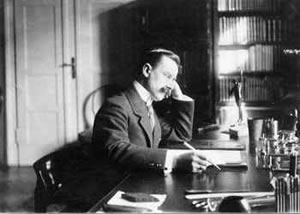
Manns werkkamer en schrijftafel, nu in het Thomas Mann Archiv in Zürich
Ozon und stille, stille Luft … für Lungenkranke ist >Einfried<, was Doktor Leanders Neider und Rivalen auch sagen mögen, aufs wärmste zu empfehlen. Aber es halten sich nicht nur Phthisiker, es halten sich Patienten aller Art, Herren, Damen und sogar Kinder hier auf: Doktor Leander hat auf den verschiedensten Gebieten Erfolge aufzuweisen. Es gibt hier gastrisch Leidende, wie die Magistratsrätin Spatz, die überdies an den Ohren krankt, Herrschaften mit Herzfehlern, Paralytiker, Rheumatiker und Nervöse in allen Zuständen. Ein diabetischer General verzehrt hier unter immerwährendem Murren seine Pension. Mehrere Herren mit entfleischten Gesichtern werfen auf jene unbeherrschte Art ihre Beine, die nichts Gutes bedeutet. Eine fünfzigjährige Dame, die Pastorin Höhlenrauch, die neunzehn Kinder zur Welt gebracht hat und absolut keines Gedankens mehr fähig ist, gelangt dennoch nicht zum Frieden, sondern irrt, von einer blöden Unrast getrieben, seit einem Jahre bereits am Arm ihrer Privatpflegerin starr und stumm, ziellos und unheimlich durch das ganze Haus.
Dann und wann stirbt jemand von den >Schweren<, die in ihren Zimmern liegen und nicht zu den Mahlzeiten noch im Konversationszimmer erscheinen, und niemand, selbst der Zimmernachbar nicht, erfährt etwas davon. In stiller Nacht wird der wächserne Gast beiseite geschafft, und ungestört nimmt das Treiben in >Einfried< seinen Fortgang, das Massieren, Elektrisieren und Injizieren, das Duschen, Baden, Turnen, Schwitzen und Inhalieren in den verschiedenen mit allen Errungenschaften der Neuzeit ausgestatteten Räumlichkeiten…“