David Leavitt, Pascal Mercier, Franca Treur, Jean Anouilh, Richard Bach, Anna Achmatova

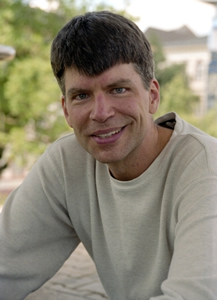
De Amerikaanse schrijver David Leavitt werd geboren in Pittsburgh op 23 juni 1961. Zie ook alle tags voor David Leavitt op dit blog.

Uit: The Page Turner

“Paul! Let me fix your tie!”
All at once his mother was on him, her hands at his throat.
“Mother, please, my tie’s all right –“
“Let me just tighten the knot, honey, you don’t want to have a loose knot for your debut –“
“It’s not my debut.” “When my son sits up on a stage in front of two thousand people, I consider it a debut. There, much better.”
She stepped back slightly, smoothed his lapels with long fingers. Even so, her face was close enough to kiss: he could see her crow’s-feet under make-up, smell the cola-like sweetness of her lipstick, the Wrigley’s on her breath.
“That’s good enough, Mother.”
“Just one little adjustment –“
“I said it was good enough!”
Writhing away from her, Paul hurried across the wings, to where Mr. Mansourian, the impresario, awaited him.
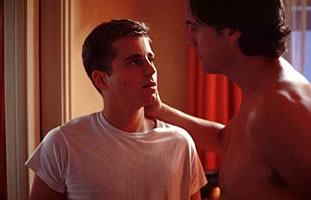
 

Paul (Kevin Bishop) en Richard (Paul Rhys).
Scene uit de film “Food of Love” uit 1998 (gebaseerd op de roman “The Page Turner”)


“Well, well, well,” said Mr. Mansourian, “if you’re not the best-dressed page turner I’ve ever seen. Come on, I’ll introduce you to Kennington.”
“Good luck, sweetheart!” Pamela called almost mournfully. She waved at Paul, a tissue balled in her fist. “Break a leg! I’ll see you after the concert.”
He didn’t answer. He was out of earshot, out of the wings, beyond which the hum of the settling audience was becoming audible.
Mr. Mansourian led him up steep stairways and along antiseptic corridors, to a dressing room at the door to which he knocked three times with sharp authority.
“Come in!”
They went. In front of mirrors Richard Kennington, the famous pianist, sat on a plastic chair, bow tie slack around his throat. He was drinking coffee. Isidore Gerstler, the famous cellist, was eating a cinnamon-frosted doughnut out of a box. Maria Luisa Strauss, the famous violinist, was stubbing out a cigarette in an ashtray already overflowing with red-tipped butts. Her perfume, capacious and spicy, suggested harems. Yet the room had no softness, no Persian carpets. Instead it was all lightbulbs that brightened the musicians’ faces to a yellowish intensity.
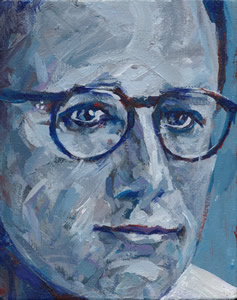
 

David Leavitt (Pittsburgh, 23 juni 1961)
Portret door Arnold Mesches

Lees verder “David Leavitt, Pascal Mercier, Franca Treur, Jean Anouilh, Richard Bach, Anna Achmatova”

Cornelia Schmerle, Wolfgang Koeppen, Urs Jaeggi, Robert C. Hunter, Will Shutt

De Duitse dichteres Cornelia Schmerle werd geboren op 23 juni 1973 in Berlijn. Zie ook alle tags voor Cornelia Schmerle op dit blog.


Unter Ulmen

Denn in meinem Arm ist eine. Gerufene;
getragen aus den Türmen der Zwanghaften.

Hier betet ein Traum um seine Richtigkeit.
Hier wird die Ungläubige verschleiert.

Sie wird dem Einäugigen laut angepriesen,
wird ihm gestellt und in die Rahmen gespannt.

Wir essen von kalten Kohlen. Magern.
Im Auge der Bienen sind wir giftig.

Ich bin aus Merkwürdigem geschaffen;
ein Allerlei aus zwittrigen Samen.

Bevor ich Wind bin – Sprache überm Wasser
bin ich verschluckt; eine Stimme nach der nächsten.


Wurzeln

Die leichten Körper liegen schon
in der Nähe auf einen Karren, den ich zieh.
Ihre schönen Gesichter schlafen, erinnern nicht.
Mein Lid halt ich gerade, die Achse.

Mutter hat den Geruch von Maulwurf;
immer ist Erde noch an ihrem mahnenden Finger.
Diese Gänge sind nicht mein Daheim!
Ihr Aufgeworfenes ist kleinlich.

Ich breche die Schale bis nichts mehr
getrennt ist durch die Ahnung der Witterungen.
Das Stöhnen bleibt, trotzdem ich fauche, den Buckel
setze gegen den Strich einer Hand.


Cornelia Schmerle (Berlijn, 23 juni 1973)

Lees verder “Cornelia Schmerle, Wolfgang Koeppen, Urs Jaeggi, Robert C. Hunter, Will Shutt”

Nescio, Juliën Holtrigter, Jaap Robben, Willie Verhegghe, Henry Rider Haggard, Erich Maria Remarque, Dan Brown

De Nederlandse schrijver Nescio (pseudoniem van Jan Hendrik Frederik Grönloh) werd geboren in Amsterdam op 22 juni 1882. Zie ook alle tags voor Nescio op dit blog.


Uit: De Uitvreter


“Die monsters werden weggegooid; die gingen nooit naar de klanten. Toch had ik in die dagen nog gelegenheid om een brief verkeerd in te sluiten. Natuurlijk was ’t erg; de man die den brief kreeg mocht niet weten, dat de baas zaken deed met den man waaraan i geschreven was. De boekhouder was totaal van streek. Toen begreep ik, dat ik maar liever heen moest gaan. Ik kreeg een poot van den baas. Ik was zelf ook blij dat ik wegging en heb hem hartelijk de hand geschud. Ik heb gezegd, dat ’t me speet, maar dat ik er niets aan doen kon en ik geloof, dat ‘k ’t meende. Zie je, Koekebakker, dat is handel. Ik ben daarna nog drie weken volontair geweest op een effectenkantoortje, krantjes nakijken met een boek om te zien of de stukken van de klanten waren uitgeloot. Je ergste vijand zal er voor bewaard blijven. Ze moesten me wegdoen. Ik moest daar ook copieeren. Er was geen denken aan, dat ze uit ’t copieboek konden wijs worden. Ik zag wel in dat ’t zoo niet ging, ik kon er mijn hoofd niet bij houden.

‘Mijn ouwe heer was ten einde raad. Hij hoopt nu, dat ’t met de jaren wel beteren zal. Ik weet dat zoo niet. ’t Lijkt er nog niet veel op. ‘k Heb ’t nog veel te goed zoo. Weet je dat Bavink pas een bom duiten heeft gemaakt? Een slootje bij Kortenhoef met een hooibergje en een kalf. Als je blieft.’ En hij haalde zijn portemonnaie voor den dag. ‘Hij puilt van de centen. Koekebakker, jong, hij puilt van de centen. Harde riksjes. Morgen ga ik op reis.’

‘Met Bavink?’ vroeg ik. ‘Neen,’ zei Japi, ‘niet met Bavink, alleen. Ik ga naar Friesland.’ ‘Midden in den winter?’ Japi knikte. ‘Wat doen?’ Hij haalde z’n schouders op. ‘Doen? Niks doen. Jelui kerels zijn zoo akelig wijs: alles moet een reden en een doel hebben. Ik ga naar Friesland, niks doen, nergens om. Zonder reden. Omdat ik er zin in heb.’

Den volgenden avond bracht ik hem weg, in donker naar den sneltrein van zevenen. Hij had een jas zonder knoopen aan, die hem veel te wijd was, een pet op, die hem een eind achter de ooren zakte en aan z’n voeten de nieuwe gele schoenen van Appi. In z’n hand hatti een papieren sigarenpijpje met een reclame. ‘Wacht even’, zei i, toen we al beneden waren. ‘Ik heb nog wat vergeten.’ Even daarna kwam i terug met een vischhengel.

Hij was weinig spraakzaam dien avond. Ik kon niet uit hem krijgen wat hij met dien vischhengel wilde. Onderweg rookte hij in een half uur vier sigaren uit zijn papieren sigarenpijpje, en toen ik aan het portier van hem afscheid nam vroeg hij me of ik niet een beetje tabak voor hem had.”


Nescio (22 juni 1882 – 25 juli 1961)

Lees verder “Nescio, Juliën Holtrigter, Jaap Robben, Willie Verhegghe, Henry Rider Haggard, Erich Maria Remarque, Dan Brown”

Tadeusz Konwicki, Xavier Grall, Anne Morrow Lindbergh, Johannes Baader, Ida von Hahn-Hahn, Jacques Delille

De Poolse schrijver en regisseur Tadeusz Konwicki werd geboren op 22 juni 1926 in Nowa Wilejka bij Vilnius. Zie ook alle tags voor Tadeusz Konwicki op dit blog.


Uit: The Calendar and the Hourglass (Vertaald door Daniel Bourne)


“New Year with a Bad Hangover
WHERE TO START? Maybe with the sign of the cross or a magic charm. I’m a superstitious person, and getting more and more so. Only people enjoying prosperity, people on a run of good luck, make fun of superstitions. But the longer one’s life, the leaner it becomes. Towards the end it gets more and more necessary to knock on wood, spit three times, to make one’s benedictions surreptitiously.
And I’m attempting something here a little absurd. For many years I’ve stuck to writing a story–that powerful chain that can hold together the most wild and wooly words. Whenever I have been carried away by excessive ambition–and strayed away from stories and started toying around with personal essays or whatever you might call them–each time I’ve ended up in abject defeat. In light of this, with great superstitious dread, I have continued to latch on to plot, to action and drama. The story leads me like a blind man through the bogs of being a writer.
But it got boring. It’s as simple as that. It got boring like a monotonous, automatic action carried out for years, so I thought it might be nice to write something from time to time, from whim to whim and chance to chance. And, as bad luck would have it, my little case of boredom came at a time when fellow novelists and other drudges in this toilsome profession–when hacks everywhere had started to abandon stories on the sly as if they were pushing out ballast no longer of use to anyone, though carried along to who knows where just in case.”


Tadeusz Konwicki (Nowa Wilejka, 22 juni 1926)

Lees verder “Tadeusz Konwicki, Xavier Grall, Anne Morrow Lindbergh, Johannes Baader, Ida von Hahn-Hahn, Jacques Delille”

Ed Leeflang, Thomas Blondeau, Anne Carson, Adam Zagajewski, Ian McEwan, Alon Hilu

De Nederlandse dichter Ed Leeflang werd geboren op 21 juni 1929 in Amsterdam. Zie ook alle tags voor Ed Leeflang op dit blog.


Hij is prins

Hij is prins, hij wil geen onderdanen,
want zij zullen allen in elk geval prinsen zijn:
prins verkoper, prins bloemist,
prins huisvrouw en prins dode.

Zijn wenkbrouw spreekt,
zijn ogen vragen en op
zijn tafel staan de staatsgeheimen
van de dagen.

Kwetsbare prinsen onder elkaar
– met moeders als een tv-serie
zo benauwend vasthoudend –
iedereen wordt een wezen.

Er is geen vrouwlijkheid in deze klas,
er is slechts hoffelijkheid en hoogheid
en hevigheid van schrijven en van lezen.
Wie ’s morgens binnenkomt is
een vereerde gast.


Botlopen

We zetten zwinnen in de zandplaat af
met warnetten en joegen stapvoets bot
en schol op, vingen emmers vol.

De kotter op de drooggevallen vlakte
hing scheef, de eerste stilte scheen
te dalen uit de zon, een oever was
er niet.

Uit water waren wij getild, samen
met gesloten schelpen, om tenminste
één keer haast te weten hoe het is: te
zijn gestrand en toch te overleven.

Twee of drie uur zou de eb ons hier
nog dulden. Dan niet meer.
Genoeg om te onthouden dat wij het
onbetwiste midden waren van de ruimte,
die wij opgelucht en nietsontziend
bevisten.


Duinen

Zoals altijd is er een dierenspoor.
Er staan gewone brem, slangenkruid,
ossetong en koekoeksbloemen. Sommige
konijnen begonnen een hol, maar
groeven niet door.

In de spaarbekkens hangt het water;
je zou er munten in kunnen gooien
als in het bassin van een fontein.

Bast is van jonge bomen afgeknaagd.
Zie toch hoe de dag werkelijk wentelt
en er van alles uit de tijd valt, ritselend,
hoe schelpen gaan, knerpend, hoe niemand
meer opraapt, hoe niemand meer ergens
naar vraagt, hoe de wind heengaat:
zonder geest te zijn wat hij afrukt
verwerpend.


Ed Leeflang (21 juni 1929 – 17 maart 2008)

Lees verder “Ed Leeflang, Thomas Blondeau, Anne Carson, Adam Zagajewski, Ian McEwan, Alon Hilu”

Vikram Seth, Paul Muldoon, Kurt Schwitters, Jean-Claude Izzo, Silke Andrea Schuemmer

De Indische schrijver Vikram Seth werd geboren op 20 juni 1952 in Kolkata. Zie ook alle tags voor Vikram Seth op dit blog.

Uit: A Suitable Boy

“Lata reflected that of the four brothers and sisters, the only one who hadn’t complained of the match had been the sweet-tempered, fair-complexioned, beautiful Savita herself.
‘He is a little thin, Ma,’ said Lata a bit thoughtlessly. This was putting it mildly. Pran Kapoor, soon to be her brother-in-law, was lank, dark, gangly, and asthmatic.
‘Thin? What is thin? Everyone is trying to become thin these days. Even I have had to fast the whole day and it is not good for my diabetes. And if Savita is not complaining, everyone should be happy with him. Arun and Varun are always complaining: why didn’t they choose a boy for their sister then? Pran is a good, decent, cultured khatri boy.’
There was no denying that Pran, at thirty, was a good boy, a decent boy, and belonged to the right caste. And, indeed, Lata did like Pran. Oddly enough, she knew him better than her sister did–or, at least, had seen him for longer than her sister had. Lata was studying English at Brahmpur University, and Pran Kapoor was a popular lecturer there. Lata had attended his class on the Elizabethans, while Savita, the bride, had met him for only an hour, and that too in her mother’s company.
‘And Savita will fatten him up,’ added Mrs Rupa Mehra. ‘Why are you trying to annoy me when I am so happy? And Pran and Savita will be happy, you will see. They will be happy,’ she continued emphatically. ‘Thank you, thank you,’ she now beamed at those who were coming up to greet her. ‘It is so wonderful–the boy of my dreams, and such a good family. The Minister Sahib has been very kind to us. And Savita is so happy. Please eat something, please eat: they have made such delicious gulabjamuns, but owing to my diabetes I cannot eat them even after the ceremonies. I am not even allowed gajak, which is so difficult to resist in winter. But please eat, please eat. I must go in to check what is happening: the time that the pandits have given is coming up, and there is no sign of either bride or groom!’ She looked at Lata, frowning. Her younger daughter was going to prove more difficult than her elder, she decided.
‘Don’t forget what I told you,’ she said in an admonitory voice.
‘Hmm,’ said Lata. ‘Ma, your handkerchief’s sticking out of your blouse.’
‘Oh!’ said Mrs Rupa Mehra, worriedly tucking it in. ‘And tell Arun to please take his duties seriously. He is just standing there in a corner talking to that Meenakshi and his silly friend from Calcutta. He should see that everyone is drinking and eating properly and having a gala time.”


Vikram Seth (Kolkata, 20 juni 1952)

Lees verder “Vikram Seth, Paul Muldoon, Kurt Schwitters, Jean-Claude Izzo, Silke Andrea Schuemmer”

Salman Rushdie, Sybren Polet, Josef Nesvadba, Osamu Dazai, José Rizal, Friedrich Huch, Gustav Schwab

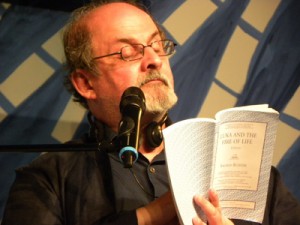
De Indisch-Britse schrijver en essayist Salman Rushdie werd geboren in Bombay op 19 juni 1947. Zie ook alle tags voor Salman Rushdie op dit blog.

Uit: The Satanic Verses

“When Baal proceeded to lay out the plan for the madam, she responded: “It is very dangerous, but it could be damn good for business.” While I do not wholly subscribe to the theory that authors tend to write self-fulfilling novels, it seems quite clear to me that “they” did hear and that they are indeed mad enough to “boil his balls in butter.” The Ayyatollah Khomeni, who issued the fatwa for Rushdie’s death, in fact stated that what Rushdie wrote about the Prophet literally made his blood boil (quoted in Appignanesi and Maitland 1990:73). The whole thing has been very dangerous, and there is little doubt but that the controversy has been “damn good for business.”

The question that remains for me is why Rushdie — being brought up as a Muslim, even a backsliding one — did not realize what the reaction of his fellow Muslims would be (Baal was certainly not naive about how Mahound would respond to knowing whores were pretending to be his wives), or why Rushdie realized it but went ahead and did it anyway. To a certain extent Rushdie’s public presentation of his private doubt came at the wrong time — it was a convenient lightning rod at a time when anger against the West — understandable anger at that — needed to go somewhere.

But the key I think is found in the same passage (p. 380), where Rushdie comments: “Where there is no belief, there is no blasphemy.” In an interview ironically broadcast the same day in 1989 as Khomeini’s death warrant, Rushdie added: “Doubt, it seems to me, is the central condition of a human being in the 20th century” (quoted in Appignanesi and Maitland 1990:24). Here I think is the crux of the problem. We can readily identify with Rushdie on doubt as the norm in the secular as well as much of the sacred thinking of our West. We can read The Satanic Verses as an exercise in dealing with that doubt, one that Rushdie as an immigrant author in our backyard vigorously defends as viable even though it may be seen as blatant unbelief by his critics. But the problem is that Rushdie, at least up until a recent interview with

David Frost, has never claimed not to have belief. He has simply admitted to doubt.”

Salman Rushdie (Bombay, 19 juni 1947)


Lees verder “Salman Rushdie, Sybren Polet, Josef Nesvadba, Osamu Dazai, José Rizal, Friedrich Huch, Gustav Schwab”

Richard Powers, Raymond Radiguet, Geoffrey Hill, Bert Schierbeek, Karin Fellner

De Amerikaanse schrijver Richard Powers werd geboren op 18 juni 1957 in Evanston, Illinois. Zie ook alle tags voor Richard Powers op dit blog.

Uit: The Echo Maker

“They converge on the river at winter’s end as they have for eons, carpeting the wetlands. In this light, something saurian still clings to them: the oldest flying things on earth, one stutter-step away from pterodactyls. As darkness falls for real, it’s a beginner’s world again, the same evening as that day sixty million years ago when this migration began.
Half a million birds—four-fifths of all the sandhill cranes on earth—home in on this river. They trace the Central Flyway, an hourglass laid over the continent. They push up from New Mexico, Texas, and Mexico, hundreds of miles each day, with thousands more ahead before they reach their remembered nests. For a few weeks, this stretch of river shelters the miles-long flock. Then, by the start of spring, they’ll rise and head away, feeling their way up to Sas-katchewan, Alaska, or beyond.
This year’s flight has always been. Something in the birds retraces a route laid down centuries before their parents showed it to them. And each crane recalls the route still to come.
Tonight’s cranes mill again on the braided water. For another hour, their massed calls carry on the emptying air. The birds flap and fidget, edgy with migration. Some tear up frosty twigs and toss them in the air. Their jitters spill over into combat. At last the sandhills settle down into wary, stilt-legged sleep, most standing in the water, a few farther up in the stubbled fields.
A squeal of brakes, the crunch of metal on asphalt, one broken scream and then another rouse the flock. The truck arcs through the air, corkscrewing into the field. A plume shoots through the birds. They lurch off the ground, wings beating. The panicked carpet lifts, circles, and falls again. Calls that seem to come from creatures twice their size carry miles before fading.”

Richard Powers (Evanston, 18 juni 1957)


Lees verder “Richard Powers, Raymond Radiguet, Geoffrey Hill, Bert Schierbeek, Karin Fellner”

Peter Rosei, Gail Jones, Ward Ruyslinck, Max Dendermonde, James Weldon Johnson

De Oostenrijkse dichter en schrijver Peter Rosei werd geboren op 17 juni 1946 in Wenen. Zie ook mijn blog van 17 juni 2009 en eveneens alle tags voor Peter Rosei op dit blog.


Uit: Wien Metropolis


„Es war auf dem Rückzug der deutschen Armeen in der Gegend von Allenstein in Masuren in Polen, also eher schon dem Ende der Schlachtereien des Großen Krieges zu – die kommenden Monate sollten allerdings besonders blutig werden –, daß im Wohntrakt eines Herrengutes, erst kurz zuvor war es von seinen Bewohnern geräumt worden, sich folgendes zutrug: Die Soldaten einer in Auflösung befindlichen deutschen Kompanie entdeckten ein erleuchtetes Fenster in der Nacht. In der Eile der Flucht hatten die Gutsleute wohl vergessen, gerade diese eine und letzte Lampe zu löschen. Die Soldaten brachen mit ein paar Kolbenschlägen das Hoftor auf und drangen ins Haus ein. Im Kamin im großen Salon fanden sich unter einer dünnblättrigen, brüchigen Schicht von grauer Asche – man hatte wohl Papiere verbrannt – noch Knollen von roter, wärmespendender Glut. Bald hatte einer der Männer die Treppe, die zum Vorratskeller hinunterführte, entdeckt. – Als endlich die Nachhut eintraf, angeführt von keinem anderen als dem Oberleutnant Oberkofler, der Pandura, seines Zeichens Stabswachtmeister, war bereits bei der ersten Gruppe dabeigewesen, da fand der Oberkofler seine Leute und also auch den Stabswachtmeister Pandura schon beim Plündern. Zwar hatte der Pandura alle vorgefundenen Fässer durch gezielte Pistolenschüsse zuschanden geschossen, er hatte aber im Durcheinander nicht verhindern können, daß der eine oder andere sein Kochgeschirr oder sonst ein Gefäß unter den kalt und dunkel herauspritschelnden Weinstrahl gehalten hatte. Der Oberkofler machte auch gar kein Aufhebens von der sich anbahnenden Sauferei, er sagte nur in Richtung Pandura, aber so laut, daß alle es hören konnten: »Wer morgen liegen bleibt, wird eben vom Russen erschossen.« Dann warf er seine Handschuhe auf einen Tisch, setzte sich und streckte die Beine breit aus.“


Peter Rosei (Wenen, 17 juni 1946)

Lees verder “Peter Rosei, Gail Jones, Ward Ruyslinck, Max Dendermonde, James Weldon Johnson”

Father (Edgar Guest)


Bij Vaderdag


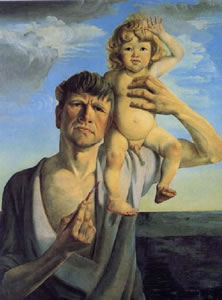
Zelfportret met mijn zoon door Otto Dix, 1930


Father


My father knows the proper way   

The nation should be run;

He tells us children every day   

Just what should now be done.

He knows the way to fix the trusts,   

He has a simple plan;

But if the furnace needs repairs,  

We have to hire a man.


My father, in a day or two   

Could land big thieves in jail;

There’s nothing that he cannot do,   

He knows no word like “fail.”

“Our confidence” he would restore,   

Of that there is no doubt;

But if there is a chair to mend,   

We have to send it out.


All public questions that arise,   

He settles on the spot;

He waits not till the tumult dies,   

But grabs it while it’s hot.

In matters of finance he can   

Tell Congress what to do;

But, O, he finds it hard to meet   

His bills as they fall due.


It almost makes him sick to read   

The things law-makers say;

Why, father’s just the man they need,   

He never goes astray.

All wars he’d very quickly end,   

As fast as I can write it;

But when a neighbor starts a fuss,   

‘Tis mother has to fight it.


In conversation father can   

Do many wondrous things;

He’s built upon a wiser plan   

Than presidents or kings.

He knows the ins and outs of each   

And every deep transaction;

We look to him for theories,   

But look to ma for action.


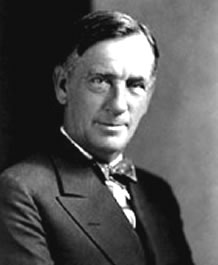
Edgar Guest (20 augustus 1881 – 5 augustus 1959)


Zie voor de schrijvers van de 16e juni ook mijn drie vorige blogs van vandaag.