Edmund de Waal

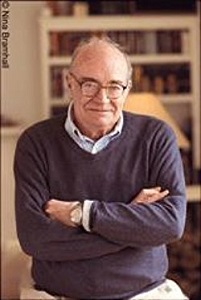
De Britse schrijver, keramist en hoogleraar Edmund Arthur Lowndes de Waal werd geboren op 10 september 1964 in Nottingham. De Waal is een zoon van de deken van Canterbury Cathedral, Victor de Waal. De Waal’s grootmoeder, Elisabeth de Waal, stamde uit de Weense, joodse familie Ephrussi. Ze trouwde met de Nederlander Hendrick de Waal en trol met hem door Europa om tijdens WO II tenslotte in Emgeland terecht te komen. Hij doorliep de King’s School in Canterbury voordat hij een beurs kreeg voor de studie Engels aan Trinity Hall in Cambridge. Tijdens zijn schooljaren in Canterbury de Waal leerde het ambacht van pottenbakker. Dus het was niet meer dan logisch dat hij na zijn afstuderen zijn eigen pottenbakkerij opende in het westen van Engeland in de buurt van de grens met Wales. Tegelijkertijd leerde hij de Japanse taal aan de Universiteit van Sheffield en kreeg een tweejarige werkbeurs ​​van de stichting van het Japanse beursbedrijf Daiwa Shōken Group Honda, die hem in staat stelde om te werken in de Mejiro Ceramics Studio in Tokio. In 2010 werd de Waasl familiegeschiedenis “The Hare with the Amber Eyes: a Hidden Inheritance” gepubliceerd en in hetzelfde jaar won het boek de Costa Book Award in de categorie biografie. De titel verwijst naar een van de 264 Netsukefiguren die de Waal van zijn oudoom Iggy (Ignaz / Ignace) Leo Ephrussi had geërfd. Het verhaal beschrijft het leven van zijn voorouders, de joodse familie Ephrussi, die als Griekse Sephardim door handel en banktransacties in heel Europabekend werd, maar werden vervolgens echter als Joden werden vervolgd in de tijd van het nationaal-socialisme.

Uit: The Hare With Amber Eyes: A Hidden Inheritance

“One sunny April day I set out to find Charles. Rue de Monceau is a long Parisian street bisected by the grand boulevard Malesherbes that charges off towards the boulevard Pereire. It is a hill of golden stone houses, a series of hotels playing discreetly on neoclassical themes, each a minor Florentine palace with heavily rusticated ground floors and an array of heads, caryatids and cartouches. Number 81 rue de Monceau, the Hôtel Ephrussi, where my netsuke start their journey, is near the top of the hill. I pass the headquarters of Christian Lacroix and then, next door, there it is. It is now, rather crushingly, an office for medical insurance.
It is utterly beautiful. As a boy I used to draw buildings like this, spending afternoons carefully inking in shadows so that you could see the rise and fall of the depth of the windows and pillars. There is something musical in this kind of elevation. You take classical elements and try to bring them into rhythmic life: four Corinthian pilasters rising up to pace the façade, four massive stone urns on the parapet, five storeys high, eight windows wide. The street level is made up of great blocks of stone worked to look as if they have been weathered. I walk past a couple of times and, on the third, notice that there is the double back-to-back E of the Ephrussi family incorporated into the metal grilles over the street windows, the tendrils of the letters reaching into the spaces of the oval. It is barely there. I try to work out this rectitude and what it says about their confidence. I duck through the passageway to a courtyard, then through another arch to a stable block of red brick with servants’ quarters above; a pleasing diminuendo of materials and textures.
A delivery man carries boxes of Speedy-Go Pizza into the medical insurers. The door into the entrance hall is open. I walk into the hall, its staircase curling up like a coil of smoke through the whole house, black cast iron and gold filigree stretching up to a lantern at the top. There is a marble urn in a deep niche, chequerboard marble tiles. Executives are coming down the stairs, heels hard on marble, and I retreat in embarrassment. How can I start to explain this idiotic quest? I stand in the street and watch the house and take some photographs, apologetic Parisians ducking past me. House-watching is an art. You have to develop a way of seeing how a building sits in its landscape or streetscape. You have to discover how much room it takes up in the world, how much of the world it displaces. Number 81, for instance, is a house that cannily disappears into its neighbours: there are other houses that are grander, some are plainer, but few are more discreet.”
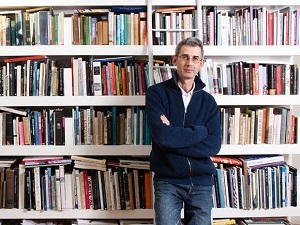
 
Edmund de Waal (Nottingham, 10 september 1964)
Dolce far niente, Herman de Coninck, C. O. Jellema, Wim Huijser, Cesare Pavese, Leo Tolstoj, Gentil Th. Antheunis, Gaston Durnez


Dolce far niente


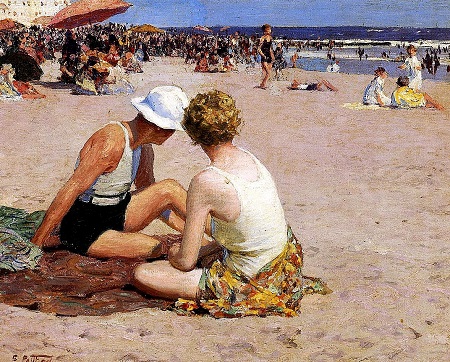
Summer Vacation door Edward Potthast, begin jaren 1900


Zomeravond

Zomeravond. We hebben woorden en tijd.
Behaaglijk is het om van mening en geslacht
te verschillen, waarna alleen nog van geslacht,
een verschil van dag en nacht, waarna nacht.

Laat je strelen, kom.
Ik hou ervan je lichaam te verdelen
in van alles twee, zoals ik deze zomer
de zee verdeelde toen ik schoolslag zwom.


Herman de Coninck (21 februari 1944 – 22 mei 1997)
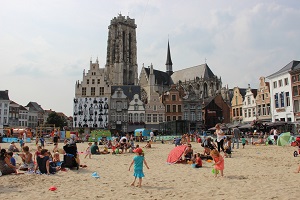
Mechelen, strand in de stad. Herman de Coninck werd geboren in Mechelen.

Lees verder “Dolce far niente, Herman de Coninck, C. O. Jellema, Wim Huijser, Cesare Pavese, Leo Tolstoj, Gentil Th. Antheunis, Gaston Durnez”

Dolce far niente, C. S. Adama van Scheltema, Siegfried Sassoon, Anthonie Donker, Clemens Brentano, Wilhelm Raabe, Eduard Mörike, Franz Hellens


Dolce far niente


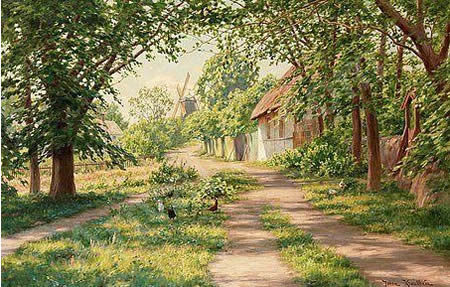
Zomers landschap met molen door Johan Krouthén, 1916


Zomer

De grote zomerdag staat open
En bouwt zijn weelde over de aarde,
Het malse moes lacht in de gaarde
Bij ‘t sappig groen, met dauw bedropen;
Het ruiselt in de weke hagen,
Het gonzelt in de bloesemstruiken,
het tintelt in de groene pruiken
Der berken bij de zoete vlagen;
De kool brandt op de peerse kluiten,
De blonde brem bloeit welig tegen
De mulle hel-beschenen wegen
Met volle gele honigtuiten, –
Hef over de aarde uw aangezicht,
Over uw ogen valt het licht,
Over uw lippen stort een lied –
Levend mooi mens geniet!


C. S. Adama van Scheltema (26 februari 1877 – 6 mei 1924)
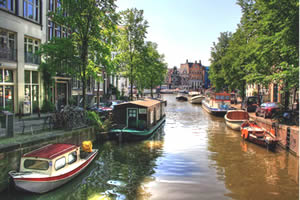
Amsterdam. C. S. Adama van Scheltema werd geboren in Amsterdam

Lees verder “Dolce far niente, C. S. Adama van Scheltema, Siegfried Sassoon, Anthonie Donker, Clemens Brentano, Wilhelm Raabe, Eduard Mörike, Franz Hellens”

Dolce far niente, Jo Govaerts, Anton Haakman, Edith Sitwell, Willem Bilderdijk, Michael Guttenbrunner, Jenny Aloni, Margaret Landon, Henry Morton Robinson


Dolce far niente


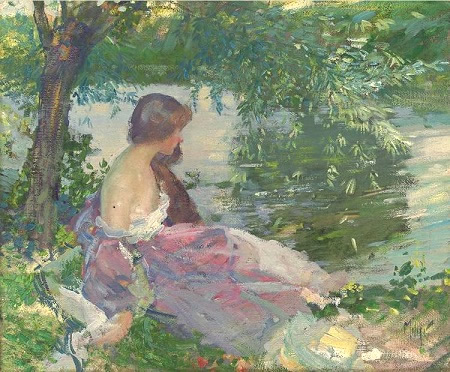
Resting by the Riverbank door Richard Emil Miller,1910-11


Waar ik naar verlang vandaag

Waar ik naar verlang vandaag
een frisse zomerjurk te dragen
met blote schouders, een uitgesneden
hals en rug en vooral goed
los om de heupen

waarmee ik dan de tuin in loop
de zon schijnt warm, maar de wind
houdt het draaglijk en brengt
de jurk in beweging en dan

ben jij er natuurlijk ook die
de jurk al even mooi vindt en samen
trekken we hem uit en hangen hem
aan een tak

en liggen te kijken in het gras naar
zo’n frisse zomerjurk in een boom, daar
verlang ik het meest naar vandaag.


Jo Govaerts (Leuven, 23 juni 1972)
Leuven

Bewaren

Lees verder “Dolce far niente, Jo Govaerts, Anton Haakman, Edith Sitwell, Willem Bilderdijk, Michael Guttenbrunner, Jenny Aloni, Margaret Landon, Henry Morton Robinson”

Merijn de Boer

De Nederlandse schrijver Merijn de Boer werd geboren in Heemstede op 7 september 1982. Hij studeerde literatuur in Amsterdam en Brussel. In 2011 verscheen bij uitgeverij Meulenhoff zijn verhalenbundel “Nestvlieders”, bestaande uit vier niet eerder gepubliceerde verhalen: ‘Overal leegte’, ‘Balthasar Tak’, ‘Luchtkasteel’ en ‘Kraaien in de schoorsteen’. Een jaar later kreeg De Boer voor deze verhalenbundel de Lucy B. en C.W. van der Hoogtprijs 2012 toegekend. In 2014 verscheen zijn eerste roman “De nacht”, die doordrong tot de longlist van de BNG Bank Literatuurprijs 2014. In 2016 volgde “’t Jagthuys”. De Boer is redacteur van uitgeverij G.A. van Oorschot en van het literaire tijdschrift Tirade.

Uit: De nacht

“Ik wachtte op haar voor de deur van het advocatenkantoor. Naast me stonden de twee rolkoffers. Omdat het lunchtijd was, kwamen er voortdurend werknemers langslopen. Ik telde het aantal donkerblauwe dassen en was bij drieëntwintig toen ze naar buiten kwam.
‘Sorry dat ik zo laat ben,’ zei Lidia, ‘ik moest nog een paar dingen afmaken. Sta je hier al lang?’
‘Vijf minuten.’ Ik had drie kwartier staan wachten.
‘O, gelukkig. Laten we snel gaan.’ Ze pakte haar koffer en liep voor me uit in de richting van de taxistandplaats.
Op Schiphol moesten we rennen om onze vlucht te halen. ‘Het is toch eigenlijk vreemd,’ riep ik tegen de rug van Lidia, ‘een mens gaat op vakantie om uit te rusten van de reis ernaartoe.’ Terwijl we het vliegtuig binnenstapten, werden we vermanend toegesproken door een stewardess.
De dag was voor mij ongebruikelijk vroeg begonnen. Even nadat Lidia naar haar werk was vertrokken, ging de bel. Gezwind schoot ik mijn kimono en pantoffels aan, om vervolgens met rechtopstaande haren en de slaap nog in mijn ogen de dakdekker te ontvangen. ‘Persoon,’ zei hij en hij stak Zij n hand uit. Ik vond het een verwarrende achternaam.
Terwijl ik met trillende handen koffiezette, klonk boven mijn hoofd het gestommel van voeten over dakpannen. Een kwartier later zaten we samen, Persoon in een overall en ik nog steeds in mijn kimono, koffie te drinken en over vrouwen en katten te praten. Ik voelde me midden in de maatschappij.
Na zijn vertrek las ik aan tafel de krant. Een Nederlandse vrouw, geboren in Zwijndrecht, was samen met haar man naar Slowakije vertrokken om een biologische augurkenkwekerij te beginnen. Aan de interviewer vertelde ze openhartig over het fiasco waarop hun onderneming was uitgelopen. Een eigen augurkenlijn was waar ze hun hele leven van hadden gedroomd. Nu woonden ze weer in Zwijndrecht, in een twee keer zo klein appartement en met een torenhoge schuld.”


Merijn de Boer (Heemstede, 7 september 1982)

Christopher Brookmyre, Jennifer Egan, Aart G. Broek, Alice Sebold, Anne Fried, Julien Green, Willem Brandt

De Schotse schrijver Christopher Brookmyre werd geboren op 6 september 1968 in Glasgow. Zie ook alle tags voor Christopher Brookmyre op dit blog.

Uit: Country of the Blind

“A speculative early spin on the story was that their loathing of the wealthy must have become intensified during their embittered prison terms, and that – whether entirely for their own motives or willingly assisting someone else’s – they had meted out terrible revenge upon their perceived oppressors murdering Voss, an international icon of arrogant, even decadent – and some would say thuggish – tycoonery. This seemed to be borne out the police’s revelation that while the bodyguards had been shot (once each, middle of the forehead – very quick, very clean, very efficient), Voss and his wife had been tied up and their throats cut. It hadn’t taken a pathologist to work out that Helene had been murdered in front of Voss before they dispatched him too.
It had been a particularly cruel and vicious crime, undoubtedly evidencing a heartless brutality borne of violent, furious hatred. And there had been something sickeningly demonstrative about it, thrusting its depravity before the public and forcing them to look at it. It seemed to crave their disgust, to solicit their repulsion, while at the same time its very publicness sought to rob Voss of his aura the posthumous humiliation of such a sordid and conspicuous death. Death often built legends, lent greater stature to mere men and granted them the immortality of public mythology. But murder could be insult through injury, a faultless disgrace in an irredeemable theft of dignity, which burnt the oil portrait of a proud man and replaced it in the public eye with a grainy police b/w of a withered corpse, helpless and bested no worthy foe, but some – and extension any – rogue whelp.
Nicole couldn’t help but feel a sense of déjà vu as she remembered Robert Maxwell’s watery demise, the unreality, the impropriety of death paying a visit to one of the untouchable Three Rs: Rupert, Robert and Roland. Maxwell had seemed a figure so proverbially larger-than-life, a looming presence in and behind the media, and a figure she had, young in years, grown used to assuming would always be there. Someone the everyday realities of life wouldn’t touch, whose very irritatingness seemed to guarantee he would be around forever so you’d better get used to it, like the common cold or washing powder ads.
She remembered how the radio bulletin had sounded like a joke. Rich tycoons don’t fall off boats; if they do, they turn up later, safe and sound, then write a book about it and bore us all on chat shows, telling the world how the publicity – sorry – their lives flashed before them. Even while he was missing, those uncertain hours of anxious speculation and dismal journalism, she had assumed Maxwell would be found boomingly alive, having spent the whole time enjoying the amorous advances of a short-sighted minke whale. But no, the only whale they found was the dead one floating off the Tenerife coastline, and the colossus had indeed been felled.”


Christopher Brookmyre (Glasgow, 6 september 1968)

Lees verder “Christopher Brookmyre, Jennifer Egan, Aart G. Broek, Alice Sebold, Anne Fried, Julien Green, Willem Brandt”

Marcel Möring, Herman Koch, Jos Vandeloo, Margaretha Ferguson, Heimito von Doderer, Rachid Boudjedra, Peter Winnen

De Nederlandse dichter en schrijver Marcel Möring werd geboren in Enschede op 5 september 1957. Zie ook alle tags voor Marcel Möring op dit blog.

Uit:In Babylon (Vertaald door Stacey Knecht)

“The last time I ever saw Uncle Herman, he was lying on a king-size bed in the finest room at the Hotel Memphis, in the company of six people: the hotel manager, a doctor, two police officers with crackling walkie-talkies, a girl who couldn’t have been more than eighteen, and me. The manager conferred with the policemen about how the matter might be settled as discreetly as possible, the doctor stood at the foot of the bed regarding my uncle with a look of mild disgust, and I did nothing. It was just past midnight and Herman lay stretched out, his white body sinewy and taut, on that crumpled white catafalque. He was naked and dead.
He had sent up for a woman. She had arrived, and less than an hour later his life was over. When I got there the young hooker, a small blond thing with crimped hair and childishly painted lips, sat hunched in one of the two white leather chairs next to the ubiquitous hotel writing table. She stared at the carpet, mumbling softly. Uncle Herman lay on his back on the big bed, his pubic hair still glistening with … all right, with the juices of love, a condom rolled halfway down his wrinkled sex like a misplaced clown’s nose. His pale, old man’s body, the tanned face with the shock of grey hair and the large, slightly hooked nose evoked the image of a warrior fallen in battle and laid in state, here, on this dishevelled altar.
I stood in that room and thought of what Zeno, with a touch of bitterness in his voice, had once said, long ago, that you could plot family histories on a graph, as a line that rippled up and down, up and down, up and down; people madetheir fortune, their offspring benefited from that fortune, the third generation squandered it all, and the family returned to the bottom of the curve and began working its way back up. An endless cycle of profit and loss, wealth and poverty, rise and fall. Except for the history of our family, Zeno had said, that was a whole other thing. Our family history could best be compared to a railway timetable: one person left, and while he was on his way, another returned, and while he was busy arriving, others were setting out on a new journey. ‘Normal families stay in the same place for centuries,’ said Zeno. ‘If they do ever leave it’s a major historical event. In our family it would be a historical event if, even after just half a generation, we associated suitcases with a holiday instead of a new life.’


Marcel Möring (Enschede, 5 september 1957)

Lees verder “Marcel Möring, Herman Koch, Jos Vandeloo, Margaretha Ferguson, Heimito von Doderer, Rachid Boudjedra, Peter Winnen”

Ward S. Just


De Amerikaanse schrijver Ward S. Just werd geboren op 5 september 1935 in Michigan City, Indiana. Just bezocht de Lake Forest Academy en vervolgens studeerde hij af aan de Cranbrook School in 1953. Ook bezocht hij kort Trinity College in Hartford, Connecticut. Hij begon zijn carrière als journalist voor de Waukegan (Illinois) News-Sun. Hij was ook correspondent voor Newsweek en The Washington Post in de periode 1959-1969, waarna hij de journalistiek verwaal zei om fictie te schrijven. Beïnvloed werd hij onder andere door Henry James en Ernest Hemingway. Zijn roman “An Unfinished Season” was finalist voor de Pulitzer Prize voor fictie in 2005. Zijn roman “Echo House” was finalist voor de National Book Award in 1997. Hij is twee keer finalist voor de O. Henry Award geweest: in 1985 voor zijn korte verhaal “About Boston”, en opnieuw in 1986 voor zijn korte verhaal “The Costa Brava” in 1959. In zijn fictie houdt hij zich vaak bezig met de invloed van de nationale politiek op de persoonlijke levens van Amerikanen. Ward S. Just schreef 17 romans en talrijke korte verhalen.

Uit: Rodin’s Debutante

„This is a true story, or true as far as it goes. OgdenHall School for Boys never would have existed were itnot for the journey that two Chicago girls made to Pariswith their mother. The eldest girl had her head sculpted in mar-ble by the great Rodin in his atelier at the Dépôt desMarbres,a bust from his own hand and chisel. The Chicago girl waseighteen and lovely, the bust a present on her birthday. Rodinwas demanding, meticulous in his craft. His eyes glittered as heworked, his unruly head moving to some mysterious rhythm.The girl was a little bit afraid of Rodin, his glare almost preda-tory, his eyes black as lumps of coal. And when she mentionedthis to her mother, the woman only smiled and said that suchmen were forces of nature but that did not mean they could notbe tamed. Only one question: Was the taming worth the trouble?This Rodin, probably yes; but it would take time to fi nd out. Thefi nding-out would be the amusing part and naturally there wasambiguity as in any sentimental endeavor. Taming had its unfor-tunate side.In any case, the girl’s mother said, you are much too young forsuch an adventure. Wait two years.The sitting took only a few days – Rodin wanted an addi-tional day but that was out of the question owing to the travelschedule – and then the girls went on to Salzburg. Their mother was devoted to German opera. Then east to Vienna, south toFlorence, and west to Nice, and when, one month later, they re-turned to Paris the bust was done and in due course sent by shipand installed in the hallway alcove of the Astor Street house, abeautiful work of art, most soulful, luminous in the yellow lightfrom the new electric lamps, and a trenchant counterpoint to thesoft Cézanne landscape on the wall opposite. All the newspaperstook notice. The Art Institute took particular notice, though thecurator privately thought that the bust showed signs of haste.Rodin’s debutante was the talk of Chicago. The cost was tri-fl ing, a bagatelle. Mother paid francs, cash, on the spot. Twohusky workmen were required to transport the wooden case tothe brougham waiting at curbside.
That was marie’s point, made again and again to herhusband Tommy, who was unimpressed, sawing away at his beef-steak, his head low to the plate. Who knew if he was even listen-ing. Tommy Ogden, irascible at all times, disliked discussion of money at meals. The price, Marie went on, was barely more thana wretched automobile, one of Ford’s small ones, a mere pieceof machinery as opposed to a work of art that would endureforever and ever. The argument began at cocktails, continuedthrough dinner, and did not end – well, in a sense it never ended. There were witnesses to it, the van Hornes and their daughter Trish and the Billingtons and Tommy’s lawyer Bert Marks andthe Italian servants, Francesca and Alana.°


Ward S. Just (Michigan City, 5 september 1935)

August Wilhelm Schlegel


De Duitse literatuurcriticus, dichter, schrijver en verrtaler August Wilhelm Schlegel werd geboren in Hannover op 5 september 1767. August Wilhelm Schlegel was de oudere broer van Friedrich Schlegel. De gebroeders Schlegel stonden aan de wieg van een romantische beweging, die niet enkel op literair, maar ook op historisch-taalkundig gebied vruchtbaar is geweest. De gebroeders Schlegel ontwikkelden een nieuwe vorm van recenseren, in hun zoektocht naar karakteristieken. De hele vroeg-romantische beweging was een reactie op de nuchtere, sobere Verlichting, die als gevoelloos ervaren werd. De vader van August en Friedrich was Johann Adolf Schlegel, Luthers predikant en zelf een dichter. August stamt uit een gezin met dertien kinderen. Hij bezocht het gymnasium in zijn geboortestad en studeerde in Göttingen waar hij theologie voor filologie inwisselde. Gottfried August Bürger beïnvloedde zijn leerling. In 1788 behaalde hij zijn eerste academische prijs met een verhandeling over geografie bij Homerus. In 1790 kwam zijn broer Friedrich naar de Universiteit van Göttingen. In 1791 sloot August zijn studie af en leverde een gedeeltelijke vertaling uit “De goddelijke komedie” van Dante en Shakespeare’s “Midsummer Night’s Dream”. Van 1791-1795 was Schlegel huisleraar bij de Amsterdamse koopman/bankier Hendrik Muilman. Na Amsterdam vestigde hij zich in Jena omdat hij door Schiller werd uitgenodigd als medewerker aan het tijdschrift Horen. Jena bleek een unieke stad, daar woonden toentertijd ook Novalis, Johann Gottlieb Fichte en Hegel. De tegenstellingen tussen Schiller en zijn broer Friedrich, die elkaars werk bekritiseerden, leiden uiteindelijk tot ontslag van August. De broers kwamen in oktober 1797 tot de conclusie zelf een tijdschrift op te richten. De bedoeling was door te dringen tot de kern van iedere wetenschap, ieder systeem en iedere auteur. In december verliet Friedrich de stad en trok naar Berlijn. In het tijdschrift “Athenäum”, dat vanaf mei 1798 twee keer per jaar uitkwam, werden de Franse Revolutie, het werk van Goethe en Fichtes wetenschapsleer besproken. Friedrich was de theoreticus en filosoof van het tijdschrift, August de filoloog en criticus, Schleiermacher de moralist en theoloog van de “romatische academie”. Tieck was de populaire verteller en Novalis de esoterische mysticus. Ook Caspar David Friedrich werkte mee. In 1798 werd August benoemd als buitengewoon hoogleraar en gaf college esthetiek. Rond het jaar 1800 waren Schlegel en zijn broer bijzonder gezaghebbende figuren. In zijn huwelijk kreeg hij problemen en August vertrok naar Berlijn. Ook Friedrich kreeg ruzie met zijn schoonzuster en met zijn broer. De voordrachten van August trokken in Berlijn de aandacht van vele literatoren. Het was duidelijk dat de Romantiek een stroming was die oorspronkelijk wilde zijn: in deze periode kwam het onderzoek naar de historische taalkunde op gang. August Schlegel was een der eersten die hierbij uitgebreid aandacht aan het oude Indië besteedden; hij wordt soms wel de grondlegger van de oriëntalistiek genoemd. In Berlijn ontmoette Schlegel Madame de Staël, die hem tot haar raadsman en vertrouweling maakt en hem meenam op haar reizen naar Italië, Frankrijk, Oostenrijk en Zweden. Veel van de ideeën die deze schrijfster in haar gezaghebbende boek “De l’Allemagne” heeft neergelegd, zijn haar door August Wilhelm ingegeven. Hij bleef in deze functie tot 1817. Na een tijd in Zwitserland, Noorwegen, Italië en Frankrijk verbleven te hebben keerde hij in 1815 naar Bonn terug. Hij werd er professor in de kunst- en literatuurgeschiedenis. Zijn werk concentreerde zich nu op vertalingen, waarin hij uitblonk: werk van Calderón de la Barca en Dante vertaalde hij virtuoos. Zijn naam is ook verbonden aan de complete vertaling van de werken van Shakespeare, die hij samen met Ludwig Tieck opzette (al dient opgemerkt dat de meerderheid ervan door Tiecks dochter Dorothea werd voltooid), de zogenaamde Schlegel-Tieck-vertaling. Zeer geslaagd zijn verder zijn vertaalde sonnetten van Petrarca.

Uit: Vorlesungen über schöne Literatur und Kunst

„„Das Schöne ist eine symbolische Darstellung des Unendlichen […]. Man halte das Unendliche nicht etwan für eine philosophische Fiktion, man suche es nicht jenseits der Welt; es umgibt uns überall, wir können ihm niemals entgehen; wir leben, weben und sind im Unendlichen. Freilich haben wir seine Gewähr nur in unsrer Vernunft und Phantasie; mit den äußern Sinnen und dem Verstände können wir es nie ergreifen, denn diese bestehen eben nur durch ein beständiges Setzen von Endlichkeiten und Verneinen des Unendlichen. Das Endliche macht die Oberfläche unsrer Natur aus, sonst könnten wir keine bestimmte Existenz haben; das Unendliche die Grundlage, sonst hätten wir überall keine Realität.
Wie kann nun das Unendliche auf die Oberfläche, zur Erscheinung gebracht werden? Nur symbolisch, in Bildern und Zeichen. Die unpoetische Ansicht der Dinge ist die, welche mit den Wahrnehmungen der Sinne und den Bestimmungen des Verstandes alles an ihnen für abgetan hält; die poetische, welche sie immerfort deutet und eine figürliche Unerschöpflichkeit in ihnen sieht. […] Dadurch wird erst alles für uns lebendig. Dichten ist nichts andres als ein ewiges Symbolisieren: Wir suchen entweder für etwas Geistiges eine äußere Hülle, oder wir beziehen ein Ôußres auf ein unsichtbares Innres.
[…]

Wie wir eben sahen, geht die Sprache vom bloßen Ausdruck durch willkürlichen Gebrauch zur Darstellung fort; wenn aber die Willkür ihr herrschender Charakter wird, so verschwindet die Darstellung, d. h. der Zusammenhang des Zeichens mit dem Bezeichneten; und die Sprache wird alsdann nichts als eine Sammlung logischer Ziffern, tauglich die Rechnungen des Verstandes damit abzumachen. Um sie wieder poetisch zu machen, muß also ihre Bildlichkeit hergestellt werden, weswegen allgemein das Uneigentliche, Ãobertragene, Tropische als dem poetischen Ausdrucke wesentlich betrachtet wird. Gewöhnlich macht man aber in den Vorschriften der Dichtkunst den bloßen Verstand zum Richter über die Schicklichkeit dieser, wie man meint, erlaubten Zieraten: es sollen Bilder und Vergleichungen gebraucht werden, aber sie dürfen nicht zu kühn sein, sondern sich nur eben über die nüchterne Prosa erheben. Manerkennt nicht an, daß die Poesie hierin überschwenglich und absolut ist, daß sie, nachdem ihr jedesmaliger Charakter es mit sich bringt, auch das Entfernteste verknüpfen und ineinander übergehen lassen kann. Die gegenseitige Verkettung aller Dinge durch ein ununterbrochenes Symbolisieren, worauf die erste Bildung der Sprache sich gründet, soll ja in der Wiederschöpfung der Sprache, der Poesie, hergestellt werden; und sie ist nicht ein bloßer Notbehelf unsers noch kindischen Geistes, sie wäre seine höchste Anschauung, wenn er je vollständig zu ihr gelangen könnte.“


August Wilhelm Schlegel (5 september 1767 – 12 mei 1845)
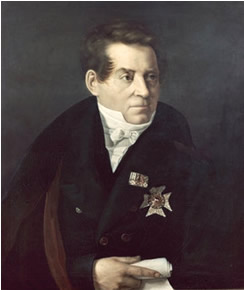
Portret door Adolf Hohneck, rond 1830

Helga Ruebsamen, Antonin Artaud, René de Chateaubriand, Constantijn Huygens, Richard Wright, Mary Renault

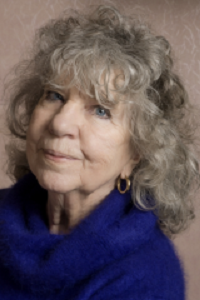
De Nederlandse schrijfster Helga Ruebsamen werd op 4 september 1934 geboren in Batavia, in Nederlands lndië. Zie ook alle tags voor Helga Ruebsamen op dit blog en ook mijn blog van 4 september 2010.

Uit: The Song and the Truth (Vertaald door Paul Vincent)

“Every day, as soon as the sun went down, tiny lizards climbed up the walls of our veranda.
“Look, the tjitjaks are here.”
The night people lit the lamps, in the rooms and on the veranda. The ladies who’d come to tea took their leave and went home. The day was over, and night was beginning.
My mother accompanied her guests as far as the waringin tree and waved to the visitors and their children as they left. I stood on the veranda listening to the sounds coming from the Lembang road. I could hear the cars driving uphill, up the mountain, where the sun was already asleep in the volcano. Or hear them driving downhill, to Bandung, the town where the zoo was and my father’s clinic. There were often parties in town, and the cars drove faster then.
My mother came back; I could hear her singing before I saw her. She didn’t hurry, she sauntered along, stopping now and then, so that the bright spot she formed in the darkness grew larger only very slowly. When it reached the point where I could make out more than the color of her dress, I could also see her platinum blond curls and even her bright eyes. By then she was so close that she could touch me.
“Well, we’ve got the veranda to ourselves again,” said Mummy. She stretched out on the settee and beckoned to me. “All those visitors,” she sighed, “and never anyone you can talk to.”
The tjitjaks had found their places. On the ceiling they had frozen into wooden ornaments, but they pounced like greased lightning on any insects that strayed close to them.
The lamps burned in the rooms and on the veranda, so that night could not descend on us.
The night abolished the distinction between inside and outside. At night it was cool and dark everywhere. Everything was safe–people, animals, and plants–beneath a dark dome as large as the world.
When the sky, the earth, and the water had attained the same dark hue, the toké arrived. I waited for the toké every night. He was the big brother of the tjitjaks. I did not need to go to bed before the first toké had called.
By that time all the other nocturnal creatures were there: flying foxes, crickets, bullfrogs. Their noisy concert was in full swing.”


Helga Ruebsamen (Batavia, 4 september 1934)

Lees verder “Helga Ruebsamen, Antonin Artaud, René de Chateaubriand, Constantijn Huygens, Richard Wright, Mary Renault”