Micha Hamel

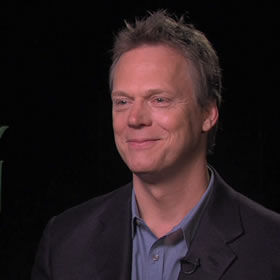
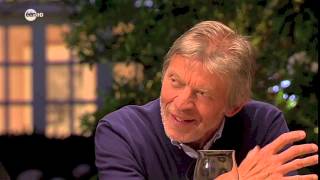
De Nederlandse dichter, componist en dirigent Micha Hamel werd geboren in Amsterdam op 8 juli 1970. Hamel studeerde aan het Koninklijk Conservatorium in Den Haag (1988-1994); daarnaast heeft hij ook een jaar filosofie gestudeerd in Amsterdam. Hij volgde een compositiecursus in het Tanglewood Music Center, in de Verenigde Staten. Zijn composities schreef hij vooral in opdracht van de Slagwerkgroep Den Haag, het Ives Ensemble, het Schönberg Ensemble en het Nieuw Ensemble. Tevens heeft hij een aantal stukken geschreven in opdracht van een aantal Engelse dansgroepen. Als dirigent heeft Hamel carrière gemaakt bij het Nederlands Balletorkest, het Radio Symfonie Orkest en bij de Slagwerkgroep Den Haag. In 1997 kreeg hij de Bernard Haitink Beurs voor een assistent-dirigentschap van het Radio Filharmonisch Orkest. Hamel was chef-dirigent van het Noordhollands Philharmonisch Orkest van september 2000 tot aan de opheffing in 2002. In 2004 debuteerde hij bij het orkest van de RAI in Turijn. Naast zijn werk in de muziek heeft Hamel in 2004 zijn eerste dichtbundel uitgebracht, “Alle enen opgeteld”. Hiervoor ontving hij in 2005 de Lucy B. en C.W. van der Hoogtprijs. In 2006 heeft hij zijn tweede bundel uitgegeven, “Luchtwortels” en in 2010 de derde, “Nu je het vraagt”.


Vader en zoon

Ik vertel hem niet dat het leven leuk is,
opdat hij later niet in verslaving vlucht.

Mijn kind, het meeste zeg ik niet. Hoe mytisch
het vaderlijk zwijgen ook worden mag, ik verkies
de aalmoes van het bestaan woordeloos te delen.

Op een speeltoestel een vrouw
in meisjeskleren met haar kind
als kortgerokte verleidster verkleed.

Ook als kleuter had ik het niet zo op kleuters.
Schreeuwerig volk, ongecoördineerd, onmachtig
zich behoorlijk te uiten of mij te verstaan.

Hierom vermijd ik nu volwassenen liefst.
Wij keren ons af van de wipkippen
en trappen een blikje voor ons uit.

Heerlijk grijpt de leegte om zich heen,
het regent knikkerputjes in het zand.
Belangrijker is de hand, een hand die leidt, die je
op het hoofd kunt voelen als een zegen levenslang.

Mijn vader, die het niet tot Sinterklaas, God of opa schopte,
had handen van gele eelt, van zalmkleur zijn mijn zoons.
Ze omklemmen de beddenspijlen, ik
voel de kriebelbaard op mijn wang.

In de zandbak graaf ik naarstig
mijn weg naar hem terug, en vind plots
de laatste spuit die hem werd toegediend.

Geen steek brengt mij terug naar
de dag dat mijn ik herboren werd,
en gretig beleven we samen de schrik die
griezeldoods vriendschap versmaadt.
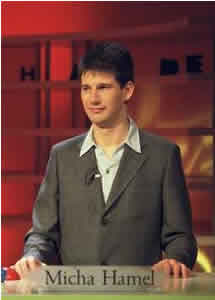
 

Micha Hamel (Amsterdam, 8 juli 1970)


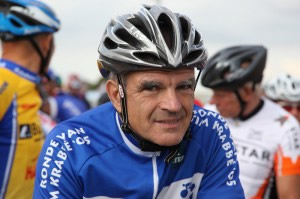
Tim Krabbé, Lion Feuchtwanger, Ivo Victoria, Vladimir Majakovski, Clemens Haipl


Bij de Tour de France


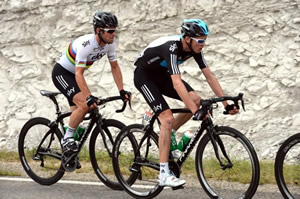
Mark Casvandish en Chris Froome in de Tour van 2012


Uit: Das Rennen (Vertaald door Susanne George)

„Nach rechts. Anstieg über 5 Kilometer zum Causse Méjean. Ich habe mich ein Stück nach hinten fallen lassen; ich bin in der Mitte des Feldes.
Durcheinander. Ein Fahrer schaltet, trifft daneben, fliegt fast über seinen Lenker, flucht. Zwanzig Fahrer vor mir, eine ganze Straße voll. Ich erkenne Lebusque, ein Segelflugzeug zwischen den Staren.
Bei Anstiegen reißen sofort die schlimmsten Löcher auf, ich muss hindurch. Schwankend halte ich nach Durchlässen Ausschau. Panik, dass sie mich allein lassen, noch spüre ich meine Pedale nicht. Ich tippe ein Hinterrad an, ich schlingere, ein anderer stößt sich von mir ab, ich lande im Straßengraben, kein platter Reifen. Flitz flitz. Zwei Fahrer weg. Mit einigen wenigen Tritten fahren sie aus meinem Rennen davon. Reilhan und Guillaumet. Die echten Klassefahrer – zwischen den Rennen mache ich mir nur selbst etwas vor. Sie sind sofort gut weggekommen. Am Berg zu attackieren ist äußerst effektiv, aber auch das Schwerste, was es gibt. Bahamontes, Fuente konnten das zwanzigmal hintereinander, wie rammelnde Kaninchen. Alle Kletterer guten Durchschnitts warnen einander vor dieser Sorte von Männern. Nicht dranhängen. Doch dranhängen? Dann ziehen sie noch mal an, sie lassen dich am Gummiband krepieren. Doch währenddessen werde ich namenlos Zehnter. Ich muss mich damit abfinden. Ich kann nur tun, was ich tue, und so weitermachen.
Ich bin nun vorne in unserem halb ausgerissenen Feld gelandet. Dritte Position. Dort bleibe ich; die beiden vor mir fahren schnell genug. Nach einer Weile wird mir klar, wer sie sind: Lebusque und Kléber, nebeneinander. Lebusque auf den Pedalen stehend mit einer riesigen Übersetzung, aber trotzdem gleichmäßig. Kléber sitzend. Halb neben mir stampfend, ächzend, aber überraschend, Barthélemy.
Allmählich finde ich einen Rhythmus. Klettern ist ein Rhythmus, ein Rausch, man muss die Proteste seiner Organe beschwichtigen.“


Tim Krabbé (Amsterdam, 13 april 1943)


Lees verder “Tim Krabbé, Lion Feuchtwanger, Ivo Victoria, Vladimir Majakovski, Clemens Haipl”

Jeff VanderMeer, Reinhard Baumgart, Kuno Bärenbold, János Székely

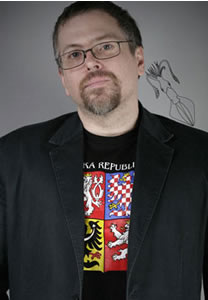
De Amerikaanse schrijver Jeffrey Scott VanderMeer werd geboren op 7 juli 1968 in Belfont, Pennsylvania. Zie ook alle tags voor Jeff VanderMeer op dit blog.

Uit: Finch

“The Partial turned and saw Finch’s gaze. “Nothing in that room, Finch. It’s all in here.” He gestured through the doorway. Light shone out, caught the dark glitter of the Partial’s skin where tiny fruiting bodies had taken hold. Uncanny left eye. Of course.
“And you are?” Finch asked.
The Partial frowned. “I’m—”
Finch brushed by him without listening, got pleasure out of the push of his shoulder into the Partial’s side. The Partial smelled like sweetly rotting meat, walked in behind him, stood there.
Everything was golden, calm, unknowable for a second. Then Finch’s eyes adjusted to the light from the large window and he saw: living room, kitchen. A sofa. Two wooden chairs. A small table, an empty vase with a rose design. And two bodies lying on the pull rug next to the sofa. One human, male, one gray cap without legs.
His boss Heretic stood there, framed by the window. Wearing his familiar gray robes and gray hat. Finch had never learned the gray cap’s real name. The series of clicks and whistles sounded like “heclereticalic” so Finch called him “Heretic.”
“Hello, Finch,” Heretic said, in the moist glottal attempt at human speech used by all of its kind. “Just in time.”


Jeff VanderMeer (Belfont, 7 juli 1968)


Lees verder “Jeff VanderMeer, Reinhard Baumgart, Kuno Bärenbold, János Székely”

Miroslav Krleza, Ludwig Ganghofer, Joseph Winckler, Hasan Abidi

De Kroatische schrijver Miroslav Krleza werd geboren op 7 juli 1893 in Zagreb. Zie ook alle tags voor Miroslav Krleza op dit blog.

Uit: The Banquet in Blitva (Vertaald door Edward Dennis Goy and Jasna Levinger)

“But who are we who live while our Blitva has not perished? I, Nielsen, and that Blitvinian they’ve arrested and whom they’re leading in chains across the empty square, under the monument of the Blitvinian genius. In a rubber raincoat that poor bugger passed by, pale and upright, defiant, surrounded by a patrol of cuirassiers, and from under his left shoulder blade, as though drawn in bright red lipstick (almost cadmium), over the muddy and drenched rubber flowed perpendicularly an intensely red stream of fresh human blood. It was morning. A gray, dark, guttering, slimy, antipathetic, muddy Blitvinian morning, and in the distance, from around the corner, where stood the frowning scaffolding of a new five-story building, from the new Blitvinian corso came the sound of “Tango-Milango” from the Hotel Blitvania. That the Hotel Blitvania, as Barutanski’s headquarters, had served as a central torture chamber during the years ’17, ’18, and ’19 and that in the cellars of that accursed hotel several hundred people had been slaughtered was known to all in the city and over the whole of Blitva, and for years people made a detour around it in silence and with bowed heads, but today, on that very same place of execution, they were dancing the Tango-Milango.

In the newspapers of that mythical period, when Barutanski ruled from that accursed hotel as the first Protector, one might read in some texts consisting of cleverly infiltrated lines, between two or three words, timidly and cautiously, hints that once again someone had been massacred in the Hotel Blitvania, that someone had given evidence in court from a stretcher, that someone had been blinded, that someone had had needles stuck under his nails, and another with broken joints, but today it was all forgotten, today the Hotel Blitvania had been renovated as a first-class hotel.”


Miroslav Krleza (7 juli 1893 – 29 december 1981)


Lees verder “Miroslav Krleza, Ludwig Ganghofer, Joseph Winckler, Hasan Abidi”

Hilary Mantel, Bodo Kirchhoff, William Wall, Bernhard Schlink, Marius Hulpe

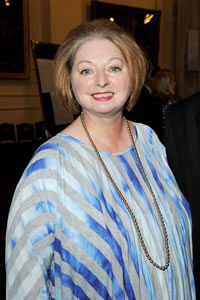
De Engelse schrijfster, critica en advocate Hilary Mary Mantel werd op 6 juli 1952 als Hilary Mary Thompson in Glossop, Derbyshire, geboren. Zie ook alle tags voor Hilary Mantel op dit blog.

Uit:Bring Up the Bodies

“His children are falling from the sky. He watches from horse-back, acres of England stretching behind him; they drop, gilt-winged, each with a blood-filled gaze. Grace Cromwell hovers in thin air. She is silent when she takes her prey, silent as she glides to his fist. But the sounds she makes then, the rustle of feathers and the creak, the sigh and riffle of pinion, the small cluck-cluck from her throat, these are sounds of recognition, intimate, daughterly, almost disapproving. Her breast is gore-streaked and flesh clings to her claws.

Later, Henry will say, ‘Your girls flew well today’. The hawk Anne Cromwell bounces on the glove of Rafe Sadler, who rides by the king in easy conversation. They are tired; the sun is declining, and they ride back to Wolf Hall with the reins slack on the necks of their mounts. Tomorrow his wife and two sisters will go out. These dead women, their bones long sunk in London clay, are now transmigrated. Weightless, they glide on the upper currents of the air. They pity no one. They answer to no one.

Their lives are simple. When they look down they see nothing but their prey, and the borrowed plumes of the hunters: they see a flittering, flinching universe, a universe filled with their dinner. All summer has been like this, a riot of dismemberment, fur and feather flying; the beating off and the whipping in of hounds, coddling of tired horses, the nursing, by the gentlemen, of contusions, sprains and blisters. And for a few days at least, the sun has shone on Henry. Sometime before noon, clouds scudded in from the west and rain fell in big scented drops; but the sun re-emerged with a scorching heat, and now the sky is so clear you can see into Heaven and spy on what the saints are doing”.

Hilary Mantel (Glossop, 6 juli 1952)


Lees verder “Hilary Mantel, Bodo Kirchhoff, William Wall, Bernhard Schlink, Marius Hulpe”

Peter Hedges, Wadih Saadeh, Fabrice Colin, Tobias Sommer

De Amerikaanse schrijver, draaiboekauteur en regisseur Peter Hedges werd geboren in West Des Moines, Iowa, op 6 juli 1962. Zie ook alle tags voor Peter Hedges op dit blog.

“My oldest sister, Amy, has fixed us a picnic feast. In a thermos was a quart of black cherry Kool-Aid, all of which Arnie drank in such a hurry that above his top lip is a purplish mustache. One of the first things you should know about Arnie is that he always has traces of some food on his face — Kool-Aid or ketchup or toast crumbs. His face is a kind of bulletin board for the four major food groups.

Arnie is the gentlest guy, but he can surprise this brother. In the summertime, he catches grasshoppers and sticks them in this metal tab on the mailbox, holding them there, and then he brings down the metal flag, chopping off the grasshopper heads. He always giggles hysterically when he does this, having the time of his life. But last night, when we were sitting on the porch eating ice cream, a countless sea of grasshopper bodies from summers past must have appeared to him, because he started weeping and sobbing like the world had ended. He kept saying, “I killed ‘em, I killed ‘em.” And me and Amy, we held him close, patted his back and told him it was okay.

Arnie cried for hours, cried himself to sleep. Makes this brother wonder what kind of a world it would be if all the surviving Nazis had such remorse. I wonder if it ever occurs to them what they did, and if it ever sinks in to a point that their bodies ache from the horrible mess they made. Or are they so smart that they can lie to us and to themselves? The beautiful thing about Arnie is that he’s too stupid to lie. Or too smart.

I’m standing with binoculars, looking down Highway 13; there is no sign of our annual carnival. The kid is on his knees, his hands rummaging around in the picnic basket. Having already eaten both bags of potato chips, both peanut-butter-and-jelly sandwiches and both chocolate donuts, he locates a green apple and bites into it.

By trying to ignore Arnie’s lip-smacking noises, I am attempting the impossible. You see, he chews as if he’s just found his mouth and the sounds are that of good, sloppy sex. My brother’s slurps and gulps make me want to procreate with an assortment of Endora’s finest women.

It’s the twenty-first of June, the first day of summer, the longest day of the year. It isn’t even 7:00 a.m. yet and here I stand, little brother in tow. Somewhere some smart person still sleeps.”

Peter Hedges (West Des Moines, 6 juli 1962)


Lees verder “Peter Hedges, Wadih Saadeh, Fabrice Colin, Tobias Sommer”

Eino Leino, Serge Pey, Walter Flex, Paul Keller

De Finse dichter en schrijver Eino Leino (eig. Armas Eino Leopold Lönnbohm) werd geboren op 6 juli 1878 in Paltamo. Zie ook alle tags voor Eino Leino op dit blog.

Summer in Lapland (Fragment)

Blooming in Lapland goes by fast and quickly.
Grass, birch and barley, soon the green has gone.
That makes me ponder on the people badly,
when looking back to nation how it’s done.

Why all the beauty we have turns to rotten,
anything high we have gives way to mean.
Why do we have so many crazy madmen,
why only few who play their music clean?

Why do the men all over fall down ceasing,
give up, turn down, when the hopes are high?
The men of function, idea, men of dreaming,
all lose their sentiment and dreams will die.

Else where the old are filled with urge and fire,
the silver hairs have heart off brave and gold.
Here are the boys, the children; growing tired
the newborn baby is already old.

And how about me, why do all this thinking?
It is a sign of early aging old.
Why don’t I go for living with joy making,
but cry the past and regret what has gone.


Vertaald door Matti Naskali

Eino Leino (6 juli 1878 – 10 januari 1926)


Lees verder “Eino Leino, Serge Pey, Walter Flex, Paul Keller”

Jean Cocteau, Felix Timmermans, Michael Blake, Jacqueline Harpman, Jean Raspail, Tin Ujević

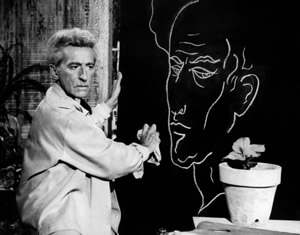
De Franse dichter, romanschrijver, toneelschrijver, ontwerper en filmmaker Jean Cocteau werd op 5 juli 1889 in Maisons Lafitte geboren. Zie ook alle tags voor Jean Cocteau op dit blog.


Le tour du monde

Le tour du monde était un bien pauvre voyage
À côté du voyage où je pars avec toi
Chaque jour je t’adore et mieux et davantage
Où tu vis c’est mon toit.


Cent ans

Cent ans j’avais dormi. Vint le prince charmant
Il était gai, naïf, infaillible, énergique,
Mais il m’a réveillé de ce sommeil magique
Je ne peux pas dire comment.


Les cheveux gris …

Les cheveux gris, quand jeunesse les porte,
Font doux les yeux et le teint éclatant ;
Je trouve un plaisir de la même sorte
A vous voir, beaux oliviers du printemps.

La mer de sa fraiche et lente salive
Imprégna le sol du rivage grec,
Pour que votre fruit ambigu, l’olive,
Contienne Vénus et Cybèle avec.

Tout de votre adolescence chenue
Me plaît, moi qui suis le soleil d’hiver,
Et qui, comme vous, sur la rose nue,
Penche un jeune front de cendres couvert.


Jean Cocteau (5 juli 1889 – 11 oktober 1963)

Lees verder “Jean Cocteau, Felix Timmermans, Michael Blake, Jacqueline Harpman, Jean Raspail, Tin Ujević”

Willie Verhegghe, Neil Simon, Walter Wippersberg, Rob van Erkelens, Sébastien Japrisot, Robert Desnos


Bij de Tour de France


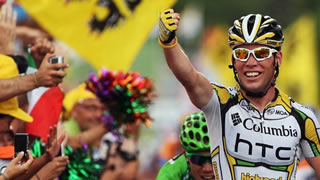
Mark Cavendish


Gevonden: Snelle benen

Voor één keer knalden de champagnekurken al
bij de start in Epernay -noblesse oblige-,
een sprankelend startschot waarop de spuit-Pierrot
van Spa alleen maar jaloers kan zijn.

Daarna de helse tocht door kokende zonnebloemvelden
met hoog Celcius-gehalte, het zweetzout zet zich gul af
en trekt grillige lijnen op de donkere shirts en broeken,
ik krijg zowaar medelijden met het brandend nageslacht
dat nog uit al die geknelde kloten groeien moet,
hier is elke vorm van deugddoende afkoeling ver weg,
het synthetisch zeemvel is ongenadig hard en
wekt met gele grijns claustrofobische jeuk op.
Ik spreek zowaar uit ondervinding !

Ten dele geteisterd door hitte in de hersenen
maar vooral begaan met de dwangarbeiders van de weg
denk ik aan Amets Txurruka die deze middag
niet meer aan de start verscheen en nu ergens
met rood geweende ogen zijn sleutelbeenwonden likt.
Amets zou in het Baskisch ‘droom’ betekenen,
in dit geval voorwaar een wel zeer boze.

En at last doet Cavendish wat van hem wordt gevraagd:
na vallen en opstaan vindt hij zijn snelle benen weer.
Snelle benen zijn altijd lekker meegenomen.
Als je ze vindt tenminste.
Ik heb de mijne al lang uit het trage oog verloren
en zoek niet langer meer: verstand komt met de jaren.


Willie Verhegghe (Denderleeuw, 22 juni 1947)


Lees verder “Willie Verhegghe, Neil Simon, Walter Wippersberg, Rob van Erkelens, Sébastien Japrisot, Robert Desnos”

Franz Kafka, Tom Stoppard, Joanne Harris, Andreas Burnier, Gerard den Brabander, David Barry, Edward Young

De Duitstalige schrijver Franz Kafka werd geboren op 3 juli 1883 in Praag, toen een stad gelegen in de dubbelmonarchie Oostenrijk-Hongarije. Zie ook alle tags voor Franz Kafka op dit blog.


Uit: Tagebücher 1910 – 1923


„Sonntag, den 19. Juli 1910, geschlafen, aufgewacht, geschlafen, aufgewacht, elendes Leben.

Variante
Oft überlege ich es und lasse den Gedanken ihren Lauf, ohne mich einzumischen, und immer, wie ich es auch wende, komme ich zum Schluß, daß mir in manchem meine Erziehung schrecklich geschadet hat. In dieser Erkenntnis steckt ein Vorwurf, der gegen eine Menge Leute geht. Da sind die Eltern mit den Verwandten, eine ganz bestimmte Köchin, die Lehrer, einige Schriftsteller – die Liebe, mit der sie mir geschadet haben, macht ihre Schuld noch größer, denn wie sehr hätten sie mir mit Liebe …, einige der Familie befreundete Familien, ein Schwimmeister, Eingeborene der Sommerfrischen, einige Damen im Stadtpark, denen man es gar nicht ansehn würde, ein Friseur, eine Bettlerin, ein Steuermann, der Hausarzt und noch viele andere, und es wären noch mehr, wenn ich sie alle mit Namen bezeichnen wollte und könnte, kurz, es sind so viele, daß man achtgeben muß, damit man nicht im Haufen einen zweimal nennt. Nun könnte man meinen, schon durch diese große Anzahl verliere ein Vorwurf an Festigkeit und müsse einfach an Festigkeit verlieren, denn ein Vorwurf sei kein Feldherr, er gehe nur geradeaus und wisse sich nicht zu verteilen. Gar in diesem Falle, wenn er sich gegen vergangene Personen richtet. Die Personen mögen mit einer vergessenen Energie in der Erinnerung festgehalten werden, einen Fußboden werden sie kaum mehr unter sich haben, und selbst ihre Beine werden schon Rauch sein. Und Leuten in solchem Zustand soll man nun mit irgendeinem Nutzen Fehler vorwerfen, die sie in früheren Zeiten einmal bei der Erziehung eines Jungen gemacht haben, der ihnen jetzt so unbegreiflich ist wie sie uns. Aber man bringt sie ja nicht einmal dazu, sich an jene Zeiten zu erinnern, kein Mensch kann sie dazu zwingen, aber offenbar kann man gar nicht von Zwingen reden, sie können sich an nichts erinnern, und dringt man auf sie ein, schieben sie einen stumm beiseite, denn höchstwahrscheinlich hören sie gar nicht die Worte.“


Franz Kafka (3 juli 1883 – 3 juni 1924)

Lees verder “Franz Kafka, Tom Stoppard, Joanne Harris, Andreas Burnier, Gerard den Brabander, David Barry, Edward Young”