Louis Simpson, Lajos Zilahy, Andon Zako Çajupi, Harry Rowohlt, Sophie Mereau, Carlo Dossi

De Jamaicaanse dichter Louis Simpson werd geboren op 27 maart 1923 in Jamaica. Zie ook mijn blog van 27 maart 2009 en ook mijn blog van 27 maart 2011.


Carentan O Carentan

Trees in the old days used to stand

And shape a shady lane

Where lovers wandered hand in hand

Who came from Carentan.

This was the shining green canal

Where we came two by two

Walking at combat-interval.

Such trees we never knew.

The day was early June, the ground

Was soft and bright with dew.

Far away the guns did sound,

But here the sky was blue.

The sky was blue, but there a smoke

Hung still above the sea

Where the ships together spoke

To towns we could not see.

Could you have seen us through a glass

You would have said a walk

Of farmers out to turn the grass,

Each with his own hay-fork.

The watchers in their leopard suits

Waited till it was time,

And aimed between the belt and boot

And let the barrel climb.

I must lie down at once, there is

A hammer at my knee.

And call it death or cowardice,

Don’t count again on me.

Everything’s all right, Mother,

Everyone gets the same

At one time or another.

It’s all in the game.

I never strolled, nor ever shall,

Down such a leafy lane.

I never drank in a canal,

Nor ever shall again.

There is a whistling in the leaves

And it is not the wind,

The twigs are falling from the knives

That cut men to the ground.

Tell me, Master-Sergeant,

The way to turn and shoot.

But the Sergeant’s silent

That taught me how to do it.

O Captain, show us quickly

Our place upon the map.

But the Captain’s sickly

And taking a long nap.

Lieutenant, what’s my duty,

My place in the platoon?

He too’s a sleeping beauty,

Charmed by that strange tune.

Carentan O Carentan

Before we met with you

We never yet had lost a man

Or known what death could do.
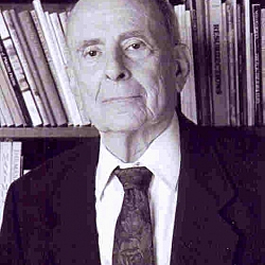
 

Louis Simpson (Jamaica, 27 maart 1923)
Lees verder “Louis Simpson, Lajos Zilahy, Andon Zako Çajupi, Harry Rowohlt, Sophie Mereau, Carlo Dossi”

Gregory Corso, Tennessee Williams, Hwang Sun-won, Martin McDonagh, Bettina Galvagni, Hai Zi

De Amerikaanse dichter Gregory Corso werd geboren in New York op 26 maart 1930. Zie ook alle tags voor Gregory Corso op dit blog.


1959

Uncomprising year—I see no meaning to life.
Though this abled self is here nonetheless,
either in trade gold or grammaticness,
I drop the wheelwright’s simple principle—
Why weave the garland? Why ring the bell?

Penurious butchery these notoriously human years,
these confident births these lucid deaths these years.
Dream’s flesh blood reals down life’s mystery—
there is no mystery.
Cold history knows no dynastic Atlantis.
The habitual myth has an eagerness to quit.

No meaning to life can be found in this holy language
nor beyond the lyrical fabricator’s inescapable theme
be found the loathed find—there is nothing to find.

Multitudinous deathplot! O this poor synod—
Hopers and seekers paroling meaning to meaning,
annexing what might be meaningful, what might be meaningless.

Repeated nightmare, lachrymae lachrymae—
a fire behind a grotto, a thick fog, shredded masts,
the nets heaved—and the indescribable monster netted.
Who was it told that red flesh hose be still?
For one with smooth hands did with pincers
snip the snout—It died like a yawn.
And when the liver sack was yanked
I could not follow it to the pan.

I could not follow it to the pan—
I woke to the reality of cars; Oh
the dreadful privilege of that vision!
Not one antique faction remained;

Egypt, Rome, Greece,
and all such pedigree dreams fled.
Cars are real! Eternity is done.
The threat of Nothingness renews.
I touch the untouched.
I rank the rose militant.
Deny, I deny the tastes and habits of the age.
I am its punk debauche …. A fierce lampoon
seeking to inherit what is necessary to forfeit.

Lies! Lies! Lies! I lie, you lie, we all lie!
There is no us, there is no world, there is no universe,
there is no life, no death, no nothing—all is meaningless,
and this too is a lie—O damned 1959!
Must I dry my inspiration in this sad concept?
Delineate my entire stratagem?
Must I settle into phantomness
and not say I understand things better than God?


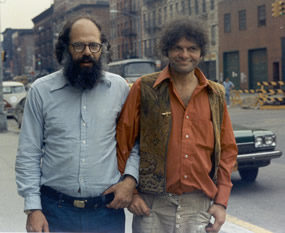
Gregory Corso (26 maart 1930 – 17 januari 2001)
Hier met Allen Ginsberg (links)

Lees verder “Gregory Corso, Tennessee Williams, Hwang Sun-won, Martin McDonagh, Bettina Galvagni, Hai Zi”

Robert Frost, Erica Jong, Patrick Süskind, A. E. Housman, Artur Landsberger

De Amerikaanse dichter Robert Lee Frost werd geboren op 26 maart 1874 in San Francisco. Zie ook alle tags voor Robert Frost op dit blog.


A Brook In The City

The farmhouse lingers, though averse to square
With the new city street it has to wear
A number in. But what about the brook
That held the house as in an elbow-crook?
I ask as one who knew the brook, its strength
And impulse, having dipped a finger length
And made it leap my knuckle, having tossed
A flower to try its currents where they crossed.
The meadow grass could be cemented down
From growing under pavements of a town;
The apple trees be sent to hearth-stone flame.
Is water wood to serve a brook the same?
How else dispose of an immortal force
No longer needed? Staunch it at its source
With cinder loads dumped down? The brook was thrown
Deep in a sewer dungeon under stone
In fetid darkness still to live and run —
And all for nothing it had ever done
Except forget to go in fear perhaps.
No one would know except for ancient maps
That such a brook ran water. But I wonder
If from its being kept forever under,
The thoughts may not have risen that so keep
This new-built city from both work and sleep.


Robert Frost (26 maart 1874 – 29 januari 1963)
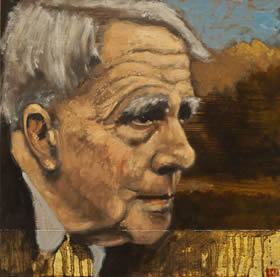
Portret door John McCormick

Lees verder “Robert Frost, Erica Jong, Patrick Süskind, A. E. Housman, Artur Landsberger”

Flannery O’Connor, Jacques Bens, Jaime Sabines, Peter Van Straaten,Toni Cade Bambara

De Amerikaanse schrijfster Flannery O’Connor werd geboren op 25 maart 1925 in Savannah, Georgia. Zie ook alle tags voor Flannery O’Connor op dit blog.

Uit: The Life You Save May Be Your Own

„The old woman and her daughter were sitting on their porch when Mr. Shiftlet came up their road for the first time. The old woman slid to the edge of her chair and leaned forward, shading her eyes from the piercing sunset with her hand. The daughter could not see far in front of her and continued to play with her fingers. Although the old woman lived in this desolate spot with only her daughter and she had never seen Mr. Shiftlet before, she could tell, even from a distance, that he was a tramp and no one to be afraid of.His left coat sleeve was folded up to show there was only half an arm in it and his gaunt figure listed slightly to the side as if the breeze were pushing him. He had on a black town suit and a brown felt hat that was turned up in the front and down in the back and he carried a tin tool box by a handle. He came on, at an amble, up her road, his face turned toward the sun which appeared to be balancing itself on the peak of a small mountain.

The old woman didn’t change her position until he was almost into her yard; then she rose with one hand fisted on her hip. The daughter, a large girl in a short blue organdy dress, saw him all at once and jumped up and began to stamp and point and make excited speechless sounds.

Mr. Shiftlet stopped just inside the yard and set his box on the ground and tipped his hat at her as if she were not in the least afflicted; then he turned toward the old woman and swung the hat all the way off. He had long black slick hair that hung flat from a part in the middle to beyond the tips of his ears on either side. His face descended in forehead for more than half its length and ended suddenly with his features just balanced over a jutting steel‑trap jaw. He seemed to be a young man but he had a look of composed dissatisfaction as if he understood life thoroughly.

“Good evening,” the old woman said. She was about the size of a cedar fence post and she had a man’s gray hat pulled down low over her head.“

Flannery O’Connor (25 maart 1925 – 3 augustus 1964)
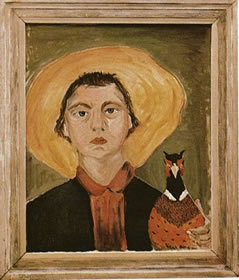
Zelfportret, 1953
Lees verder “Flannery O’Connor, Jacques Bens, Jaime Sabines, Peter Van Straaten,Toni Cade Bambara”

Pol Hoste, Jacques Audiberti, Filip De Pillecyn, Evliya Çelebi, Anne Fanshawe

De Vlaamse schrijver Pol Hoste werd geboren in Lokeren op 25 maart 1947. Zie ook alle tags voor Pol Hoste op dit blog.

Uit: Vier Scabreuze

De volgende

‘Ik houd mij,’ deelde mij een dame mee, ‘maar even vast aan uw geslacht.’ We stonden op de tram. ‘Het is hier zo druk.’
‘Het weze mij een aangename plicht, mevrouw,’ sprak ik, gehecht aan openbaar vervoer, ‘reizigers als u voor onvoorziene schokken te behoeden.’
‘Hoe zwelt uw lid! Bedrieg ik mij?’ wilde ze weten.
‘Ik haak,’ sprak ik, ‘mij ook maar even vast in uw geslacht.’
‘Het subtiele past bij u,’ zei zij. ‘Ik merk het aan uw duim en mond.’
‘Althans tenminste het tactiele,’ zei ik. ‘Het verbale ligt mij minder. Wat dat betreft verkies ik snijbranders.’
‘En zo,’ vroeg zij, ‘mijn andere hand zich aan uw tong vasthouden wilde?’
‘Daarvoor heeft u twee handen,’ zei ik, ‘en ik waar u om vraagt.’
‘Laat dit uw laatste woord zijn!’ klonk haar stem.
Ze bracht vier vingers in, ik hijgde.
‘Geen halte, ik ben nat,’ riep ze. Mijn taal bleef stokken. Ik beet. Zij sloot.
Als men zich stevig vastklampt aan elkaar hoeft het leven niet slechts onaangenaam te zijn. Een witte vloed! Ballonnen! Men komt behouden thuis.“


Pol Hoste (Lokeren, 25 maart 1947)

Lees verder “Pol Hoste, Jacques Audiberti, Filip De Pillecyn, Evliya Çelebi, Anne Fanshawe”

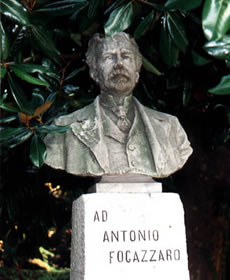
Antonio Fogazzaro, Daniel Schiebeler, Mary Webb, Erica Pedretti

De Italiaanse schrijver Antonio Fogazzaro werd geboren op 25 maart 1842 in Vicenza. Zie ook alle tags voor Antonio Fogazzaro op dit blog.


Uit: The Saint

„The Dessalles, brother and sister, had spentthe preceding summer at Maloja. Jeannestriving to make herself a pleasant companion,and hiding as best she could her incurablewound ; Carlino searching out traces of Nietzsche in mystic hours round Sils Maria or in worldlymoments flitting like a butterfly from one womanto another, frequently dining at St. Moritz, or atPontresina, making music with a military attache”of the German Embassy at Rome, or with Noemid’Arxel, and discussing religious questions withNoemi’s sister and brother-in-law The twod’Arxel sisters, orphans, were Belgian by birth, but of Dutch and Protestant ancestry. Theelder, Maria, after a peculiar and romantic court-ship, had married the old Italian philosopherGiovanni Selva, who would be famous in hisown country, did Italians take a deeper interestin theological questions; for Selva is perhapsthe truest representative of progressive Catholicism in Italy. Maria had become a Roman Catholic before her marriage. The Selvas spent thewinter in Rome, the rest of the year at Subiaco.
Noemi, who had remained true to the faith of her
fathers, divided her time between Brussels and
Italy. Only a month before, at the end of March,at Brussels, death had claimed the old governess,
with whom she had lived. Neither GiovanniSelva nor his wife had been able to come to Noemiat this great crisis, for Selva was seriously ill atthe time. Jeanne Dessalle, who had become muchattached to Noemi, persuaded her brother toundertake the journey to Belgium, a countrywith which he was hitherto unacquainted, andthen offered to take the Selvas’ place in Brussels.“


Antonio Fogazzaro (25 maart 1842 – 7 maart 1911)

Lees verder “Antonio Fogazzaro, Daniel Schiebeler, Mary Webb, Erica Pedretti”

Jeroen Mettes

De Nederlandse dichter, essayist en blogger Jeroen Mettes werd geboren in Valkenswaard op 24 maart 1978. Mettes studeerde filosofie in Utrecht, en literatuurwetenschap aan de Universiteit Leiden, waar hij tot 2006 aan een proefschrift werkte over poëtisch ritme. In 1999 begon hij aan een lang prozagedicht dat hij de naam N30 gaf. Dat was de codenaam van de anti- of andersglobalistische protesten in Seattle tijdens de onderhandelingen van de WTO. In 2005 startte Jeroen Mettes het blog Poëzienotities. Als dichter debuteerde Jeroen Mettes in het tijdschrift Parmentier met de reeks van vier gedichten getiteld ‘In de sfeer van het gestelde’. Als jonge twintiger had hij al prozabijdragen geleverd aan onder meer de tijdschriften Zoetermeer en Passionate. In 2006 trad Mettes toe tot de redactie van het tijdschrift yang. Hij was ook vast medewerker van het tijdschrift Parmentier. Op 21 september 2006 plaatste hij een lege post op zijn blog. Diezelfde dag maakte hij een einde aan zijn leven. Hij liet naast zijn gedichten, essays en zijn blog, een ver gevorderd Engelstalig proefschrift na. In 2011 verscheen het Nagelaten werk van Jeroen Mettes bij uitgeverij Wereldbibliotheek.

Uit: N30

In de c&a (kelders) bevindt zich een gedenksteen. De cia heeft mijn familieleden nooit wat misdaan. Toch zit, anno nu, in een Geleense huiskamer… ’n Armada kantoorgebouwen. Om je ‘dood’ te lachen. Liefste? Mag ik je voorstellen aan mijn muze? Anorexia = ambitie. Als je door de supermarkt loopt. Waar blijf je? We plunderen de stad. In de nek is ze het mooist (bij de achterkant van haar oren). Ik was die woonwagen gewend, ’t rondtrekken… We zien onszelf rijden in de ruiten. Ik moet niet overdrijven. Ik ben al rijk. Uitgeput lig ik in haar witte kamer, als een kaal veld in het najaar. Meeslepend! Een kat kijkt me aan van de andere kant van het water. Geef mij maar een, uhm, even kijken… De ideale girl-next-door? Ontroerend! De allochtoonse schrijver gefilmd als randgroepjongere. Reflectie van water (schaduw van water?) op ’t plafond van de bus als we de brug oversteken. Een schaduw valt over mijn boek als de bus een bocht neemt. Overal ontstonden soldaten- en arbeidersraden. Daar moeten we nu juist op blijven hameren! Mijn schande is niet zwaar; ik ben zwaar. Een oude zwarte bedelaar.


Jeroen Mettes (24 maart 1978 – 21 september 2006)

Martin Walser, Peter Bichsel, Dario Fo, Lawrence Ferlinghetti, Jacob van Lennep

De Duitse schrijver Martin Walser werd op 24 maart 1927 geboren in Wasserburg aan de Bodensee. Zie ook alle tags voor Martin Walser op dit blog.

Uit: Muttersohn

„Ewald, ich heiße Percy. Das sagte er, als er die Tür hinter sich zugemacht hatte. Ewald hatte auf sein Klopfen nicht geantwortet. Percy sagte, das verstehe er. In der Geschlossenen Abteilung an eine Tür zu klopfen und auf ein Herein zu warten, sei heuchlerisch, da doch der Klopfende den Schlüssel habe, mit dem die Tür aufzuschließen sei.

Ewald lag auf dem gemachten Bett. Er lag auf dem Rücken. Die Augen offen. Die rechte Seite seines Gesichts war rot, vernarbt, die rechte Hand auch. Diese rechte Hand lag auf Ewalds Brust. Sie hielt ein Handy. Das konnte nur heißen, dass er auf etwas wartete, was aus dem Handy kommen musste. Percy sagte: Ich setz’ mich auf den Stuhl an deinem Tisch. Dann schwieg er. Er wartete nicht, er schwieg. Plötzlich richtete sich Ewald auf, schlüpfte in die schwarzen Schuhe, die unter seinem Bett

standen, und legte sich wieder hin und schaute zur Decke. Es war klar, er wollte nicht, dass ihn jemand ohne Schuhe sähe. Schwarze Schlüpfschuhe, schwarze Socken, schwarze Hose, schwarzes, langärmliges Hemd. Als Manschettenknöpfe goldgefasste rote Steine. Karneol, dachte Percy. Das Handy hatte Ewald beim In-die- Schuhe-Schlüpfen in der Hand behalten.

So blieben sie. Stumm. Zwei Stunden lang oder drei. Dann stand Percy auf, ging zur Tür, schloss auf und sagte: Ich will nicht, dass du dich wunderst. Ich bin mit allen per du, seit ich hier in der Pflegerschule war. Der Professor hat mich Latein lernen lassen. Da gibt es kein Sie. Seit dem sag ich zu allen du. Es ist dann immer, als spräche ich Latein. So ein Gefühl halt. Bis bald, Ewald.

Als Percy draußen war, drehte er den Schlüssel so leise wie möglich im Schloss.

Zwei Empfindungen waren Percy fremd: Furcht und Ungeduld.“


Martin Walser (Wasserburg, 24 maart 1927)

Lees verder “Martin Walser, Peter Bichsel, Dario Fo, Lawrence Ferlinghetti, Jacob van Lennep”

Harry Prenen, Top Naeff, Willem van Iependaal, Robert Hamerling, Fanny Lewald

De Nederlandse (gelegenheids)dichter, historicus, geschiedenisleraar, illustrator en journalist Harry Prenen werd geboren in Schoten op 24 maart 1915. Zie ook alle tags voor Harry Prenen op dit blog.

Uit: Het een en ander over Godfried Bomans

„Dat sloeg de deur dicht. De aanvoerder van het gezelschap hield nog genoeg adem over om mij naar de redenen van deze opinie te vragen. Ik moet bekennen: mijn antwoord geleek op het eerste gezicht wel wat op een Delphische orakelspreuk: ‘Daar heb ik zeven redenen voor. Zeven grote en honderd kleine.”

– “Wat? Zeven? En honderd?” – “Zijn zeven boeken: Pieter Bas, Erik, Wonderlijke nachten, Sprookjes, Kopstukken, Bill Clifford en Pa Pinkelman.”

– “En die honderd andere redenen?” – “Zijn artikelen in Elsevier, zijn recensies en feuilletons in de Volkskrant, zijn verspreide verhalen als ‘Het Doosje’ en ‘Hoebe’, zijn toneelstukjes in het fonds van de heer Anton Zweers, zoals het kleine éénactertje ‘Driekoningen’, zijn circulaires voor feesten en gelegenheden, zijn brieven aan mij persoonlijk (maar daar hebt ge verder uw neus niet in te steken) en zo al verder. Mij dunkt dat beloopt nog meer dan honderd. En nu ik toch bezig ben wil ik meteen maar zeggen dat het bij al uw veneratie( verering) voor Slau en Vestdijk en dergelijke (wat ik u niet betwisten wil, al kan ik het niet van harte delen) en bij al uw schampere waardering voor Bomans als louter amuseur (dit zienlijk deel is ’t minst van hem, zou vader Vondel zeggen) het toch geen kwaad kan eerst eens tot overeenstemming te komen wat eigenlijk goed proza is alvorens op pad te gaan om de beste prozaïst te zoeken.”


Harry Prenen (24 maart 1915 – 20 oktober 1992)
De Rijnlandse Academie door Peer Molengraft, 1952
V.l.n.r. Jan Mul en Wouter Paap, Godfried Bomans en Harry Prenen

Lees verder “Harry Prenen, Top Naeff, Willem van Iependaal, Robert Hamerling, Fanny Lewald”

Christian Schubart, Gabriele von Baumberg, Olive Schreiner, William Morris, Richard Leising

De Duitse dichter, componist enn journalist Christian Friedrich Daniel Schubart werd geboren op 24 maart 1739 in Obersontheim. Zie ook alle tags voor Christian Schubart op dit blog.


Die Forelle

In einem Bächlein helle,
Da schoß in froher Eil’
Die launige Forelle
Vorüber wie ein Pfeil.
Ich stand an dem Gestade,
Und sah in süßer Ruh’
Des muntern Fisches Bade
Im klaren Bächlein zu.

Ein Fischer mit der Ruthe
Wohl an dem Ufer stand,
Und sah’s mit kaltem Blute,
Wie sich das Fischlein wand.
So lang dem Wasser Helle,
So dacht’ ich, nicht gebricht,
So fängt er die Forelle
Mit seiner Angel nicht.

Doch plötzlich war dem Diebe
Die Zeit zu lang. Er macht
Das Bächlein tückisch trübe,
Und eh’ ich es gedacht,
So zuckte seine Ruthe,
Das Fischlein zappelt dran,
Und ich mit regem Blute
Sah die Betrogne an.

Die ihr am goldnen Quelle
Der sichern Jugend weilt,
Denkt doch an die Forelle;
Seht ihr Gefahr, so eilt!
Meist fehlt ihr nur aus Mangel
Der Klugheit. Mädchen, seht
Verführer mit der Angel!
Sonst blutet ihr zu spät.


Christian Schubart (24 maart 1839 – 10 oktober 1791)

Lees verder “Christian Schubart, Gabriele von Baumberg, Olive Schreiner, William Morris, Richard Leising”