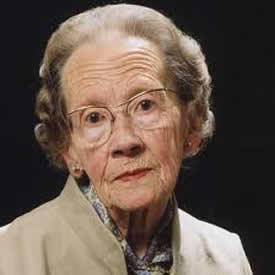
De Nederlandse dichteres Inge Lievaart is maandag op 95-jarige leeftijd overleden in haar woonplaats Scheveningen. Ze was bekend van haar religieuze en mystieke gedichten. Inge Lievaart werd geboren op 14 april 1917 in Oosterend. Ze was, vanwege de vaak mystieke en religieuze boodschap van haar gedichten, vooral bekend in protestants-christelijke kringen. Zie ook alle tags voor Inge Lievaart op dit blog.
Wat steen was
Is er een diepere dood: mensen gaan dicht voor elkaar kunnen geen kier meer open harten zijn dicht voor God steen, in zichzelf besloten. Is er nog leven dat breekt wel een hamer zo hard een beitel zo scherp iemand die iets er op weet? Luister, een woord wekt het oor Luister, wat steen was beweegt Hij die aan ons zich verloor open tot op het eind breekt als de Levende door roepende tot men Hem kent.
‘Gezichtsbedrog,’ glimlachte de tandarts, ‘een knappe truc. De moderne techniek staat voor niets. Later stonden ze weer op de gewone plaats, herinnert u zich maar… Misschien heeft u aan de Openbaring gedacht; maar daarin staat wèl geschreven, dat er geen nacht meer zal zijn, maar niets over de tijd. Ik ben natuurlijk geen autoriteit, al beschouw ik mezelf als tamelijk bijbelvast… Dominee, kunt u
ons ook zeggen of er in de Openbaring iets over de tijd staat: dat die er niet meer zijn zal, of stilgezet is, of iets van dien aard?’
‘Maar wat ik zeggen wou; dat-er-geen-tijd-meer-zal-zijn, – waar staat dat beschreven, meneer Veenstra?’
‘In de Bijbel toch zeker?’
‘Mij niets van bekend. We zouden dit aan onze dominee moeten vragen, het is niet mijn bedoeling om eh… Hm… U doelt waarschijnlijk op Mattheüs 24, maar daarin staat niets over de tijd; wel over de voleinding der wereld, en oorlogen, en verduistering der zon, en de sterren die van de hemel zullen vallen, en een bazuin met groot geluid, en natuurlijk de komst van Christus…’
‘En hebben we die sterren soms niet gezien? In die grote zaal met al die boeken?’
‘Gezichtsbedrog,’ glimlachte de tandarts, ‘een knappe truc. De moderne techniek staat voor niets. Later stonden ze weer op de gewone plaats, herinnert u zich maar… Misschien heeft u aan de Openbaring gedacht; maar daarin staat wèl geschreven, dat er geen nacht meer zal zijn, maar niets over de tijd. Ik ben natuurlijk geen autoriteit, al beschouw ik mezelf als tamelijk bijbelvast… Dominee, kunt u
ons ook zeggen of er in de Openbaring iets over de tijd staat: dat die er niet meer zijn zal, of stilgezet is, of iets van dien aard?’
Met inspanning van al zijn krachten richtte dominee Van der Woght zich op uit de dodelijke vermoeidheid, die hem nog steeds
gekluisterd hield. Werktuiglijk glimlachte hij zijn mooie oude-mannenglimlach, en wijd sperden zijn fletsblauwe ogen zich open, als om te zien, te weten, zich te herinneren wat hij vroeger geweten had. Voor ieder was het duidelijk, dat op dit moment de Openbaring voor hem een boek was met evenveel zegelen gesloten als het boek, waarvan in de Openbaring wordt gerept”.
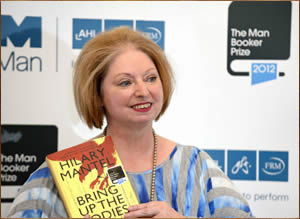
De Britse schrijfster Hilary Mantel heeft dinsdag voor de tweede keer de literaire Booker Prize gewonnen. Zij krijgt de prijs voor Bring Up the Bodies.Hilary Mary Mantel werd op 6 juli 1952 als Hilary Mary Thompson in Glossop, Derbyshire, geboren. Zie ook alle tags voor Hilary Mantel op dit blog.
Uit: Bring Up the Bodies
“His children are falling from the sky. He watches from horse-back, acres of England stretching behind him; they drop, gilt-winged, each with a blood-filled gaze. Grace Cromwell hovers in thin air. She is silent when she takes her prey, silent as she glides to his fist. But the sounds she makes then, the rustle of feathers and the creak, the sigh and riffle of pinion, the small cluck-cluck from her throat, these are sounds of recognition, intimate, daughterly, almost disapproving. Her breast is gore-streaked and flesh clings to her claws.
Later, Henry will say, ‘Your girls flew well today’. The hawk Anne Cromwell bounces on the glove of Rafe Sadler, who rides by the king in easy conversation. They are tired; the sun is declining, and they ride back to Wolf Hall with the reins slack on the necks of their mounts. Tomorrow his wife and two sisters will go out. These dead women, their bones long sunk in London clay, are now transmigrated. Weightless, they glide on the upper currents of the air. They pity no one. They answer to no one.
Their lives are simple. When they look down they see nothing but their prey, and the borrowed plumes of the hunters: they see a flittering, flinching universe, a universe filled with their dinner. All summer has been like this, a riot of dismemberment, fur and feather flying; the beating off and the whipping in of hounds, coddling of tired horses, the nursing, by the gentlemen, of contusions, sprains and blisters. And for a few days at least, the sun has shone on Henry. Sometime before noon, clouds scudded in from the west and rain fell in big scented drops; but the sun re-emerged with a scorching heat, and now the sky is so clear you can see into Heaven and spy on what the saints are doing.”
“Zugegeben: ich bin Insasse einer Heil- und Pflegeanstalt, mein Pfleger beobachtet mich, läßt mich kaum aus dem Auge; denn in der Tür ist ein Guckloch, und meines Pflegers Auge ist von jenem Braun, welches mich, den Blauäugigen, nicht durchschauen kann. Mein Pfleger kann also gar nicht mein Feind sein. Liebgewonnen habe ich ihn, erzähle dem Gucker hinter der Tür, sobald er mein Zimmer betritt, Begebenheiten aus meinem Leben damit er mich trotz des ihn hindernden Guckloches kennenlernt. Der Gute scheint meine Erzählungen zu schätzen, denn sobald ich ihm etwas vorgelegen habe, zeigt er mir, um sich erkenntlich zu geben, sein neuestes Knotengebilde. Ob er ein Künstler ist, bleibe dahingestellt. Eine Ausstellung seiner Kreationen würde jedoch von der Presse gut aufgenommen werden, auch einige Käufer herbeilocken. Er knotet ordinäre Bindfäden, die er nach den Besuchsstunden in den Zimmern seiner Patienten sammelt und entwirrt, zu vielschichtig verknorpelten Gespenstern, taucht diese dann in Gips, läßt sie erstarren und spießt sie mit Stricknadeln, die auf Holzsöckelchen befestigt sind. Oft spielt er mit dem Gedanken, seine Werke farbig zu gestalten. Ich rate davon ab, weise auf mein weißlackiertes Metallbett hin und bitte ihn, sich dieses vollkommenste Bett bunt bemalt vorzustellen. Entsetzt schlägt er dann seine Pflegerhände über dem Kopf zusammen, versucht in etwas zu starrem Gesicht allen Schrecken gleichzeitig Ausdruck zu geben und nimmt Abstand von seinen farbigen Plänen. Mein weißlackiertes metallenes Anstaltsbett ist also ein Maßstab. Mir ist es sogar mehr: mein Bett ist das endlich erreichte Ziel, mein Trost ist es und könnte mein Glaube werden, wenn mir die Anstaltsleitung erlaubte, einige Änderungen vorzunehmen: das Bettgitter möchte ich erhöhen lassen, damit mir niemand mehr zu nahe tritt…”
“Er was die keer dat hii voor me uit de trap afdaalde, terwijl hij lachend iets over zijn schouder zei. Halverwege stond hij opeens stil, zodat ik tegen hem op botste.
‘Dat ik dat toch ooit geweest ben.’
Op ooghoogte hing tegen de muur van de overloop zrjn portret als kaalhoofdige zuigeling, in een gestreept rompertje dwars in
zijn ledikant liggend, met boven zich kleurige houten ringen waaraan hij zich nog moest leren optrekken. Hij keek schuins in
de camera, happend in het dons.
Tonio schudde zijn hoofcl, alsof het een onbezonnen keuze betrof ‘dat daar ooit te zqn geweest’. Jaren eerder had ik in mijn dagboek
genoteerd dat hij, net zo ongelovig zijn hoofd schuddend, had gezegd: ‘Dat ik toch ooit dood zaI gaan.’
(…)
Soms wil ik hem heel dicht tegen me aan houden. De gedachte doet zich meestal voor als ik in bed lig te lezen, en zomaar opeens mijn boek ter zijde leg. Kom maar, zeg ik dan geluidloos. Kom maar, Tonio, onder het dek. Ik zal je warm houden.
Zijn lichaam is willoos, slap, maar niet koud. Het is de Tonio die na de aanrijding op het plaveisel heeft gelegen, een half etmaal voor zijn dood. De inzittenden van de rode Suzuki Swift staan buiten de auto, en durven niet naar het verderop neergekwakte lijf te kijken. De sirenes van politie en ambulance zijn nog niet hoorbaar. Het blauwe geflakker van de zwaailichten moet nog komen. Het is dan dat ik hem opraap en naar mijn bed draag, waarvan ik het dek opensla.
Kom maar. Dicht tegen me aan. Dat zal je warm houden. Ze komen zo om je beter te maken.”
A. F.Th. van der Heijden (Geldrop, 15 oktober 1951)
Friedenspreis des Deutschen Buchhandels 2012 voor Liao Yiwu
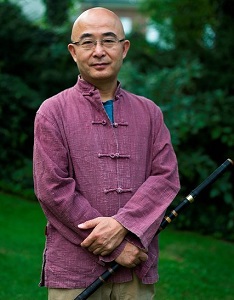
Aan de Chinese dichter en schrijver Liao Yiwuwerd gisteren in de Frankfurter Paulskerk de Friedenspreis des Deutschen Buchhandels uitgereikt. Liao Yiwu(ook bekend als Lao Wei) werd geboren op 4 augustus 1958 in Yanting, Sichuan Zie ookalle tags voor Liao Yiwuop dit blog.
Uit: For a Song and a Hundred Songs (Vertaald door Wenguang Huang)
“I have written this book three times, thanks to the relentless obstructions of the Chinese security police.
I first started writing it on the backs of envelopes and on scraps of paper that my family smuggled into the prison where I was serving a four-year sentence from 1990 to 1994 for writing and distributing a poem that condemned the infamous, bloody government crackdown on the 1989 student prodemocracy movement in Tiananmen Square.
Even after my release in 1994, the police continued to monitor and harass me. On October 10, 1995, police raided my apartment in Chengdu, Sichuan Province, confiscating the handwritten manuscript of For a Song and a Hundred Songs. As a punishment for what they called “attacking the government’s penitentiary system” with my writings, I was placed under house arrest for twenty days.
I started on my book again from scratch. It took me three years to finish a new version, which was seized in 2001, along with my other unpublished literary works. This time, the police also absconded with my computer.
Writers like to wax poetic and brag about their works in an attempt to secure a berth in the history of literature. Unfortunately, I no longer possess many physical products of my years of toil. Instead, I have become an author who writes for the pleasure of the police. Most of my past memories—the manuscripts that I have painstakingly created about my life, and my poems—are now locked away at the Public Security Bureau. In a grimly humorous twist, the police used to peruse my writings more meticulously than even the most conscientious editors.
Chinese career spies have amazing memories. A director of a local public security branch could memorize many of my poems and imbue them with more complicated ideas than I had originally intended. So in a sense, my writing found a way to the minds and lips of at least one eager audience.
Indeed, the police proved to have an insatiable need for more of my work. So after each successive raid, I dug more holes like a rat, and I hid my manuscripts in deeper and deeper crevices across the city, in the homes of family and friends. My furtive efforts to conceal my work called to mind those of the Nobelist Aleksandr Solzhenitsyn, whose handwritten manuscript of The Gulag Archipelago had famously faced similar threats from the KGB. The only way to preserve his writings was to get them published.
In early 2011, after this book was finally smuggled out of China and scheduled to be published in Taiwan and in Germany, I again met resistance from the Chinese authorities.”.
if you like my poems let them walk in the evening,a little behind you
then people will say “Along this road i saw a princess pass on her way to meet her lover(it was toward nightfall)with tall and ignorant servants.”
my father moved through dooms of love
my father moved through dooms of love through sames of am through haves of give, singing each morning out of each night my father moved through depths of height
this motionless forgetful where turned at his glance to shining here; that if(so timid air is firm) under his eyes would stir and squirm
newly as from unburied which floats the first who,his april touch drove sleeping selves to swarm their fates woke dreamers to their ghostly roots
and should some why completely weep my father’s fingers brought her sleep: vainly no smallest voice might cry for he could feel the mountains grow.
Lifting the valleys of the sea my father moved through griefs of joy; praising a forehead called the moon singing desire into begin
joy was his song and joy so pure a heart of star by him could steer and pure so now and now so yes the wrists of twilight would rejoice
keen as midsummer’s keen beyond conceiving mind of sun will stand, so strictly(over utmost him so hugely) stood my father’s dream
his flesh was flesh his blood was blood: no hungry man but wished him food; no cripple wouldn’t creep one mile uphill to only see him smile.
Scorning the Pomp of must and shall my father moved through dooms of feel; his anger was as right as rain his pity was as green as grain
septembering arms of year extend yes humbly wealth to foe and friend than he to foolish and to wise offered immeasurable is
proudly and(by octobering flame beckoned)as earth will downward climb, so naked for immortal work his shoulders marched against the dark
his sorrow was as true as bread: no liar looked him in the head; if every friend became his foe he’d laugh and build a world with snow.
My father moved through theys of we, singing each new leaf out of each tree (and every child was sure that spring danced when she heard my father sing)
then let men kill which cannot share, let blood and flesh be mud and mire, scheming imagine,passion willed, freedom a drug that’s bought and sold
giving to steal and cruel kind, a heart to fear,to doubt a mind, to differ a disease of same, conform the pinnacle of am
though dull were all we taste as bright, bitter all utterly things sweet, maggoty minus and dumb death all we inherit,all bequeath
and nothing quite so least as truth –i say though hate were why men breathe– because my Father lived his soul love is the whole and more than all
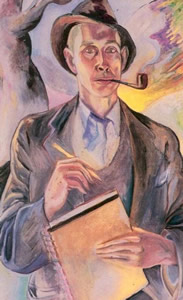
E. E. Cummings (14 oktober 1894 – 3 september 1962) Self-portrait with sketchpad, 1939
“He stood at the hall door turning the ring, turning the heavy signet ring upon his little finger while his glance travelled coolly, deliberately, over the round tables and basket chairs scattered about the glassed-in veranda. He pursed his lips–he might have been going to whistle–but he did not whistle–only turned the ring–turned the ring on his pink, freshly washed hands.
Over in the corner sat The Two Topknots, drinking a decoction they always drank at this hour–something whitish, greyish, in glasses, with little husks floating on the top–and rooting in a tin full of paper shavings for pieces of speckled biscuit, which they broke, dropped into the glasses and fished for with spoons. Their two coils of knitting, like two snakes, slumbered beside the tray.
The American Woman sat where she always sat against the glass wall, in the shadow of a great creeping thing with wide open purple eyes that pressed–that flattened itself against the glass, hungrily watching her. And she knoo it was there–she knoo it was looking at her just that way. She played up to it; she gave herself little airs. Sometimes she even pointed at it, crying: “Isn’t that the most terrible thing you’ve ever seen! Isn’t that ghoulish!” It was on the other side of the veranda, after all . . . and besides it couldn’t touch her, could it, Klaymongso? She was an American Woman, wasn’t she, Klaymongso, and she’d just go right away to her Consul. Klaymongso, curled in her lap, with her torn antique brocade bag, a grubby handkerchief, and a pile of letters from home on top of him, sneezed for reply.
The other tables were empty. A glance passed between the American and the Topknots. She gave a foreign little shrug; they waved an understanding biscuit. But he saw nothing. Now he was still, now from his eyes you saw he listened. “Hoo-e-zip-zoo-oo!” sounded the lift. The iron cage clanged open. Light dragging steps sounded across the hall, coming towards him. A hand, like a leaf, fell on his shoulder. A soft voice said: “Let’s go and sit over there–where we can see the drive. The trees are so lovely.” And he moved forward with the hand still on his shoulder, and the light, dragging steps beside his. He pulled out a chair and she sank into it, slowly, leaning her head against the back, her arms falling along the sides.”
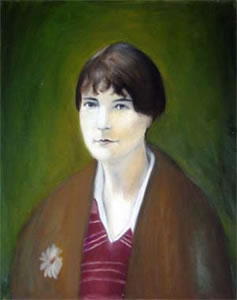
Katherine Mansfield (14 oktober 1888 – 9 januari 1923) Portret door Shoshana Kertesz
„De vrouwen in mijn leven hielden mij ieder op hun eigen manier een spiegel voor. Mannen deden dat niet, zelfs mijn beste vrienden niet. Mannen bevechten elkaar of steunen elkaar onvoorwaardelijk. Ze houden elkaar een masker voor, wat op zijn tijd veel prettiger is dan een spiegel. Hoe het met vrouwen zit, weet ik niet zeker, maar ik denk dat vrouwen tegenover elkaar juist hun masker afleggen. Ik had wel een vrouw willen zijn.’
(…)
‘Dat deze vrouw dood was, fascineerde me. Dood zijn en toch lust weten aan te wakkeren van de man die naar die naaktfoto van je kijkt, daarin schuilt een mysterieuze biologische tegenstrijdigheid die mijn zinnen extra prikkelde. […] Misschien komt het doordat seks zich op deze foto’s dwars door de dood heen manifesteert, lak heeft aan de voortplanting en daardoor zelfs meer aan botte levensdrift appelleert dan de aanblik van een blote prachtvrouw in levende lijve. Het kan ook zijn dat die oude naaktfoto’s je laten voelen dat al die maatschappelijke veranderingen er niet zo veel toe doen. De mens blijft zichzelf gelijk, nu en toen, hier en daar, in weer en wind, door de eeuwen heen. Je waant je een ogenblik een met alle mensen die er zijn en waren. Dus als seks een verlangen naar eenwording is, wordt door de vrouwen op die oude foto’s niet alleen die eenwording maar ook het verlangen daarnaar tot de zoveelste macht verheven.’
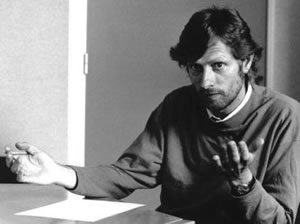
Herman Franke (13 oktober 1946 – 14 augustus 2010) In 1990