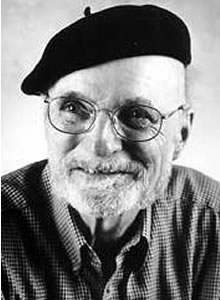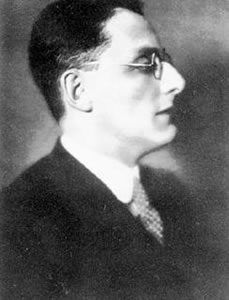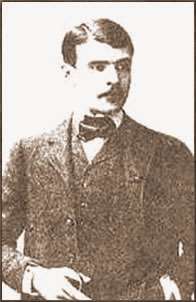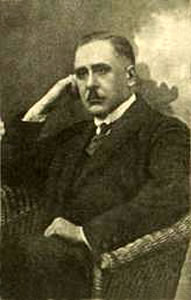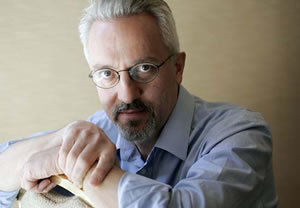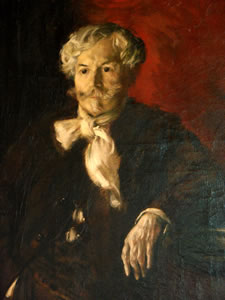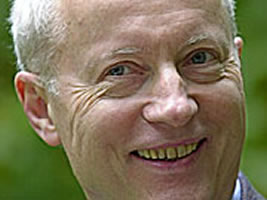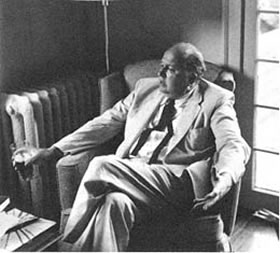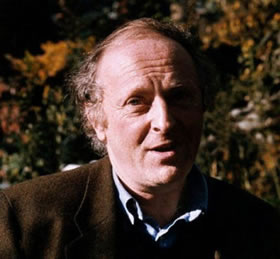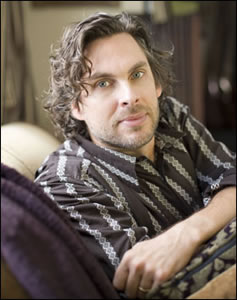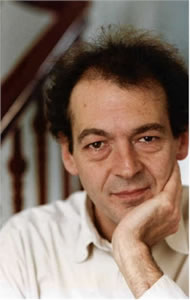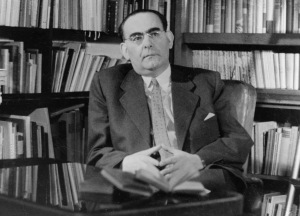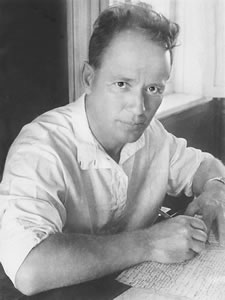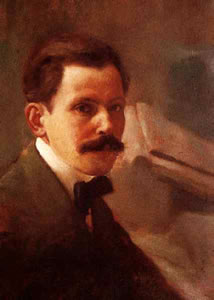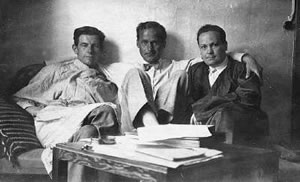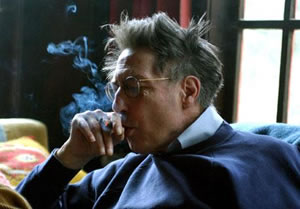
Ian Fleming, Henri-Pierre Roché, Maximilian Voloshin, Maria Müller-Gögler, B. S. Ingemann, J. D. Wyss, C. H. von Ayrenhoff, Xin Qiji

De Britse schrijver Ian Fleming werd geboren op 28 mei 1908 in Londen. Zie ook mijn blog van 28 mei 2007 en ook mijn blog van 28 mei 2009.


Uit:  Live and Let Die


‘You’re very welcome, Mr Bond.’ Halloran smiled and offered him a cigarette from a fresh pack of Luckies. ‘We want to make your stay comfortable. Anything you want, just say so and it’s yours. You’ve got some good friends in Washington. I don’t myself know why you’re here but it seems the authorities are keen that you should be a privileged guest of the Government. It’s my job to see you get to your hotel as quickly and as comfortably as possible and then I’ll hand over and be on my way. May I have your passport a moment, please.’

Bond gave it to him. Halloran opened a briefcase on the seat beside him and took out a heavy metal stamp. He turned the pages of Bond’s passport until he came to the US Visa, stamped it, scribbled his signature over the dark blue circle of the Department of Justice cypher and gave it back to him. Then he took out his pocket-book and extracted a thick white envelope which he gave to Bond.

‘There’s a thousand dollars in there, Mr Bond.’ He held up his hand as Bond started to speak. ‘And it’s Communist money we took in the Schmidt-Kinaski haul. We’re using it back at them and you are asked to co-operate and spend this in any way you like on your present assignment. I am advised that it will be considered a very unfriendly act if you refuse. Let’s please say no more about it and,’ he added, as Bond continued to hold the envelope dubiously in his hand, ‘I am also to say that the disposal of this money through your hands has the knowledge and approval of your own Chief.’

Bond eyed him narrowly and then grinned. He put the envelope away in his notecase.

‘All right,’ he said. ‘And thanks. I’ll try and spend it where it does most harm. I’m glad to have some working capital. It’s certainly good to know it’s been provided by the opposition.’

‘Fine,’ said Halloran; ‘and now, if you’ll forgive me, I’ll just write up my notes for the report I’ll have to put in. Have to remember to get a letter of thanks sent to Immigration and Customs and so forth for their co-operation. Routine.’


connery-fleming

Ian Fleming (28 mei 1908 – 12 augustus 1964)
Fleming hier met Sean Connery (l)


De Franse schrijver, journalist en verzamelaar Henri-Pierre Roché werd op 28 mei 1879 geboren te Parijs. Zie ook mijn blog van 28 mei 2009.


Uit: Jules et Jim


-Vous avez aimé, Jim. Pour de bon, Jim. Cela se sent. Pourquoi ne l’avez-vous pas épousée?
-Cela n’est pas arrivé.
-Où est-elle ?
-En France
Comment est-elle ?
-Pure, elle aussi.
Jim sentit une pression du bras de Lucie.
-Vous l’aimez encore, et elle vous aime ?
-Oui, mais nous nous
voyons peu, bien que nous soyons libres.

-Ne faites pas souffrir, Jim…
-Et puis, il y a du nouveau.
-Lequel ?
-Je vous admire, Lucie. J’ai pris gout à vous voir. Je crains d’oublier Jules.
-Il ne faut pas l’oublier, il faut le prévenir.
[…]
L’été tourna vite. Jules fit sa demande à Lucie, ajoutant que, quelle que fût sa réponse, il resterait toujours à sa merci. Lucie lui dit qu’elle était touchée, qu’elle ne pourrait probablement jamais l’épouser, et qu’elle souhaitait que leur grande amitié n’en souffrît pas.
Jules, qui s’y attendait pourtant, devint blanc, lui baisa les mains, et vint trouver Jim.
-Jim, dit-il, Lucie ne veut pas de moi. J’ai la terreur de la perdre et qu’elle sorte tout à fait de ma vie. Jim, aimez-la, épousez-la, et laissez-moi la voir. Je veux dire : si vous l’aimez, cessez de penser que je suis un obstacle.


jules_et_jim

Henri-Pierre Roché (28 mei 1879 – 9 april 1959)
Scene uit de film Jules et Jim van François Truffaut


De Russische dichter, schrijver en schilder Maximilian Voloshin werd geboren op 28 mei 1877 in Kiev. Zie ook mijn blog van 28 mei 2009.


Koktebel


As in the tiny shell – the Ocean

With mighty breathing hums, concealed inside,

As flesh of her is flickering and burns

With silver shimmer of the air of foggy,

And curvatures of her reiterate

Their look in movements and in curls of waves, –

So in your harbors my entire soul,

Oh Cimmerian country dark of mine,

Is captivated and transfigured truly.


Since being adolescent by the silent

The solemn, godforsaken shores

I woke up – my soul opened widely,

And thought was grown up and shaped, and sculptured

On folds of rocks, on curvatures of hills,

The fire of the depths and rainy moisture

With double chisel your appearance built –

Monotonous formation of the hills

And strain of Kara-Dag’s intensive pathos.


Indented concentration of the rocks

Along with prairies and flickering expances

Gave freedom to my verse and measure to my thought.

Since then are saturated with my dreams

Heroic reveries of drowsing foothills

And stone mane of wistful Koktebel;

His wormwood’s getting drunken with my pang,

My verse is singing in the surging ocean,

And on the rock, enclosing rippled harbor,

By fate and wind is sculptured my profile.


Vertaald door I. Larkov


voloshin

Maximilian Voloshin (28 mei 1877 – 11 augustus 1932)
Buste in de studeerkamer van Voloshins huis in Koktebel


De Duitse dichteres en schrijfster Maria Müller-Gögler werd geboren op 28 mei 1900 in Leutkirch im Allgäu. Zie ook mijn blog van 28 mei 2009.


Willkommen


Die Liebe hat dich hergerufen,

und Liebe gibt dir das Geleit.

Sie stützt dich auf den ersten Stufen

des schweren Weges durch die Lebenszeit,

bleibt später auch an deiner Seite,

stärkt dich noch mehr als Milch und Brot.

Auch in der ungeschützten Weite

hilft sie bestehen, was dich fremd umdroht.


Du bist in eine Zeit geboren,

vor deren Zeichen manchem bangt,

der seine Zuversicht verloren,

weil er im Glauben an die Liebe wankt.

Er ängstigt sich vielleicht gleich scheuen,

verfolgten Tieren in der Nacht.

Du fürchtest nichts, du darfst dich freuen,

weil deiner Eltern Liebe dich bewacht.
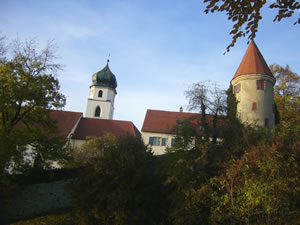


leutkirch_martinskirche_pulverturm

Maria Müller-Gögler (28 mei 1900 – 23 september 1987)
Leutkirch im Allgäu (Geen portret beschikbaar)


De Deense dichter en schrijver Bernhard Severin Ingemann werd geboren op 28 mei 1789 in Thorkildstrup op het eiland Falster. Zie ook mijn blog van 28 mei 2009.


Uit: The Sealed Room


„Madame Wolff had in vain endeavored to avoid using the great hall at all, for the foolish old legend of the sealed chamber aroused a certain superstitious dread in her heart, and she rarely if ever entered the hall herself.  But merry Miss Elizabeth, her pretty young daughter, was passionately fond of dancing, and her mother had promised that she should have a ball on her wedding day.  Her betrothed, Secretary Winther, was also a good dancer, and the two young people combated the mother’s prejudice against the hall and laughed at her fear of the sealed room.  They

thought it would be wiser to appear to ignore the stupid legend altogether, and thus to force the world to forget it.  In spite of secret misgivings Madame Wolff yielded to their arguments.  And for

the first time in many years the merry strains of dance music were heard in the great hall that lay next the mysterious sealed chamber.

The bridal couple, as well as the wedding guests, were in the gayest mood, and the ball was an undoubted success.  The dancing was interrupted for an hour while supper was served in an adjoining

room.  After the repast the guests returned to the hall, and it was several hours more before the last dance was called.  The season was early autumn and the weather still balmy.  The windows had been

opened to freshen the air.  But the walls retained their dampness and suddenly the dancers noticed that the old wall paper which covered the partition wall between the hall and the sealed chamber

had been loosened through the jarring of the building, and had fallen away from the sealed door with its mysterious inscription.“
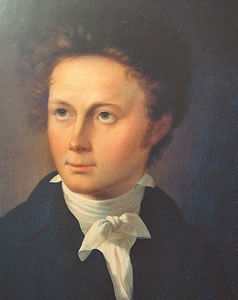
 

Bernhard_Severin_Ingemann_1822_AIKoop

Bernhard Severin Ingemann (28 mei 1789 – 24 februari 1862)
Portret door A. I. Koop, 1822


De Zwitserse schrijver Johann David Wyss werd geboren op 28 mei 1743 in Bern. Zie ook mijn blog van 28 mei 2009.


Uit: The Swiss Family Robinson

“Amid the roar of the thundering waves I suddenly heard the cry of “Land, land!” while at the same instant the ship struck with a frightful shock, which threw everyone to the deck and seemed to threaten her immediate destruction.
Dreadful sounds betokened the breaking up of the ship, and the roaring waters poured in on all sides:
Then the voice of the captain was heard above the tumult shouting, “Lower away the boats! We are lost!”
“Lost!” I exclaimed, and the word went like a dagger to my heart; but seeing my children’s terror renewed, I composed myself, calling out cheerfully, “Take courage, my boys! We are all above water yet. There is the land not far off; let us do our best to reach it. You know God helps those that help themselves!” With that, I left them and went on deck. What was my horror when through the foam and spray I beheld the only remaining boat leave the ship, the last of the seamen spring into her and push off, regardless of my cries and entreaties that we might be allowed to share their slender chance of preserving their lives. My voice was drowned in the howling of the blast; and even had the crew wished it, the return of the boat was impossible.
Casting my eyes despairingly around, I became gradually aware that our position was by no means hopeless, inasmuch as the stern of the ship containing our cabin was jammed between two high rocks, and was partly raised from among the breakers which dashed the fore part to pieces. As the clouds of mist and rain drove past, I could make out, through rents in the vaporous curtain, a line of rocky coast, and rugged as it was, my heart bounded toward it as a sign of help in the hour of need. Yet the sense of our lonely and forsaken condition weighed heavily upon me as I returned to my family, constraining myself to say with a smile, “Courage, dear ones! Although our good ship will never sail more, she is so placed that our cabin will remain above water, and tomorrow, if the wind and waves abate, I see no reason why we should not be able to get ashore.”
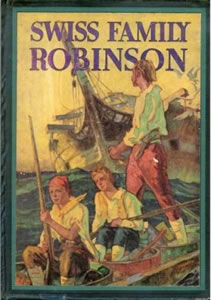
 

Wyss

Johann David Wyss (28 mei 1743 – 11 januari 1818)
Een van de uitgaven van The Swiss Family Robinson


De Oostenrijkse schrijver Cornelius Hermann von Ayrenhoff werd geboren op 28 mei 1733 in Wenen. Zie ook mijn blog van 28 mei 2009.


Uit: Virginia oder das abgeschaffte Decemvirat


MARCUS.

Bald, Lucius, entweicht mir die Geduld.

So lange weilt kein Flamen in dem Tempel

wie dieses Mädchen.

LUCIUS.

Wahr! – Nun schließe, Freund,

von Deiner Ungeduld auf die, die jetzt

des Appius Erwartung spannt! Sein Herz

scheint ein Vulkan entflammter Leidenschaft.

Kaum war es Mitternacht, so ließ er schon

mich rufen, daß ich ja dich früh genug

zur That ermahnte, früh genug ihm dann

vom Ausschlag Nachricht brächte.

MARCUS.

Sollte denn

Verhaftung eines Weibs, noch beynah Kinds,

ein Werk von ungewissem Ausschlag seyn?

LUCIUS.

Selbst diese Furcht des Allgewaltigen

verräth die Stärke seiner Leidenschaft.

Doch Marcus – oft vernahm ich von dir selbst,

in deiner Lälia getreuen Brust

herrsch’ Eifersucht mit unzähmbarer Macht:

wird sie wohl ruhig sehn, daß du das schönste

von allen Mädchen Roms nach Hause bringest?


wiener-altstadt

Cornelius Hermann von Ayrenhoff (28 mei 1733 – 15 augustus 1819)
Wenen (Geen portret beschikbaar)


De Chinese dichter Xin Qiji werd geboren op 28 mei 1140 in Jinan, in de provicie Shandong. Zie ook mijn blog van 28 mei 2009.


Lines Written on a Wall of Dongliu Village


Wild pear blossoms start falling again,

so soon, the Qingming festival over.

The cruel eastern wind, for no reason,

interrupts a traveler’s dream.

I awake, the brocade curtain

devastatingly cold. Once,

she held the drink to me

on the winding river bank,

and we
bade farewell to each other

under a weeping willow tree

with my horse tethered to it.

Now, the pavilion deserted,

there is no trace of her,

only the swallows twittering about bygones.


She’s been seen, people say,

east of the bustling thoroughfare,

behind the curtain, still as graceful

as the new moon. Old regrets

run like the endless spring water. New griefs

pile up like the clouds over the mountains.

If we were going to meet again,

at a banquet, to tell her all this

would be impossible

as to pluck the flower from a mirror.

She would say, perhaps,

“How white your hair has grown!”


Vertaald door Qiu Xiaolong
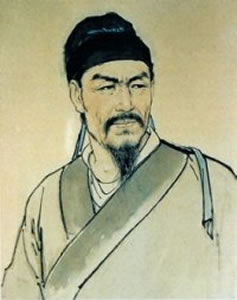
XinQiji

Xin Qiji (28 mei 1140 – 1207)
Louis-Ferdinand Céline, Jan Blokker, Niels ’t Hooft, Kaur Kender, Said, Adriaan Venema, John Barth

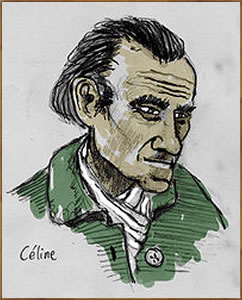
De Franse schrijver Louis-Ferdinand Céline (pseudoniem van Louis Ferdinand Destouches) werd geboren in Courbevoie op 27 mei 1894. Zie ook alle tags voor Louis-Ferdinand Céline op dit blog.


Uit: Reis naar het einde van de nacht (Vertaald door E.Y. Kummer)


“Dat was het eind van deze dialoog, want ik herinner me goed dat hij nog net tijd had om te zeggen: ‘En ’t brood?’ En toen niets meer. Daarna, alleen maar een vlam, met lawaai erbij. Maar dan een lawaai zoals je nooit zou geloven dat het bestond. M’n ogen, oren, neus en mond waren opeens zo vol lawaai dat ik werkelijk dacht dat dit het eind betekende, dat ik zelf vuur en lawaai was geworden.

Maar nee, de vlam verdween, het lawaai bleef lang in m’n hoofd hangen, en m’n armen en benen beefden alsof iemand ze van achteren heen en weer schudde. ’t Leek of mijn ledematen ervandoor gingen, maar ze bleven toch bij me. In de rook, die nog lang daarna in m’n ogen prikte, bleef de scherpe geur van kruit en zwavel hangen, alsof men de luizen en vlooien van de hele wereld wilde verdelgen.

Onmiddellijk daarop dacht ik aan wachtmeester Barousse, die zo juist uit elkaar gespat was, zoals de andere knaap ons verteld had. Dat was goed nieuws. ‘Prachtig!’ dacht ik meteen. ‘Dat is een hele grote ploert minder in het regiment!’ Hij had me voor de krijgsraad willen slepen voor een blik conserven. ‘Ieder z’n privé-oorlogje!’ zei ik bij mezelf. Van die kant bekeken, scheen de oorlog zo nu en dan wel z’n nut te hebben, dat moest ik toegeven! Ik kende nog wel drie of vier rotschoften in het regiment die ik, net als Barousse, graag aan een granaat had geholpen. Wat de kolonel betrof, die wenste ik geen kwaad toe. Toch was hij ook dood. Ik zag hem eerst niet meer. Dat kwam omdat hij door de ontploffing op het talud was geslingerd, languit op z’n zij, in de armen van de cavalerist te voet, de boodschapper, die ook dood was. Ze omhelsden elkaar, die twee, nu en voor eeuwig, maar de cavalerist had geen hoofd meer, je zag alleen een opening boven in z’n hals, met bloed erin dat klokkend sudderde, zoals jam in een pan. De buik van de kolonel was opengereten, z’n gezicht was afschuwelijk vertrokken. ’t Had hem beslist pijn gedaan, toen het gebeurde. Z’n eigen schuld! Als hij bij de eerste kogels weg was gegaan, was hem dit niet overkomen.”


Celine

Louis-Ferdinand Céline (27 mei 1894 – 1 juli 1961)


De Nederlandse schrijver, journalist en columnist Jan Blokker werd geboren in Amsterdam op 27 mei 1927. Zie ook alle tags voor Jan Blokker op dit blog.


Uit: Serven aan de Schelde


‘Hollanders’, zegt Louis Seynaeve in Het verdriet van België tegen zijn vriendin, ‘Hollanders verstaan geen kloten, Constance. Zij interesseren zich helemaal niet aan België.’

Maar het land ligt wel bij ons om de hoek, ze spreken er voor de helft een taal die op de onze lijkt, ze hebben een federale minister-president die in vergelijking met Balkenende nog heel wat lijkt omdat hij in drie jaar nog pas twee kabinetten heeft verklungeld, maar daar staat tegenover dat hij in die tijd al drie keer naar z’n koning terug moest omdat hij geen formatie rondkreeg, en dat hij het verschil niet kent tussen de Brabançonne en de Marseillaise. In het 1-uur-nieuws van de VRT vroegen ze aan de voorzitster van de Vlaamse socialisten of de geboren christen-democraat Leterme nog kans zal zien om Leterme II een doorstart te bezorgen. De voorzitster lachte vriendelijk, en zei: ‘Ach, Leterme. Daar is geen depanneren aan.’

We kunnen veel herkennen, maar niettemin: geen belangstelling. Toen vorige week de Vlaamse liberalen onaangekondigd met hun regering braken, had ons Journaal daar een itempje van twintig seconden voor over, in sommige avondkranten was het nieuws als kortje op een economiepagina terechtgekomen, en de volgende ochtend las ik de column van iemand die toegaf dat hij niets van dat BHV-gedoe begreep, maar uit wiens toon je kon afleiden dat hij er eigenlijk heel trots op was dat die onzin hem boven de pet ging. Wel columns schrijven, maar te lui om het nieuws van de buren bij te houden.“


Blokker

Jan Blokker (Amsterdam, 27 mei 1927)
Getekend door Peter van Straaten


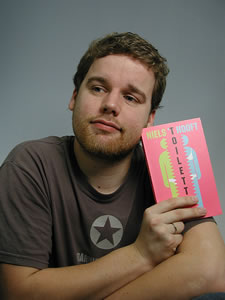
De Nederlandse schrijver, journalist, blogger en gamedeskundige Niels ’t Hooft werd geboren in Leiderdorp op 27 mei 1980. Zie ook alle tags voor Niels ‘t Hooft op dit blog.


Uit: Toiletten


Je zei: ‘Er zijn cafés in de straat, laten we daar eens naar toe gaan.’
Het was een onbekende buurt in een stad waar ik wel eens in winkels had geneusd. Mijn moeder op zoek naar mooie kleren die toch goedkoop zijn en ik naar plekken waar ze videogames verkopen.
We liepen langs spiegels, voorbij het grofvuil. We zagen de reflectie van onze eigen benen en dat was tof. Het kon zo in een videoclip. Ik keek om me heen en probeerde de indrukken zo goed mogelijk in me op te nemen en vast te leggen, als het beste fototoestel van Nederland.
Dit was het dan. Mijn nieuwe leven was begonnen.
Als ik mijn Game Boy bij me had gedragen, dan had ik hem nonchalant achter me gegooid, want ik had hem niet meer nodig. Ik zag het grijze ding kletteren: het Dit Matrix scherm schoot los, zoals het van ouderdom vanzelf losging, het ketste tegen de straat en vloog omhoog, de klep van de batterijen vloog eraf, en de batterijen zelf, die doken erachteraan. Ik sprong erop. Krak, net als Mario dat doet om met zijn opponenten af te rekenen. In een flits was de kapotte Game Boy een blauwe schildpad met stekels; ik stelde me voor hoe ik erop landde, hoe de stekels zich een weg baanden door mijn schoenzolen en hoe ik het leven liet. Je moet het een keer meegemaakt hebben voordat je ze de volgende keer kunt ontwijken. Je kunt dan rustig een andere strategie bedenken. Zo sterk zien die beesten er niet uit, er moet een manier zijn om met ze af te rekenen zonder stekels in je zolen te krijgen. Het denkbeeldig gebroken plastic liet ik achter me.
Ik probeerde je hand te pakken, maar dat stond je niet toe. Je vond dat stom, meer iets voor kinderen, of voor moeders met kinderen. Ik tuurde om me heen, hield onder mijn linkerarm een grote doos. Daar zat een Super Nintendo in. Die was anders dan de gameboy. Dierbaar, kostbaar, het nieuwste van het nieuwste o
f toch zeker pas drie jaar oud, iets om nog wat beter over na te denken voor ie zonder pardon in de goot werd geworpen of in de gracht, tussen de brokken piepschuim en de half gezonken boten.”


Niels 't Hooft

Niels ’t Hooft (Leiderdorp, 27 mei 1980)


De Estse schrijver Kaur Kender werd geboren op 27 mei 1971 in Estland. Zie ook alle tags voor Kaur Kender op dit blog.


Uit: Through Peaceful Eyes (Vertaald door Jurgen Kaljuvee)


„Every time you think of me the bells are singing somewhere. I am lying down, my body is in heat. Every part of me you touched hums. I am lying in the bed, the window is open, you are everywhere and you are getting increasingly closer to me. Your voice is sounding in the clatter of trams, in the rumble of the cars, your look is in the neon lights, in traffic lights, in street lights, your hair is waving in the trees, your pride is in the church towers and tall buildings. You are everywhere: your hurry is in the hourly radio news, people shaking in trolleys and trams feel your solitude, your tenderness and care is in the children marching across the street, your secrets are behind the dark windows of the the abnormally parked jeeps, your impatience is in the people waiting behind the traffic lights, your indifference is in the smiling tourists, your contempt is in the large street adverstisments. Your peace is in the morning mist and your search is in the car lights gleaming through the mist, your existence, your presence is in the parking tickets, your memories are in the Toompea viewing platforms, your past and the future are at this graveyard reachable by the noise of cars, and sometimes a thought about you rests there as well. All the flower shop vases are full of your smiles, every café is full of your leisurely moments, some have many, some very few. Your sudden appearance is in all the the ringing mobile phones, every plane taking flight is your desire to leave, each plane landing your delight of arrival, every passing train has an unused opportunity of yours, every train passing the bridge has your superstition and out there by the sea, there, on those rocks, at the sunset is your faith, your decision, your strength. Your love … Look at me through your peaceful eyes. Love is in your eyes.“


Kender

Kaur Kender (Estland, 27 mei 1971)


De Duits-Iraanse dichter en schrijver Said werd geboren op 27 mei 1947 in Teheran. Zie ook alle tags voor Said op dit blog.


Für mich
riechen deine Hände nach Muskat
und Kindertagen.

Für mich
ist dein Mund ein sanftes Ufer,
nahgespült und unbewacht.

Für mich
hat sich das Blau deiner Augen
zurückgezogen zu meinen Schiffen.
Wir schlafen auf dem Flußbrett.
Fische von damals kommen
und küssen uns die Zehen.


Die Farbe der Liebe ist blau,
ich weiß.
Nur,
daß diese Erde –
genarbt von unseren Küssen –
mit ihren gebrochenen Farben
auf uns lastet.
Der Fesselballon
trägt die Wurzeln in der Hosentasche.
Ich habe dich
mit einer Wolke verwechselt.


said

Said (Teheran, 27 mei 1947) (Teheran, 27 mei 1947)


De Nederlandse journalist, schrijver en kunsthandelaar Adriaan Harrie Venema werd geboren in Heiloo op 27 mei 1941. Zie ook alle tags voor Adriaan Venema op dit blog.


Uit: Schrijvers, uitgevers en hun collaboratie. Deel 3B S. Vestdijk


Overigens had Vestdijk op 5 september al in Het Parool een artikel gepubliceerd, getiteld ‘Wel Duitsch op school’. Vestdijk nam hierin duidelijk stelling tegen hen die vonden dat het Duits als leervak op middelbare scholen niet gehandhaafd moest worden. Vrij Nederland behoorde tot de tegenstanders van het Duits als leervak. Het blad poneerde een mening die niet was mis te verstaan: ‘Afschaffing van het Duitsch als leervak is een waardig, scherp en blijvend protest van het geheele Nederlandsche volk tegen de gebeurtenissen van 10 Mei 1940 tot 7 Mei 1945. Afschaffing van het Duitsch als leervak ontlast het overladen onderwijsprogramma en maakt tijd vrij, veel beter te besteden aan andere vakken als Nederlandsch, vaderlandsche geschiedenis, Engelsch en Fransch. Door afschaffing van het Duitsch als leervak beschermt het Nederlandsche volk zich tegen een naburigen haard van geestelijke besmetting, welks gevaarlijkheid nog vergroot wordt door de nauwe verwantschap van beide talen en door de geestesgesteldheid van zeer velen, wier moedertaal het Duitsch is.

Handhaving van het verplichte onderwijs in het Duitsch beteekent ernstige en onnodige verzwakking van de positie der Nederlandsche beschaving, dus van Nederland, tegenover een gevaarlijken buur.’

We kunnen ons de geestelijke benauwenis die in de eerste naoorlogse jaren heerste en die mensen tot dit soort opinies bracht nauwelijks meer voorstellen. De afschaffing van het Duits als leervak, alleen omdat de nationaal-socialisten deze taal spraken en schreven, is al even benepen als, bijvoorbeeld, het taboe dat in het hedendaagse Israël rust op de muziek van Wagner, enkel en alleen omdat de nationaal-socialisten in die muziek, die ze zonder twijfel niet begrepen, wat van hun waanideeën terugvonden.

Vestdijk intussen had van een dergelijke benepenheid geen last. Hij was vóór het leervak Duits. ‘Men las wel eens, dat het hier ging om een “waardig protest” tegen… ja, tegen wien of wat eigenlijk?’ schreef hij. ‘Tegen Duitschland? Nederland heeft vijf jaar lang met voldoende waardigheid tegen de Duitsche overheersching geprotesteerd om dit eenigszins holle gebaar er niet aan toe te voegen. Men krijgt trouwens den indruk dat hier minder de behoefte aan “protest” in het spel is dan wel de zucht naar wraak.’


nol-gregoor-en-simon-vestdijk

Adriaan Venema (27 mei 1941 – 31 oktober 1993)
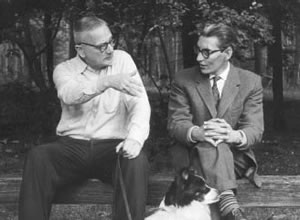
Vestdijk en zijn biograaf Nol Gregoor


De Amerikaanse schrijver John Barth werd geboren op 27 mei 1930 in Cambridge, Maryland. Zie ook alle tags voor John Barth op dit blog.


Uit: Coming Soon!!!


„Call me ditsy, call me whatchadurn please; just an old-fart Chesapeake progger’s what I am, with more orneriness than good sense — else I wouldn’t be sitting here a-hunting and a-pecking on “Big Bitsy’s” ergonomic keyboard whilst the black wind roars and the black water rises and the power flickers and the cabin shakes. I’d’ve hauled my bony butt across Backwater Strait to high ground over in Crassfield whilst the hauling was still doable, before the storm-surge from Zulu Two (stay tuned) puts Hick Fen Island* eight fingerforking feet under Backwater Sound.

“Whoa ho there, Dits,” my mind’s ear hears the gentle reader gently interpose: “Where’s Hick Fen I.? Where’re Backwater Sound and ditto Strait and mainland Crassfield? Who’s Zulu Two, and whaddafug’s a progger, and who’s thissere EARL character, that you haven’t even mentioned yet?”

All in good time, mon semblable et cet, which Yrs Truly don’t happen to have a whole skif?oad of just now. Anyhow, old Ditsy-Belle’s a gal that likes her stories straight up, if you read me: Get things going, says I, then cut to the chase, or old Dits’ll chase to the cut. Once upon a time’s about as far as we’ll go in the way of wind-up for your pitch. You say It was a dark and stormy night? We copy, mate: now on with the story, ess vee pee.

Ditsy-Belle, Ditsy-Boy: I’ve done time in my time as mainly male and ditto feem; have attained the age where what’s between my legs matters less to either of us than what’s between my ears or just twixt you and me. Which is to say, a certain high-density disk-in-the-hand that I progged from the bush this morning after Zulu One (a dark and stormy night forsooth) in the westmost marshes of B.E.W.A.R.(E.), the Backwater Estuarine Wetlands Area Reserve (East): a double-sided disk triple-zipped in a ZiplocTM baggie inside another inside another and hence bone-dry enough, as bones go hereabouts, that I could read its blot-free label through all three bags in the mucky marshgut whither it’d wended from wherethefuckever.“


barth-john

John Barth (Cambridge, 27 mei 1930)


 Zie voor nog meer schrijvers van de 27e mei ook mijn vorige blog van vandaag.

Herman Wouk, John Cheever, Dashiell Hammett, Georges Eekhoud, Max Brod, Arnold Bennett, Richard Schaukal, Ferdynand Ossendowski, M. A. vonThümmel

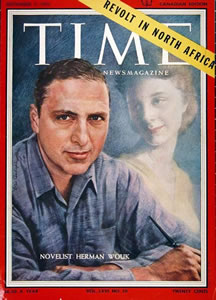
De Amerikaanse schrijver Herman Wouk werd geboren op 27 mei 1915 in New York. Zie ook alle tags voor Herman Wouk op dit blog.


Uit: The Caine Mutiny


“Mr. Keefer,” said the judge advocate, “at any time prior to 18 December were you informed that Maryk suspected Queeg of being mentally ill?”

“Yes.”

“Describe how you learned this fact.”

“At Ulithi, about two weeks before the typhoon, Maryk showed me a medical log he’d kept on Queeg’s behavior. He asked me to come with him to the New Jersey to report the situation to Admiral Halsey.”

“What was your reaction to the medical log?”

“I was dumfounded to learn that Maryk had kept it.”

“Did you consent to go with him?”

“Yes.”

“Why?”

“Well, I was stunned. And I–that is, he was my superior officer and also my close friend. I didn’t consider refusing.

“Did you believe that the log justified the relief of Queeg?”

“No. when we arrived aboard the New, Jersey, I told him as forcibly as I could that in my opinion the log would not justify the action, and that both of us would be liable to a charge of combining, to make a mutiny.”

“What was his response?”

“He followed my advice. We returned to the Caine and no further reference was made by either of us to the log or to Queeg’s mental condition.”

“Did you inform the captain of Maryk’s log?”

“I did not.”

“Why not?”

“It would have been disloyal and contrary to the best interests of the ship to stir up my captain against my executive officer. Maryk had evidently abandoned his intention to pursue the matter. I considered the matter closed.”


hermanwouk

Herman Wouk (New York, 27 mei 1915)
Time Magazine Cover van 5 september 1955


De Amerikaanse schrijver John Cheever werd geboren op 27 mei 1912 in Quincy, Massachusetts. Zie ook alle tags voor John Cheever op dit blog.


Uit: Bullet Park


„–”How is your horrid country?”

–”You can look all over the world but you won’t find neighbors as kind and thoughtful as the people in Bullet Park.”

–He possesses for a moment the curious power of being able to frighten himself.

–”Oh, I wish it would never get dark—never. I suppose you know all about that lady who was mistreated and strangled on Maple Street last month. She was my age and we had the same first name. We had the same horoscope and they never found the murderer…”

–I heard her swear and a moment later I heard the noise of falling glass, and why is this sound so portentous, so like a doomcrack bell?

–He turned on a light and saw how absorbed his son was in the lisping clown.

—society had become so automative and nomadic that nomadic signals or means of communication had been established by the means of headlights, parking lights, signal lights and windshield wipers. Hang the child murderer. (Headlights.) Reduce the state income tax. (Parking lights.) Abolish the secret police. (Emergency signal.) The bishop had suggested that churchgoers turn on their windshield wipers to communicate their faith in the resurrection of the dead and the life of the world to come.

–The place had long ago gone to seed and had then been abandoned. The water traps were dry, the windmill had lost its sails and the greens were bare concrete but most of the obstacles were intact and on summer nights men and boys still played the course although there were no trespassing signs all over the place.

–”I was feeling good too but we have a problem here and we can’t evade it just because the veal birds smell good.”

–The man explained that he was after draft evaders because he had spent a year and a half in a POW camp in Germany, eating rats and mice. He wanted the younger generation to learn what it was all about.“


john-cheever

John Cheever (27 mei 1912 – 18 juni 1982)


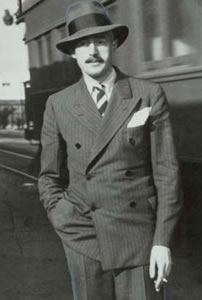
De Amerikaanse schrijver Dashiell Samuel Hammett werd geboren in Saint Mary’s County (Maryland), op 27 mei 1894. Zie ook alle tags voor Dashiell Hammett op dit blog.


Uit: The Thin Man


„I was leaning against the bar in a speakeasy on Fifty-second Street, waiting for Nora to finish her Christmas shopping, when a girl got up from the table where she had been sitting with three other people and came over to me. She was small and blonde, and whether you looked at her face or at her body in powder-blue sports clothes, the result was satisfactory. “Aren’t you Nick Charles?” she asked.

I said: “Yes.”

She held out her hand. “I’m Dorothy Wynant. You don’t remember me, but you ought to remember my father, Clyde Wynant. You–”

“Sure,” I said, “and I remember you now, but you were only a kid of eleven or twelve then, weren’t you?”

“Yes, that was eight years ago. Listen: remember those stories you told me? Were they true?”

“Probably not. How is your father?”

She laughed. “I was going to ask you. Mamma divorced him, you know, and we never hear from him–except when he gets in the newspapers now and then with some of his carryings on. Don’t you ever see him?”

My glass was empty. I asked her what she would have to drink, she said Scotch and soda. I ordered two of them and said: “No, I’ve been living in San Francisco.”

She said slowly: “I’d like to see him. Mamma would raise hell if she found it out, but I’d like to see him.”

“Well?”

“He’s not where we used to live, on Riverside Drive, and he’s not in the phone book or city directory.”


Hammett

Dashiell Hammett (27 mei 1894 – 10 januari 1961)


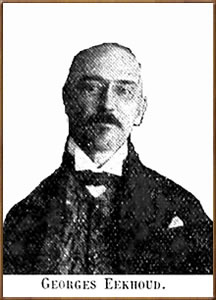
De Belgische Franstalige schrijver Georges Eekhoud werd in Antwerpen geboren op 27 mei 1854. Zie ook alle tags voor Georges Eekhoud op dit blog.


Uit: L’autre vue ou Voyous de velours


„Apres l’homme domestique ou l’ouvrier, il m’aurait plu de voir un nouveau Barye s’attaquer á l’homme fauve, préférer le truand au peinard, comme il célébra le tigre et le loup plutôt que le boeuf et le chien .

Et quel musicien transposerait en son art leurs insidieuses modulations, le timbre de leur voix gutturales, ces intonations imprévues, cette façon de redoubler, en s’appelant les uns les autres, la derniere voyelle de leur noms, par un coup de gosier semblable á un sanglot et qui me donne chaque

fois la chair de poule : Palu …hul, Bugu…hutte ! Zwolu hue !..

Mais le verbe lui-même parviendrait-il á s’assimiler le fluide de ces enfants de la libre aventure ; le fumet de cette venaison humaine ? Par exemple, á certaines heures oú ils me paraissaient tellement saturés de vie et de jeunesse, que je m’évoque jusqu’au graillon de leur baiser et la saumure de leur salive !

L’autre jour, je m’imaginais être cet artiste absolu : poete, sculpteur, peintre et musicien, le tout á la fois . Que dis-je ? Un instant je crus même avoir usurpé la suprême béatitude réservée aux seuls dieux .

La force physique, l’adresse, la résistance musculaire fournissent le theme principal des causeries de mes inséparables et le prétexte á leurs jeux . Ce jour donc, ils m’entraînerent dans leur gymnase, pompeusement intitulé Arenes athlétiques . Représentez-vous, au fond d’un étroit boyau du quartier des Marolles, ironiquement appelé rue de la Philanthropie, un asez vaste hangar, ancien atelier de charron, ou magasin de chiffonniers, dans lequel on pénetre par un bouge ne différant des autres taudis de la ruelle que par les photographies des célébrités foraines accrochées aux parois .

Sur la lice jonchée de tan et de sciure de bois, dont l’odeur résineuse se mêle á des émanations humaines, s’éparpillent des halteres et des poids . A travers la buée opaque et rousse, á peine combattue par une fumeuse lampe á pétrole, je démêle les habitués de l’endroit, des apprentis pour la

plupart, venus en grand nombre á cause du samedi soir.“


georges_eekhoud

Georges Eekhoud (27 mei 1854 – 29 mei 1927)


De Tsjechisch-Israëlische dichter, schrijver, criticus en componist Max Brod werd geboren in Praag op 27 mei 1884. Zie ook alle tags voor Max Brod op dit blog.


Uit: Beinahe ein Vorzugsschüler oder Pièce Touchée


„Für die Palästinawanderung der vielen Tausenden, ja Zehntausenden von Prager Zionisten hatte die großmütige englische Regierung damals genau zehn Einwanderungserlaubnisse oder Zertifikate bereitgestellt, nicht mehr und nicht weniger. Sie hätte alle retten können; sie wußte, daß die Deutschen sich zum Einmarsch in Prag rüsteten, wußte, daß jeder Jude, der zurückblieb, verloren war – sie machte auch einige schwache Rettungsansätze und brachte noch manch einzelnen in letzter Minute in Sicherheit –, im ganzen aber zog sie es vor, den überwiegenden Rest der jahrhundertalten Gemeinde Prag an Hitlers Schlachtmesser zu liefern.“


max_brod

Max Brod (27 mei 1884 – 20 december 1968)


De Engelse schrijver Arnold Bennett werd geboren in Hanley, Staffordshire, op 27 mei 1867. Zie ook alle tags voor Arnold Bennett op dit blog.


Uit: The Price Of Love


“THE dramatic moment of the birthday feast came A nearly at the end of the meal when Mrs. Mal- don, having in mysterious silence disappeared for a space to the room behind, returned with due pomp bearing a parcel in her dignified hands. During her brief absence Louis, Rachel, and Julian—hero of the night—had sat mute and somewhat constrained round the debris of the birthday pudding. The constraint was no doubt due partly to Julian’s characteristic and notorious grim temper, and partly to mere anticipation of a solemn event. Julian Maldon in particular was self-conscious. He hated intensely to be self-conscious, and his feeling towards every witness of his self-consciousness partook always of the homicidal. Were it not that civilization has the means to protect itself, Julian might have murdered defenseless aged ladies and innocent young girls for the simple offense of having seen him blush. He was a perfect specimen of a throw-back to original ancestry. He had been born in London, of an American mother, and had spent the greater part of his life in London. Yet London and his motherseemed to count for absolutely nothing at all in his composition. At the age of seventeen his soul, quitting the exile of London, had come to the Five Towns with a sigh of relief as if at the assuagement of a long nostalgia, and had dropped into the district as into a socket. In three months he was more indigenous than a native. Any experienced observer who now chanced at a week-end to see him board the Manchester express at Euston would have been able to predict from his appearance that he would leave the train at Knype. He was an undersized man, with a combative and suspicious face. He regarded the world with crafty pugnacity from beneath frowning eyebrows.“


Arnold_Bennett

Arnold Bennett (27 mei 1867 – 27 maart 1931)


De Duitse dichter en schrijver Richard von Schaukal werd geboren op 27 mei 1874 in Brünn. Zie ook alle tags voor Richard von Schaukal op dit blog.


Traurige Mär


Ich gab mein Herz einem blonden Kind,

sie nahm’s und lachte.

Ich wusste nicht wie die Kinder sind,

ich freute mich und dachte:

“Nun legt sie’s zärtlich in den Schrein

und wird es waren”.

Sie aberwärf’s in den Tag hinein,

der Stunden wagen fuhr polternd drein:

Da ward es überfaren.


Schaukal

Richard von Schaukal (27 mei 1874 – 10 oktober 1942)


De Poolse schrijver, journalist, ontdekkingsreiziger en globetrotter Ferdynand Ossendowski werd geboren op 27 mei 1876 in Dvina. Zie ook alle tags voor Ferdynand Ossendowski op dit blog.


Uit: Beasts, Men And Gods


„”Stop!” whispered my old Mongol guide, as we were one day crossing the plain near Tzagan Luk. “Stop!”

He slipped from his camel which lay down without his bidding. The Mongol raised his hands in prayer before his face and began to repeat the sacred phrase: “Om! Mani padme Hung!” The other Mongols immediately stopped their camels and began to pray.

“What has happened?” I thought, as I gazed round over the tender green grass, up to the cloudless sky and out toward the dreamy soft rays of the evening sun.

The Mongols prayed for some time, whispered among themselves and, after tightening up the packs on the camels, moved on.

“Did you see,” asked the Mongol, “how our camels moved their ears in fear? How the herd of horses on the plain stood fixed in attention and how the herds of sheep and cattle lay crouched close to the ground? Did you notice that the birds did not fly, the marmots did not run and the dogs did not bark? The air trembled softly and bore from afar the music of a song which penetrated to the hearts of men, animals and birds alike. Earth and sky ceased breathing. The wind did not blow and the sun did not move. At such a moment the wolf that is stealing up on the sheep arrests his stealthy crawl; the frightened herd of antelopes suddenly checks its wild course; the knife of the shepherd cutting the sheep’s throat falls from his hand; the rapacious ermine ceases to stalk the unsuspecting salga. All living beings in fear are involuntarily thrown into prayer and waiting for their fate. So it was just now. Thus it has always been whenever the King of the World in his subterranean palace prays and searches out the destiny of all peoples on the earth.”


ferdynand_ossendowski

Ferdynand Ossendowski (27 mei 1876 – 3 januari 1945)


De Duitse dichter en schrijver Moritz August von Thümmel werd geboren op 27 mei 1738 in Schönefeld. Zie ook alle tags voor Moritz August von Thümmel en voor August von Thümmel op dit blog.


Uit: Reise in die mittäglichen Provinzen von Frankreich im Jahre 1785-1786


„Freund! Ich bin nun gerettet – wie ein Fisch, der den Köder vom Faden gebissen hat, und mit dem Angelhaken in der Gurgel davon schwimmt. Hätte ich, zu einem Bettler herab gesunken, mein Land verlassen müssen, wo ich als König regierte, bänger hätte mir [313] kaum um das Herz seyn können, als da mir nun die Wohnung der Unschuld und Freude im Rücken – und, abgeschnitten von allem, was mir lieb war, die ganze weite freudenlose Welt vor mir lag. Ach! nichts begleitete mich, als mein trauriger Schatten. – Mir fehlte Margots sonorische Stimme – ich vermißte den Nachtrab meines treuen schwatzhaften Johann, und mein zerstreuter Blick, der selbst manchmal sich nach meinem guten asthmatischen Mops umsah, kehrte betroffen über seinen Verlust zurück. Und o wie viele andere stachlichte Empfindungen – die ich aus Zärtlichkeit gegen mich nicht berühren mag – kletteten sich nicht an dieses belastende Gefühl von Trennung und Einsamkeit! Es war mir, als ob an jedem Pflasterstein, über den ich auf meinem Wege fortschritt, ein Theil meines Eigenthums hängen blieb, so daß ich es mit jeder Minute kleiner, unbedeutender werden, und zuletzt in ein Nichts verschwunden sah.

Ich konnte es nicht über mich gewinnen, auf der Chaussee fort – bei der steinernen Bank vorbei zu gehen, auf der sich meine Eigenliebe, und, wie Du weißt, ganz ohne Noth, brüstete, und aus einem Mißverständnisse, das ich mir noch nicht vergeben kann, in so lebhafte Bewegung gerieth. In solchen Umständen, lieber Eduard, ist es sehr bequem, wenn man neben der Landstraße noch einen Rasenweg findet.“


Moritz_august_von_thuemmel

Moritz August von Thümmel (27 mei 1738 – 26 oktober 1817)

Alan Hollinghurst, Hugo Raes, Radwa Ashour, Ivan O. Godfroid, Isabella Nadolny, Vítězslav Nezval, Maxwell Bodenheim, Edmond De Goncourt, Mary Wortley Montagu, Machteld Brands

De Britse schrijver Alan Hollinghurst werd geboren op 26 mei 1954 in Stoud, Gloucestershire. Zie ook alle tags voor Alan Hollinghurst op dit blog.

Uit: Die Schönheitslinie (Vertaald door Thomas Stegers)


Heute Abend, acht Uhr, war er zu einem Blinddate verabredet, und der heiße Augusttag war bestimmt vom Flimmern der Nerven, unterbrochen von Schönwetterperioden lüsterner Träumereien. Das Date war nicht gänzlich “blind” – “nur sehr kurzsichtig”, wie Catherine Fedden sich ausgedrückt hatte, als Nick ihr das Foto und den Brief gezeigt hatte. Anscheinend gefiel ihr das Äußere des Mannes, der Leo hieß und auch gut ihr Typ hätte sein können, wie sie gestand; nur seine Handschrift erschreckte sie: Sie wirkte kunstvoll und gleichzeitig ungestüm. Catherine besaß ein Taschenbuch, ‘Grafologie’: ‘Der Charakter in der Hand’, das alle möglichen Warnungen vor den Neigungen und Hemmungen der Menschen enthielt (“Künstler oder Verrückter?”, “Schoßhündchen oder Reißwolf?”). “Diese wahnsinnigen Oberlängen, Darling”, sagte sie. “Dahinter steckt jede Menge Ego.” Wieder hatten sie sich mit spitzen Lippen über den kleinen Bogen billigen, blauen Briefpapiers gebeugt. “Und das bedeutet nicht zufällig bloß einen starken Sexualtrieb?”, fragte Nick. Sie hatte das verneint. Er war sehr aufgewühlt und sogar ziemlich gerührt über diesen Brief eines völlig fremden Menschen; aber es stimmte, der Text an sich weckte kaum Erwartungen. “Nick – OK! Habe deinen Brief erhalten. Arbeite in der Personalabteilung (London, Bezirk Brent). Wir können uns treffen, uns über Interessen und Wünsche unterhalten. Wann? Wo?” – und dann ein riesiges, wucherndes L für Leo, das die ganze untere Hälfte des Blattes einnahm.
Wenige Wochen zuvor war Nick in das große, weiße Haus der Feddens in Notting Hill eingezogen. Sein Zimmer befand sich unterm Dach und war mit seinem Fluidum von Teenager-Heimlichkeiten und -Trotz eindeutig dem Kinderbereich zuzuordnen. Tobys aufgeräumte Bude lag am Kopf der Treppe, Nicks Zimmer ein Stück weiter den durch eine Dachluke erhellten Flur entlang und Catherines am Ende. Nick hatte keine Geschwister, aber hier konnte er sich in die Rolle eines verlorenen mittleren Kindes hineinversetzen. Es war Toby, der ihn hergebracht hatte, früher schon, in den Ferien, seine “Saison” in London über – eine lang anhaltende, anregende Auszeit von seiner eigenen, alles andere als glanzvollen Familie -; und es war Toby, dessen Gestalt, halb bekleidet, noch immer hier herumspukte.“


dd_hollinghurst

Alan Hollinghurst (Stoud, 26 mei 1954)


De Egyptische schrijfster en literatuurwetenschapster Radwa Ashour werd geboren op 26 mei 1946 in Caïro. Zie ook alle tags voor Radwa Ashour op dit blog.


Uit: Siraaj. An Arab Tale (Vertaald door Barbara Romaine)


„She had been a lisping child not four feet tall when her grandfather took her with him. It was a night when the full moon cast its light on the men and the sea. Mounted on camels, they made their way along the beach, singing. She was afraid, despite the singing, the moonlight, and her grandfather’s strong arm encircling her as she rode before him on the camel. The sea was at ebb tide, and they advanced farther and farther into the wet sand, searching for ambergris. She stared at the moon in alarm, then turned and buried her head in her grandfather’s shoulder, and began to cry, begging him to take her back to her mother. Did her heart know, then, and speak to her?

Men go to sea, they go and then they come back . . . they go and then they don’t come back, so the women go out to wait for them, their shoulders rigid with fear, furrows of anxiety etched in their faces. Amina saw it all: the women striking their cheeks in lamentation, when they knew for certain, rending their garments, wailing with cries that split the air, cleaving it in two as the executioner’s blade cleaves the living head from the body.

They say that the sea is generous; even as she fears its treachery, she never admits her fear, but rather dissimulates, even to her own heart.“


radwa

Radwa Ashour (Caïro, 26 mei 1946)


De Belgische schrijver Hugo Raes werd geboren in Antwerpen op 26 mei 1929. Zie ook alle tags voor Hugo Raes op dit blog.


Uit: Bankroet van een charmeur


„Het type van Johan: de wijze, de succesfilosoof, de intellectueel aandoende, of een beeld gevend van wat cafévrouwen zich als romantische intellectuelen voorstellen. De rol spelend van de man met geld. De vlotte heer met rijzige gestalte, met maniertjes, de man die de wereld kent, de he-man met allure, de rustigheid van: ‘Ik ben 37 jaar hoor, weet jij wel wat dat betekent? Maar wijven zijn mijn ongeluk, Peter, ze laten me niet met rust.’

Ik glimlach, knik, gelijkgevend, dat heeft hij graag.

Ik kom ergens binnen, ik zie even rond, daar zit er al een mij te begluren. Maar zeg, ik word ook al eens moe, hoor. Ik ben geen jonge snaak meer. Ik ga naar de veertig. Maar wat wil je, ze hangen aan mijn arm, ze zuigen zich aan mij vast. Ook al was ik niets van plan: ze komen op me af als vliegen op een klontje suiker.

Tik (weer bier).

‘Het bier is weer best’ zeg ik.

‘Het bier is weer best’ herhaalt hij met kleine schokjes lachend. Hij rookt, blaast ostentatief, loert rond met zijn brutale oogjes.

We rijden met zijn Fiat 1800 met sport-knalpot, rukkend door de stad, zoeken weer een ander schuin café op. We proberen geregeld een nieuwe kroeg. Hij danst een beetje loom en totaal ontspannen met meiden, doet ze intussen lachen, overdondert met zijn zelfzekerheid, met zijn opdringerigheid. Een vliegenpikker moet opdringerig kunnen zijn. Zij speuren haast altijd naar stille vrouwen, naar de zwijgzamen. Dikwijls zijn de passieven gemakkelijke prooien. Soms zoeken ze zulke vrouwen onbewust. Of lelijke vrouwen, daar heb je een dankbare prooi aan, die zijn altijd verrukt, direkt verkocht, werpen zich open als een geslacht en gereinigd rund. Vele passieve, lelijke of onzekere vrouwen, zijn types die zich in toom houden, omdat ze angst hebben van zichzelf, van hun losbrekend zelf. Zij die huilend en krochend stukgaan. Daarnaar speuren zij, de geoefende vrouwenkenners.

‘Ik’, zegt hij, ‘ik schijn het te hebben voor de magere types. Als ik zo eens overschouw welke mijn figuren zoal waren, dan sta ik er zelf een beetje verbaasd over: mijn eerste vrouw, mijn tweede vrouw, die van mij weggelopen is, mijn derde, die je kent, dan Betty, Loulou van de Prado, en tenslotte mijn jong ding, ‘kindje’.“


Raes

Hugo Raes (Antwerpen, 26 mei 1929)


De Belgische, Franstalige, schrijver en essayist Ivan O. Godfroid werd geboren in Boussu op 26 mei 1971. Zie ook alle tags voor Ivan O. Godfroid op dit blog.


Uit: Glam dicinn


Note n° 25

Il était une fois (c’était, ah ! mais il y a fort longtemps : en un temps où l’océan recouvrait toutes terres), un pauvre pauvre pauvre pêcheur de perles qui vivait dans une hutte, sur le rivage effilé d’un croissant de sable. Il plongeait chaque matin dans la mer turquoise, chaude, et claire, et calme. Il y plongeait longtemps, retenant son souffle, très profond, jusqu’au fond. Il y plongeait à la recherche de ces longues huîtres au cœur d’argent, desquelles il remontait ses perles noires.

Un jour (un de ces jours sans pareil – mais tous les jours sont mortels, n’est-ce pas ?), le pêcheur fut attiré par une lueur inhabituelle qui semblait venir des entrailles de la mer. Cette lueur l’intrigua tant qu’il délaissa la parcelle perlière qui lui portait chance, pour découvrir l’origine de cette clarté surnaturelle. Il plongea de plus belle, s’enfonçant vers la nuit éternelle.

Il aperçut alors la béance gigantesque d’un tridacne abyssal. Jamais un tel bénitier n’avait existé de mémoire de pêcheur de perles… Il s’en approcha lentement, presque respectueusement, et la crainte se mêlait en son sang à l’excitation. La lueur blafarde provenait du cœur du coquillage monstrueux. Le pêcheur voulut s’en approcher pour mieux voir, mais le tridacne resserra aussitôt ses mâchoires.

Il dut attendre à bonne distance, luttant contre l’asphyxie. Et le bénitier s’ouvrit à nouveau, brisant l’obscurité sourde et oppressante. C’est à cet instant que le pêcheur la vit pour la première fois. Elle était d’une beauté nacrée, à la fois fragile et éternelle. Elle semblait s’éveiller, et ses yeux d’albâtre grandissaient à mesure que, doucement, elle se dressait. Il voulut la regarder encore, mais son corps implorait, et il remonta.


godfroid

Ivan O. Godfroid (Boussu, 26 mei 1971)


De Duitse schrijfster Isabella Nadolny (eig. Isabella Peltzer) werd geboren op 26 mei 1917 in München. Zie ook alle tags voor Isabella Nadolny op dit blog.


Uit:  Die Stunden vor Morgengrauen


„»Wenn wir«, sagte mein Bruder Leo, »jeden Sommer zu viert auf Sommerfrische gehen, so kostet das pro Jahr . . . Wartet mal.« Er griff nach einem Blatt Papier und fragte mich über die Schulter:

»Wie lange dauern deine Ferien eigentlich?«

Ich gab mürrisch Auskunft. Gegen die Autorität eines um elf Jahre älteren Bruders war nichts auszurichten.

»Und zwei Jahre mußt du doch noch zur Schule gehen – ist sowieso wenig genug«, murmelte er, »zweimal Ferien à sechs Wochen. Also das macht . . .« Er blinzelte gegen den Rauch seiner Zigarette und rechnete. »Da ist es viel billiger, wir bauen uns ein Sommerhaus.«

Er strich die Zahlen aus und begann einen Grundriß zu zeichnen. Wir saßen im Eßzimmer, Mama in dem Sessel unter dem Porträt, so daß man prüfen konnte, ob es ähnlich genug war. Nur drei der vielen Porträts, die von Mama gemalt worden waren, hatten in unserer Wohnung Platz gefunden, einer großen, altmodischen Wohnung mit hochherrschaftlichen Stuckdecken.

»Ein Sommerhaus«, sagte Mama und drehte mit gedankenvoll gerunzelter Stirn an ihrem Ring, »ein Sommerhaus wäre fein. Man könnte einen Hund dort halten!«

Hunde und Pferde waren vielleicht das einzige, was Mama seit jenem Tage entbehrt hatte, als sie neunzehnjährig das Schloß ihrer Ahnen verließ, um zu heiraten. Hätte sie, der Pferde und Hunde wegen, damals den ungarischen Offizier genommen, der sie so glühend verehrte, so wäre ich heute schwarzhaarig und braunäugig, was ich mir immer gewünscht habe. Sie verzichtete jedoch auf die

Pferde und Hunde und heiratete Papa. Das ist zu verstehen. Papa war reizend, hochmusikalisch und ungewöhnlich sprachbegabt, wenn auch etwas schüchtern. In seinem Paß stand als Berufsbezeichnung »Kaufmann«, ein dehnbarer Begriff, der nichts besagte, außer daß Papa Geld genug hatte, um nur gelegentliche weite Geschäftsreisen unternehmen zu müssen, und zwar von Moskau aus, wo er und seine ganze Verwandtschaft lebten.“


Nadolny

Isabella Nadolny (26 mei 1917 – 31 juli 2004)


De Tsjechische dichter en vertaler Vítezslav Nezval werd geboren op 26 mei 1900 in Biskoupky. Zie ook alle tags voor Vítězslav Nezval op dit blog.


City of Towers


o hundred-towered Prague

city with fingers of all the saints

with fingers made for swearing falsely

with fingers from the fire & hail

with a musician’s fingers

with shining fingers of a woman lying on her back

……………………..

with fingers of asparagus

with fingers with fevers of 105 degrees

with fingers of frozen forest & with fingers without gloves

with fingers on which a bee has landed

with fingers of blue spruces

………………………..

with fingers disfigured by arthritis

with fingers of strawberries

with spring water fingers & with fingers of bamboo


Vertaald door Jerry and Diane Rothernberg


Vitezslav_Nezval_bust_by_Otakar_Svec

Vítězslav Nezval (26 mei 1900 – 6 april 1958)

Buste op de begraafplaats van Vyšehrad in Praag


De Amerikaanse dichter en schrijver Maxwell Bodenheim werd geboren op 26 mei 1892 in Hermanville, Mississippi. Zie ook alle tags voor Maxwell Bodenheim op dit blog.


Poet to his love


AN old silver church in a forest

Is my love for you.

The trees around it

Are words that I have stolen from your heart.

An old silver bell, the last smile you gave,

Hangs at the top of my church.

It rings only when you come through the forest

And stand beside it.

And then, it has no need for ringing,

For your voice takes its place.


Bodenheim

Maxwell Bodenheim (26 mei 1892 – 6 februari 1954)


De Franse schrijver Edmond de Goncourt werd geboren op 26 mei 1822. Zie ook alle tags voor Edmond de Goncourt op dit blog.


Uit: Journal (Visite chez lord Hankey)


Lundi 7 avril 1862.

 (…)

J‘ai vu là le fameux livre de La Popelinière, si longtemps désiré par lui et que Pichon ne lui a cédé que lors du procès de Lacour : il s’en débarrassa bien vite alors. C’est un gros maroquin rouge, avec des coqs pour armoiries; une grosse et riche impression sur papier de Hollande et des miniatures, dont une ou deux rappellent un peu Carmontelle, dont les autres ne nomment personne. Il n’y a dans ce livre même, comme dans tous les autres du même genre, que de la cochonnerie et point d’art. Chose incroyable, pas une saleté, même dans ce XVIIIe siècle si voluptueux, n’a été relevée par l’art. Comment un véritable artiste du temps n’a-t-il pas, en un jour de bandaison, jeté au papier quelque gouache verveuse; quelque polissonnerie chaude et spirituelle ? Cela me passe! Mais plus je vais – et ici, j’ai sous les yeux les plus beaux échantillons de l’obscénité – moins je trouve dans toutes ces scènes un coup de crayon ou de pinceau qui mérite d’arrêter les yeux des amateurs. Cela m’a fait bonne bouche, après cela, de feuilleter un album du Carrache. Quelle grandeur dans l’obscénité! Ce sont des amours cosmogoniques, des jouissances de Pasiphaé.

Nous montrant cela, Henkey parle et parle sans cesser, mais par arrêts, d’une voix un peu chantante, mais égale, qui va toujours, coupe les mots, les reprend, d’une voix jaillissante et toujours repartante, qui à la longue vous lasse, vous entre dans le crâne, dans les nerfs des tempes, comme une goutte d’eau qui tomberait et à tout moment redoublerait.

Il ne vous regarde pas, il regarde ses ongles, et comme nous regardons un de Sade :


«J’attends une peau,… une peau de jeune fille qu’un de mes amis dit m’avoir. On la tanne… Si vous voulez voir ma peau… Il m’a proposé de la voir enlever devant moi… Six mois pour la tanner… Mais il faut deux femmes,… c’est entre les cuisses,… et alors, vous comprenez, il en faut deux… Mais c’est désagréable,… il faudrait enlever la peau sur une jeune fille vivante… J’ai mon ami, le docteur Barth, vous savez… Il voyage dans l’Afrique, et dans les massacres,… il m’a promis de me prendre une peau, comme ça, pendant la vie… Et alors, ce serait très bien…»


Puis il ouvre une grande boîte. C’est un marbre qu’on dit être de Pradier, une scène de tribaderie, très mauvaise, veule et mal dessinée; il n’y a guère de Pradier qu’une main de femme, gracieusement et mollement infléchie par la jouissance.

Je suis sorti de chez cet homme comme d’un cauchemar, brisé, l’estomac en bas, comme après avoir bu, la tête vide.


Edmond_de_Goncourt_Rafaëlli_Nancy

Edmond de Goncourt (26 mei 1822 – 16 juli 1896)


 Onafhankelijk van geboortedata

De Engelse schrijfster Lady Mary Wortley Montagu werd geboren in Thoresby Hall, Nottinghamshire, op 15 mei 1689. Zie ook alle tags voor Mary Wortley Montagu op dit blog.


Uit: Letters of the Right Honourable Lady M—y W—y M—e


TO MRS. S. C.

_Nimeguen, Aug_.13. O. S. 1716.

I AM extremely sorry, my dear S. that your fears of disobliging your relations, and their fears for your health and safety, have hindered me from enjoying the happiness of your company, and you the pleasure of a diverting journey.  I receive some degree of mortification from every agreeable novelty, or pleasing prospect, by the reflection of your having so unluckily missed the delight which I know it would have given you.  If you were with me in this town, you would be ready to expect to receive visits from your Nottingham friends.  No two places were ever more resembling; one has but to give the Maese the name of the Trent, and there is no distinguishing the prospect.  The houses, like those of Nottingham, are built one above another, and are intermixed in the same manner with trees and gardens.  The tower they call Julius Caesar’s, has the same situation with Nottingham castle; and I cannot help fancying, I see from it the Trentfield, Adboulton, places so well known to us.  ‘Tis true, the fortifications make a considerable difference.  All the learned in the art of war bestow great commendations on them; for my part, that know nothing of the matter, I shall content myself with telling you, ’tis a very pretty walk on the ramparts, on  which there is a tower, very deservedly called the Belvidera; where people go to drink coffee, tea, &c. and enjoy one of the finest prospects in the world.  The public walks have no great beauty but the thick shade of the trees, which is solemnly delightful.  But I must not forget to take notice of the bridge, which appeared very surprising to me.  It is large enough to hold hundreds of men, with horses and carriages.  They give the value of an English two-pence to get upon it, and then away they go, bridge and all, to the other side of the river, with so slow a motion, one is hardly sensible of any at all.  I was yesterday at the French church, and stared very much at their manner of service.  The parson clapped on a broad-brimmed hat in the first place, which gave him entirely the air of _what d’ye call him_, in Bartholomew fair, which he kept up by extraordinary antic gestures, and preaching much such stuff as the other talked to the puppets.“

Montagu

Mary Wortley Montagu (15 mei 1689 – 21 augustus 1762)


Zie voor alle bovenstaande schrijvers ook mijn blog van 26 mei 2009.


Onafhankelijk van geboortedata:


De Nederlandse dichteres Machteld Brands werd geboren in 1986 in Kampen. Tijdens het studiejaar 2008 – 2009 was zij huisdichter van de Rijks Universioteit Groningen, waar zij Algemene Taalwetenschap studeert. Ze publiceerde met vaste regelmaat haar gedichten in de universiteitskrant.


Dagje UB


De portier denkt
aan hoe ze ieder jaar
weer jonger worden
de meisjes


met hun slonzige staartjes
en als het warmer wordt
lachend en vrolijk flipfloppend
door de gangen


de baliemedewerkster
ziet wel daarbeneden
wordt het elk jaar gezelliger


met Groninger gebabbel
en als de dag bijna klaar is
dansen om haar de haren
klepperen de tenen


zegt ze hem gedag


Machteld BRANDS

Machteld Brands (Kampen, 1986)

Friedrich Dieckmann, Egyd Gstättner, Claire Castillon, Eve Ensler, Robert Ludlum, Theodore Roethke, Georges Bordonove, Jamaica Kincaid, W. P. Kinsella

De Duitse schrijver Friedrich Dieckmann werd geboren op 25 mei 1937 in Landsberg an der Warthe.

Uit: Freiheit ist nur in dem Reich der Träume (Schillers Jahrhundertwende)


„Der Achtunddreißigjhrige, der, ein Windlicht in der Hand, am 11. Oktober 1798 durch das im Abenddämmer liegende Weimar geht, um seinQuartier aufzusuchen, die Gästewohnung im Schloß,

wo Frau und Schwägerin auf ihn warten, – dieser hochgewachsene, etwas vornübergeneigt laufende Mann mit den blauen Augen, der schmalen, weit vorspringenden Nase, dem starken Kinn, kommt aus dem Theater, er hat der Generalprobe seines neuen, erst vor vier Tagen fertig gewordenen Stückes beigewohnt, »Wallensteins Lager«. Aber was heißt beigewohnt? Er hat es gesehen und gehört, zumeist aus dem Zuschauerraum, dem von Grund auf erneuerten, aber manchmal auch aus der Kulisse; zwischendurch hatte er dem Regisseur noch ein paar Textänderungen an die Hand gegeben, die ihm am Vormittag, ehe er in Jena mit Lotte und Caroline in die Kutsche gestiegen war, in den Sinn gekommen waren. Denn dem Regisseur, der zugleich der Intendant und beinahe auch der Bühnenbildner ist, seinem Freund, Kollegen, Kooperator, dem Geheimen Rat, Weimars oberster Kunstinstanz, war erst vor einer Woche noch etwas Lustiges zu seinem Stück eingefallen, eine drastische Priester-Ermahnung an die zügellose Soldateska.

Das hatte er ganz schnell machen und abliefern müssen, und es war, als es schon einstudiert wurde, noch gar nicht fertig gewesen.

Und nicht nur das war noch nicht fertig gewesen in der letzten Woche, ein Eingangslied für den Abend hatte auch noch gefehlt. Hätten sie besser dieses alte Volkslied von der Zerstörung Magdeburgs nehmen sollen, das der Goethe in petto gehabt hatte, mitsamt der Melodie? »O Magdeburg die Stadt, die schöne Mädchen hat« – elf Strophen hatte es gehabt und war so traurig-schön, so herzzerreißend-schicksalsergeben gewesen, daß er’s beiseite gelassen hatte. Es paßte nicht zu seinemStück, das auf einen andern, herzhaften Ton gestimmt war. Zusammen hatten sie versucht, ein

passendes Lied zu schreiben, jener war mit ein paar Strophen angekommen, er hatte noch einige zugesetzt – es war simpel genug eraten, um fü diese Landsknechtsschar zu passen: »Es leben

die Soldaten, der Bauer gibt den Braten . . .«


dieckmann

Friedrich Dieckmann (Landsberg an der Warthe, 25 mei 1937)


De Oostenrijkse schrijver en essayist Egyd Gstättner werd geboren op 25 mei 1962 in Klagenfurt. Zie ook mijn blog van 25 mei 2007.


Uit: Der letzte Tag des Carlo Michelstaedter


Das Studium war meine Galgenfrist. Die ist jetzt zu Ende.
Heute bin ich dreiundzwanzig, morgen bin ich Doktor, und übermorgen fängt das Leben an. Aber wie soll ich das machen: Leben? Was heißt das und wie geht das: Leben? Ich bin dazu weder qualifiziert noch ausgerüstet, Vladimiro! Ich müsste, um mein Leben zu leben, bei null anfangen mit meinen dreiundzwanzig Jahren. Das Leben ist etwas Unmögliches. Allein durch ihre Art zu leben, haben mich meine Eltern gelehrt, daß das Leben unheimlich kompliziert und widerwärtig ist. Nur das widerwärtige Leben ist das richtige Leben, das wahre, das eigentliche. Durch ihre Art zu leben haben mich meine Eltern gelehrt, daß das Leben etwas so Schwieriges ist, daß man es praktisch nicht schaffen kann: Ich jedenfalls auf gar keinen Fall. Ich kann ein bisschen zeichnen. Aber leben kann ich nicht. Zeichnen ist etwas für Kinder. Alle Kinder zeichnen. Und alle Erwachsenen hören zu zeichnen auf. Man müsste sich die Frage stellen, warum ich mit dreiundzwanzig Jahren noch immer nicht zu zeichnen aufgehört habe. Ich kann das Grab meines Bruders pflegen und eine Doktorarbeit schreiben. Aber leben kann ich nicht. Ich kann mit Paula, Fulvia und Argia ein paar Tage nach Piran fahren, Scampi essen und baden gehen. Aber leben kann ich nicht.
Nur die hervorragendsten Repräsentanten der Menschheit schaffen es, ihr schwieriges Dasein zu bewältigen, indem sie Friseure werden. Die Philosophie ist dazu da, dass der Friseur während des Frisierens etwas zu plaudern hat. Meine Mutter und mein Vater sind unfehlbar: jedes Mal, wenn sie in ihrem Leben vor einer Entscheidung gestanden sind, haben sie mit Weisheit und Verstand die richtige – jedenfalls bestmögliche – Entscheidung getroffen.”


egyd_gstaettner

Egyd Gstättner (Klagenfurt, 25 mei 1962)


De Franse schrijfster Claire Castillon werd geboren op 25 mei 1975 in Neuilly-sur-Seine. Zie ook mijn blog van 25 mei 2007 en ook mijn blog van 25 mei 2008.

Uit: Insecte


“Elle est belle, au-dessus de mon berceau, devant l’école, dans la voiture garée au coin, et puis maintenant, vingt ans plus tard, dans le café où elle m’attend pour boire un thé, vert, c’est à la mode, il paraît que ça peut faire maigrir, alors elle essaye, des fois qu’elle perde un os ou deux.

(…)


Je marche vers elle, il va bien se produire un drame sur la route, m’arriver quelque chose, ou au moins une idée, depuis le temps que je la cherche, cette idée, pour la sauver et me perdre. Je marche et, quandj’arriverai, elle aura des ampoules, c’est ainsi qu’on fonctionne. Quandj’ai mal au ventre, on retire son colon ; quandj’ai mal à la tête, on lui trouve une bille cachée derrière un oeil. Sij’ai mal quelque part, aussitôt ma mère meurt. Sij’ai peur, elle appelle ; sij’ai soif, elle transpire ; on n’a pas vu donner autant et sans retour. Si je prends, elle donne. Si je marche, elle accourt. Si je pars, elle revient. Tiens,j’essaye. Ce serait bien.”


castillon

Claire Castillon (Neuilly-sur-Seine, 25 mei 1975)


De Amerikaanse schrijfster en feminste Eve Ensler werd op 25 mei 1953 in New York geboren.


Uit: The Good Body


In the midst of a war in Iraq, in a time of escalatingglobal terrorism, when civil liberties are disappearingas fast as the ozone layer, when one out of threewomen in the world will be beaten or raped in herlifetime, why write a play about my stomach?

Maybe because my stomach is one thing I feel Ihave control over, or maybe because I have hopedthat my stomach is something I could get controlover. Maybe because I see how my stomach has cometo occupy my attention, I see how other women’sstomachs or butts or thighs or hair or skin have cometo occupy their attention, so that we have very littleleft for the war in Iraq—or much else, for that matter.When a group of ethnically diverse, economicallydisadvantaged women in the United States wasrecently asked about the one thing they wouldchange in their lives if they could, the majority ofthese women said they would lose weight. Maybe Iidentify with these women because I have boughtinto the idea that if my stomach were flat, then Iwould be good, and I would be safe. I would be protected.I would be accepted, admired, important,loved. Maybe because for most of my life I have feltwrong, dirty, guilty, and bad, and my stomach isthe carrier, the pouch for all that self-hatred. Maybebecause my stomach has become the repository formy sorrow, my childhood scars, my unfulfilled ambition,my unexpressed rage. Like a toxic dump, it iswhere the explosive trajectories collide—the Judeo-Christian imperative to be good; the patriarchal mandate that women be quiet, be less; the consumer-stateimperative to be better, which is based on the assumptionthat you are born wrong and bad, and thatbeing better always involves spending money, lots ofmoney. Maybe because, as the world rapidly dividesinto fundamentalist camps, reductive sound bites, andpolarizing platitudes, an exploration of my stomachand the life therein has the potential to shatter thesedangerous constraints.“


Ensler

Eve Ensler (New York, 25 mei 1953)


De Amerikaanse schrijver Robert Ludlum werd geboren in New York op 25 mei 1927. Zie ook mijn blog van 25 mei 2007 en ook mijn blog van 25 mei 2008


Uit: The Bourne Sanction


“Who is David Webb?”

Moira Trevor, standing in front of his desk at Georgetown University, asked the question so serio
usly that Jason Bourne felt obliged to answer.

“Strange,” he said, “no one’s ever asked me that before. David Webb is a linguistics expert, a man with two children who are living happily with their grandparents” — Marie’s parents — “on a ranch in Canada.”

Moira frowned. “Don’t you miss them?”

“I miss them terribly,” Bourne said, “but the truth is they’re far better off where they are. What kind of life could I offer them? And then there’s the constant danger from my Bourne identity. Marie was kidnapped and threatened in order to force me to do something I had no intention of doing. I won’t make that mistake again.”

“But surely you see them from time to time.”

“As often as I can, but it’s difficult. I can’t afford to have anyone following me back to them.”

“My heart goes out to you,” Moira said, meaning it. She smiled. “I must say it’s odd seeing you here, on a university campus, behind a desk.” She laughed. “Shall I buy you a pipe and a jacket with elbow patches?”

Bourne smiled. “I’m content here, Moira. Really I am.”

“I’m happy for you. Martin’s death was difficult for both of us. My anodyne is going back to work full-bore. Yours is obviously here, in a new life.”

“An old life, really.” Bourne looked around the office. “Marie was happiest when I was teaching, when she could count on me being home every night in time to have dinner with her and the kids.”

“What about you?” Moira asked. “Were you happiest here?”

= cloud passed across Bourne’s face. “I was happy being with Marie.” He turned to her. “I can’t imagine being able to say that to anyone else but you.”


ludlum

Robert Ludlum (25 mei 1927 – 12 maart 2001)
Matt Damon al Jason Bourne


Zie voor alle bovenstaande schrijvers ook mijn blog van 25 mei 2009.


De Amerikaanse dichter Theodore Huebner Roethke werd geboren in Saginaw, Michigan op 25 mei 1908. Zie ook mijn blog van 25 mei 2009 en ook mijn blog van 25 mei 2008. en ook mijn blog van 25 mei 2007 en ook mijn blog van 25 mei 2006.


Child on Top of a Greenhouse 


The wind billowing out the seat of my britches,

My feet crackling splinters of glass and dried putty,

The half-grown chrysanthemums staring up like accusers,

Up through the streaked glass, flashing with sunlight,

A few white clouds all rushing eastward,

A line of elms plunging and tossing like horses,

And everyone, everyone pointing up and shouting!


She 


I think the dead are tender. Shall we kiss? —

My lady laughs, delighting in what is.

If she but sighs, a bird puts out its tongue.

She makes space lonely with a lovely song.

She lilts a low soft language, and I hear

Down long sea-chambers of the inner ear.


We sing together; we sing mouth to mouth.

The garden is a river flowing south.

She cries out loud the soul’s own secret joy;

She dances, and the ground bears her away.

She knows the speech of light, and makes it plain

A lively thing can come to life again.


I feel her presence in the common day,

In that slow dark that widens every eye.

She moves as water moves, and comes to me,

Stayed by what was, and pulled by what would be.


roethke

Theodore Roethke (25 mei 1908 – 1 augustus 1963)


De Franse schrijver en historicus Georges Bordonove werd geboren in Enghien-les-Bains op 25 mei 1920.

Uit: La vie quotidienne de Napoléon en route vers Saint-Hélène

 “Combien j’ai été fou de me jeter entre vos mains! Je m’étais fait une fausse idée de votre caractère national; j’avais UNE OPINION ROMANESQUE de la nation anglaise. A cette idée se joignait un peu d’orgueil. J’aurais rougi de me livrer à l’un des souverains dont j’avais conquis les États, et dans les capitales desquels j’étais entré en vainqueur; c’est ce qui m’a déterminé à me confier à vous que je n’avais jamais subjugués. Docteur, je suis bien puni de la haute opinion que j’avais conçue de votre nation!”

bordonove

Georges Bordonove (25 mei 1920 – 16 maart 2007)


De Amerikaanse schrijfster Jamaica Kincaid (eig. Elaine Cynthia Potter Richardson) werd geboren in Saint John’s, Antigua en Barbuda, op 25 mei 1949.


Uit: Small Place


If you go to Antigua as a tourist, this is what you will see. If you come by aeroplane, you will land at the V. C. Bird International Airport. Were Cornwall (V. C.) Bird is the Prime Minister of Antigua. you may be the sort of tourist who would wonder why a Prime Minister would want an airport named after him—why not a school, why not a hospital, why not some great public monument? You are a tourist and you have not yet seen a public monument in Antigua. As your plane descends to land, you might say, What a beautiful island Antigua is—more beautiful than any of the other islands you have seen, and they were very beautiful, in their way, but they were much too green, much too lush with vegetation, which indicated to you, the tourist, that they got quite a bit of rainfall, and rain is the very thing that you, just now, do not want, for you are thinking of the hard and cold and dark and long days you spent working in North America (or, worse, Europe), earning some money so that you could stay in this place (Antigua) where the sun always shines and where the climate is deliciously hot and dry for the four to ten days you are going to be staying there; and since you are on your holiday, since you are a tourist, the thought of what it might be like for someone who had to live day in, day our in a place that suffers constantly from drought, and so has to watch carefully every drop of fresh water used (while at the same time surrounded by a sea and an ocean—the Caribbean Sea on one side, the Atlantic Ocean on the other), must never cross your mind.”


kincaid

Jamaica Kincaid (Saint John’s, 25 mei 1949)


De Canadese schrijver William Patrick Kinsella werd geboren op 25 mei 1935 in Edmonton, Alberta.


Uit: Waiting on Lombard Street


There is an old fashioned I-HOP on Lombard Street in San Francisco, probably one of the originals, blue roof, A-Frame, from the days when they were known as International House of Pancakes.
Driving south on a hot afternoon, fresh out of both air conditioning and Diet Coke, we decided to stop for refreshment. A pleasant young woman greeted us and escorted us to a booth, my red-headed lady and I, brought us water and menus and an assurance that a waitress would soon be with us. She may have even supplied us with a name, “Barcelona will be your waitress this afternoon,” I prefer waitresses who don’t have names, I prefer an arm clutching a pencil with a yellow pad at the end of it.
It was about 3:30 in the afternoon, Bermuda Triangle time in restaurants: the last of the lunch crowd has lurched out, belching martini fumes, time to wash the floors and scrape the food off the windows.
We decided on what we wanted, I chose a chocolate malt, my red- headed lady decided on iced tea, then we visited the washrooms one at a time so in case the waitress came one of us would be there to give her the order.
The waitress did not appear. She never appeared.
There came a point when we simultaneously realized we had been waiting an extraordinarily long time for service. We stared around. There was only one other occupied table, far away. The silence was eerie. It reminded me of the Mary Deare. Food steaming on some tables, but no one in sight, especially a waitress.
We waited a few more minutes. We finished our water.
I really wanted a chocolate malt. No one came or went.
“In another dimension, in another I-HOP, perhaps in Sacramento, or San Luis Obispo, or maybe even Honolulu, a tall, blond man and his red-headed lady have just been served a chocolate milkshake and an iced tea,” I said. “They’ve drunk them up, received their check, and are now going to try and sneak out without paying. Look furtive,” I said, standing up. “I’m going to walk sideways down the aisle. Try to look as if you have a sugar dispenser in your purse.”


Kinsella

W. P. Kinsella (Edmonton, 25 mei 1935)


Zie voor de drie bovenstaande schrijvers ook mijn blog van 25 mei 2009.

De 25e mei is een zeer vruchtbare schrijversdag. Zie voor nog meer schrijvers ook mijn vorige blog van vandaag.


Raymond Carver, Rosario Castellanos, John Gregory Dunne, Max von der Grün, Alain Grandbois, Naim Frashëri, Edward Bulwer-Lytton, Ralph Waldo Emerson

De Amerikaanse dichter en schrijver Raymond Carver werd geboren op 25 mei 1938 in Port Angeles. Zie ook mijn blog van 25 mei 2009.


Drinking While Driving


It’s August and I have not

Read a book in six months

except something called The Retreat from Moscow

by Caulaincourt

Nevertheless, I am happy

Riding in a car with my brother

and drinking from a pint of Old Crow.

We do not have any place in mind to go,

we are just driving.

If I closed my eyes for a minute

I would be lost, yet

I could gladly lie down and sleep forever

beside this road

My brother nudges me.

Any minute now, something will happen.


What The Doctor Said


He said it doesn’t look good
he said it looks bad in fact real bad
he said I counted thirty-two of them on one lung before
I quit counting them
I said I’m glad I wouldn’t want to know
about any more being there than that
he said are you a religious man do you kneel down
in forest groves and let yourself ask for help
when you come to a waterfall
mist blowing against your face and arms
do you stop and ask for understanding at those moments
I said not yet but I intend to start today
he said I’m real sorry he said
I wish I had some other kind of news to give you
I said Amen and he said something else
I didn’t catch and not knowing what else to do
and not wanting him to have to repeat it
and me to have to fully digest it
I just looked at him
for a minute and he looked back it was then
I jumped up and shook hands with this man who’d just given me
something no one else on earth had ever given me
I may have even thanked him habit being so strong


Raymond-Carver

Raymond Carver (25 mei 1938 – 2 augustus 1988)


De Mexicaanse dichteres en schrijfster Rosario Castellanos werd geboren in Mexico-stad op 25 mei 1925. Zie ook mijn blog van 25 mei 2009.


De andere

Waarom namen van goden uitspreken, sterren
van schuim uit een onzichtbare oceaan,
stuifmeel van de verste tuinen,
als het leven ons pijn doet, als elke dag die komt
ons het hart verscheurt, als elke nacht ineengekrompen,
vermoord neervalt,
als het lijden van iemand, van een mens ons onbekend
maar straks aanwezig en slachtoffer,
de vijand en de liefde en alles dat ons ontbreekt
om volmaakt te zijn ons pijn doen?
Zeg nooit dat de duisternis
niet met één slok kan verslinden het geluk.
Kijk om je heen: er is de andere, er is altijd de andere.
Wat hij ademt is wat je verstikt,
wat hij eet is jouw honger.
Hij sterft met de zuiverste helft van jouw dood.

Vertaald door Henri Thijs


Chess


Because we were friends and sometimes loved each other,

perhaps to add one more tie

to the many that already bound us,

we decided to play games of the mind.


We set up a board between us:

equally divided into pieces, values,

and possible moves.

We learned the rules, we swore to respect them,

and the match began.


We’ve been sitting here for centuries, meditating

ferociously

how to deal the one last blow that will finally

annihilate the other one forever.


castellanos

Rosario Castellanos (25 mei 1925 – 7 augustus 1974)


De Amerikaanse schrijver en journalist John Gregory Dunne werd geboren op 25 mei 1932 in West Hartford, Connecticut. Zie ook mijn blog van 25 mei 2009.


Uit: Nothing Lost


The University of South Midland, whose main campus is located in Cap City, has never had a Nobel laureate, but its football team has been the national champion three times in the last eight years, and its coach, Dr. John Strong, has been on the cover of Time, Newsweek, U.S. News, and Sports Illustrated (three times, twice as he was doused with Gatorade by his team and assistant coaches after a victory); the editorial page of The Wall Street Journal has even floated his name as a future Republican vice-presidential candidate because of his devotion both to winning and to American ideals. All the university sports teams are named the Rhinos, although there is no palaeontological evidence that herds of rhinoceroses ever roamed the empty vistas of the Great Plains.
I teach a night school course in criminal law at Osceola County Community College in Cap City, and at the first class meeting each semester I tell my students that when I open the Kiowa Times-Ledger and the Capital City Herald every morning, I turn first to the obituary page. In an obit, I say, the spaces between the lines tell all. What is omitted is often more interesting than what is said. Example, from yesterday’s Herald, the deceased, a forty-nine-year-old professor of agronomy at the university, unknown to me, killed by a hit-and-run driver in a Kmart parking lot; said driver, just turned fifteen and without a license, apprehended two blocks from the accident site after blindsiding a brand-new Volvo SUV on a pre-purchase trial spin: “He is survived by his second wife, from whom he was recently divorced, and by a stepson from his first marriage.” Think of the moral and sexual misdemeanors woven into that simple sentence, the mosaic of small, mean betrayals. The mind has difficulty entertaining all the agronomist’s sins and discontents, mortal and venial, the permutations and possibilities of discarded and discarding spouses. And that is before we consider the teenage jerkoff who thought the Kmart parking lot was the Talledega Superspeedway.“


JohnGregoryDunneJDidi

John Gregory Dunne (25 mei 1932 – 30 december 2003)
Hier met zijn vrouw, de schrijfster Joan Didion


De Duitse schrijver Max von der Grün werd geboren op 25 mei 1926 in Bayreuth. Zie ook mijn
blog van 25 mei 2009.


Uit: Flächenbrand


„Frank hatte zwei Mal schnell hintereinander geschossen.
Er schoss in dem Augenblick, als wir uns einig geworden waren, nicht zu schießen. Ich stand wie gelähmt, als die zwei dumpfen Schläge durch den Wald blafften; dann rannte ich einfach fort, ohne mich nach Frank umzusehen.
Nur fort, versinken, unsichtbar machen oder einfach in Luft auflösen, und beim Laufen hörte ich die beiden Schüs­se tausendfach an meine Ohren trommeln.
Als ich Franks Wagen erreichte, den er in einer Feldeinfahrt geparkt hatte, schloss er gerade den Wagen auf.
Bist du geflogen?, fragte ich keuchend.
Mir war, als dauerte es Stunden, bis das Auto ansprang und Frank losfuhr, ich hatte den Eindruck, als bewegte er sich im Zeitlupentempo auf der schmalen Straße, die von Hagen nach Dortmund von der Ruhr bergauf führt. Fahr doch schneller!, schrie ich. Fahr! Fahr!“


maxvondergruen1

Max von der Grün (25 mei 1926 – 7 april 2005)


De Canadese dichter en schrijver Alain Grandbois werd geboren op 25 mei 1900 in Saint-Casimir, Québec. Zie ook mijn blog van 25 mei 2009.


Libération


Chacun sans issue

Très bien muré

Dans son cachot dévorant

Le temps glisse à reculons

Mon fer m’a forgé


Nuls maillons de chaînes

Ne peuvent me retenir

Je suis plus dur

Que tout l’acier du monde

Je ne veux plus rien entendre


Je connais ces mots

Gonflés comme des fruits mûrs

Ah dans le brouillard

Ces îles fantômales

Je refuse leur murmure


Je refuse l’émouvante évasion

D’une aube libératrice

Avec le ciel de ses étoiles

Leurs troupes de fraîcheur

Dispensant les délices


Je refuse l’empreinte

De son pas sur la plage

Le sable léger

Marquant le signe encore

Aux cadrans solennels


Îles frontées de rubis

Îles belles perdues

Ô lumineux sarcophages

Vos purs doigts repliés

Me trouvent insaisissable


Les grands vertiges de la mer

Souffraient les souffles incantatoires

Quels éblouissants coquillages

Pour faire oublier la noyade

De ce qui restait de nos morts


Nous aurions pu tenter alors

La calme angoisse de la nuit

Le cristal de la solitude

L’innocence de l’immobilité

Le secret refuge des miroirs noirs

&nbsp
;

La dévastation de l’univers

Soudain sur nous répandue

La sourde confession

Des mornes mélancolies

Glissaient au bleu des ravisseurs


Plus loin que l’apparat des mondes

Au delà des abîmes prématurés

Au delà des tendres prairies vertes

Au delà du plus sûr piège

De l’instant du jeu brisé


Les prédestinations défendues

La voix de l’espoir avec appel

Un sang rouge comme apprivoisé

Un fallacieux destin de bonheur

Les liens de la mer et de la joie


Cette prison mortelle

Ô belle aux yeux morts

Je tente en veillant

De libérer ta mort

De libérer ma mort


Grandbois

Alain Grandbois (25 mei 1900 – 18 maart 1975)


De Albanese dichter en schrijver Naim Frashëri werd geboren op 25 mei 1846 in Frashër. Zie ook mijn blog van 25 mei 2009.


The Flute


Listen to the flute a-speaking,
Tell the tale of wretched exile,
Weeping for this world of sorrow
Using words of truth to spin it.


Since the day they seized and took me
From my friends and my companions,
Men and women have been weeping
At the echo of my sobbing.


I have rent my breast from beating,
Gaping holes have made within it,
How I’ve wept and have lamented,
Thousand sighs my heart has rendered.


I’m a friend and blithe companion
Both of this world’s happy people
And of all folk sad, embittered,
With them do I make alliance.


Whate’er be the situation,
I can weep and mourn in longing,
At any time and any place will
My heart sigh and be a-moaning.


All the world does listen to me,
Sees though only my appearance,
Of my wishes they know nothing,
Nor the fire that burns within me.


People come and gather ‘round me
When I weep and tell of longing,
Yet they do not know my secret,
Thus I find no consolation.


Those abandoned, hearts forsaken,
Of the flute become companions,
Some, its mellow scales a-hearing,
Lose their minds, their wits completely.


Human falsehood and illusion!
The flute’s voice is not mere wind, it
Has the fire of love within it
When that lowly reed is fingered.


When it plays, the heavens brighten,
When it plays, do hearts take courage,
When it plays, the summer blossoms,
When it plays, the soul’s ecstatic.


To the rose it lends its fragrance,
And to beauty adds an aura,
Gives the nightingale its music,
Charm bestows upon the cosmos.


Of that fire to the heavens
Rising, flickering and flaming,
Does it make the sun and stars which
God within his hands is holding.


From that fire, true God Almighty
All the firmament he fashioned,
Sent the spark of life, creating
Humankind after his likeness.


Fire, oh blessed fire a-blazing,
I with you have been united,
Thus am purified and blended.
Never leave me, my beloved!


Vertaald door Robert Elsie


NAIM_FRASHERI

Naim Frashëri (25 mei 1846 – 20 oktober 1900)


De Britse schrijver, criticus en politicus Sir Edward Bulwer-Lytton werd geboren in Londen op 25 mei 1803. Zie ook mijn blog van 25 mei 2009.


Uit: Zanoni


„In looking round the wide and luminous circle of our great living Englishmen, to select one to whom I might fitly dedicate this work,one who, in his life as in his genius, might illustrate the principle I have sought to convey; elevated by the ideal which he exalts, and serenely dwelling in a glorious existence with the images born of his imagination,in looking round for some such man, my thoughts rested upon you. Afar from our turbulent cabals; from the ignoble jealousy and the sordid strife which degrade and acerbate the ambition of Genius,in your Roman Home, you have lived amidst all that is loveliest and least perishable in the past, and contributed with the noblest aims, and in the purest spirit, to the mighty heirlooms of the future. Your youth has been devoted to toil, that your manhood may be consecrated to fame: a fame unsullied by one desire of gold. You have escaped the two worst perils that beset the artist in our time and land,the debasing tendencies of commerce, and the angry rivalries of competition. You have not wrought your marble for the market,you have not been tempted, by the praises which our vicious criticism has showered upon exaggeration and distortion, to lower your taste to the level of the hour; you have lived, and you have laboured, as if you had no rivals but in the dead,no purchasers, save in judges of what is best. In the divine priesthood of the beautiful, you have sought only to increase her worshippers and enrich her temples. The pupil of Canova, you have inherited his excellences, while you have shunned his errors,yours his delicacy, not his affectation.”


Bulwer

Edward Bulwer-Lytton (25 mei 1803 – 18 januari 1873)


De Amerikaanse schrijver, filosoof en essayist Ralph Waldo Emerson werd geboren in Boston, Massachusetts op 25 mei 1803. Zie ook mijn blog van 25 mei 2007 en ook mijn blog van 25 mei 2009.


Uit: The Essential Writings of Ralph Waldo Emerson (Introductie door Maty Oliver)


The distinction and particular value of anything, or any person, inevitably must alter according to the time and place from which we take our view. In any new discussion of Emerson, these two weights are upon us. By time, of course, I mean our entrance into the twenty-first century; it is almost two hundred years since Emerson’s birth in Boston. By place, I mean his delivery from the town of Concord, and his corporeal existence anywhere. Now he is only within the wider, immeasurable world of our thoughts. He lives nowhere but on the page, and in the attentive mind that leans above that page.
This has some advantage for us, for he is now the Emerson of our choice: he is the man of his own time–his own history–or he is one of the mentors of ours. Each of these possibilities has its attractions, for the man alive was unbelievably sweet and, for all his devotion to reason, wondrously spontaneous. Yet as time’s passage has broken him free of all mortal events, we begin to know him more clearly for the labors of his life: the life of his mind. Surely he was looking for something that would abide beyond the Tuesday or the Saturday, beyond even his first powerful or cautionary or lovely effect.“


ralph-waldo-emerson

Ralph Waldo Emerson (25 mei 1803 – 27 april 1882)


Joseph Brodsky, Michael Chabon, Rainald Goetz, Kamiel Vanhole, Henri Michaux, Bob Dylan, William Trevor


De Russisch-Amerikaanse dichter en schrijver Joseph Brodsky werd op 24 mei 1940 in Leningrad (het huidige St.Petersburg) geboren als Iosif Brodski. Zie ook alle tags voor Joseph Brodsky op dit blog.


IK DENK AAN HOLLAND als een vlak en effen land,

een laaggelegen land dat over gaat in zee,

en zee, dat is wat Holland eigenlijk

in wezen is. De ongevangen vissen

die met elkaar in ’t Hollands keuvelen

zijn zeker dat hun vrijheid een soort kruising is

van kant en een gravure. Bergbeklimmen

of sterven van de dorst, dat gaat in Holland niet;

nog moeilijker is het om sporen na te laten

wanneer je op je fiets van huis wegrijdt,

laat staan wanneer je wegvaart. Holland-

herinneringen. En die breng je met geen dijk

of dam tot staan. ’t Is in die zin dat ik

al vele malen langer leef in Holland

dan al die golven die daarginder rollen

zonder bestemming. Net als deze regels.


Elegie


M’n lieveling, de kroeg is nog hetzelfde,
dezelfde rotzooi pronkt nog aan de muren,
dezelfde prijzen. Beet’re wijn misschien?
Ik dacht van niet; niet beter en niet slechter.
Een status quo, en ach, zo hoort het ook.

Een vliegenier zit sombertjes alleen,
als een gevallen engel, drinkt z’n wodka.
Violen werken in op mijn verbeelding,
vanwege vroeger. Buiten tekenen
zich maagd’lijk witte daken af, en ergens
begint een klok te luiden. ’t Is al nacht.

Je loog, waarom? Waarom kan ik niet langer
een leugen van de waarheid onderscheiden,
en eis ik nieuwe woorden, steeds maar weer,
gedempte, vreemde en jou onbekende,
maar woorden welke, net als in ’t verleden,
uitsluitend kunnen komen uit jouw mond.


Vertaald door Peter Zeeman


Odysseus to Telemachus 


My dear Telemachus,

The Trojan War

is over now; I don’t recall who won it.

The Greeks, no doubt, for only they would leave

so many dead so far from their own homeland.

But still, my homeward way has proved too long.

While we were wasting time there, old Poseidon,

it almost seems, stretched and extended space.


I don’t know where I am or what this place

can be. It would appear some filthy island,

with bushes, buildings, and great grunting pigs.

A garden choked with weeds; some queen or other.

Grass and huge stones . . . Telemachus, my son!

To a wanderer the faces of all islands

resemble one another. And the mind

trips, numbering waves; eyes, sore from sea horizons,

run; and the flesh of water stuffs the ears.

I can’t remember how the war came out;

even how old you are–I can’t remember.


Grow up, then, my Telemachus, grow strong.

Only the gods know if we’ll see each other

again. You’ve long since ceased to be that babe

before whom I reined in the plowing bullocks.

Had it not been for Palamedes’ trick

we two would still be living in one household.

But maybe he was right; away from me

you are quite safe from all Oedipal passions,

and your dreams, my Telemachus, are blameless.


Brodsky

Joseph Brodsky (24 mei 1940 – 28 januari 1996)


De Amerikaanse schrijver Michael Chabon werd geboren op 24 mei 1963 in Washington. Zie ook alle tags voor Michael Chabon op dit blog.


Uit: The Yiddish Policemen’s Union


Nine months Landsman’s been flopping at the Hotel Zamenhof without any of his fellow residents managing to get themselves murdered. Now somebody has put a bullet in the brain of the occupant of 208, a yid who was calling himself Emanuel Lasker.

“He didn’t answer the phone, he wouldn’t open his door,” says Tenenboym the night manager when he comes to roust Landsman. Landsman lives in 505, with a view of the neon sign on the hotel across Max Nordau Street. That one is called the Blackpool, a word that figures in Landsman’s nightmares. “I had to let myself into his room.”

The night manager is a former U.S. Marine who kicked a heroin habit of his own back in the sixties, after coming home from the shambles of the Cuban war. He takes a motherly interest in the user population of the Zamenhof. He extends credit to them and sees that they are left alone when that is what they need.

“Did you touch anything in the room?” Landsman says.

Tenenboym says, “Only the cash and jewelry.”

Landsman puts on his trousers and shoes and hitches up his suspenders. Then he and Tenenboym turn to look at the doorknob, where a necktie hangs, red with a fat maroon stripe, already knotted to save time. Landsman has eight hours to go until his next shift. Eight rat hours, sucking at his bottle, in his glass tank lined with wood shavings. Landsman sighs and goes for the tie. He slides it over his head and pushes up the knot to his collar. He puts on his jacket, feels for the wallet and shield in the breast pocket, pats the sholem he wears in a holster under his arm, a chopped Smith & Wesson Model 39.

“I hate to wake you, Detective,” Tenenboym says. “Only I noticed that you don’t really sleep.”


chabon

Michael Chabon (Washington, 24 mei 1963)


De Duitse schrijver Rainald Maria Goetz werd geboren op 24 mei 1954 in München. Zie ook alle tags voor Rainald Goetz op dit blog.


Uit: Loslabern


„1. Der Gefangene

In einer Aufwallung von Direktheit und quasi sinnfreier Intentionalität hatte der Höllor, die Arme von sich werfend himmelwärts, ausgerufen: LOSLABERN: Traktat, Traktat über den Tod, über Wahn, Sex und Text, und, erheitert von diesem soeben durch ihn hindurchgefahrenen Expressivitätsereignis: Bericht!, der Herbst 2008!, dem davon Angestoßenen sofort stattgegeben und es geschehen lassen, dass da also LOSGELABERT würde, und dabei erzählt, wie ich, hier ja in Gestalt des Klagor noch, auf der Buchmesse 2008 bei Joachim Unseld auf dem Gang gestanden war, zu etwas vorgerückter Stunde schon, an dieser Ecke bei der Treppe, im Gespräch mit dem Schriftsteller Binswanger und dem Feuilletonredakteur Canetti, selbst schon etwas angetrunken, dadurch aber auch gesteigert animiert und verstärkt bei Sinnen, und wie es dort also zu diesen sofortistisch hochfahrenden Darlegungen über das LOSLABERN, eine entsprechend maximale Ethik der Schrift gekommen war, eine Moral des Schreibens, ich hatte in den Tagen zuvor diesbezüglich einige Notizen gemacht und war dadurch aktuell besonders besessen von diesen für mich verschiedene sehr existentielle Fragen lösenden Ideen, redete dadurch aber auch wie eingesperrt in diese Ideen daher, viel zu sehr gefesselt von ihnen, grotesk hysterifiziert durch sie, ich fing schon an, mich zum Ausgleich gegen das von mir selbst Gesagte nocheinmal auf das zuvor von Binswanger Gesagte konzentrieren zu wollen, während ich aber zugleich weiter über das LOSLABERN redete, es war mir jedoch entfallen, worauf genau ich eigentlich gerade zu antworten versuchte, der binswangersche Gesprächsbeitrag war von mir missbräuchlich nur in einen Anstoß für diesen meinerseitigen Moralmonolog umformatiert worden, ein Missbrauch der Kommunikationsfreiheiten nach Artikel 5 Grundgesetz (du sollst nicht missachten das Gesagte deines Gegenübers), es war mir jedoch viel weniger gegenwärtig, was er eben gesagt hatte, als das von mir in den vergangenen Tagen zur Moral der Schrift Zusammennotierte, und während ich gerade am Preisen der mit dieser Schriftmoral einhergehenden, ihr tatsächlich vorausgehenden richtigen Haltung zu den Realien des Sozialen im mitmenschlichen Kontakt gewesen war, war mir im staunenden Innersten meiner betrübten Seele klar, was für ein absolut absurder Irrsinn dies hier war, den Takt und die Tugenden der Geselligkeit als Basis für ein richtiges Schreiben zu preisen und dabei wie ein Verrückter und rücksichtslos monoman auf die direkt um einen Herumstehenden einzutexten und auch gar nicht mehr damit aufzuhören, das LOSLABERN, das einfach so dahergelaberte Schreiben, als höchste Textethik darzustellen, weil ja in ihm als vorher schon Gelöstes alles Entscheidende darin und enthalten und ausgesprochen sei usw usf, und in Wirklichkeit dabei selber daherzureden und aufzutreten wie der letzte Idiot, als, um hier zuletzt ganz an den Anfang, in die achternbuschischen Urgründe der Textmotorik zurückzukehren: DER DEPP.


Goetz

Rainald Goetz (München, 24 mei 1954)


De Vlaamse schrijver Kamiel Vanhole werd geboren in Etterbeek op 24 mei 1954.Zie ook alle tags voor Kamiel Vanhole op dit blog.


Uit: Simsalabim


„(…) een rimram van klanken, dartel als kosmisch gruis, waarvan ik wou dat ik ze zelf had uitgevonden, dat woord dus, waarover Frans Kellendonk ooit zei dat het Bijbelse kracht bezat, dat specifieke woord hebt u intussen al lang in het oog gekregen, waarde lezer, aangezien het zich als kopje boven dit stuk bevindt en u zich niet altijd meer de moeite getroost om teksten in hun geheel te
lezen, er verschijnt ook zoveel de jongste jaren, de bundels en de bladen en de bijlagen bulken van de Nederlandse woorden, ze fokken als konijnen, alleen van dit woord weet ik allerminst hoe het is ontstaan, het is dan ook een toverspreuk die net als alle andere woorden geheime luikjes in onze hersenschors openklapt en werelden ontvouwt, mensen, ikken, zo werken woorden en zo heeft voornoemde titel in zijn eentje alle andere woorden weten op te trommelen die ik voor deze zin nodig had, dat schijnt de mysterieuze drift van taal te zijn, en om de lezers te gerieven die gauw gauw naar de slotregel gaan kijken om zich al enig idee van de afloop te vormen en desgewenst op een volgend stuk over te springen, voor die geheide lezers zou ik nog een ander woord willen opgooien dat mij eveneens na aan het hart ligt, maar dat vooral een waardig slotakkoord mag vormen waar al het voorgaande in meezindert, dat woord, ik wil het best nog even uitstellen, mijn vingers hangen gereed boven het klavier, ik hoef ze slechts met een brede pianistengeste te laten neerkomen om er een punt achter te zetten, dat woord, beste lezer, dat volgens de jongste Van Dale van Westvlaamse origine is, als zulks u enig plezier kan doen, dat woord luidt apekool.”


VANHOLE

Kamiel Vanhole (24 mei 1954 – 12 juni 2008)


De Franse schrijver, dichter  en schilder Henri Michaux werd geboren op 24 mei 1899 in Namur in België. Zie ook alle tags voor Henri Michaux op dit blog.


Un homme perdu


En sortant, je m’égarai. Il fut tout de suite trop tard pour reculer. Je me trouvais au milieu d’une plaine. Et partout circulaient de grandes roues. Leur taille était bien cent fois la mienne. Et d’autres étaient plus grandes encore.Pour moi, sans presque les regarder, je chuchotais à leur approche, doucement, comme à moi-même :

” Roue, ne m’écrase pas… Roue, je t’en supplie, ne m’écrase pas… Roue, de grâce, ne m’écrase pas. ” Elles arrivaient, arrachant un vent puissant, et repartaient. Je titubais. Depuis des mois ainsi : ” Roue, ne m’écrase pas… Roue, cette fois-ci, encore, ne m’écrase pas. ” Et personne n’intervient ! Et rien ne peut arrêter ça ! Je resterai là jusqu’à ma mort.


Ma vie s’arréta


J’étais en plein océan. Nous voguions. Tout à coup le vent tomba. Alors l’océan démasqua sa grandeur, son interminable solitude.

Le vent tomba d’un coup, ma vis fit « toc ». Elle était arrêtée à tout jamais.

Ce fut une après-midi de délire, ce fut après-midi singulière, l’après-midi de « la fiancée se retire ».

Ce fut un moment, un éternel moment, comme la voix de l’homme et sa santé étouffe sans effort les gémissements des microbes affamés, ce fut un moment, et tous les autres moments s’y enfournèrent, s’y envaginèrent, l’un après l’autre, au fur au mesure qu’ils arrivaient, sans fin, sans fin, et je fus roulé dedans, de plus en plus enfoui, sans fin, sans fin.


henri_michaux

Henri Michaux (24 mei 1899 – 19 oktober 1984)


De Amerikaanse zanger, songwriter en dichter Bob Dylan werd geboren als Robert Allen Zimmerman op 24 mei 1941 in Duluth, Minnesota. Zie ook alle tags voor Bob Dylan op dit blog.


Clothes Line


After a while we took in the clothes,

Nobody said very much.

Just some old wild shirts and a couple pairs of pants

Which nobody really wanted to touch.

Mama come in and picked up a book

An’ papa asked her what it was.

Someone else asked, what do you care?

Papa said, well, just because.

Then they started to take back their clothes,

Hang ’em on the line.

It was january the thirtieth

And everybody was feelin’ fine.


The next day everybody got up

Seein’ if the clothes were dry.

The dogs were barking, a neighbor passed,

Mama, of course, she said, hi!

Have you heard the news? he said, with a grin,

The vice-president’s gone mad!

Where? downtown. when? last night.

Hmm, say, that’s too bad!

Well, there’s nothin’ we can do about it, said the neighbor,

It’s just somethin’ we’re gonna have to forget.

Yes, I guess so, said ma,

Then she asked me if the clothes was still wet.


I reached up, touched my shirt,

And the neighbor said, are those clothes yours?

I said, some of ’em, not all of ’em.

He said, ya always help out around here with the chores?

I said, sometime, not all the time.

Then my neighbor, he blew his nose

Just as papa yelled outside,

Mama wants you t’ come back in the house and bring them clothes.

Well, I just do what I’m told,

So, I did it, of course.

I went back in the house and mama met me

And then I shut all the doors. 


bob_dylan

Bob Dylan (24 mei 1941)


De Ierse schrijver William Trevor werd geboren op 24 mei 1928 in Mitchelstown, County Cork. Zie ook alle tags voor William Trevor op dit blog.


Uit: Love and Summer


On a June evening some years after the middle of the last century Mrs Eileen Connulty passed through the town of Rathmoye: from Number 4 The Square to Magennis Street, into Hurley Lane, along Irish Street, across Cloughjordan Road to the Church of the Most Holy Redeemer. Her night was spent there.
The life that had come to an end had been one of good works and resolution, with a degree of severity in domestic and family matters. The anticipation of personal contentment, which had long ago influenced M
rs Connulty’s acceptance of the married state and the bearing of two children, had since failed her: she had been disappointed in her husband and in her daughter. As death approached, she had feared she would now be obliged to join her husband and prayed she would not have to. Her daughter she was glad to part from; her son — now in his fiftieth year, her pet since first he lay in her arms as an infant — Mrs Connulty had wept to leave behind.
The blinds of private houses, drawn down as the coffin went by, were released soon after it had passed. Shops that had closed opened again. Men who had uncovered their heads replaced caps or hats, children who had ceased to play in Hurley Lane were no longer constrained. The undertakers descended the steps of the church. Tomorrow’s Mass would bring a bishop; until the very last, Mrs Connulty would be given her due.
People at that time said the family Mrs Connulty had married into owned half of Rathmoye, an impression created by their licensed premises in Magennis Street, their coal yards in St Matthew Street, and Number 4 The Square, a lodging house established by the Connultys in 1903. During the decades that had passed since then there had been the acquisition of other properties in the town; repaired and generally put right, they brought in modest rents that, accumulating, became a sizeable total. But even so it was an exaggeration when people said that the Connultys owned half of Rathmoye.“


trevorwilliam

William Trevor (Mitchelstown, 24 mei 1928)


Zie voor alle bovenstaande schrijvers ook mijn blog van 24 mei 2009. 

Zie voor nog meer schrijvers van de 24e mei ook mijn vorige blog van vandaag.


Tobias Falberg, Arnold Wesker, George Tabori, Louis Fürnberg, Michail Sjolochov, Jean de La Varende, Arthur Wing Pinero


De Duitse schrijver en tekenaar Tobias Falberg werd geboren op 24 mei 1976 in Wittenberg. Hij groeide op in Dessau en was daar van 1992 tot 1994 lid van een theatergroep. Vanaf 1995 studeerde hij aan de Otto-von-Guericke-Universität in Magdeburg economie. Tegenwoordig woont en werkt hij in Nürnberg, waar hij deel uitmaakt van de schrijversgroep Wortwerk. Falberg maakte als tekenaar het portret voor de gedenkplaat voor Gottfried Benn aan de Mehringdamm 38 in Berlijn, de voormalige artsenpraktijk van Benn.


Reise ins Innere des Dias


Erinnerung, farbige
aus ihrem Innern
leuchtende Scherben,

erdnah, ein kleines Grasstück,
ein Gedächtnis, gebettet auf die Lamellen
der Radarwelle, netzgrün. Schemen-

haft am Sichtfenster
belebt sich die Weite
in helles und dunkleres

Dunkel:
es öffnet die Augen,
es schließt sie.


tobias-falberg

Tobias Falberg (Wittenberg, 24 mei 1976)


De Britse schrijver Arnold Wesker werd geboren op 24 mei 1932 in Londen. Zie ook mijn blog van 24 mei 2009


Uit: Little Old Lady


“I suppose he’s imagining he’s exercising his democratic rights. Well let me tell you, sir, if you’ll forgive me lecturing you, sir, and I know I’m only a foolish old woman with everything finished and failed behind me, and you’re a splendid young man with everything brave and shining ahead of him, let me tell you – democratic rights have their limitations. They have! Your democratic rights are limited by our democratic rights. And it’s our democratic right not to have to breathe in the foul smoke of your cigarette or run the risk of going up in flames. What do you say to that?”


Arnold_Wesker

Arnold Wesker (Londen, 24 mei 1932)


De van oorsprong Duits-Hongaarse, maar Engelstalig schrijver en dramaturg George (György) Tabori werd geboren in Boedapest op 24 mei 1914. Zie ook alle tags voor George Tabori op dit blog.


Uit: Gefährten zur linken Hand (Vertaald door Ursula Grützmacher-Tabori)


Ugo verschwand durch die Schwingtür in die Küche. Die Terrasse war jetzt leer bis auf Farkas und den Mann im weißen Anzug: Er saß, den Ellbogen auf der Lehne seines Korbstuhls ruhend, und rauchte nachdenklich. Aber Farkas wußte, er wartete nur auf eine Gelegenheit, um in ein paar Minuten aufzustehen, verlegen an seinen Tisch zu kommen, sich zu verbeugen und zu sagen, ‘Entschuldigen Sie, sind Sie nicht der berühmte Stückeschreiber Stefan Farkas?’ – oder etwas in der Art. Der Mann interessierte ihn nicht, auch sein unglücklicher Bruder nicht. Aber er langweilte sich und wollte noch nicht hinaufgehen. Er hätte ganz gern mit jemandem gesprochen, der zuhören konnte. Don Teofilo und der Doktor waren ihm heute auf die Nerven gegangen. Der fette Gnom hatte einen schmutzigen Witz nach dem anderen erzählt, die aus seinem Mund besonders widerwärtig klangen, als hätte er sie alle persönlich erlebt. Der Doktor war nocch schläfriger gewesen als sonst. Seine Lider waren immer wieder zugefallen, und er hatte kaum zugehört, als Farkas, um Don Teofilos pornographische Ausbrüche abzuwürgen, eine feinsinnige Anekdote aus dem siebzehnten Jahrhundert erzählt hatte.“


Tabori

George Tabori (24 mei 1914 – 23 juli 2007)


De Duitse dichter en componist Louis Fürnberg werd geboren op 24 mei 1909 in Iglau. Zie ook alle tags voor Louis Fürnberg op dit blog.


Das Lied der Partei


Sie hat uns alles gegeben.

Sonne und Wind und sie geizte nie.

Wo sie war, war das L
eben.

Was wir sind, sind wir durch sie.

Sie hat uns niemals verlassen.

Fror auch die Welt, uns war warm.

Uns schützt die Mutter der Massen.

Uns trägt ihr mächtiger Arm.


Die Partei, die Partei, die hat immer Recht!

Und, Genossen, es bleibe dabei;

Denn wer kämpft für das Recht,

Der hat immer recht.

Gegen Lüge und Ausbeuterei.

Wer das Leben beleidigt,

Ist dumm oder schlecht.

Wer die Menschheit verteidigt,

Hat immer recht.

So, aus Leninschem Geist,

Wächst, von Stalin geschweißt,

Die Partei – die Partei – die Partei.


Sie hat uns niemals geschmeichelt.

Sank uns im Kampfe auch mal der Mut,

Hat sie uns leis nur gestreichelt,

zagt nicht und gleich war uns gut.

Zählt denn noch Schmerz und Beschwerde,

wenn uns das Gute gelingt.

Wenn man den Ärmsten der Erde,

Freiheit und Frieden erzwingt.


Die Partei, die Partei, die hat immer Recht!

Und, Genossen, es bleibe dabei;

Denn wer kämpft für das Recht,

Der hat immer recht.

Gegen Lüge und Ausbeuterei.

Der das Leben beleidigt,

Ist dumm oder schlecht.

Wer die Menschheit verteidigt,

Hat immer recht.

So, aus Leninschem Geist,

Wächst, von Stalin geschweißt,

Die Partei – die Partei – die Partei.


Sie hat uns alles gegeben,

Ziegel zum Bau und den großen Plan.

Sie sprach: Meistert das Leben,

Vorwärts Genossen packt an.

Hetzen Hyänen zum Kriege,

Bricht euer Bau ihre Macht,

Zimmert das Haus und die Wiege,

Bauleute seid auf der Wacht.


Die Partei, die Partei, die hat immer Recht!

Und, Genossen, es bleibe dabei;

Denn wer kämpft für das Recht,

Der hat immer Recht.

Gegen Lüge und Ausbeuterei.

Der das Leben beleidigt,

ist dumm oder schlecht.

Wer die Menschheit verteidigt,

Hat immer recht.

So, aus Leninschem Geist,

Wächst, von Stalin geschweißt,

Die Partei – die Partei – die Partei.


fuernberg

Louis Fürnberg (24 mei 1909 – 23 juni 1957)


De Russische schrijver Michail Aleksandrovitsj Sjolochov werd geboren in Kroesjilin op 24 mei 1905. Zie ook mijn blog van 24 mei 2009


Uit: Ein Menschenschicksal (Vertaald door Otto Braun)


Aber Onkel, ich bin doch noch gar kein Mann. Ich bin doch ein ganz kleiner Junge, und überhaupt friere ich nicht, nur die Hände sind kalt, weil ich mit Schneebällen gespielt habe.“
Der Vater nahm den halbleeren Rucksack ab, setzte sich erschöpft neben mich und sagte:
„Ein Kreuz ist es mit diesem Begleiter! Seinetwegen habe ich auch schlappgemacht. Schreitet man einmal tüchtig aus, so setzt er sich gleich in Trab, und einem solchen Infanteristen soll man sich nun anpassen. Wo ich einen Schritt machen müßte, da mache ich drei, und so gehen wir, jeder für sich, als wäre ein Pferd mit einer Schildkröte eingespannt. Und dabei darf man ihn nicht eine Sekunde lang aus den Augen lassen. Kaum schaut man weg, da watet er schon durch eine Pfütze oder bricht einen Eiszapfen ab und lutscht daran, als wäre es ein Bonbon. Nein, das ist keine Männersache, mit einem solchen Begleiter zu wandern.“ Er schwieg eine Weile und fragte dann: „Und du, Kumpel, du wartest hier wohl auf deinen Chef?“
Es war mir peinlich, ihm sagen zu müssen, daß ich kein Kraftfahrer bin, und so antwortete ich:
„Ich muß hier auf jemand warten.“
„Kommt er vom dortigen Ufer?“
„Ja.“
„Weißt du nicht, ob das Boot bald hier sein wird?“
„Ungefähr in zwei Stunden.“
„Ziemlich lange. Na, macht nichts, ruhen wir uns aus, ich habe keine Eile. Wie das so ist, ich komme vorbei und sehe, da aalt sich ein Kumpel von mir. Geh mal hin, sag’ ich zu mir, rauchen wir eine zusammen. Allein rauchen ist fast ebenso schlimm wie allein sterben. Oho, du hast es ja dick, du rauchst Zigaretten! Sind aber naß geworden, was? Na, mein Lieber, ausgelaugter Tabak ist wie ein kurierter Gaul, beide taugen nichts mehr. Wir wollen lieber meinen Knaster rauchen.“


Sholokhov-1938

Michail Sjolochov (24 mei 1905 – 21 februari 1984)


De Franse schrijver Jean de La Varende werd geboren op 24 mei 1887 op het kasteel van Bonneville à Chamblac (Eure). Zie ook mijn blog van 24 mei 2009


Uit: Mademoiselle de La Vallière


„En 1661, quand commença le douloureux pèlerinage, elle apparut, dans cette Cour de Madame, princesse d’Angleterre, non comme une belle, mais seulement comme une jolie. La beauté, le XVIIe siècle, sans grande finesse esthétique, la voyait plutôt dans un jeu de lignes que dans un jeu de couleurs et de nuances. Certes, la blondeur était appréciée : Mademoiselle de La Fayette fut belle, quoique brune – mais le beau officiel résidait plus dans une certaine affirmation de hauteur ; dans un maintien, peut-être, qui révélait la puissance et qui s’appelait le grand air. Très peu de peintres ont su nous le révéler, même des plus habiles, et c’est pourquoi nous comprenons si mal, en face des portraits, l’engouement dont bénéficièrent les modèles qu’il nous est si particulièrement difficile de le faire saisir. Mais leurs pâtes lourdes et cernées, à
ces maîtres, furent encore moins enclines à nous restituer ce qui retenait chez un être d’irréalités ineffables tel que fut Mademoiselle de La Vallière : ce pastel, qu’il eût fallu traduire avec des pollens, des givres, des nuées…

Oui, ce qui fit d’abord remarquer la jeune fille, ce fut sa nuance et le mouvement de ses traits plus que la régularité et le dessin. Elle s’animait de ce quelque chose qui correspond à la beauté du diable, par la mobilité, la variété expressive et l’éclat changeant, mais qu’on pourrait dire plus justement, en présence de toute cette fragilité si tendre, la beauté de l’ange.“


Varende

Jean de La Varende (24 mei 1887 – 8 juni 1959)


De Britse schrijver Arthur Wing Pinero werd geboren in Londen op 24 mei 1855. Zie ook alle tags voor Arthur Wing Pinero op dit blog


Uit: His House In Order


„THE FIRST ACT The scene represents a library in a country mansion. There is a door on the right, another on the left. A mul- lioned window set in a deep bay faces the spectator. To the left of this, another window, opening to the floor, gives access to a broad, stone-paved terrace. Beyond the terrace are the lawns and flower-gardens. The walls are lined with bookcases. A large writing- table stands in the middle of the room; on Its right is a writing-chair, on Its left a chair of an ordinary kind. A heap of unopened letters lies upon the blotting-pad, and among the various objects upon the table are three miniatures. In the bay-window there is a rapacious, high-backed chair and, by its side, a small table bearing a pile of Blue-books. On the left of the room is a settee covered with leather; on the right another settee of the same character. Close to these settees are other small tables laden with books and reviews; but, though there is evidence that the room is in use, everything appears to be strictly in its place. The green in the garden is the fresh green of spring. The sun is shining brilliantly and the window on the left is open. [FoRSHAW, a young man, is seated, gloved, upon the settee on the left, turning the leaves of a review. Harding, another young man, enters at the door on the right. Harding. [Referring to a visiting-card.] Mr. Forshaw? Forshaw. [Laying the review aside and rising. ] Yes. Harding. Good-morning. My name is Harding; I am Mr. Jes- son’s secretary. [Shaking hands.] Mr. Jesson has gone to the station to meet his brother. He has asked me to receive you and show you round. Forshaw. Much obliged. Perhaps I may …“


Pinero

Arthur Wing Pinero (24 mei 1855 – 23 november 1934)

Gottfried Keller, Adriaan Roland Holst, Maarten Biesheuvel, Mitchell Albom, Lydia Rood

Prettige Pinksterdagen!


ElGreco

El Greco, Uitstorting van de Heilige Geest, 1604-1614


Berliner Pfingsten


Heute sah ich ein Gesicht,

Wonnevoll zu deuten:

In dem frühen Pfingstenlicht

Und beim Glockenläuten

Schritten Weiber drei einher,

Feierlich im Gange,

Wäscherinnen, fest und schwer!

Jede trug `ne Stange.


Mädchensommerkleider drei

Flaggten von den Stangen;

Schönre Fahnen, stolz und frei,

Als je Krieger schwangen,

Blau und weiß und rot gestreift,

Wunderbar beflügelt,

Frisch gewaschen und gesteift,

Tadellos gebügelt.


Lustig blies der Wind, der Schuft,

Lenden auf und Büste,

Und von frischer Morgenluft

Blähten sich die Brüste!

Und ich sang, als ich gesehn

Ferne sie entschweben:

Auf und laßt die Fahnen wehn,

Schön ist doch das Leben!


Gottfried Keller


Keller

Gottfried Keller (19 juli 1819 – 15 juli 1890)

Portret door Karl Stauffer-Bern


De Nederlandse dichter Adriaan Roland Holst werd geboren op 23 mei 1888 in Amsterdam. Zie ook alle tags voor Adriaan Roland Holst op dit blog.


Ontmoeting


Verdwaald voorbij de laatste wegen
kwam ik mijn evenbeeld weer tegen.
Hij hield mij staande en zag mij aan:
wij zijn op aarde al lang vergaan,
over ons wordt voorgoed gezwegen.
Wij staan alleen onder de maan.


De maan scheen in zijn heldere ogen
die waren leeg en onbewogen.
Ik voelde mij erin vergaan
en zei: wat hebben wij misdaan,
was dan ons leven maar een logen?
Hij zweeg en liep van mij vandaan.
Ik bleef alleen onder de maan.


Ontroostbaar


Ik ging de duistere sparrenlaan tot aan
de hoek waar achter struikgewas en keien
een man bleef wachten tot hij zou vergaan,
een diep bedroefde maar die niet kon schreien.
Hij dacht aan haar die zijn hart meenam in
haar graf: dat was al vele trage jaren
geleden en al had het dan geen zin
er aan te denken en er naar te staren,
hij dacht er aan en staarde voor zich uit
en fluisterde haar naam en wou niet weten
dat zij er niet meer was en het geluid
van zijn naam in haar stem nu was vergeten
en dat het leven doorging als van ouds
meedogenloos en door zou blijven dreunen
en koud of warm zou zijn, en warm of koud,
en dat geen mens er zich om zou bekreunen
tot het einde der dagen als het nacht
wordt en geen de ander ooit meer kan aanschouwen
en wij, verlorenen van dit geslacht,
teloor gaan in een overweer wantrouwen.


Naar de kroeg


Hield ik maar minder van het volle leven
dat langzaam leegloopt en te sterven ligt.
De afbraak begon, de trots gaat mij begeven,
mijn oude botten kraken en ik zwicht
de drempel over naar mijn bed. De dekens
liggen nog net zo als vanmorgen vroeg
toen ik opstond – zijn dit ook voortekens?
Alles wijst naar de dood als naar een kroeg
waar ieder stombeschonken kan inslapen
en als het voor het laatste is zegt men zacht
fluisterend: goedennacht.
De predikant verklaart: hij is ontslapen.


Holst

Adriaan Roland Holst (23 mei 1888 – 5 augustus 1976)  

Jan Slauerhoff, Adriaan Roland Holst en Eddy du Perron


De Nederlandse schrijver Maarten Biesheuvel werd geboren in Schiedam op 23 mei 1939. Zie ook alle tags voor Maarten Biesheuvel op dit blog.


Uit:Reis door mijn kamer


„Ik zal u door mijn kamer laten reizen tot het u duizelt! Ik zal u mijn kamer beschrijven precies zoals hij is, opdat mensen over duizend jaar weten hoe een kamer anno 1983 in Leiden, Nederland, eruitzag. Ik geloof dat iedereen graag wil weten hoe mijn kamer eruitziet, omdat hij of zij dan het arrangement van voorwerpen vergelijken kan met dat in de eigen kamer: ‘Dus daar heeft hij de schemerlamp staan?’ Ik heb trouwens gemerkt dat mensen die mijn huis bezoeken altijd het liefst mijn kamer willen zien. ‘Dus hier zit je nou altijd?’ vragen ze verbaasd alsof het eigenlijk niet mogelijk is. Wat doet het ertoe hoe groot het heelal is als mijn kamer voor mij al zo belangwekkend is?

Ik voer u eerst naar een grote foto achter glas in een zwarte lijst die boven mijn bed hangt. Daarop ziet u de kop van Nabokov die zelf door de leegte van het heelal reist. Hij kan niet meer schrijven, omdat hij dood is. Vladimir Nabokov is mijn grote voorbeeld, iedere dag denk ik aan hem. Een geniale grappenmaker. De foto is geknipt uit het Amerikaanse tijdschrift Life. Het moet in 1965 geweest zijn dat ik het blad met de foto van Nabokov vond en op de foto moet hij dus ongeveer zesenzestig jaar zijn. Hij heeft een kleine glimlach om zijn mond, draagt een gewoon jasje, een gewone das en overhemd. Maar op zijn neus zit de lorgnet van zijn grootmoeder geklemd en daardoor lijkt hij een beetje op een kip. Die foto is misschien het liefste ding dat ik in huis heb. Natuurlijk heb ik van mijn vader en moeder gehouden, maar hun portretten heb ik niet in mijn kamer hangen, ze hangen in de slaapkamer. Van het portret van Nabokov reizen wij met gezwinde spoed (een lunch zal worden gebruikt ter hoogte van de boekenkast en na de middag bent u vrij) naar mijn schrijfmachine. Die machine is een Remington uit 1912 en hij zal wat uiterlijk betreft niet veel verschillen van de Remington uit de ‘Remingtonnaja komnata’ (De Remington-kamer) van Lev Tolstoj die, zoals u weet, Kreutzersonate, Anna Karenina en Vojna i mir heeft geschreven.“


Biesheuvel

Maarten Biesheuvel (Schiedam, 23 mei 1939)


De Amerikaanse schrijver, journalist en radiopresentator  Mitchell David Albom werd geboren op 23 mei 1958 in Passaic, New Jersey. Zie ook alle tags voor Mitch Allborn op dit blog.


Uit: Have a Little Faith


„I once asked the Reb that most common of faith questions: why do bad things happen to good people? It had been answered countless times in countless ways; in books, in sermons, on Web sites, in tear-filled hugs. The Lord wanted her with him . . . ​He died doing what he loved . . . ​She was a gift . . . ​This is a test . . . ​

I remember a family friend whose son was struck with a terrible medical affliction. After that, at any religious ceremony—even a wedding—I would see the man out in the hallway, refusing to enter the service. “I just can’t listen to it anymore,” he would say. His faith had been lost.

When I asked the Reb, Why do bad things happen to good people?, he gave none of the standard answers. He quietly said, “No one knows.” I admired that. But when I asked if that ever shook his belief in God, he was firm.

“I cannot waver,” he said.

Well, you could, if you didn’t believe in something all-powerful.

“An atheist,” he said.

Yes.

“And then I could explain why my prayers were not answered.”

Right.

He studied me carefully. He drew in his breath.

“I had a doctor once who was an atheist. Did I ever tell you about him?”

No.

“This doctor, he liked to jab me and my beliefs. He used to schedule my appointments deliberately on Saturdays, so I would have to call the receptionist and explain why, because of my religion, that wouldn’t work.”

Nice guy, I said.

“Anyhow, one day, I read in the paper that his brother had died. So I made a condolence call.”

After the way he treated you?

“In this job,” the Reb said, “you don’t retaliate.”

 I laughed.“


mitchell

Mitchell Albom (Passaic, 23 mei 1958)


De Nederlandse schrijfster en columniste Lydia Rood werd geboren op 23 mei 1957 in Velp. Zie ook alle tags voor Lydia Rood op dit blog.


Uit: De Kus


„De vrouw schudde haar hoofd, sloeg haar omslagdoek dichter om zich heen en porde in het vuur. Het was maar een armzalig vuurtje, veel warmte kwam er niet af.
‘Ik hoop maar dat Grietje het brood niet aan de vogeltjes voert,’ zei ze. ‘Ze heeft zo’n goed hart. En ze houdt van dansen, weet je dat?’
‘Welnee,’ zei de man. Hij slurpte. ‘Dansen, wat een onzin.’
‘Gelukkig heeft ze Hans om op haar te passen. Hans is zo’n slimme jongen. Hij lijkt sprekend op jou.’
‘Waarom zeg je dat?’ vroeg de man wantrouwend.
‘Nou, omdat het zo is. Hans heeft jouw ogen, jouw neus, en jouw voeten. Echt sprekend. En zo moedig, echt een zoon van jou.’
‘Ik heb het altijd een achterbaks joch gevonden,’ zei de man. Hij gooide zijn kom aan de kant en pakte de soeppot om hem uit te slurpen.
‘Bedoel je soms te zeggen dat hij een koekoeksjong is?’ vroeg de vrouw met haar handen op haar heupen. Ze rechtte haar rug en ging pal voor haar man staan. ‘Waar beschuldig jij mij van, man? Heb je hem daarom zo diep het bos in gebracht?’


Rood

Lydia Rood (Velp, 23 mei 1957)


Zie voor nog meer schrijvers van de 23e mei ook mijn vorige blog van vandaag.

Susan Cooper, Friedrich Achleitner, Jane Kenyon, Jack McCarthy, Jean Markale, Pär Fabian Lagerkvist, Annemarie Schwarzenbach

De Britse schrijfster Susan Cooper werd op 23 mei 1935 geboren in Buckinghamshire. Zie ook mijn blog van 23 mei 2009.

Uit: The Dark Is Rising

„The walk down Tramps’ Alley began soon to be less fun than he had expected. Will’s ankles ached from the strain of kicking a way through the snow. The parcels were awkward to carry. The red-golden glow from the sun died away into a dull greyness. He was hungry, and he was cold.
Trees loomed high on his right: mostly elms, with an occasional beech. At the other side of the track was a stretch of wasteland, transformed by the snow from a messy array of rank weeds and scrub into a moon-landscape of white sweeping slopes and shaded hollows. All around him on the snow-covered track twigs and small branches lay scattered, brought down from the trees by the weight of the snow; just ahead, Will saw a huge branch lying right across his path. He glanced apprehensively upward, wondering how many other dead arms of the great elms were waiting for wind or snow-weight to bring them crashing down. A good time for collecting firewood, he thought, and had a sudden tantalising image of the leaping fire that had blazed in the fireplace of the great hall: the fire that had changed his world, by vanishing at the word of his command and then obediently blazing into his life again.
As he stumbled along in the cold snow, a sudden wild cheerful idea sprang up in his mind out of he thought of that fire, and he paused, grinning to himself. You gonna fix it? Well, no, friend, I probably can’t get you a warm Christmas day really, but I could warm things up a bit here, now. He looked confidently at the dead branch lying before him, he said to it softly, mischievously, “Burn!”


Cooper

Susan Cooper (Buckinghamshire, 23 mei 1935)


De Oostenrijkse schrijver en architect Friedrich Achleitner werd geboren op 23 mei 1930 in Schalchen. Zie ook mijn blog van 23 mei 2009.


Uit: Einschlafgeschichten


„1 karl sparschwein – der name war ein pseudonym, das auf einen sparkassenbeamten im mittleren management gut passte –, karl sparschwein also war der meinung, dass er sich ein originelles pseudonym ausgesucht habe.

2 karl sparefroh war schweizer, etwas einfachen gemüts und nicht besonders gut mit humor ausgestattet. von einem pseudonym hat man ihm abgeraten, was er, ohne die miene zu verziehen, befolgte.

3 karl sparschwein hat, wie man weiß, ein zusammengesetztes pseudonym verwendet. das spar bezog sich auf seinen beruf und das schwein auf ihn selbst.

4 franz freudenschuss war schweizer vom scheitel bis zur sohle, womit aber nicht bewiesen ist, dass er auch wirklich eine sohle hatte.

5 georg ungestüm war so lahmarschig, dass ihm sogar das von der gemeinde aufgezwungene pseudonym nichts nutzte.

6 milchreis ist kein name, erklärte unlängst der berühmte namensforscher hans-walther reisfleisch. milchreis nicht.
7 karl schweizer war siebenbürger. er trug diesen namen, weil die sachsen jene
leute, die die kühe molken, schweizer nannten. in der schweiz war er nie. er durfte auch als kind beim blinde-kuh-spiel nie mitmachen.

es ist vier uhr früh. ich liege im romantikhotel stern in chur. ich habe jetzt sieben mal das licht aufgedreht und hoffe inbrünstig, dass mir keine blöde geschichte mehr einfällt. kaum hatte ich das licht wieder ausgedreht, kam ein anruf der schweizer landesverteidigung, sie hätten meine lichtsignale aus dem zimmer 306 (mit der bezeichnung: alt landammann dr. christian jost nationalrat und bankpräsident der gkb) empfangen, aber keinen passenden code. mich überkam ein berauschendes machtgefühl, und ich schlief sofort ein.

als vor meinem fenster ein böller krachte und ich nachschaute, was los war, sah ich, dass auf der straße niemand, jedoch vollmond war.“


achleitner_friedrich

Friedrich Achleitner (Schalchen, 23 mei 1930)


De Amerikaanse dichteres en vertaalster Jane Kenyon werd geboren op 23 mei 1947 in Ann Arbor, Michigan. Zie ook mijn blog van 23 mei 2009.


February: Thinking of Flowers 


Now wind torments the field,

turning the white surface back

on itself, back and back on itself,

like an animal licking a wound.


Nothing but white–the air, the light;

only one brown milkweed pod

bobbing in the gully, smallest

brown boat on the immense tide.


A single green sprouting thing

would restore me. . . .


Then think of the tall delphinium,

swaying, or the bee when it comes

to the tongue of the burgundy lily. 


Dutch Interiors 


Christ has been done to death

in the cold reaches of northern Europe

a thousand thousand times.

Suddenly bread

and cheese appear on a plate

beside a gleaming pewter beaker of beer.


Now tell me that the Holy Ghost

does not reside in the play of light

on cutlery!


A Woman makes lace,

with a moist-eyed spaniel lying

at her small shapely feet.

Even the maid with the chamber pot

is here; the naughty, red-cheeked girl. . . .


And the merchant’s wife, still

in her yellow dressing gown

at noon, dips her quill into India ink

with an air of cautious pleasure.


jane-kenyon

Jane Kenyon (23 mei 1947 – 22 april 1995)


De Amerikaanse schrijver en slam poet Jack McCarthy werd geboren op 23 mei 1939 in Massachusetts. Zie ook mijn blog van 23 mei 2009.


Even Though 


We were sitting in our armchairs,

feet up, blankets over legs,

watching a DVR on TV,

and when it ended and I deleted it,

the cable box defaulted to Americana music,

John Fogarty singing “Don’t You Wish It Was True,”


and simultaneously,

Carol’s toes and mine started

tapping—well, not really tapping,

there was nothing actually to tap against,

just wiggling the blankets.


Carol noticed the synchronism before I did,

and said, “This is how old people dance,”

and we both laughed. Even though

it wasn’t the least bit funny,

we had a good laugh.

Both of us.

Together.


jackmccarthy

Jack McCarthy (Massachusetts, 23 mei 1939)


Zie voor onderstaande schrijvers ook mijn blog van 23 mei 2009.


De Franse dichter en schrijver Jean Markale (eig. Jacques Bertrand) werd geboren in Parijs op 23 mei 1928.


De Zweedse schrijver Pär Fabian Lagerkvist werd geboren in Växjö op 23 mei 1891 in Stockholm. Zie ook mijn blog van 23 mei 2007 en ook mijn blog van 23 mei 2008


De Zwitserse schrijfster Annemarie Schwarzenbach werd geboren op 23 mei 1908 in Zürich.