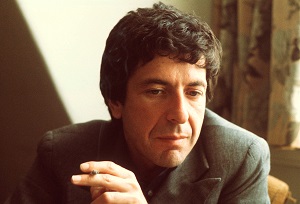
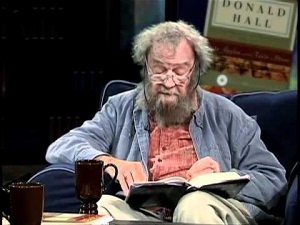
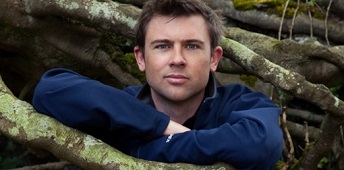
Hendrik Tollens, Fernand Ouellette, Yves Navarre, Alfons Petzold, Charles Ferdinand Ramuz, Szilvia Molnar

De Nederlandse dichter Hendrik Tollens werd op 24 september 1780 te Rotterdam geboren. Zie ook mijn blog van 24 september 2010 en eveneens alle tags voor Hendrik Tollens op dit blog.

Geluk en deugd (Fragment)

de grijsaard
Och, meer niet dan een schone bloem,
maar die van verf verschiet,
verwaaiend loof is aardse Roem
en wat gij najaagt niet.-
’t Was ook ’t Geluk niet, neen voorwaar!
Die opschik droeg het nooit!
Dat droombeeld met juweel in ’t haar,
met loovren gouds bestrooid:
dat was de Rijkdom. – Arme dwaas
die, ’t hart vertuit aan pracht,
uit klei en mijnkloof zich, helaas!
’t geluk te delven tracht!
Neen, neen, mijn zoon! vertrouw op mij:
’t geluk stak nooit in ’t goud!
Het hang’ de pels u om de pij,
het laat u ’t harte koud.
Niet zoeter smaakt des levens zuur
schoon gij ’t uit zilver drinkt;
niet zachter valt hem ’t scheidensuur
wie op een goudbaar zinkt.
Neen, neen, mijn zoon! wat faalt en vliedt
wanneer gij ’t bijstand vraagt,
wat in de nood u ’t eerst verliet,
dat is ’t Geluk voorzeker niet,
waarnaar gij smacht en jaagt.
de jongeling
Maar dan die derde schoonheid toch,
slechts met een roos in ’t haar…?
Dát was voorzeker geen bedrog:
dát was ’t Geluk voorwaar!
Neen, nimmer joeg mij ’t hart zo snel
als toen dat beeld verscheen!
Dat is ’t Geluk! ik dacht het wel!
Ontdek mij ’t pad erheen.

 
Hendrik Tollens (24 september 1780 -21 oktober 1856)
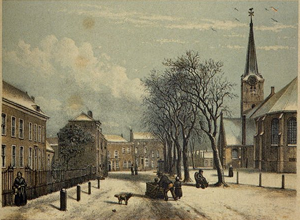
Litho Rijswijk ca. 1840-’50. Links het huis waar Tollens vanaf 1846 tot zijn dood leefde.

Lees verder “Hendrik Tollens, Fernand Ouellette, Yves Navarre, Alfons Petzold, Charles Ferdinand Ramuz, Szilvia Molnar”

Frances Harper

De Amerikaanse dichteres, schrijfster,suffragette en abolitioniste Frances Ellen Watkins Harper werd geboren in Baltimore op 24 september 1825 als enig kind van twee vrije zwarte ouders. Veel zwarte mensen waren in die tijd slaaf. Haar moeder overleed in 1828 toen Frances pas drie jaar oud was en ze werd opgevoed door haar moeders tante en oom, dominee William Watkins, een burgerrechtenactivist. Ze werd opgeleid in zijn Academy for Negro Youth en hij zou een belangrijke invloed hebben op haar leven en werk. Op 14-jarige leeftijd begon ze te werken als naaister. Haar eerste dichtbundel “Forest Leaves” werd gepubliceerd in 1845, haar tweede “Poems on Miscellaneous Subjects” (1854), was heel populair en werd in de loop van de volgende jaren verscheidene malen herdrukt. In 1859 werd haar kort verhaal “The Two Offers” gepubliceerd in Anglo-African Magazine, waardoor ze de eerste Afro-Amerikaanse vrouw was die een kort verhaal publiceerde.Drie van haar romans werden van 1868 tot 1888 als serie uitgebracht in het christelijk tijdschrift Christian Recorder. Haar bekendste werk “Iola Leroy” (alternatieve titel Shadows Uplifted) werd als roman in 1892 gepubliceerd, toen Harper 67 jaar oud was. Het werd lang beschouwd als de eerste roman, uitgebracht door een Afro-Amerikaanse auteur (latere onderzoeken vonden nog vroegere werken van Harriet E. Wilson en William Wells Brown). Naar de conventies van die tijd behandelde ze ernstige sociale kwesties zoals onderwijs voor vrouwen, rassenvermenging, passing, afschaffing van de slavernij, wederopbouw, matigheid met alcohol en sociale verantwoordelijkheid. In 1850 verhuisde Watkins naar Ohio waar ze de eerste vrouwelijke docent werd aan het Union Seminary. Frances Harper was een groot voorvechter van het abolitionisme en het vrouwenkiesrecht. Ze was ook actief in de Unitarian Church, die de afschaffing van de slavernij ondersteunde. Samen met Mary Church Terrell hielp Harper met de oprichting van de National Association of Colored Women (Nationale vereniging van gekleurde vrouwen) in 1896 en ze werd in 1897 verkozen tot vicepresident.


The Slave Auction

The sale began—young girls were there,
Defenseless in their wretchedness,
Whose stifled sobs of deep despair
Revealed their anguish and distress.

And mothers stood, with streaming eyes,
And saw their dearest children sold;
Unheeded rose their bitter cries,
While tyrants bartered them for gold.

And woman, with her love and truth—
For these in sable forms may dwell—
Gazed on the husband of her youth,
With anguish none may paint or tell.

And men, whose sole crime was their hue,
The impress of their Maker’s hand,
And frail and shrinking children too,
Were gathered in that mournful band.

Ye who have laid your loved to rest,
And wept above their lifeless clay,
Know not the anguish of that breast,
Whose loved are rudely torn away.

Ye may not know how desolate
Are bosoms rudely forced to part,
And how a dull and heavy weight
Will press the life-drops from the heart.


Learning to Read

Very soon the Yankee teachers
Came down and set up school;
But, oh! how the Rebs did hate it,—
It was agin’ their rule.

Our masters always tried to hide
Book learning from our eyes;
Knowledge did’nt agree with slavery—
’Twould make us all too wise.

But some of us would try to steal
A little from the book.
And put the words together,
And learn by hook or crook.

I remember Uncle Caldwell,
Who took pot liquor fat
And greased the pages of his book,
And hid it in his hat.

And had his master ever seen
The leaves upon his head,
He’d have thought them greasy papers,
But nothing to be read.

And there was Mr. Turner’s Ben,
Who heard the children spell,
And picked the words right up by heart,
And learned to read ’em well.

Well, the Northern folks kept sending
The Yankee teachers down;
And they stood right up and helped us,
Though Rebs did sneer and frown.

And I longed to read my Bible,
For precious words it said;
But when I begun to learn it,
Folks just shook their heads,

And said there is no use trying,
Oh! Chloe, you’re too late;
But as I was rising sixty,
I had no time to wait.

So I got a pair of glasses,
And straight to work I went,
And never stopped till I could read
The hymns and Testament.

Then I got a little cabin
A place to call my own—
And I felt independent
As the queen upon her throne.
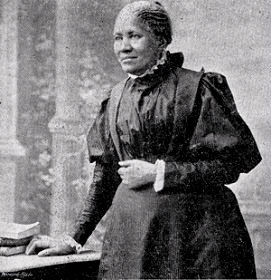
 
Frances Harper (24 september 1825 – 25 februari 1911)

De mist (Jan Prins), Dolce far niente


Dolce far niente


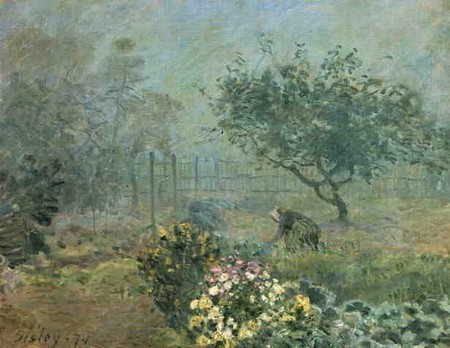
Misty Morning door Alfred Sisley, 1874


De mist

De mist, onzeker,
dan grauw, dan bleker
hangt om ons heen.
De schim van stranden,
van lage landen,
verzonk, verdween.

Wij turen, turen
door eenzame uren
en dan, een wijl, –
als vanuit dromen
tot ons gekomen, –
verschijnt een zeil.

Wij zien, – een rimpel
in ’t licht, – de wimpel
hoog in de mist
voorbij ons drijven.
Daaronder blijven
als weggewist

de vage lijnen,
die weer verdwijnen.
Een horen klinkt,
en van een schinkel
rukt het gerinkel.
En dan verzinkt

alles in ’t wijde
vaal uitgespreide
voor ons gezicht.
De mist, al-nauwer,
dan bleek, dan grauwer
klemt om ons dicht.


Jan Prins (5 februari 1876 – 9 februari 1948)
Rotterdam, de geboorteplaats van Jan Prins


Zie voor de schrijvers van de 23e september ook mijn twee vorige blogs van vandaag.

Peter Drehmanns, Inge Boulonois, Antonio Tabucchi, Tom de Cock, Ellen Warmond, Olga Kirsch, Mary Coleridge

De Nederlandse dichter en schrijver Peter Drehmanns werd op 22 september 1960 in Roermond geboren. Zie ook alle tags voor Peter Drehmanns op dit blog.

Victors verweer

Hij heet Victor en zijn plasser ziet eruit als een verfrommeld kotszakje. In plaats van een ritslipje heeft zijn jas een paperclip. En als hij zijn bril afzet wil de wereld niets meer met hem te maken hebben.
Maar dat maakt hem nog niet kansloos.
Hij is jong genoeg om het leven aan te kunnen en oud genoeg om het aan zijn laars te lappen. Of andersom.
Op een heldere winterochtend van het jaar 19.. klapte Victor de kleppen van zijn pet naar beneden en ging op het zadel zitten. Een vliegenier op een fiets – het moet een belachelijk gezicht zijn geweest. Maar zijn oren, zijn vleermuisdunne oren eisten respect en mochten niet worden blootgesteld aan polaire geselingen. Hij begaf zich op weg naar het postkantoor.
Hoewel hij zeker wist dat de brief het standaardgewicht niet overschreed, liet hij hem wegen door de postbeambte. Niets mocht aan het toeval worden overgelaten. Op de envelop had hij haar naam en adres met de Parker 51 geschreven, die hij uitsluitend gebruikte voor liefdesbrieven. Hij wachtte tot hij de brief in de postzak zag verdwijnen.
De hele dag had hij jeuk aan zijn ogen. Men zei dat het kwam door de barbaarse kou. Hij geloofde er geen woord van. Hij wreef zo hard en zo vaak in zijn ogen dat hij vreesde dat ze zouden verpulveren.
In de vroege avond, toen de dag rood aan de randen werd (als een in brand gestoken vel papier dat langzaam naar het midden toe krult en ten slotte in zwarte slierten uiteenvalt), metselde Victor zijn brievenbus dicht. Hij verstevigde het cement met zijn collectie Bic-pennen, die nu als speerpunten de postbode opwachtten. Tussen hen in troonde de Parker 51, de veldmaarschalk. Zijn gouden bajonet glom van trots.


Peter Drehmanns (Roermond, 22 september 1960)

Lees verder “Peter Drehmanns, Inge Boulonois, Antonio Tabucchi, Tom de Cock, Ellen Warmond, Olga Kirsch, Mary Coleridge”

Leni Saris, Jaroslav Seifert, Theodor Körner, Euripides, Emma Orczy, Daniel Czepko von Reigersfeld

De Nederlandse schrijfster Leni Saris werd geboren in Rotterdam op 23 september 1915. Zie ook alle tags voor Leni Saris op dit blog.

Uit: Zomaar een dak

“Dorrith en Maxi Sunderman waren in de omgeving minder bekend om het feit dat ze tweelingen waren, als door het feit dat ze in de gekste verwikkelingen verzeild raakten. Dat wilde zeggen, dat Maxi de moeilijkheden veroorzaakte en Dorrith, meestal met succes, probeerde haar eruit te halen. Uiterlijk leken ze verwarrend op elkaar, maar innerlijk waren ze zo verschillend als twee mensen maar kunnen zijn. Maxi was vrolijk, voortvarend en wild. Ze dacht wel degelijk, maar meestal te laat. Dorrith, veel kalmer, was ook vrolijk, maar ze dacht na voor ze iets deed, en ze gaf niet op als ze zich eenmaal iets in het hoofd had gezet. Dat betekende dat ze in haar kleuterjaren vocht voor Maxi als ze het niet anders kon winnen. Maxi deed weinig voor Dorrith, want die kwam nooit in moeilijkheden, tenzij door het beroep dat haar zusje op haar deed. Toch waren ze niet de verknochte tweeling die geen stap zonder elkaar kan doen. Ze hadden hun eigen vrienden en vriendinnen en gingen zo veel mogelijk hun eigen weg. Hun ouders waren er blij mee en mevrouw Sunderman had de meisjes, hoe vreemd iedereen het ook vond, na hun kleuterperiode nooit meer in dezelfde kleren en kleuren gestoken. Dorothea had zichzelf kortweg Dorrith genoemd en Maria Xenia was voor het gemak Maxi geworden. En als mevrouw Sunderman een enkele maal heel moe was, zuchtte ze diep en zei meer dan eens: ‘En dan zeggen ze nog dat een naam er niets toe doet! Maxi… ze is inderdaad in alles Maxi. Zou ze anders zijn geweest als we haar Mini hadden genoemd? Ik word dol van dat kind!’ Dat zei ze niet vaak. Maar wel op de beruchte middag die Maxi enkele ontvellingen opleverde wegens een conflict met een grotere jongen die haar bal had afgepakt, en Dorrith een compleet regenboog-oog, omdat ze gevochten had om de gillende zuster uit de handen van het zeer hardhandig exemplaar van het andere geslacht te halen.
„Ik kon er niets aan doen!” loeide Maxi. „Het was een gemene jongen!”
„Vecht dan voor jezelf,” stelde haar vader vermoeid voor. „Gil niet altijd om je zus. Vertel me nou eens of jij voor haar hetzelfde zou doen, hè?”
„Dat weet ik niet,” bekende Maxi eerlijk. Ze veegde over haar betraande gezicht.”


Leni Saris (23 september 1915 – 9 december 1999)
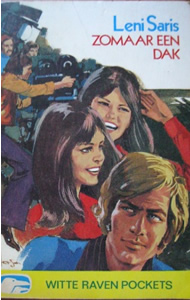
Cover

Lees verder “Leni Saris, Jaroslav Seifert, Theodor Körner, Euripides, Emma Orczy, Daniel Czepko von Reigersfeld”

Dannie Abse, Lodewijk van Deyssel, Nick Cave, Fay Weldon, György Faludy, Hans Leip, Uri Zvi Greenberg, Rosamunde Pilcher, Nathan Hill

De Britse dichter en schrijver Dannie Abse werd geboren op 22 september 1923 in Cardiff, Wales. Zie ook mijn blog van 22 september 2010 en eveneens alle tags voor Dannie Abse op dit blog.

In the Theatre

Sister saying—‘Soon you’ll be back in the ward,’
sister thinking—‘Only two more on the list,’
the patient saying—‘Thank you, I feel fine’;
small voices, small lies, nothing untoward,
though, soon, he would blink again and again
because of the fingers of Lambert Rogers,
rash as a blind man’s, inside his soft brain.

If items of horror can make a man laugh
then laugh at this: one hour later, the growth
still undiscovered, ticking its own wild time;
more brain mashed because of the probe’s braille path;
Lambert Rogers desperate, fingering still;
his dresser thinking, ‘Christ! Two more on the list,
a cisternal puncture and a neural cyst.’

Then, suddenly, the cracked record in the brain,
a ventriloquist voice that cried, ‘You sod,
leave my soul alone, leave my soul alone,’—
the patient’s dummy lips moving to that refrain,
the patient’s eyes too wide. And, shocked,
Lambert Rogers drawing out the probe
with nurses, students, sister, petrified.

‘Leave my soul alone, leave my soul alone,’
that voice so arctic and that cry so odd
had nowhere else to go—till the antique
gramophone wound down and the words began
to blur and slow, ‘ … leave … my … soul … alone … ‘
to cease at last when something other died.
And silence matched the silence under snow.


Angels

Most are innocent, shy, will not undress.
They own neither genitals nor pubic hair.
Only the fallen of the hierarchy
make an appearance these secular days.

No longer useful as artists’ models,
dismissed by theologians, morale tends
to be low—even high class angels grumble
as they loiter in our empty churches.

Neutered, they hide when a gothic door opens.
Sudden light blinds them, footsteps deafen,
Welsh hymns stampede their shadows entirely.
Still their stink lingers, cold stone and incense.

But the fallen dare even to Downing Street,
astonish, fly through walls for their next trick;
spotlit, enter the dreams of the important,
slowly open their gorgeous, Carnaby wings.

 
Dannie Abse (22 september 1923 – 28 september 2014)

Lees verder “Dannie Abse, Lodewijk van Deyssel, Nick Cave, Fay Weldon, György Faludy, Hans Leip, Uri Zvi Greenberg, Rosamunde Pilcher, Nathan Hill”

Leonard Cohen, Stephen King, Frédéric Beigbeder, Xavier Roelens, Fannie Flag, H.G. Wells, Johann Peter Eckermann, Max Porter, Paul Ewen

De Canadese dichter, folk singer-songwriter en schrijver Leonard Cohen werd geboren op 21 september 1934 te Montréal. Zie ook alle tags voor Leonard Cohen op dit blog.

Uit: The favorite game

“Breavman knows a girl named Shell whose ears were pierced so she could wear the long filigree earrings. The punctures festered and now she has a tiny scar in each earlobe. He discovered them behind her hair. A bullet broke into the flesh of his father’s arm as he rose out of a trench. It comforts a man with coronary thrombosis to bear a wound taken in combat. On the right temple Breavman has a scar which Krantz bestowed with a shovel. Trouble over a snowman. Krantz wanted to use clinkers as eyes. Breavman was and still is against the use of foreign materials in the decoration of snowmen. No woollen muf-flers, hats, spectacles. In the same vein he does not approve of inserting carrots in the mouths of carved pumpkins or pinning on cucumber ears.
His mother regarded her whole body as a scar grown over some earlier perfection which she sought in mirrors and windows and hub-caps. Children show scars like medals. Lovers use them as secrets to reveal. A scar is what happens when the word is made flesh. It is easy to display a wound, the proud scars of combat. It is hard to show a pimple.
Breavman’s young mother hunted wrinkles with two hands and a magnifying mirror. When she found one she consulted a fortress of oils and creams arrayed on a glass tray and she sighed. Without faith the wrinkle was anointed. “This isn’t my face, not my real face.” “Where is your real face, Mother?” “Look at me. Is this what I look like?” “Where is it, where’s your real face?” “I don’t know, in Russia, when I was a girl.” He pulled the huge atlas out of the shelf and fell with it. He sifted pages like a goldminer until he found it, the whole of Russia, pale and vast. He kneeled over the distances until his eyes blurred and he made the lakes and rivers and names become an incredible face, dim and beautiful and easily lost. The maid had to drag him to supper.”


Leonard Cohen (21 september 1934 – 7 november 2016)

Lees verder “Leonard Cohen, Stephen King, Frédéric Beigbeder, Xavier Roelens, Fannie Flag, H.G. Wells, Johann Peter Eckermann, Max Porter, Paul Ewen”

Donald Hall, Javier Marías, Cyriel Buysse, Upton Sinclair, Joseph Breitbach, Adolf Endler, Henry Arthur Jones, Stevie Smith, Hanns Cibulka

De Amerikaanse dichter en schrijver Donald Hall werd geboren in Hamden, New Haven County, Connecticut op 20 september 1928. Zie ook alle tags voor Donald Hall op dit blog.


Distressed Haiku

In a week or ten days
the snow and ice
will melt from Cemetery Road.

I’m coming! Don’t move!

Once again it is April.
Today is the day
we would have been married
twenty-six years.

I finished with April
halfway through March.

You think that their
dying is the worst
thing that could happen.

Then they stay dead.

Will Hall ever write
lines that do anything
but whine and complain?

In April the blue
mountain revises
from white to green.

The Boston Red Sox win
a hundred straight games.
The mouse rips
the throat of the lion

and the dead return.


Donald Hall (Hamden, 20 september 1928)

Lees verder “Donald Hall, Javier Marías, Cyriel Buysse, Upton Sinclair, Joseph Breitbach, Adolf Endler, Henry Arthur Jones, Stevie Smith, Hanns Cibulka”

Owen Sheers

De Engelse (Welshe) dichter, schrijver en presentator Owen Sheers werd geboren op 20 september 1974 in Suva op de Fiji eilanden en groeide op in Abergavenny, Zuid-Wales. Hij bezocht de King Henry VIII School in Abergavenny, voordat hij ging studeren aan New College, Oxford en de Universiteit van East Anglia, waar hij een MA in creatief schrijven behaalde. Tijdens zijn studietijd aan het New College leidde Sheers het moderne pentatlonteam van de Universiteit van Oxford. In 1999 ontving Sheers een Eric Gregory Award van de Society of Authors. Zijn eerste bundel poëzie, “The Blue Book”, werd in 2000 uitgegeven. De bundel haalde de shortlist voor het Wales Book of the Year en de Forward Prize voor ‘Best First Collection’. Na deze eerste publicatie werkte Sheers aan het lichte entertainment-tv-programma The Big Breakfast mee als onderzoeker. Zijn prozadebuut “The Dust Diaries” werd in 2004 uitgegeven. Het werd in 2005 het Wales Book of the Year en was ook genomineerd voor de Ondaatje-prijs van de Royal Society of Literature. Voor Sheers tweede poëziebundel “Skirrid Hill” uit 2005 ontving hij een Somerset Maugham Award. “Unicorns, een bijna eenmanspel, gebaseerd op het leven en de poëzie van de WOII-dichter Keith Douglas, werd ontwikkeld door Old Vic, New Voices en uitgevoerd door Joseph Fiennes. Sheers eerste roman “Resistance”, is vertaald in tien talen en stond op de shortlist voor de Writer’s Guild of Great Britain Best Book Award 2008 en won een 2008 Hospital Club Creative Award. Deze roman werd in 2011 verfilmd. In 2007 werkte Sheers samen met componist Rachel Portman aan “The Water Diviner’s Tale”, een oratorium voor kinderen dat in première ging in de Royal Albert Hall voor de BBC Proms. In 2007/8 was Sheers Dorothy en Lewis B. Cullman Fellow in de New York Public Library. Sheers werkte ook als journalist en schreef reportages voor verschillende tijdschriften, waaronder Granta, The Guardian, Esquire, GQ, The Times en The Financial Times. Ook schreef hij een toneelstuk voor BBC Radio 4 over de WOII-dichter Alun Lewis: “If I Should Go Away”. In 2012 schreef Sheers “The Two Worlds of Charlie F”, een toneelstuk gebaseerd op de ervaringen van gewonde soldaten, van wie velen ook de cast van de productie vormden, geregisseerd door Stephen Rayne en opgevoerd in de Theatre Royal Haymarket. Zijn versdrama “Pink Mist” werd voor het eerst uitgezonden op Radio 4. “Pink Mist” werd in 2014 Welsh Book of the Year en werd geproduceerd als toneelstuk door het Bristol Old Vic-theater in 2015.

Uit:Resistance

“For Sarah Lewis it began in her sleep. The drag, rattle, and bark of the dogs straining on their chains was so persistent it entered her dreams. A ship in storm, the sailors shouting for help from the deck, their pink faces and open mouths obscured by the spray blown up the sides of the hull. Then the noise became Marley’s ghost, dragging his shackles over a flagstone floor. Clink,slump, clink, slump. Eventually, as the light brightened about the edges of the blackout curtain and Sarah surfaced through the layers of her sleep, the sound became what it was. Two dogs, urgent and distressed, pulling again and again on their rusty chains and barking, short and sharp through the constraint of their collars.
Without opening her eyes Sarah slid her hand across the sheet behind her, feeling for the warm impression of her husband’s body. The old horsehair mattress they slept on could hold the shape of a man all day and although Tom was usually up before her, she found comfort in touching the warm indentation of where he’d lain beside her. She stroked her palm over the thin cotton sheet. A few hairs poking through the mattress caught against her skin, hard and stubborn as the bristles on a sow’s back.
And there he was. A long valley where his weight had pressed the ball of his shoulder and his upper arm into the bed; a rise where his neck had lain beneath the pillow. She explored further down. A deeper bowl again, sunk by a protruding hip and then the shallower depression of his legs tapering towards the foot of the bed. As usual, Tom’s shape, the landscape of him, was there. But it was cold. Normally Sarah could still feel the last traces of his body’s heat, held in the fabric of the sheet just as the mattress held his form. But this morning that residue was missing.
With fragments of her dreams still fading under her lids, she slid her hand around the curves and indentations again, and then beyond them, outside the borders of his body. But the sheet was cold there too. The dogs below her window barked and barked, their sound making pictures in her mind’s eye: their sharp noses tugging up with each short yap, exposing the white triangles of their necks, flashing on and off like a warning. She lay there listening to them, their chains rising and falling on the cobblestones of the yard.
Tom must have been up early. Very early. Not in the morning at all but in the night. She turned on her side and shifted herself across the bed. The blankets blinked with her movement and she felt a stab of cold air at her shoulder. Pulling them tight about her neck, she lay there within the impression of her husband, trying not to disturb the contours of his map.“

 
Owen Sheers (Suva, 20 september 1974)

Hanya Yanagihara

De Amerikaanse schrijfster Hanya Yanagihara werd geboren op 20 september 1975 in Los Angeles. Zie ook alle tags voor Hanya Yanagihara op dit blog.

Uit: A Little Life

“The eleventh apartment had only one closet, but it did have a sliding glass door that opened onto a small balcony, from which he could see a man sitting across the way, outdoors in only a T-shirt and shorts even though it was October, smoking. Willem held up a hand in greeting to him, but the man didn’t wave back.
In the bedroom, Jude was accordioning the closet door, opening and shutting it, when Willem came in. “There’s only one closet,” he said.
“That’s okay,” Willem said. “I have nothing to put in it anyway.”
“Neither do I.” They smiled at each other. The agent from the building wandered in after them. “We’ll take it,” Jude told her.
But back at the agent’s office, they were told they couldn’t rent the apartment after all. “Why not?” Jude asked her.
“You don’t make enough to cover six months’ rent, and you don’t have anything in savings,” said the agent, suddenly terse. She had checked their credit and their bank accounts and had at last realized that there was something amiss about two men in their twenties who were not a couple and yet were trying to rent a one-bedroom apartment on a dull (but still expensive) stretch of Twenty-fifth Street.
“Do you have anyone who can sign on as your guarantor? A boss? Parents?”
“Our parents are dead,” said Willem, swiftly.
The agent sighed. “Then I suggest you lower your expectations. No one who manages a well-run building is going to rent to candidates with your financial profile.” And then she stood, with an air of finality, and looked pointedly at the door.
When they told JB and Malcolm this, however, they made it into a comedy: the apartment floor became tattooed with mouse droppings, the man across the way had almost exposed himself, the agent was upset because she had been flirting with Willem and he hadn’t reciprocated.
“Who wants to live on Twenty-fifth and Second anyway,” asked JB. They were at Pho Viet Huong in Chinatown, where they met twice a month for dinner. Pho Viet Huong wasn’t very good–the pho was curiously sugary, the lime juice was soapy, and at least one of them got sick after every meal–but they kept coming, both out of habit and necessity. You could get a bowl of soup or a sandwich at Pho Viet Huong for five dollars, or you could get an entrée, which were eight to ten dollars but much larger, so you could save half of it for the next day or for a snack later that night. Only Malcolm never ate the whole of his entrée and never saved the other half either, and when he was finished eating, he put his plate in the center of the table so Willem and JB–who were always hungry–could eat the rest. »


Hanya Yanagihara (Los Angeles, 20 september 1975)