Annette von Droste-Hülshoff, Elizabeth Alexander, Countee Cullen, Emmanuel Hiel, Martin Jankowski, Jan Geerts

Bij Sacramentsdag


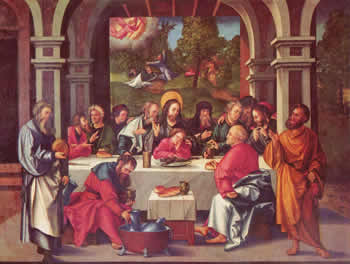
Abendmahl door Hans Leonhard Schäufelein, 1515, Ulmer Münster


Am Fronleichnamstage

“Mein Fleisch ist wahrhaftig eine Speise,
und mein Blut ist wahrhaftig ein Trank”

O fasse Mut; er ist dir nah!
Du hast sein Fleisch, sein heilig Blut
Genossen ja.
O meine arme Seele, fasse Mut;
Er ist ja dein, er ward dein Fleisch und Blut.

Nicht, wie ich sollte, reich und warm
Kam freilich ich zu deinem Mahl:
Ich war ein arm
Zerlumpter Gast; doch zitterte die Qual
In mir des Sehnens; Tränen sonder Zahl

Hab’ ich vergossen in der Angst,
Die dennoch Freudeschauer war.
Sprich, warum bangst
Du vor der Arzenei so süß und klar,
Die Leben dir und Frieden bietet dar?

Wohl ist es furchtbar, seinen Gott
Zu einen mit dem sünd’gen Leib;
Es klingt wie Spott.
O Herr, ich bin ein schwach und wirres Weib,
Und stärker als die Seele ist der Leib!

So hab’ ich schuldbeladen dir
In meiner Sünde mich vereint;
Doch riefst du mir
So laut wie Einem, der um Leben weint:
So ist es Gnade, was von oben scheint.

Und hast du des Verstandes Fluch
Zu meiner Prüfung mir gestellt:
Er ist ein Trug.
Doch hast du selber ja, du Herr der Welt,
Hast selber den Verführer mir gesellt.

Drum trau ich, daß du dessen nicht
Vergessen wirst an jenem Tag,
Daß dein Gericht
Mir sprechen wird: Den Irren seh’ ich nach;
Dein Herz war willig, nur dein Kopf war schwach.


Annette von Droste-Hülshoff (10 januari 1797 – 24 mei 1848)

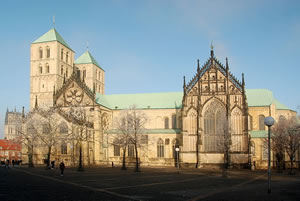
De Paulusdom in Münster, dichtbij Drostes geboortehuis

Lees verder “Annette von Droste-Hülshoff, Elizabeth Alexander, Countee Cullen, Emmanuel Hiel, Martin Jankowski, Jan Geerts”

André Brink, Eduard Escoffet, G. K. Chesterton, Bernard Clavel, Leah Goldberg

De Zuid-Afrikaanse schrijver André Brink werd geboren op 29 mei 1935 in Vrede. Zie ook alle tags voor André Brink op dit blog.

Uit: Philida

“Here come shit. Just one look, and I can see it coming. Here I walk all this way and God know that is bad enough, what with the child in the abbadoek on my back, and now there’s no turning back, it’s just straight on to hell and gone. This is the man I got to talk to if I want to lay a charge, they tell me, this Grootbaas who is so tall and white and thin and bony, with deep furrows in his forehead, like a badly ploughed wheat field, and a nose like a sweet potato that has grown past itself.
It’s a long story. First he want to find out everything about me, and it’s one question after another. Who am I? Where do I come from? What is the name of my Baas? What is the name of the farm? For how long I been working there? Did I get a pass for coming here? When did I leave and how long did I walk? Where did I sleep last night? What do I think is going to happen to me when I get home again? And every time I say something, he first write it down in his big book with those knobbly hands and his long white fingers. These people got a thing about writing everything down. Just look at the back pages of the black Bible that belong to Oubaas Cornelis Brink, that’s Francois Gerhard Jacob’s father.
While the Grootbaas is writing I keep watching him closely. There’s something second-hand about the man, like a piece of knitting gone wrong that had to be done over, but badly, not very smoothly. I can say that because I know about knitting. On his nose sit a pair of thick glasses like a bat with open wings, but he look at me over them, not through them. His long hands keep busy all the time. Writing, and dipping the long feather in the ink, and sprinkling fine sand on the thick paper, and shifting his papers this way and that on top of the table that is really too low for him because he is so tall. He is sitting, I keep standing, that is how it’s got to be.

In the beginning I feel scared, my throat is tight. But after the second or third question I start feeling better. All I can think of is: If it was me that was knitting you, you’d look a bit better, but now whoever it was that knitted you, did not cast you off right. Still, I don’t say anything. In this place it’s only him and me and I don’t want to get on his wrong side. I got to tell him everything, and that is exactly what I mean to do today, without keeping anything back.”


André Brink (Vrede, 29 mei 1935)

Lees verder “André Brink, Eduard Escoffet, G. K. Chesterton, Bernard Clavel, Leah Goldberg”

Adriaan Bontebal, Leo Pleysier, Frank Schätzing, Maeve Binchy, Thomas Moore, Ian Fleming

De Nederlandse dichter en schrijver Adriaan Bontebal werd als Aad van Rijn op 28 mei 1952 in Leidschendam geboren. Zie ook alle tags voor Adriaan Bontebal op dit blog.

ONTWAKEN

Ieder ontwaken
een feest

Ik sta op
rek me uit en
krab me eens flink
aan het onderlijf

Als rijpe vruchten
vallen de eitjes
van mijn schaamluis
op het dauwvochtige
slaapkamerzeil

Iedere morgen
een feest

Zwarte koffie
zware shag en
scharreleieren
bij het ontbijt


PAULUS POTTERSTRAAT

naar De Dapperstraat van J.C.Bloem

De legen kom je aan de randen tegen
Waar stoffig op de schoorsteen prijkt:
‘Over mijn lijk naar de Schilderswijk’
Dat volk ervaart de rust als zegen

Maar zo niet ik, voor mij geen kassen
Hoewel ik van een dorpje ben
De stad niet echt van huis uit ken
Haal ‘k nu mijn lucht uit uitlaatgassen

Als kneuter ben ik afgemeld
Mijn teugen zijn steeds voller teugen
De stedeling hij kent geen maat

Tevreden heb ik vastgesteld
Ik deug niet en ik zal nooit deugen
Dom weg gelukkig in de Potterstraat
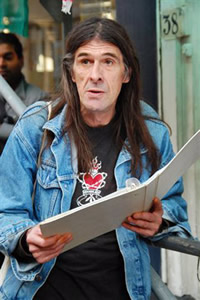


Adriaan Bontebal (28 mei 1952 – 11 februari 2012)


De Belgische schrijver Leo Pleysier werd geboren in Rijkevorsel op 28 mei 1945. Zie ook alle tags voor Leo Pleysier op dit blog.

Uit: The Yellow River Is Frozen (Vertaald door Tanis Guest.)

“The first time I saw her in the flesh was in the early fifties when she, one of the last remaining Western nuns, was expelled from the country for good on the orders of the government of the Chinese People’s Republic. I was a small boy of seven or eight. And she was a tall, bony creature dressed in white with a black veil who was staying with us for a while. She looked thin and pale. I had noticed her eyes at once: they were huge, sunk deep in their sockets. I also found her disquietingly silent as she sat there at table with us. Suddenly, instead of sending a letter she had come herself. That in itself was a wonder. So she really did exist. She had a face. Maybe, under her clothes, there was even a body of flesh and blood. And on top of that she had brought someone else with her. A sort of replica of herself. But a much softer version. Applecheeked, even. It turned out she was the daughter of a fruit farmer and came originally from Montenaken, not far from Sint-Truiden. A sweetly smiling guardian angel from Limburg. Born and bred in the Haspengouw hills. Among the apples and pears.

– You can call me Sister Irma.

– Hullo, Sister Irma.

– That’s a clever boy.

But actually she was a sort of watchdog they’d sent to keep an eye on Aunt Roza. Not for nothing was it called The Guardian, the mother house in Leefdaal.

Black nuns and white nuns. The black ones I was familiar with from kindergarten. The white ones, to whom Aunt Roza belonged, were new to me. And I thought her sort and her plumage were much finer. More elegant, especially. There was something of a big, slow bird about her. A seagull. A stork. A pelican who had landed unexpectedly at our house after a long journey. Had come here to rest and get its strength back.

– You’ve got to feed yourself up!”

Time and again I heard my father telling her that and he kept piling much too much food on her plate. She weighed barely forty kilos when she came home from China. She’d weighed as little as that once before, when she was about twenty-five, so my mother said. That time she had gone on hunger strike because Grandfather and Grandmother wouldn’t let her ‘take the veil’. And it had been weeks before her parents gave in to her blackmail.”
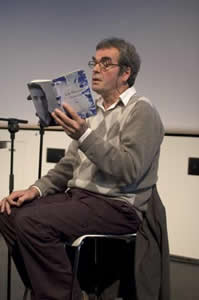


Leo Pleysier (Rijkevorsel, 28 mei 1945)


De Duitse schrijver Frank Schätzing werd geboren in Keulen op 28 mei 1957. Zie ook alle tags voor Frank Schätzing op dit blog.


Uit: Mordshunger


„Sie hatte ihm eine Gurke geschenkt mit dem Ratschlag,sie sich sonst wohin zu stecken, und war ausgezogen.

»Ein guter Kriminalist«, pflegte er zu sagen, »wird verlassen. Er muss verlassen werden. Würde er der Idee verfallen, hinter Wahnsinnigen und Mördern herzulaufen, wenn man ihn nicht verlassen hätte? Fähige Polizisten neigen zum Verlust der Freundin, die Genies sind allesamt geschieden. Schön, ich hab nur eine Freundin. Aber ich bin ein guter Polizist! Folglich wird sie mich verlassen, irgendwann, das ist die Tragik meiner Profession.

Ich frage mich eigentlich nur, ob ich sie vorher schnell heiraten sollte, um hinterher ein ganz besonders genialer Polizist zu sein. Verzwickt, das Ganze! Geht mir im Kopf rum, immer wieder. Im Allgemeinen gehe ich dann was essen und sage mir, langsam Cüpper. Sechsunddreißigmal kauen, jeden Bissen. Hat alles noch Zeit.«

Es hatte keine Zeit.

Sie hatte ihm eine Gurke geschenkt, weil sie wusste, dass er keine Gurken mochte, dass es nur drei Dinge gab, die er von Herzen verabscheute: Gurken, Kümmel, Kokos.

Er war um die Gurke herumspaziert, als könne sie den Lauf der Dinge biegen, während im Nebenzimmer Blusen, Röcke, Jeans, Dessous flupp flupp in den Koffer flogen. Dann kamen die Packer, und man trug die Couch und den Glastisch und die zwei CD-Regale und die komplette Stereoanlage und noch bedenklich viel mehr an ihm vorbei nach draußen und fütterte einen schier unersättlichen Möbelwagen. Währenddessen lag die Gurke lang und dunkelgrün vor ihm und begann ihn auf merkwürdige Weise zu faszinieren, bis einer der Männer sie kurzerhand auf die Fensterbank legte, um das Schränkchen wegzutragen, das ihm, wie er sich mit einem Mal entsann, auch nicht gehörte.“



Frank Schätzing (Keulen, 28 mei 1957)


De Ierse schrijfster en columniste Maeve Binchy werd geboren op 28 mei 1940 in Dalkey. Zie ook alle tags voor Maeve Binchy op dit blog.


Uit: Scarlet Feather


“On the radio show they were asking people what kind of a New Year’s Eve did they really want. It was very predictable. Those who were staying at home doing nothing wanted to be out partying, those who were too busy and rushed wanted to go to bed with a cup of tea and be asleep before the festivities began.
Cathy Scarlet smiled grimly as she packed more trays of food into the van. There could hardly be anyone in Ireland who would answer the question by saying that they really and truly wanted to spend the night catering a supper party for a mother-in-law. Now that was the punishment posting tonight, feeding Hannah Mitchell’s guests at Oaklands. Why was she doing it then? Partly for practice, and of course it would be a good way to meet potential customers. Jock and Hannah Mitchell knew the kind of people who could afford caterers. But mainly she was doing it because she wanted to prove to Hannah Mitchell that she could. That Cathy, daughter of poor Lizzie Scarlet, the maid who cleaned Oaklands, who had married the only son of the house, Neil, was well able to run her own business and hold her head as high as any of them.
Neil Mitchell was in his car when he heard the radio program. It annoyed him greatly. Anyone looking at him from another car would have seen his sharp, handsome face frown. People often thought they recognized him; his face was familiar from television, but he wasn’t an actor. He just turned up on the screen so often, pushing the hair out of his eyes, passionate, concerned and caring, always the spokes- person for the underdog. He had the bright burning eyes of a crusader. This kind of whining and moaning on a radio show really drove him mad. People who had everything, a home, a job, a family, all telephoning a radio station to complain about the pressures of life.”
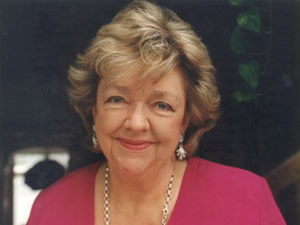


Maeve Binchy (28 mei 1940 – 30 juli 2012)


De Ierse dichter en songwriter Thomas Moore werd geboren op 28 mei 1779 in Dublin. Zie ook alle tags voor Thomas Moore op dit blog.

Come, Send Round the Wine

Come, send round the wine, and leave points of belief
To simpleton sages and reasoning fools;
This moment’s a flower too fair and brief
To be wither’d and stain’d by the dust of the schools.
Your glass may be purple, and mine may be blue,
But, while they are fill’d from the same bright bowl,
The fool who would quarrel for difference of hue,
Deserves not the comfort they shed o’er the soul.

Shall I ask the brave soldier, who fights by my side
In the cause of mankind, if our creeds agree?
Shall I give up the friend I have valued and tried,
If he kneel not before the same altar with me?
From the heretic girl of my soul should I fly?
To seek somewhere else a more orthodox kiss?
No, perish the hearts, and the laws that try
Truth, valour, or love, by a standard like this!
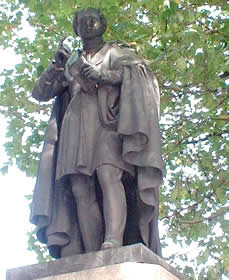


Thomas Moore (28 mei 1779 – 25 februari 1852)

Standbeeld in Dublin


De Britse schrijver Ian Fleming werd geboren op 28 mei 1908 in Londen. Zie ook alle tags voor Ian Fleming op dit blog.

Uit: From Russia With Love


“Bond’s thoughts were interrupted by the stewardess. ‘Fasten your seat-belts, please.’ As she spoke the plane dropped sickeningly and soared up again with an ugly note of strain in the scream of the jets. The sky outside was suddenly black. Rain hammered on the windows. There came a blinding flash of blue and white light and a crash as if an anti-aircraft shell had hit them, and the plane heaved and bucketed in the belly of the electric storm that had ambushed them out of the mouth of the Adriatic.
Bond smelt the smell of danger. It is a real smell, something like the mixture of sweat and electricity you get in an amusement arcade. Again the lightning flung its hands across the windows. Crash! It felt as if they were the centre of the thunder clap. Suddenly the plane seemed incredibly small and frail. Thirteen passengers! Friday the Thirteenth! Bond thought of Loelia Ponsonby’s words and his hands on the arms of his chair felt wet. How old is this plane, he wondered? How many flying hours has it done? Had the deathwatch beetle of metal fatigue got into the wings? How much of their strength had it eaten away? Perhaps he wouldn’t get to Istanbul after all. Perhaps a plummeting crash into the Gulf of Corinth was going to be the destiny he had been scanning philosophically only an hour before.
In the centre of Bond was a hurricane-room, the kind of citadel found in old-fashioned houses in the tropics. These rooms are small, strongly built cells in the heart of the house, in the middle of the ground floor and sometimes dug down into its foundations. To this cell the owner and his family retire if the storm threatens to destroy the house, and stay there until the danger is past. Bond went to his hurricane room only when the situation was beyond his control and no other possible action could be taken. Now he retired to this citadel, closed his mind to the hell of noise and violent movement and focused on a single stitch in the back of the seat in front of him, waiting with slackened nerves for whatever fate had decided for BEA Flight No. 130.”
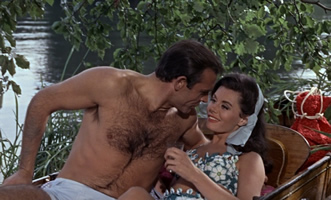


Ian Fleming (28 mei 1908 – 12 augustus 1964)

Scene uit de film “From Russia With Love”, 1963


Zie voor nog meer schrijvers van de 28e mei ook mijn drie blogs van 28 mei 2011.

 

Louis-Ferdinand Céline, Jan Blokker, Niels ’t Hooft, Kaur Kender, Georges Eekhoud

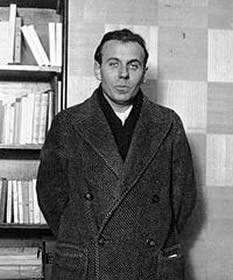
De Franse schrijver Louis-Ferdinand Céline (pseudoniem van Louis Ferdinand Destouches) werd geboren in Courbevoie op 27 mei 1894. Zie ook alle tags voor Louis-Ferdinand Céline op dit blog.

Uit: Journey To The End Of The Night (Vertaald door Ralph Manheim)


“Lola had a genuine official uniform, and it was really natty, decorated with little crosses all over, on the sleeves and on the tiny cap that she perched at a rakish angle on her wavy hair. She’d come to help us save France, as she told the hotel manager, to the best of her humble ability but with all her heart! We understood each other right away, but not completely, because the transports of the heart were beginning to give me a pain, I was more interested in the transports of the body. You can’t trust the heart, not at all. I’d learned that in the war, and I wasn’t going to forget it in a hurry.

Lola’s heart was tender, weak, and enthusiastic. Her body was sweet, it was adorable, so what could I do but take her all together as she was? Lola was a good kid all right, but between us stood the war, the monstrous frenzy that was driving half of humanity, lovers or not, to send the other half to the slaughterhouse. Naturally this interfered with our relationship. 

To me her body was a joy without end. I never wearied of exploring that American body. I have to admit that I was a terrible lecher. I still am. And I formed the pleasant and fortifying conviction that a country capable of producing bodies so daringly graceful, so tempting in their spiritual flights, must have countless other vital revelations to offer, of a biological nature, it goes without saying.

I made up my mind, while feeling and fondling Lola, that sooner or later I’d take a trip, or call it a pilgrimage, to the United States, the sooner the better. And the fact is that I knew neither peace nor rest (in an implacably adverse and harassed life) until I managed to go through with that profound and mystically anatomical adventure.

So it was in the immediate vicinity of Lola’s rear end that I received the message of a new world. Of course Lola wasn’t all body, she also had a wee little face that was adorable and just a bit cruel because of her gray-blue eyes that slanted slightly upward at the corners like a wildcat’s.”


Louis-Ferdinand Céline (27 mei 1894 – 1 juli 1961)

Lees verder “Louis-Ferdinand Céline, Jan Blokker, Niels ’t Hooft, Kaur Kender, Georges Eekhoud”

Alan Hollinghurst, Radwa Ashour, Hugo Raes, Maxwell Bodenheim, Isabella Nadolny

De Britse schrijver Alan Hollinghurst werd geboren op 26 mei 1954 in Stoud, Gloucestershire. Zie ook alle tags voor Alan Hollinghurst op dit blog.

Uit: The Line of Beauty

“When Gerald had won Barwick, which was Nick’s home constituency, the arrangement was jovially hailed as having the logic of poetry, or fate.

Gerald and Rachel were still in France, and Nick found himself almost resenting their return at the end of the month. The housekeeper came in early each morning, to prepare the day’s meals, and Gerald’s secretary, with sunglasses on top of her head, looked in to deal with the imposing volume of post. The gardener announced himself by the roar of the mower outside an open window. Mr Duke, the handyman (His Grace, as the family called him), was at work on various bits of maintenance. And Nick was in residence, and almost, he felt, in possession. He loved coming home to Kensington Park Gardens in the early evening, when the wide treeless street was raked by the sun, and the two white terraces stared at each other with the glazed tolerance of rich neighbours. He loved letting himself in at the three-locked green front door, and locking it again behind him, and feeling the still security of the house as he looked into the red-walled dining room, or climbed the stairs to the double drawing room, and up again past the half-open doors of the white bedrooms. The first flight of stairs, fanning out into the hall, was made of stone; the upper flights had the confidential creak of oak. He saw himself leading someone up them, showing the house to a new friend, to Leo perhaps, as if it was really his own, or would be one day: the pictures, the porcelain, the curvy French furniture so different from what he’d been brought up with. In the dark polished wood he was partnered by reflections as dim as shadows. He’d taken the chance to explore the whole house, from the wedge-shaped attic cupboards to the basement junk room, a dim museum in itself, referred to by Gerald as the trou de gloire. Above the drawingroom fireplace there was a painting by Guardi, a capriccio of Venice in a gilt rococo frame; on the facing wall were two large gilt-framed mirrors. Like his hero Henry James, Nick felt that he could ‘stand a great deal of gilt’.


Scene uit de tv-serie „The Line of Beauty“ uit 2006


Sometimes Toby would have come back, and there would be loud music in the drawing room; or he was in his father’s study at the back of the house making international phone calls and having a gin-and-tonic – all this done not in defiance of his parents but in rightful imitation of their own freedoms in the place. He would go into the garden and pull his shirt off impatiently and sprawl in a deckchair reading the sport in the Telegraph. Nick would see him from the balcony and go down to join him, slightly breathless, knowing Toby quite liked his rower’s body to be looked at. It was the easy charity of beauty. They would have a beer and Toby would say, ‘My sis all right? Not too mad, I hope,’ and Nick would say, ‘She’s fine, she’s fine,’ shielding his eyes from the dropping August sun, and smiling back at him with reassurance, among other unguessed emotions.”


Alan Hollinghurst (Stoud, 26 mei 1954)

Lees verder “Alan Hollinghurst, Radwa Ashour, Hugo Raes, Maxwell Bodenheim, Isabella Nadolny”

Vítězslav Nezval, Ivan O. Godfroid, Edmond De Goncourt, Machteld Brands

De Tsjechische dichter en vertaler Vítezslav Nezval werd geboren op 26 mei 1900 in Biskoupky. Zie ook alle tags voor Vítězslav Nezval op dit blog.


Fireworks 1924, A Cinemagenic Poem (Fragment)

the detective while choosing a magazine stares deep into the lady’s eyes (medium close shot)
the lady getting up (full shot)
the detective grabs his heart & sinks down to the floor (fade out)
a crowd of guests & waiters
the lady puts a handkerchief on the detective’s head
(close-up) the detective’s hand picking a photo & 2 tram tickets from the lady’s bag
in the fields the hare is pricking up its ears
a railway station where a train is being boarded
a gentleman with monocle at ticket counter
a hand plugging lines in at the phone exchange
the detective makes a call while staring at the tram ticket
index finger in the book
the tram ticket held in two hands as it grows in size till it dissolves into
the image of the tram (interior)
the dispatcher in his office struggling to recall something (medium close shot)
presses his index finger to his forehead (full shot)
& gives a smile (medium close shot)
giving a large banknote to the gentleman with the monocle seated beside the lady in the tram
a maze of telegraph wires
a postal clerk pondering a telegram
a lookout post in front of which there stands a yardman
the yardman runs into the lookout
a corridor inside the train down which the man with monocle is passing
he is entering the toilet
dumping his revolver
his pocket watch
(fade out) in the dark a sign HOTEL


Vertaald door Jerome Rothenberg en Milos Sovak


Vítězslav Nezval (26 mei 1900 – 6 april 1958)

Lees verder “Vítězslav Nezval, Ivan O. Godfroid, Edmond De Goncourt, Machteld Brands”

Egyd Gstättner, Eve Ensler, Friedrich Dieckmann, Claire Castillon, Raymond Carver, Jamaica Kincaid

De Oostenrijkse schrijver en essayist Egyd Gstättner werd geboren op 25 mei 1962 in Klagenfurt. Zie ook alle tags voor Egyd Gstättner op dit blog.


Uit: Absturz aus dem Himmel


„Eigentlich wollte ich – literarisch gerade wieder einmal frei geworden, was ein nervlich strapaziöser und auf Dauer wenigstens mir unausstehlicher Zustand ist – die Geschichte eines mündigen Staatsbürgers schreiben, der nach einem langen Wahlkampf in der Wahlzelle plötzlich von einer akuten Unentschiedenheit gepackt wird.
Denn er hält alle Parolen und Versprechungen und Gesichter aller Kandidaten aller Parteien gegeneinander und weiß partout nicht, in welchen Kreis er sein Kreuz machen könnte: eine Prosa übrigens, die deutliche autobiografische Züge enthalten soll; immerhin sagt eine meiner wenigen Literaturtheorien, dass meine Existenz von Haus aus derart dramatisch ist, dass ich keine andere benötige und nichts erfinden muss. Ich muss nur Ordnung schaffen.
Ich kann von meinem Leben leben. Weil er trotz der dringlichen Aufforderungen der Wahlhelfer der Parteien die Wahlzelle stundenlang nicht wieder verlässt mit der Begründung, eine solche Wahl sei eine heikle Angelegenheit und die gründlichste und genaueste Überlegung daher ein unerlässlicher Sachzwang, ungeachtet des sicher stimmigen Einwands, dass zunehmende Gründlichkeit und Genauigkeit dieser Überlegung eine daran anschließende Entscheidung für einen der Spitzenkandidaten, denen von der Meinungsforschung seriöse Gewinnchancen zugebilligt werden, keineswegs vereinfache, sondern im Gegenteil erschwere und verunmögliche, wird bald nicht nur die Warteschlange außerhalb der Wahlzelle, sondern auch das Fernsehen und damit das gesamte Bundesgebiet auf den Wähler aufmerksam, denn der Fernsehmoderator muss der am Höhepunkt der Hochspannung befindlichen Bevölkerung eingestehen, dass die für siebzehn Uhr angekündigte Hochrechnung, die das für das politische Leben der nächsten Jahre oder gar Jahrzehnte so richtungweisende und bedeutsame und mit einem Wort entscheidende Endergebnis der Wahlen erfahrungsgemäß mit verblüffender Exaktheit vorwegnimmt, nicht ausgestrahlt werden könne, obwohl sie natürlich bereits vorliege, aber erst veröffentlicht werden dürfe, sobald das letzte Wahllokal geschlossen habe.“


Egyd Gstättner (Klagenfurt, 25 mei 1962)

Lees verder “Egyd Gstättner, Eve Ensler, Friedrich Dieckmann, Claire Castillon, Raymond Carver, Jamaica Kincaid”

Robert Ludlum, Theodore Roethke, Georges Bordonove, W. P. Kinsella, Max von der Grün, John Gregory Dunne

De Amerikaanse schrijver Robert Ludlum werd geboren in New York op 25 mei 1927. Zie ook alle tags voor Robert Ludlum op dit blog.


Uit: The Janson Directive


“N. Indian Ocean, 250 miles east of Sri Lanka
Northwestern Anura
The night was oppressive, the air at body temperature and almost motionless. Earlier in the evening there had been light, cooling rains, but now everything seemed to radiate heat, even the silvery half-moon, its countenance brushed with the occasional wisps of cloud. The jungle itself seemed to exhale the hot, moist breath of a predator lying in wait.
Shyam shifted restlessly in his canvas chair. It was, he knew, a fairly ordinary night on the island of Anura for this time of year: early in the monsoon season, the air was always heavy with a sense of foreboding. Yet only the ever attentive mosquitoes disturbed the quiet. At half past one in the morning, Shyam reckoned he had been on checkpoint duty for four and a half hours. In that time, precisely seven motorists had come their way. The checkpoint consisted of two parallel lines of barbed-wire frames–“knife rests”–set up eighty feet apart on the road, to either side of the search and administration area. Shyam and Arjun were the two sentries on forward duty, and they sat in front of the wooden roadside booth. A pair of backups was supposedly on duty on the other side of the hill, but the hours of silence from them suggested that they were dozing, along with the men in the makeshift barracks a few hundred feet down the road. For all the dire warnings of their superiors, these had been days and nights of unrelieved boredom. The northwestern province of Kenna was sparsely populated in the best of times, and these were not the best of times.
Now, drifting in with the breeze, as faint as a distant insect drone, came the sound of a gunned motor.
Shyam slowly got to his feet. The sound was growing closer.
“Arjun,” he called out in a singsong tone. “Ar-jun. Car coming.”
Arjun lolled his head in a circle, working out a crick in his neck. “At this hour?” He rubbed his eyes. The humidity made the sweat lie heavily on his skin, like mineral oil.


Robert Ludlum (25 mei 1927 – 12 maart 2001)

Lees verder “Robert Ludlum, Theodore Roethke, Georges Bordonove, W. P. Kinsella, Max von der Grün, John Gregory Dunne”

Ralph Waldo Emerson, Rosario Castellanos, Alain Grandbois, Naim Frashëri, Edward Bulwer-Lytton

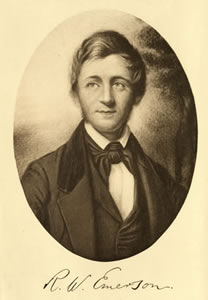
De Amerikaanse dichter, schrijver, filosoof en essayist Ralph Waldo Emerson werd geboren in Boston, Massachusetts op 25 mei 1803. Zie ook alle tags voor Ralph Waldo Emerson op dit blog.

My Garden

If I could put my woods in song
And tell what’s there enjoyed,
All men would to my gardens throng,
And leave the cities void.

In my plot no tulips blow,–
Snow-loving pines and oaks instead;
And rank the savage maples grow
From Spring’s faint flush to Autumn red.

My garden is a forest ledge
Which older forests bound;
The banks slope down to the blue lake-edge,
Then plunge to depths profound.

Here once the Deluge ploughed,
Laid the terraces, one by one;
Ebbing later whence it flowed,
They bleach and dry in the sun.

The sowers made haste to depart,–
The wind and the birds which sowed it;
Not for fame, nor by rules of art,
Planted these, and tempests flowed it.

Waters that wash my garden-side
Play not in Nature’s lawful web,
They heed not moon or solar tide,–
Five years elapse from flood to ebb.

Hither hasted, in old time, Jove,
And every god,–none did refuse;
And be sure at last came Love,
And after Love, the Muse.

Keen ears can catch a syllable,
As if one spake to another,
In the hemlocks tall, untamable,
And what the whispering grasses smother.

Æolian harps in the pine
Ring with the song of the Fates;
Infant Bacchus in the vine,–
Far distant yet his chorus waits.

Canst thou copy in verse one chime
Of the wood-bell’s peal and cry,
Write in a book the morning’s prime,
Or match with words that tender sky?

Wonderful verse of the gods,
Of one import, of varied tone;
They chant the bliss of their abodes
To man imprisoned in his own.

Ever the words of the gods resound;
But the porches of man’s ear
Seldom in this low life’s round
Are unsealed, that he may hear.

Wandering voices in the air
And murmurs in the wold
Speak what I cannot declare,
Yet cannot all withhold.

When the shadow fell on the lake,
The whirlwind in ripples wrote
Air-bells of fortune that shine and break,
And omens above thought.

But the meanings cleave to the lake,
Cannot be carried in book or urn;
Go thy ways now, come later back,
On waves and hedges still they burn.

These the fates of men forecast,
Of better men than live to-day;
If who can read them comes at last
He will spell in the sculpture,’Stay.


Ralph Waldo Emerson (25 mei 1803 – 27 april 1882)

Lees verder “Ralph Waldo Emerson, Rosario Castellanos, Alain Grandbois, Naim Frashëri, Edward Bulwer-Lytton”

Harry Mulisch, Joseph Brodsky, Michael Chabon, Bob Dylan

Dolce far niente (bij een bijzondere verjaardag)


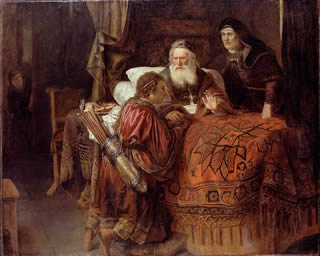
Isaak zegent Jacob door Gerrit Willemsz. Horst, 1638


Ongerijmdheden

dat komt gewoon doordat zijn vader eens.
gewoon omdat zijn vader in zijn jeugd.
doordat zijn vader in zijn jeugd gewoon.
gewoon al in zijn jeugd zijn vader toen.

omdat zijn vader ooit eens tegen hem.
ooit gewoon eens in zijn jeugd hem tegen.
dat komt gewoon doordat zijn vader ooit.
gewoon hem in zijn jeugd toen ooit al eens.

ooit eens tegen hem en nooit zijn moeder.
nooit zijn moeder in zijn jeugd zijn vader.
gewoon toen tegen hem zijn moeder ooit.
nooit eens in zijn jeugd gewoon ooit vader.


Harry Mulisch (29 juli 1927 – 30 oktober 2010)

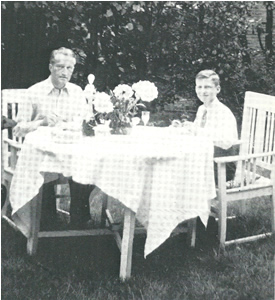
Vader Kurt en zoon Harry Mulisch in 1941

Lees verder “Harry Mulisch, Joseph Brodsky, Michael Chabon, Bob Dylan”