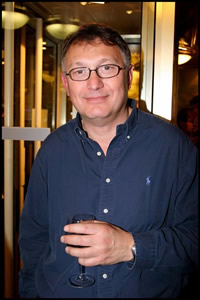
Thomas Mann, Aleksandr Poesjkin, Sarah Dessen, Jean Cayrol

De Duitse schrijver Thomas Mann werd geboren in Lübeck op 6 juni 1875. Zie ook mijn blog van 6 juni 2010 en eveneens alle tags voor Thomas Mann op dit blog.

Uit: Buddenbrooks

“Zwei und ein halbes Jahr später, um die Mitte des April schon, war zeitiger als jemals der Frühling gekommen, und zu gleicher Zeit war ein Ereignis eingetreten, das den alten Johann Budden­brook vor Vergnügen trällern machte und seinen Sohn aufs freu­digste bewegte.
Um 9 Uhr, eines Sonntag morgens, saß der Konsul im Früh­stückszimmer vor dem großen, braunen Sekretär, der am Fenster stand und dessen gewölbter Deckel vermittelst eines witzigen Mechanismus zurückgeschoben war. Eine dicke Le­dermappe, gefüllt mit Papieren, lag vor ihm; aber er hatte ein Heft mit gepreßtem Umschlage und Goldschnitt herausgenom­men, und schrieb, eifrig darüber gebeugt, in seiner dünnen, winzig dahineilenden Schrift, – emsig und ohne Aufenthalt, es sei denn, daß er die Gänsefeder in das schwere Metall-Tintenfaß tauchte…
Die beiden Fenster standen offen, und vom Garten her, wo eine milde Sonne die ersten Knospen beschien, und wo ein paar kleine Vogelstimmen einander kecke Antworten gaben, weh­te voll frischer und zarter Würze die Frühlingsluft herein und trieb dann und wann sacht und geräuschlos die Gardinen ein wenig empor. Drüben, auf dem Frühstückstische, ruhte die Sonne blendend auf dem weißen, hie und da von Brosamen ge­sprenkelten Leinen und spielte in kleinen, blitzenden Drehun­gen und Sprüngen auf der Vergoldung der mörserförmigen Tassen …
Beide Flügel der Tür zum Schlafzimmer waren geöffnet, und von dorther vernahm man die Stimme Johann Buddenbrooks, der ganz leise nach einer alten drolligen Melodie vor sich hin summte:

»Ein guter Mann, ein braver Mann,
Ein Mann von Complaisancen;
Er kocht die Stipp’ und wiegt das Kind
Und riecht nach Pomeranzen.
†

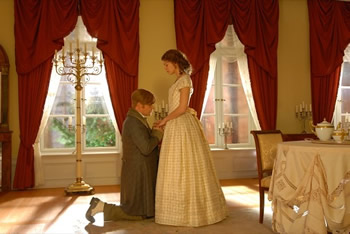
Bendix Grünlich (Justus von Dohnányi) vraagt Tony Buddenbrook (Jessica Schwarz) ten huwelijk. Scene uit de verfilming van „Buddenbrooks“ uit 2008.†

Er saß zur Seite der kleinen Wiege mit grünseidenen Vorhängen, die bei dem hohen Himmelbett der Konsulin stand und die er mit einer Hand in gleichmäßiger Schwingung erhielt. Die Kon­sulin und ihr Gatte hatten sich, der leichteren Bedienung halber, für einige Zeit hier unten eingerichtet, während ihr Vater und Madame Antoinette, die, eine Schürze über dem gestreiften Kleide und eine Spitzenhaube auf den dicken weißen Locken, sich dort hinten am Tische mit Flanell und Linnen zu schaffen machte, das dritte Zimmer des Zwischengeschosses zum Schla­fen benutzten.
Konsul Buddenbrook warf kaum einen Blick in das Neben­zimmer, so sehr war er von seiner Arbeit in Anspruch genom­men. Sein Gesicht trug einen ernsten und vor Andacht beinahe leidenden Ausdruck. Sein Mund war leicht geöffnet, er ließ das Kinn ein wenig hängen, und seine Augen verschleierten sich dann und wann. Er schrieb:
»Heute, d. 14. April 1838, morgens um 6 Uhr, ward meine liebe Frau Elisabeth, geb. Kröger, mit Gottes gnädiger Hilfe aufs glücklichste von einem Töchterchen entbunden, welches in der hl. Taufe den Namen Clara empfangen soll. Ja, so gnädig half ihr der Herr, obgleich nach Aussage des Doktors Grabow die Ge­burt um etwas zu früh eintrat und sich vordem nicht alles zum Besten verhielt und Bethsy große Schmerzen gelitten hat. Ach, wo ist doch ein solcher Gott, wie du bist, du Herr Zebaoth, der du hilfst in allen Nöten und Gefahren und uns lehrst deinen Wil­len recht zu erkennen, damit wir dich fürchten und in deinem Willen und Geboten treu mögen erfunden werden! Ach Herr, leite und führe uns alle, solange wir leben auf Erden … « –
†

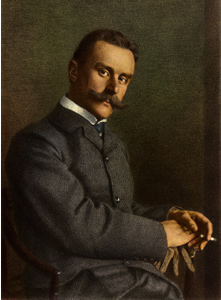
Thomas Mann (6 juni 1875 – 12 augustus 1955)
Ets door Johannes Lindner, 1905

Lees verder “Thomas Mann, Aleksandr Poesjkin, Sarah Dessen, Jean Cayrol”
Federico García Lorca, Adriaan Morriën, Ken Follett, Margo Lanagan, Carel Peeters

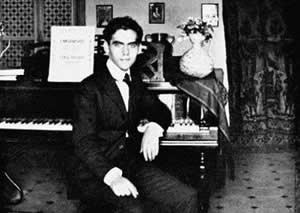
De Spaanse dichter en toneelschrijver Federico Garcia Lorca werd geboren op 5 juni 1898 in Fuente Vaqueros, Granada. Zie ook alle tags voor Federico Garcia Lorca op dit blog.


 Struikje Struikje

Struikje struikje
dor en groen.

Het meisje met het knappe snoetje
plukt olijven op het veld.
De wind die van de torens houdt,
slaat zijn armen om haar heupen.
Vier ruiters komen voorbij
op Andalusische paardjes,
in het blauw en het groen
met langere donkere mantels.
“Kom mee naar Córdoba, lief kind.”
Het meisje luistert niet.
Drie jonge torero’s komen voorbij
in oranje pakken
en slank van lijf,
met degens van belegen zilver.
“Kom mee naar Sevilla, lief kind.”
Het meisje luistert niet.
Als de avondhemel paars kleurt,
komt in het wazige schemerdonker
een jongeman voorbij
met rozen en mirten van maanlicht.
“Kom mee naar Granada, lief kind.”
En het meisje luistert niet.
Het meisje met het knappe snoetje
blijft maar olijven plukken,
met de grijze armen van de wind
om haar heupen.

Struikje struikje
dor en groen.


Vertaald door Bart Vonck


The Poet asks his Love to write

Visceral love, living death,
in vain, I wait your written word,
and consider, with the flower that withers,
I wish to lose you, if I have to live without self.

The air is undying: the inert rock
neither knows shadow, nor evades it.
And the heart, inside, has no use
for the honeyed frost the moon pours.

But I endured you: ripped open my veins,
a tiger, a dove, over your waist,
in a duel of teeth and lilies.

So fill my madness with speech,
or let me live in my calm
night of the soul, darkened for ever.


The Dawn

New York’s dawn holds
four mud pillars,
and a hurricane of black doves,
paddling in foul water.

New York’s dawn
moans on vast stairways,
searching on the ledges,
for anguished tuberoses.

Dawn breaks and no one’s mouth breathes it,
since hope and tomorrow, here, have no meaning.
Sometimes coins, furiously swarming,
stab and devour the abandoned children.

The first to go outside know in their bones
Paradise will not be there, nor wild loves.
They know they go to the swamp of law, and numbers,
to play without art, and labour without fruit.

The light is buried by chains and by noise,
in the shameless challenge, of rootless science.
All across the suburbs, sleepless crowds stumble,
as if saved, by the moment, from a shipwreck of blood.


Vertaald door A. S. Kline

Federico García Lorca (5 juni 1898 – 19 augustus 1936)

Lees verder “Federico García Lorca, Adriaan Morriën, Ken Follett, Margo Lanagan, Carel Peeters”

Marie Ndiaye, Ralf Thenior, Erasmus Schöfer, Buddy Wakefield, Yaak Karsunke, Elizabeth Jolley


De Franse schrijfster Marie Ndiaye werd geboren op 4 juni 1967 in Pithiviers. Zie ook alle tags voor Marie Ndiaye op dit blog.


Uit: Drie sterke vrouwen (Vertaald door Jeanne Holierhoek)


“En degene die haar ontving of die toevallig, zo leek het, op de drempel van zijn grote betonnen huis verscheen, in een aanzwellende, plotseling zo krachtige schittering dat zijn in lichte kleuren geklede lichaam die schittering zelf leek voort te brengen en te verspreiden, de man die daar stond, klein, zwaarder geworden, als een neonlamp omhuld door een wit schijnsel, die man, plotseling opgedoken op de drempel van zijn kolossale huis, had niets meer van zijn vroegere arrogantie, zei Norah meteen in zichzelf, was zijn fiere houding kwijt en ook zijn jeugdigheid, ooit zo raadselachtig constant dat ze onvergankelijk leek.
Zijn handen hield hij gevouwen op zijn buik, zijn hoofd helde zijwaarts, en dat hoofd was grauw, die buik puilde week uit onder het witte overhemd, boven de riem van de crèmekleurige broek.
Daar stond hij in een kille glans, hij moest op de drempel van zijn pretentieuze huis zijn neergekomen van de tak van een flamboyant die in de tuin stond, want toen ze het huis was genaderd, overwoog Norah, was ze door het hek heen strak naar de voordeur blijven kijken, en ze had niet gezien dat die deur was opengegaan om haar vader naar buiten te laten – en toch was hij voor haar verschenen in het kwijnende daglicht, die afgetakelde man in zijn stralenkrans, die zo’n zware klap op zijn schedel leek te hebben gekregen dat de harmonische proporties die Norah zich herinnerde, waren vervormd tot die van een dikke man zonder hals met plompe, korte benen.
Roerloos zag hij haar naderen en niets in zijn weifelende, ietwat starende blik duidde erop dat hij haar komst verwachtte, dat hij haar had gevraagd, haar had gesmeekt (voorzover, dacht zij, een man als hij in staat was om wat voor hulp dan ook af te smeken) of ze naar hem toe wilde komen.”


Marie Ndiaye (Pithiviers, 4 juni 1967)

Lees verder “Marie Ndiaye, Ralf Thenior, Erasmus Schöfer, Buddy Wakefield, Yaak Karsunke, Elizabeth Jolley”

Allen Ginsberg, Philippe Djian, Maarten van Buuren, Monika Maron, Larry McMurtry

De Amerikaanse dichter Irwin Allen Ginsberg werd geboren in Newark, New Jersey, op 3 juni 1926. Zie ook alle tags voor Allen Ginsberg op dit blog.


Hospital Window

At gauzy dusk, thin haze like cigarette smoke
ribbons past Chrysler Building’s silver fins
tapering delicately needletopped, Empire State’s
taller antenna filmed milky lit amid blocks
black and white apartmenting veil’d sky over Manhattan,
offices new built dark glassed in blueish heaven–The East
50’s & 60’s covered with castles & watertowers, seven storied
tar-topped house-banks over York Avenue, late may-green trees
surrounding Rockefellers’ blue domed medical arbor–
Geodesic science at the waters edge–Cars running up
East River Drive, & parked at N.Y. Hospital’s oval door
where perfect tulips flower the health of a thousand sick souls
trembling inside hospital rooms. Triboro bridge steel-spiked
penthouse orange roofs, sunset tinges the river and in a few
Bronx windows, some magnesium vapor brilliances’re
spotted five floors above E 59th St under grey painted bridge
trestles. Way downstream along the river, as Monet saw Thames
100 years ago, Con Edison smokestacks 14th street,
& Brooklyn Bridge’s skeined dim in modern mists–
Pipes sticking up to sky nine smokestacks huge visible–
U.N. Building hangs under an orange crane, & red lights on
vertical avenues below the trees turn green at the nod
of a skull with a mild nerve ache. Dim dharma, I return
to this spectacle after weeks of poisoned lassitude, my thighs
belly chest & arms covered with poxied welts,
head pains fading back of the neck, right eyebrow cheek
mouth paralyzed–from taking the wrong medicine, sweated
too much in the forehead helpless, covered my rage from
gorge to prostate with grinding jaw and tightening anus
not released the weeping scream of horror at robot Mayaguez
World self ton billions metal grief unloaded
Pnom Penh to Nakon Thanom, Santiago & Tehran.
Fresh warm breeze in the window, day’s release
> from pain, cars float downside the bridge trestle
and uncounted building-wall windows multiplied a mile
deep into ash-delicate sky beguile
my empty mind. A seagull passes alone wings
spread silent over roofs.


Allen Ginsberg (3 juni 1926 – 6 april 1997)
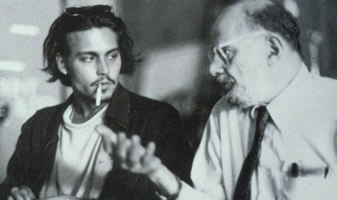
Hier met acteur Johnny Depp (links)

Lees verder “Allen Ginsberg, Philippe Djian, Maarten van Buuren, Monika Maron, Larry McMurtry”

Jim Knipfel, Marcel Reich-Ranicki, Sibylle Berg, Carol Shields, Jean Nelissen

De Amerikaanse schrijver Jim Knipfel werd geboren op 2 juni 1965 in Green Bay, Wisconsin. Zie ook alle tags voor Jim Knipfel op dit blog.

Uit: The Blow-off

“The recording started once again from the beginning.
“No,” was all she said.
The limp and faded banner hanging over the entrance to the tent featured a screaming, bikini-clad beauty held loosely in the clutches of what appeared to be a twelve-foot-tall gorilla who, likewise, was screaming about something. His (as promised) wicked yellow fangs were dripping blood. Behind them, for some reason, stood a single palm tree.
“C’mon,” he said, his voice distant, his eyes fixed on the crudely painted banner. His legs were already moving toward the tent, and he was tugging at her immovable arm like a Jack Russell terrier who’d just spotted something in the gutter. A slice of pizza or the severed wing of a pigeon.
“No,” Annie repeated more firmly. She leaned back, digging her heels into the blacktop, which had softened in the unbearable heat of the past three days. She wrenched her arm free from his sweaty grip. There was no question or hesitation in her tone, no opening for negotiations. She folded her arms and waited for him to turn around and meet her unwavering gaze.
The heavy air around them reeked of burnt sugar and sweat and howled with a collision of warped calliope music, classic rock, and screams. Where they stood, they were hemmed in on all sides by thousands of dancing and whirling and throbbing pinpoint lights.
Hank’s eyes snapped away from the banner and back to his wife, his confusion deepening. “No? Whaddya mean no? It’s a Girl-to-Gorilla show.” He spoke the term as if merely uttering it aloud would clarify everything.
“No.”
“Look, sweetie—Annie—like the tape says, there’s nothing to worry about. It’s in a cage. I’ve seen this show a dozen times and it gets me every time. Great little trick. It’s done with mirrors, you know.” He stared at her expectantly.
“That’s great, Marv. Really. But no.”

Jim Knipfel (Green Bay, 2 juni 1965)

Lees verder “Jim Knipfel, Marcel Reich-Ranicki, Sibylle Berg, Carol Shields, Jean Nelissen”

Thomas Hardy, Markies De Sade, Dorothy West, Max Aub, Karl Gjellerup, Barbara Pym

De Engels romanschrijver en dichter Thomas Hardy werd op 2 juni 1840 geboren in Higher Bockhampton, bij Dorchester. Zie ook alle tags voor Thomas Hardy op dit blog


A Broken Appointment

You did not come,
And marching Time drew on, and wore me numb.
Yet less for loss of your dear presence there
Than that I thus found lacking in your make
That high compassion which can overbear
Reluctance for pure lovingkindness’ sake
Grieved I, when, as the hope-hour stroked its sum,
You did not come.

You love not me,
And love alone can lend you loyalty;
-I know and knew it. But, unto the store
Of human deeds divine in all but name,
Was it not worth a little hour or more
To add yet this: Once you, a woman, came
To soothe a time-torn man; even though it be
You love not me.


A Poet

Attentive eyes, fantastic heed,
Assessing minds, he does not need,
Nor urgent writs to sup or dine,
Nor pledges in the roseate wine.

For loud acclaim he does not care
By the august or rich or fair,
Nor for smart pilgrims from afar,
Curious on where his hauntings are.

But soon or later, when you hear
That he has doffed this wrinkled gear,
Some evening, at the first star-ray,
Come to his graveside, pause and say:

‘Whatever his message his to tell
Two thoughtful women loved him well.’
Stand and say that amid the dim:
It will be praise enough for him.


A Thunderstorm in Town

She wore a ’terra-cotta’ dress,
And we stayed, because of the pelting storm,
Within the hansom’s dry recess,
Though the horse had stopped; yea, motionless
We sat on, snug and warm.

Then the downpour ceased, to my sharp sad pain,
And the glass that had screened our forms before
Flew up, and out she sprang to her door:
I should have kissed her if the rain
Had lasted a minute more.


Thomas Hardy (2 juni 1840 – 11 januari 1928)
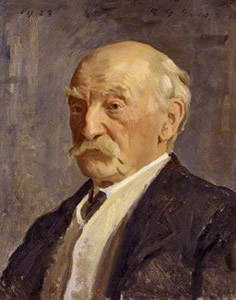
Portret door Reginald Grenville Eves, 1923

Lees verder “Thomas Hardy, Markies De Sade, Dorothy West, Max Aub, Karl Gjellerup, Barbara Pym”

Patrick Besson, John Masefield, Ferdinand Raimund, Peter de Mendelssohn

De Franse schrijver en journalist Patrick Besson werd geboren op 1 juni 1956 in Montreuil. Zie ook mijn blog van 1 juni 2009 en alle tags voor Patrick Besson op dit blog.


Uit: Mais le fleuve tuera l’homme blanc


« Ça valait mieux. Installé près d’elle pendant plusieurs heures, j’aurais fini par lui poser des questions auxquelles elle n’aurait pas répondu. Si c’était encore la Blandine de Kergalec qui avait fait autrefois les gros titres des journaux. Dure comme le granit breton, avaient écrit à son sujet les éditorialistes dans leur style caractéristique. Elle était installée de l’autre côté de l’appareil, à deux rangs derrière moi. Elle occupait la place près du hublot. Elle garda son sac sur les genoux pendant plusieurs minutes, semblant douter de vouloir se rendre à destination, puis le glissa sous son siège. Elle n’avait pris ni livre, ni iPod, ni lecteur DVD. Elle passerait les six heures de vol à penser, comme tous les gens en proie à une obsession. Avait-elle remarqué que je la regardais ? Sa façon de ne pas me voir m’inclinait à croire que oui. Passa devant mes genoux une silhouette fluette, puis il y eut un souffle léger à ma droite : la créature infime s’asseyait. Une veste fluide flottait autour de son absence d’épaules. L’homme se présenta. Entre passagers de la classe affaires, on se présente. Pour faire des affaires. C’était un conseiller de présidents africains. Les conseillers de présidents africains sont intéressés par les hommes du pétrole et les hommes du pétrole par les conseillers de présidents africains. Ils exercent, en Afrique, la même profession : pomper. Il regarda alentour, vérifiant qu’il n’avait plus personne à saluer. Partiellement chauve, il avait choisi, comme nombre de footballeurs et de chanteurs hip-hop, de l’être en entier, et son petit crâne rasé luisait comme une pomme au-dessus des fauteuils. Il se rassit, ouvrit son ordinateur et se mit à écrire, sans doute à l’usage du président du pays où nous nous rendions, une note facturée 50 000 euros. 75 000 ? Il refusa le verre de champagne que lui proposait l’hôtesse. Je regardai, de l’autre côté de l’avion, si Blandine de Kergalec avait accepté le sien. Non plus. On se préparait pourtant à un long voyage et les longs voyages se passent mieux avec du champagne.”


Patrick Besson (Montreuil, 1 juni 1956)

Lees verder “Patrick Besson, John Masefield, Ferdinand Raimund, Peter de Mendelssohn”

Colleen McCullough, Macedonio Fernández, Dennis Gaens, Rhidian Brook

De Australische schrijfster Colleen McCullough werd geboren op 1 juni 1937 in Wellington. Zie ook mijn blog van 1 juni 2009 en eveneens alle tags voor Colleen McCullough op dit blog.


Uit: The Thorn Birds


The doll’s golden hair tumbled down, the pearls flew winking into the long grass and disappeared. A dusty boot came down thoughtlessly on the abandoned dress, smearing grease from the smithy across its satin. Meggie dropped to her knees, scrabbling frantically to collect the miniature clothes before more damage was done them, then she began picking among the grass blades where she thought the pearls might have fallen. Her tears were blinding her, the grief in her heart new, for until now she had never owned anything worth grieving for.

Frank threw the shoe hissing into cold water and straightened his back; it didn’t ache these days, so perhaps he was used to smithying. Not before time, his father would have said, after six months at it. But Frank knew very well how long it was since his introduction to the forge and anvil; he had measured the time in hatred and resentment. Throwing the hammer into its box, he pushed the lank black hair off his brow with a trembling hand and dragged the old leather apron from around his neck. His shirt lay on a heap of straw in the corner; he plodded across to it and stood for a moment staring at the splintering barn wall as if it did not exist, his black eyes wide and fixed.

He was very small, not above five feet three inches, and thin still as striplings are, but the bare shoulders and arms had muscles already knotted from working with the hammer, and the pale, flawless skin gleamed with sweat. The darkness of his hair and eyes had a foreign tang, his full-lipped mouth and wide-bridged nose not the usual family shape, but there was Maori blood on his mother’s side and in him it showed. He was nearly sixteen years old, where Bob was barely eleven, Jack ten, Hughie nine, Stuart five and little Meggie three. Then he remembered that today Meggie was four; it was December 8th. He put on his shirt and left the barn”.


Colleen McCullough (Wellington, 1 juni 1937)

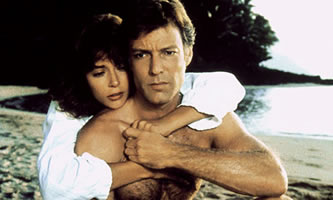
Scene uit de tv-serie met Richard Chamberlain en Rachel Ward, 1983

Lees verder “Colleen McCullough, Macedonio Fernández, Dennis Gaens, Rhidian Brook”

Walt Whitman, Frank Goosen, Gabriel Barylli, Konstantin Paustovski

De Amerikaanse dichter Walt Whitman werd geboren op 31 mei 1819 in Westhills, Long Island, New York. Zie ook alle tags voor Whalt Whitman op dit blog.


A Leaf For Hand In Hand


A LEAF for hand in hand!
You natural persons old and young!
You on the Mississippi, and on all the branches and bayous of the
Mississippi!
You friendly boatmen and mechanics! You roughs!
You twain! And all processions moving along the streets!
I wish to infuse myself among you till I see it common for you to
walk hand in hand!


As Adam, Early In The Morning


AS Adam, early in the morning,
Walking forth from the bower, refresh’d with sleep;
Behold me where I pass–hear my voice–approach,
Touch me–touch the palm of your hand to my Body as I pass;
Be not afraid of my Body.


Uit: Calamus Poems


11.

When I heard at the close of the day how my name had been received with plaudits in the capitol, still it was not a happy night for me that followed;

And else, when I caroused, or when my plans were accomplished, still I was not happy;

But the day when I rose at dawn from the bed of perfect health, refreshed, singing, inhaling the ripe breath of autumn,

When I saw the full moon in the west grow pale and disappear in the morning light,

When I wandered alone over the beach, and, undressing, bathed, laughing with the cool waters, and saw the sun rise,

And when I thought how my dear friend, my lover, was on his way coming, O then I was happy;

O then each breath tasted sweeter — and all that day my food nourished me more — And the beautiful day passed well,

And the next came with equal joy — And with the next, at evening, came my friend;

And that night, while all was still, I heard the waters roll slowly continually up the shores,

I heard the hissing rustle of the liquid and sands, as directed to me, whispering, to congratulate me,

For the one I love most lay sleeping by me under the same cover in the cool night,

In the stillness, in the autumn moonbeams, his face was inclined toward me,

And his arm lay lightly around my breast — And that night I was happy.


Walt Whitman (31 mei 1819 – 26 maart 1893)

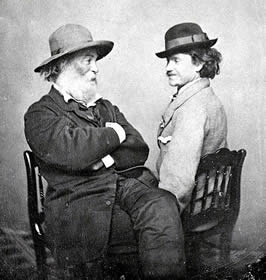
Hier met vriend Peter Doyle (rechts)


Lees verder “Walt Whitman, Frank Goosen, Gabriel Barylli, Konstantin Paustovski”

Svetlana Alexievich

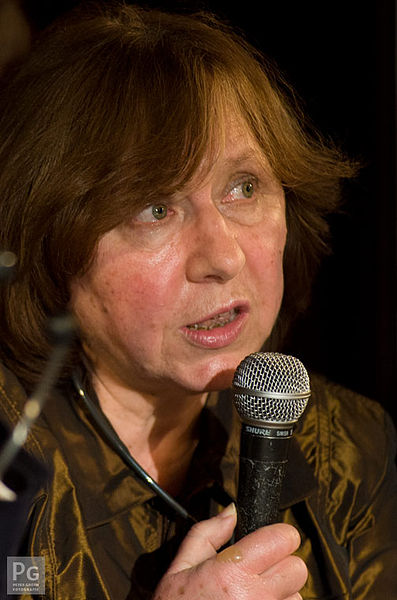
De Wit-Russische schrijfster en onderzoeksjournaliste Svetlana Alexandrovna Alexievich  werd geboren op 31 mei 1948 in Stanyslaviv (sinds 1962 Ivano – Frankivsk) Na haar schoolopleiding werkte ze als verslaggever in diverse lokale kranten, en vervolgens als correspondente voor het literaire tijdschrift “Neman” in Minsk. Zij maakte carrière in de journalistiek en door het schrijven van verhalen, gebaseerd op interviews met getuigen van de meest dramatische gebeurtenissen in het land zoals de Tweede Wereldoorlog,de Sovjet – Afghaanse oorlog, de val van de Sovjet- Unie en de ramp in Tsjernobyl. Na de vervolging door het Loekasjenko-regime  verliet zij Belarus in 2000. Gedurende de volgende tien jaar woonde ze in Parijs, Göteborg en Berlijn .In 2011 verhuisde Alexievich terug naar Minsk. Haar boeken worden beschreven als een literaire kroniek van de emotionele geschiedenis van de Sovjet -en post-Sovjet-mens. Haar meest opmerkelijke werken in Engelse vertalingen gaan over de oorlog in Afghanistan (The Boys of Zinc) en over de ramp in Tsjernobyl (Voices from Chernobyl. Haar eerste boek “Het onvrouwelijk gezicht van de oorlog” kwam uit in 1985. Het werd meerdere malen herdrukt en er werden meer dan twee miljoen exemplaren van verkocht. Deze roman is opgebouwd uit monologen van vrouwen in de oorlog die spreken over de aspecten van de Tweede Wereldoorlog die nooit eerder aan de orde kwamen. Een ander boek, “De laatste getuige: het Boek van onkinderlijke verhalen” beschrijft persoonlijke herinneringen van kinderen in oorlogstijd. In 1993 publiceerde ze “Betoverd door de dood”, een boek over geslaagde zelfmoorden en zelfmoordpogingen als gevolg van de ondergang van de Sovjet- Unie. Veel mensen voelden zich onlosmakelijk verbonden met de communistische ideologie en waren niet in staat om de nieuwe orde en de nieuw geïnterpreteerde geschiedenis te accepteren . Alexievich ’s boeken zijn gepubliceerd in vele landen, waaronder de VS, Duitsland, Groot-Brittannië, Japan, Zweden, Frankrijk, China, Vietnam, Bulgarije en India met een totaal van 19 landen in totaal. Ze heeft 21 scripts voor documentaires op haar naam en drie toneelstukken die werden opgevoerd in Frankrijk, Duitsland en Bulgarije.


Uit: Voices from Chernobyl


Lyudmilla Ignatenko Wife of deceased Fireman Vasily Ignatenko

We were newlyweds. We still walked around holding hands, even if we were just going to the store. I would say to him, “I love you.” But I didn’t know then how much. I had no idea . . . We lived in the dormitory of the fire station where he worked. I always knew what was happening—where he was, how he was.

One night I heard a noise. I looked out the window. He saw me. “Close the window and go back to sleep. There’s a fire at the reactor. I’ll be back soon.”

I didn’t see the explosion itself. Just the flames. Everything was radiant. The whole sky. A tall flame. And smoke. The heat was awful. And he still hadn’t come back.

They went off just as they were, in their shirtsleeves. No one told them. They had been called for a fire, that was it.

Seven o’clock in the morning. At seven I was told he was in the hospital. I ran over there‚ but the police had already encircled it, and they weren’t letting anyone through. Only ambulances. The policemen shouted: “The ambulances are radioactive‚ stay away!” I started looking for a friend, she was a doctor at that hospital. I grabbed her white coat when she came out of an ambulance. “Get me inside!” “I can’t. He’s bad. They all are.” I held onto her. “Just to see him!” “All right‚” she said. “Come with me. Just for fifteen or twenty minutes.”

I saw him. He was all swollen and puffed up. You could barely see his eyes.

“He needs milk. Lots of milk‚” my friend said. “They should drink at least three liters each.”

“But he doesn’t like milk.”

“He’ll drink it now.”

Many of the doctors and nurses in that hospital‚ and especially the orderlies‚ would get sick themselves and die. But we didn’t know that then.

At ten‚ the cameraman Shishenok died. He was the first.”


Svetlana Alexievich
(Stanyslaviv, 31 mei 1948)