Rutger Kopland, Simon Vinkenoog, Hunter S. Thompson, Steffen Popp, Per Petterson, Elizabeth Gilbert, Aad Nuis, Judith Beveridge, Dolce far niente

Dolce far niente


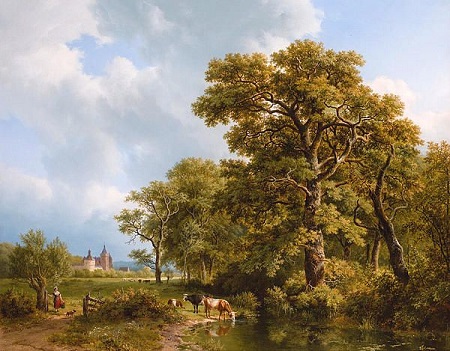
Zomerlandschap met koeien door B.C. Koekkoek, 1836


Onder het vee

En toen de zomer dan toch weer was teruggekeerd
en wij dus weer zaten te drinken bij de rivier.
Zijn oude armen bewogen nog, naar daar, die wereld
dat langzame, eeuwige leven van vee in de verte.

Ieder mens zou een dier moeten zijn, moeten sterven
in de herfst, en in de lente weer worden geboren.

Of, ieder mens zou een rivier moeten zijn, komen
zonder verlangen te blijven, gaan zonder heimwee.

Zo zaten we dus weer te drinken daar, tegen de tijd,
oude verhalen, oude jenever, maar de zon ging wel onder.

En hij sliep in. Omdat de wereld insliep. Zwart
zat hij bij de rivier, zwart gat in het uitzicht.
 

Rutger Kopland (4 augustus 1934 – 11 juli 2012)
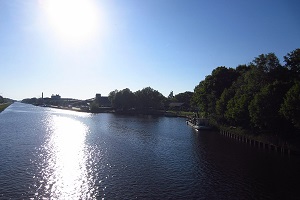
De haven van Goor, de geboorteplaats van Rutger Kopland


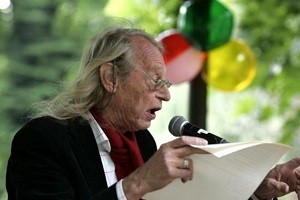
De Nederlandse dichter en schrijver Simon Vinkenoog werd op 18 juli 1928 in Amsterdam geboren. Zie ook alle tags voor Simon Vinkenoog op dit blog.

Oponthoud in Rapallo

ik speel ik met een vol gezicht ik
en ik spel ik tussen de woorden door
ik beland in een haven versierd met muziek
en overal is het als ik:

ik woon in de dagen op lange passen
ik kan het stof nog van mijn kleren slaan
en jaja knikken tegen alle deuren

ik kan hier in de lengte door
ik kan van achter van mezelf opaan
ik weet van de zijkanten ik
en ik kan het van voren vragen
aan het rijmelend indecent glas
dat spiegel heet
ik zie het overal aan
ik zie het aan ik en aan het fluisterend
radeloos licht van de zon
en ik zwem nog doorschijnend
door dit vloeibaar dierbaar
eigen andermanse ik


Tenzij de dingen uit zichzelf gaan spreken

een kraan het hoog geluid van liefde fluit
een waterstraal die onverslapte aandacht tikt
een dronken boodschap in de brievenbus
een onverwacht bezoek aan de deur gevonden

de zee die door de straten weifelt
de zon een onbeholpen minnaar op mijn huid
en de doofstomme takken van de bomen
in mijn ogen et cetera

Tenzij ik jaren op je wachten wil
en op je mond het stempel ongeopend druk

als met een zegelring die woorden bloed
en vlijt in de nagels drijft

de handen die niets meer weten
van het feest dat morgen
in de cijfers van het heden
wijdbeens staat geplant


Ver als de horizon ben je

ver als de horizon ben je
in de glazen kist van het weer geborgen
beukend op de blikken deksels
van het najaar
ik zie de bliksem langs je lichaam trillen
en de regen loopt onrustig door je ogen

ik kan de afstand die mij van je scheidt
in lichtjaren tellen
en in de meter van het geluid
zoemen de seconden

mijn handen opnieuw in gebruik gesteld
sluiten het onweer in je borsten buiten

alleen de regen is thuis
op de platte daken van de nachten
zonder duizelingen
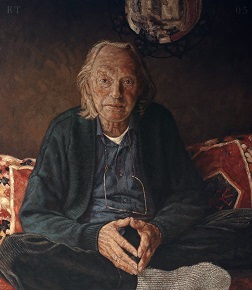
Simon Vinkenoog (18 juli 1928 – 12 juli 2009)
Portret door René Tweehuysen, 2015


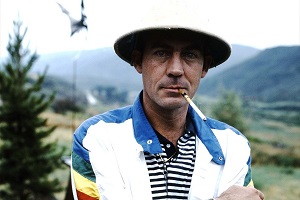
De Amerikaanse schrijver en journalist Hunter Stockton Thompson werd geboren in Louisville (Kentucky). op 18 juli 1937. Zie ook alle tags voor Hunter S. Thompson op dit blog.

Uit: Fear and Loathing in Las Vegas

“How long can we maintain? I wondered. How long before one of us starts raving and jabbering at this boy? What will he think then? This same lonely desert was the last known home of the Manson family. Will he make that grim connection when my attorney starts screaming about bats and huge manta rays coming down on the car? If so – well, we’ll just have to cut his head off and bury him somewhere. Because it goes without saying that we can’t turn him loose. He’ll report us at once to some kind of outback nazi law enforcement agency, and they’ll run us down like dogs.
Jesus! Did I say that? Or just think it? Was I talking? Did they hear me? I glanced over at my attorney, but he seemed oblivious – watching the road, driving our Great Red Shark along at a hundred and ten or so. There was no sound from the back seat.Maybe I’d better have a chat with this boy, I thought. Perhape if I explain things, he’ll rest easy.
Of course. I leaned around in the seat and gave him a fine big smile . . . admiring the shape of his skull.“By the way,” I said. “There’s one thing you should probably understand.”
He stared at me, not blinking. Was he gritting his teeth?
“Can you hear me?” I yelled.
He nodded.
“That’s good,” I said. “Because I want you to know that we’re on our way to Las Vegas to find the American Dream.” I smiled. “That’s why we rented this car. It was the only way to do it. Can you grasp that?”
He nodded again, but his eyes were nervous.
“I want you to have all the background,” I said. “Because this is a very ominous assignment – with overtones of extreme personal danger. . . . Hell, I forgot all about this beer; you want one?”
He shook his head.
“How about some ether?” I said.
“What?”
“Never mind. Let’s get right to the heart of this thing. You see, about twenty – four hours ago we were sitting in the Polo Lounge of the Beverly Hills Hotel – in the patio section, of course – and we were just sitting there under a palm tree when this uniformed dwarf came up to me with a pink telephone and said, ‘This must be the call you’ve been waiting for all this time, sir.’”
I laughed and ripped open a beer can that foamed all over the back seat while I kept talking. “And you know? He was right! I’d been expecting that call, but I didn’t know who it would come from. Do you follow me?”
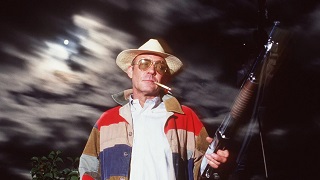
Hunter S. Thompson (18 juli 1937 – 20 februari 2005)


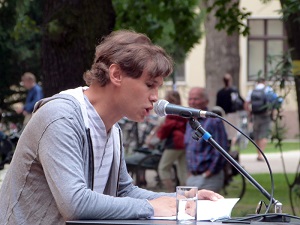
De Duitse dichter en schrijver Steffen Popp werd geboren op 18 juli 1978 in Greifswald. Zie ook alle tags voor Steffen Popp op dit blog.


O elefantischer Pan im Porzellantrakt der Musen

O elefantischer Pan im Porzellantrakt der Musen
hinter den Schleiern suchst du Gesang, übst dich
in Gedanken: »Wir sind
            ein Gespräch«, sagst du, »Wir sind
                                                                      Elefanten«

und bist ganz allein mit diesen Sätzen
einsamer als Dialoge, Dickhäuter
einsamer als die Elektrogeräte des Weltalls

stromsparende Lampen, Wärmepumpen
verwahrlost und hungrig nach Liebe kommen sie
langsam heran aus dem unendlichen Dunkel

an deiner Raumkapsel, ihren geheimen Sprossen
an deinen klugen Händen und Knien
deinen schlafenden Füßen, geträumten Flügeln
reiben sie ihre Felle aus Chrom und Kunststoff …

Die angelernte Hilflosigkeit der Gegenstände
Unmöglichkeit einer Berührung

das Lied, unter seiner Nachtmütze aus Sternen
bewegt es den einsamen Boiler, den irrenden
                                                                       Ventilator
dein irrendes Auge
auch

in eine Nestgemeinschaft ohne Strom
ohne Gedanken
nur gravitierende Körper, ihre beinahe
staatenbildende Panik vor dem Winter.
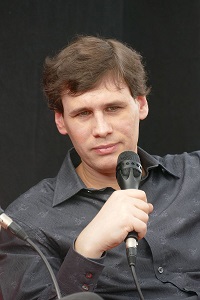
Steffen Popp (Greifswald, 18 juli 1978)


De Noorse schrijver Per Petterson werd geboren in Oslo op 18 juli 1952. Zie ook alle tags voor Per Petterson op dit blog.

Uit: Out Stealing Horses (Vertaald door Anne Born Picador)

“I too have a dog. Her name is Lyra. What breed she is would not be easy to say. It’s not that important. We have been out already, with a torch, on the path we usually take, along the lake with its few millimetres of ice up against the bank where the dead rushes are yellow with autumn, and the snow fell silently, heavily out of the dark sky above, making Lyra sneeze with delight. Now she lies there close to the stove, asleep. It has stopped snowing. As the day wears on it will all melt. I can tell that from the thermometer. The red column is rising with the sun.
All my life I have longed to be alone in a place like this. Even when everything was going well, as it often did. I can say that much. That it often did. I have been lucky. But even then, for instance in the middle of an embrace and someone whispering words in my ear I wanted to hear, I could suddenly get a longing to be in a place where there was only silence. Years might go by and I did not think about it, but that does not mean that I did not long to be there. And now I am here, and it is almost exactly as I had imagined it.
In less than two months’ time this millennium will be finished. There will be festivities and fireworks in the parish I am a part of. I shall not go near any of that. I will stay at home with Lyra, perhaps go for a walk down to the lake to see if the ice will carry my weight. I am guessing minus ten and moonlight, and then I will stoke the fire, put a record on the old gramophone with Billie Holiday’s voice almost a whisper, like when I heard her in the Oslo Colosseum some time in the 50s, almost burned out, yet still magic, and then fittingly get drunk on a bottle I have standing by in the cupboard. When the record ends I will go to bed and sleep as heavily as it is possible to sleep without being dead, and awake to a new millennium and not let it mean a thing. I am looking forward to that.”
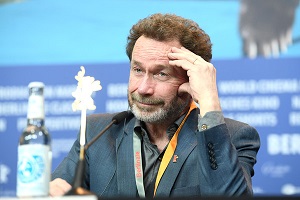
Per Petterson (Oslo, 18 juli 1952)


De Amerikaanse schrijfster en essayiste Elizabeth M. Gilbert werd geboren op 18 juli 1969 in Waterbury, Connecticut. Zie ook alle tags voor Elizabeth Gilbert op dit blog.

Uit: City of Girls

“I fell in love with Anthony Roccella, and I’m not going to dillydally around, pretending that I didn’t. And he fell in love with me too—in his own way and for a little while at least. Best of all, I managed to fall in love with him within the space of just a few hours, which is a model of efficiency. (The young can do that kind of thing, as you must know, without difficulty. In fact, passionate love, executed in short bursts, is the natural condition of the young. The only surprising thing was that it hadn’t happened to me sooner.)
The secret to falling in love so fast, of course, is not to know the person at all. You just need to identify one exciting feature about them, and then you hurl your heart at that one feature, with full force, trusting that this will be enough of a foundation for lasting devotion. And for me, the exciting thing about Anthony was his arrogance. I wasn’t the only one who noticed it, of course—that cockiness was how he got cast in our play, after all—but I was the one who fell in love with it.
Now, I’d been around plenty of arrogant young men since arriving in town a few months earlier (it was New York City; we breed them here), but Anthony’s arrogance had a special twist to it: he genuinely didn’t seem to care. All the cocky boys I’d met thus far liked to play at nonchalance, but they still had an air about them of wanting something, even if it was only sex. But Anthony had no apparent hunger or longing about him. He was fine with whatever transpired. He could win, he could lose, it didn’t shake him up. If he didn’t get what he wanted out of a situation, he would just stroll away with his hands in his pockets, unfazed, and try again somewhere else. Whatever life offered, he could take it or leave it.
He could even take it or leave it when it came to me—so, as you can imagine, I had no choice but to become completely smitten with him.
Anthony lived in a fourth-floor walk-up on West Forty-Ninth Street between Eighth and Ninth Avenues. He lived with his older brother, Lorenzo, who was the head chef at the Latin Quarter restaurant where Anthony worked waiting tables when he didn’t have an acting job. His mom and pop used to live in that apartment too, he told me, but they were both dead now—a fact that Anthony relayed to me with no evident sense of loss or sorrow. (Parents: another thing he could take or leave.)
Anthony was Hell’s Kitchen born and raised. He was pure Forty-Ninth Street, right to the core. Grew up playing stickball on that very street, and learned how to sing just a few blocks away at the Church of the Holy Cross. I came to know that street awfully well in the next few months. I certainly came to know that apartment awfully well, and I remember it with warm fondness because it was in his brother Lorenzo’s bed that I experienced my first climax. (Anthony didn’t have a bed of his own—he slept on the couch in the living room—but we helped ourselves to his brother’s room when Lorenzo was at work. Thankfully, Lorenzo worked long hours, giving me ample time to receive pleasure from young Anthony.)”
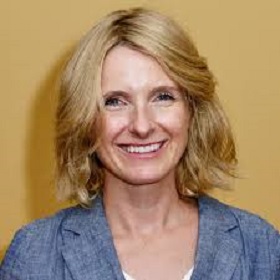
Elizabeth Gilbert (Waterbury, 18 juli 1969)


De Nederlandse schrijver, criticus en politicus Aad Nuis werd geboren op 18 juli 1933 in Sliedrecht. Zie ook alle tags voor Aad Nuis op dit blog.

Holland

Buiten zwaait de wind uitbundig
wolkendundoek zonnevanen
over een wijde weilanden wereld
over de verre vijandige zee

Binnen wordt mijn hart vakkundig
ingedeeld met oude namen
uitgesloten van de wereld
afgesloten van de zee


Amsterdam, maart

Vandaag kun je de lente ruiken
in het midden van de hoofdstad des lands
De bomen langs de gracht zijn kaal nog
hun stammen zijn stemmig donkerbruin donkergroen

Om de kleinste twijgen een ragdun waas
zo teer als een traan aan een kinderwimper
hetzelfde waas dat bij jonge vrouwen
je stil kan doen worden van eerbied

Daarachter de zon, de blauwe blinkende hemel
en de huizen die door de zon eigenhandig
in de goudgele neonverf zijn gezet

In het snelwisselend water alleen
huivert de winter nog aarzelend weg
als de droom in je ogen des morgens
kort na het ontwaken.
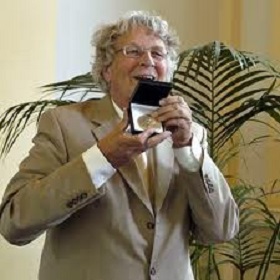
Aad Nuis (18 juli 1933 – 8 november 2007)


Onafhankelijk van geboortedata

De Australische dichteres en schrijfster Judith Beveridge werd geboren in 1956 in Londen, Engeland. Zie ook alle tags voor Judith Beveridge op dit blog.

Woman and Child

They listen to the myna birds dicker in the grass.
The child’s blue shoes are caked with
garden dirt. When he runs, she sees the antics
of a pair of wrens. She works the garden,

a pot of rusting gardenias has given off its ales
and infused the danker germinations of her
grief. She watches her son chase pigeons,
kick at the leaves piled high. Now, a magpie

adds to his cascades of laughter as he runs with
the hose, pours a fine spray, happy to be giving
to the grass this silver courtship. She sighs,
watches the drops settle in. Today, who

can explain the sadness she feels. Surely this
day is to be treasured: the sun out, the breeze
like a cat’s tongue licking a moon of milk;
her son expending himself in small, public

bursts, happy among clover where bees hover,
and unfold centrefolds of nectar. Today,
who can explain the heaviness in her head, as if
all her worries were tomes toward a larger work,

one she knows she will never finish, but to which
she must keep adding, thought by thought.
She sweeps the petals, smells their russet imprint.
Soon dusk will come with an envoy of smoke

and her son outlast her patience by a rose.
Already he is tiring, puling at the flowers.
It won’t be long before they’ll go in, listen
to the jug purr comfort. He’ll sleep and she’ll

lie back, or get up to unhook the cry of her cat
from the wire door. Now, a few cicadas are idling,
giving each other the gun and a cockatoo calls,
a haughty felon. She sighs, knowing she won’t

escape her mood today, the turned earth
or its rank persuasions; her child’s petulance
flaring like an orchid, or a cockatoo’s unruly crest.
Today, she knows she will need to consider

her unhappiness, of what she is a prisoner – if not
the loss of hope’s particulars. Her son soaks
the path, rinses the sky of its featureless blue.
He is giving that water, now, to everything.
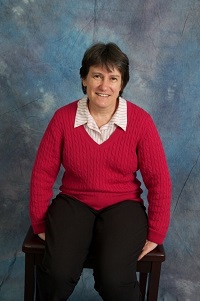
Judith Beveridge (Londen, 1956)


Judith Beveridge, Simon Vinkenoog, Hunter S. Thompson, Steffen Popp, Per Petterson, Elizabeth Gilbert, Alicia Steimberg, Aad Nuis

Dolce far niente


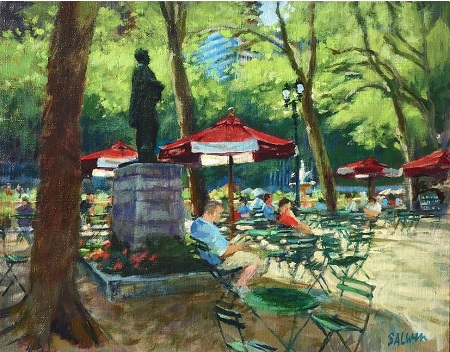
Bryant Park Reading Room door Peter Salwen, 2014


In The Park

Sitting on the grass
in the park—thinking about
what’s going by, about
the pinks and plenary reds

of today’s sunset.
Insects rampant as ions
off charged wires nipping,
tingling my legs.

Those buildings are like
bottles of scent fragile
in their lemon spray
mist and cologne light.

The harbour’s becoming
dark against the chromocosm
of the moon adrift
under the stars.

A gull squeaks—it’s
the sound of a pin
piercing polystyrene—it
carries out to the yachtmasts

moving mechanically
as wiper-bars, out to
the Opera House a duster
of starched serviettes.

Now, out to the suburbs,
those racks and racks
of tinted light
rising behind the trees.


Judith Beveridge (Londen, 1956)
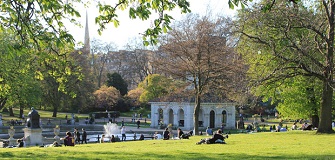
Hydepark in een zomers Londen


De Nederlandse dichter en schrijver Simon Vinkenoog werd op 18 juli 1928 in Amsterdam geboren. Zie ook alle tags voor Simon Vinkenoog op dit blog.


Robert

dit kan mijn geboorte nog niet zijn
dit is het leven van een ander –
het slaan van mijn hart is geen bewijs
en mijn mond is nog gesloten

dit is het bloeden van een rose keel
het woord dat de eerste daad verlamt
de hand die op mijn mond gelegd
aarzelend de gedichten zegt
waarin mijn vloeken
huizen naar beneden halen

dan sloop ik deze negenmaandse muur
waarop mijn vingers langzaam
het mene mene tekel schrijven


Groet

In de pijnkamer van onthechting
overgave deint en dreint

alles weten om niets te weten
lessen vergeten alles opnieuw
van te voren

kleine roofridder
hard als staal

adieu


Thelonious Monk

dit is een straat van parijs
met een arabier in de zon
die langzaam slenterend werkloos
loopt te zijn een 1951-noordafrikaan
ting ting ting in de bleke zon
zonder geluid

dit onder water uitgesproken
vonnis ting ting ting
ternauwernood de oppervlakte rakend
en met een strofe in de franse taal:
je donnerais ma vie
toute entière
pour un petit rire confus et obscène
herinnert aan de dierentuinapen
met mondbekken harige benen
en ronde gladde achterhanden
die gretig alle kleuren willen grijpen wit en zwart
ting ting ting


Simon Vinkenoog (18 juli 1928 – 12 juli 2009)


De Amerikaanse schrijver en journalist Hunter Stockton Thompson werd geboren in Louisville (Kentucky). op 18 juli 1937. Zie ook alle tags voor Hunter S. Thompson op dit blog.

Uit: Fear and Loathing in Las Vegas

“The only thing that really worried me was the ether. There is nothing in the world more helpless and irresponsible and depraved than a man in the depths of an ether binge. And I knew we’d get into that rotten stuff pretty soon. Probably at the next gas station. We had sampled almost everything else, and now – yes, it was time for a long snort of ether. And then do the next 100 miles in a horrible, slobbering sort of spastic stupor. The only way to keep alert on ether is to do up a lot of amyls – not all at once, but steadily, just enough to maintain the focus at 90 miles an hour through Barstow.
“Man, this is the way to travel,” said my attorney. He leaned over to turn the volume up on the radio, humming along with the rhythm section and kind of moaning the words: “One toke over the line … Sweet Jesus … One toke over the line …”
One toke? You poor fool! Wait till you see those goddamn bats. I could barely hear the radio … slumped over on the far side of the seat, grappling with a tape recorder turned all the way up on “Sympathy for the Devil.” That was the only tape we had, so we played it constantly, over and over, as a kind of demented counterpoint to the radio. And also to maintain our rhythm on the road. A constant speed is good for gas mileage – and for some reason that seemed important at the time. Indeed. On a trip like this one must be careful about gas consumption. Avoid those quick bursts of acceleration that drag blood to the back of the brain.
My attorney saw the hitchhiker long before I did. “Let’s give this boy a lift,” he said, and before I could mount any argument he was stopped and this poor Okie kid was running up to the car with a big grin on his face, saying, “Hot damn! I never rode in a convertible before!”
“Is that right?” I said. “Well, I guess you’re about ready, eh?”
The kid nodded eagerly as we roared off.
“We’re your friends,” said my attorney. “We’re not like the others.”
O Christ, I thought, he’s gone around the bend. “No more of that talk,” I said sharply. “Or I’ll put the leeches on you.” He grinned, seeming to understand. Luckily, the noise in the car was so awful – between the wind and the radio and the tape machine – that the kid in the back seat couldn’t hear a word we were saying. Or could he?”


Hunter S. Thompson (18 juli 1937 – 20 februari 2005)


De Duitse dichter en schrijver Steffen Popp werd geboren op 18 juli 1978 in Greifswald. Zie ook alle tags voor Steffen Popp op dit blog.


Dickicht mit Reden und Augen

Möglichkeit und Methode überschneiden sich
ein kühner Satz bricht sich im Wald, fortan er hinkt

kein Sprung ins Dickicht dringt, kein Huf hinaus
kein ausrangiertes Fahrrad betet hier um Ruh
kein altes Lama spuckt, kein junges auch

sie hängen in den Tag, in Baumschaukeln
kein Baum, genau besehen, keine Schaukel, nicht mal
ein sie, nur hängen, Tag

Reden, durch nichts gedeckt, doch lebhaft
Lebewesen fast in einem Dickicht
hängend, hinkend eine, darum nicht weniger wahr
nicht wahr, nicht weniger, nicht – ungerührt

schaukeln oder grasen zur Pflege der Landschaft
oder stehen nur in ihr, schauen herüber mit Augen.


Betonstufen, die Meere

Bewegung (Luft), Meerfarbe (grün), ein Igel (die Technik eines Coyoten
ihn auf den Rücken zu drehen) – dein Herz, der nahe Hafen
dehnt sich an seinen Schlafkanten. Futter in Säcken, Munitionskisten
der gespaltene Huf eines Esels im Brackwasser –

das Meer zeigt dir Ufer (die Grenzen), du schläfst in deinen Staaten
es gibt Geheimzeichen, Türme (auf See blickend), Flugabwehr
Ingenieure mit Fliegerkappen – du zählst sie an Stränden, es sind Gelenke
und sie verbinden dich (wie eine Schrift) mit allen Dingen.


Steffen Popp (Greifswald, 18 juli 1978)
In 2013


De Noorse schrijver Per Petterson werd geboren in Oslo op 18 juli 1952. Zie ook alle tags voor Per Petterson op dit blog.

Uit: Out Stealing Horses (Vertaald door Anne Born Picador)

„Early November. It’s nine o’clock. The titmice are banging against the window. Sometimes they fly dizzily off after the impact, other times they fall and lie struggling in the new snow until they can take off again. I don’t know what they want that I have. I look out the window at the forest. There is a reddish light over the trees by the lake. It is starting to blow. I can see the shape of the wind on the water.
I live here now, in a small house in the far east of Norway. A river flows into the lake. It is not much of a river, and it gets shallow in the summer, but in the spring and autumn it runs briskly, and there are trout in it. I have caught some myself. The mouth of the river is only a hundred metres from here.
I can just see it from my kitchen window once the birch leaves have fallen. As now in November. There is a cottage down by the river that I can see when its lights are on if I go out onto my doorstep.  A man lives there. He is older than I am, I think. Or he seems to be. But perhaps that’s because I do not realise what I look like myself, or life has been tougher for him than it has been for me. I cannot rule that out. He has a dog, a border collie.
I have a bird table on a pole a little way out in my yard. When it is getting light in the morning I sit at the kitchen table with a cup of coffee and watch them come fluttering in. I have seen eight different species so far, which is more than anywhere else I have lived, but only the titmice fly into the window. I have lived in many places. Now I am here. When the light comes I have been awake for several hours. Stoked the fire. Walked around, read yesterday’s paper, washed yesterday’s dishes, there were not many. Listened to the B.B.C. I keep the radio on most of the day. I listen to the news, cannot break that habit, but I do not know what to make of it any more. They say sixty-seven is no age, not nowadays, and it does not feel it either, I feel pretty spry. But when I listen to the news it no longer has the same place in my life. It does not affect my view of the world as once it did. Maybe there is something wrong with the news, the way it is reported, maybe there’s too much of it. The good thing about the B.B.C.’s World Service, which is broadcast early in the morning, is that everything sounds foreign, that nothing is said about Norway, and that I can get updated on the position of countries like Jamaica, Pakistan, India and Sri Lanka in a sport such as cricket; a game I have never seen played and never will see, if I have a say in the matter. But what I have noticed is that ‘The Motherland’, England, is constantly being beaten. That’s always something.”


Per Petterson (Oslo, 18 juli 1952)


De Amerikaanse schrijfster en essayiste Elizabeth M. Gilbert werd geboren op 18 juli 1969 in Waterbury, Connecticut. Zie ook alle tags voor Elizabeth Gilbert op dit blog.

Uit: Big Magic

“When I talk about ‘creative living’ here, please understand that I am not necessarily talking about pursuing a life that is professionally or exclusively devoted to the arts. I’m not saying that you must become a poet who lives on a mountaintop in Greece, or that you must perform at Carnegie Hall, or that you must win the Palme d’Or at the Cannes Film Festival. (Though if you want to attempt any of these feats, by all means, have at it. I love watching people swing for the Bleachers.) No, when I refer to ‘creative living’ I am speaking more broadly. I’m talking about living a life that is driven more strongly by curiosity than by fear.
One of the coolest examples of creative living that I’ve seen in recent years, for instance, came from my friend Susan, who took up figure skating when she was forty years old. To be more precise, she actually already knew how to skate. She had competed in figure skating as a child and had always loved it, but she’d quit the sport during adolescence when it became clear she didn’t have quite enough talent to be a champion. (Ah, lovely adolescence when the ‘talented’ are officially shunted off from the herd, thus putting the total burden of society’s creative dreams on the thin shoulders of a few select souls, while condemning everyone else to live a more commonplace, inspiration-free existence! What a system…)
For the next quarter of a century, my friend Susan did not skate. Why bother, if you can’t be the best? Then she turned forty. She was listless. She was restless. She felt drab and heavy. She did a little soul-searching, the way one does on the big birthdays. She asked herself when was the last time she’d felt truly light, joyous, and – yes – creative in her own skin. To her shock, she realised that it had been decades since she’d felt that way. In fact, the last time she’d experienced such feelings had been as a teenager, back when she was still figure skating. She was appalled to discover that she had denied herself this life-affirming pursuit for so long, and she was curious to see if she still loved it.“


Elizabeth Gilbert (Waterbury, 18 juli 1969)


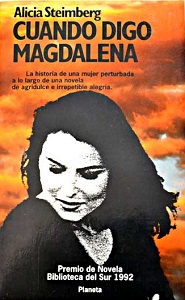
De Argentijnse schrijfster en vertaalster Alicia Steimberg werd geboren op 18 juli 1933 in Buenos Aires. Zie ook alle tags voor Alicia Steinberg op dit blog.

Uit: Call Me Magdalena

“They were helping themselves from all the dishes and trays, and they left everything a mess. They were playing with a little rubber ball, and suddenly one of them missed the mark and the ball fell into Enrique’s cup, and to top it all off he was dressed in a white shirt and blue tie at the time?’ “My God” “But nothing bothered us after the first bite of that crisp toast with butter and homemade duke de leche. And right after that a good cup of excellent coffee” “With milk?” “Yes, it was already mixed with the milk, in an enormous coffee pot?’ “Just like in those old-fashioned hotels” “Everything was old-fashioned in that house. Even the kitchen helper, who was white and chubby, with a blue dress and apron and white slippers, with freckles on her arms and chest. She was the one who knew how to make a cocktail with port and a beaten egg” “What’s it like?” “You have to go get the eggs from the henhouse and use them while they’re still warm. You separate the whites from the yolks. You can reserve the whites to make meringue. You beat the yolks with sugar until they take on a whitish color, and you add the port drop by drop, beating all the while. That woman beats egg yolks with sugar and port all day long?’
“Now let’s have breakfast in Mar del Plata, as you suggested?’ “This isn’t the same place where we always go?’ “But Hike it, dear. It’s sheltered from the wind and you can see the ocean. How many croissants do you want?” “How many do you think? Three, of course. Don’t they always bring three croissants with the café au lait?” “No, dear, that was before. Now you have to ask for the number of croissants you’re going to eat” “Why did they change it, dear?”
“Because diets have become so popular: croissants are very fattening. By the way, shouldn’t you be on a diet?” ‘
“Im not planning to diet in Mar del Plata, dear?’
“But you weigh 125.”
“And YOU weigh 150. Let’s go to the casino?”
“Later. I think I’m just going to order cafe au lait and nothing else. No croissants.”
“I’ll do the same, dear. Coffee with skim milk and artificial sweetener?’
“Now you’re talking?”
“May I ask your name? We’ve called each other ‘dear’ so much I’ve forgotten your name?’
“My name is Ignacio Ibargiiengoitia.”
“Basque?”‘
“Strange that you should ask after forty years of marriage. My grandparents were Basque, all four of them.”


Alicia Steimberg (18 juli 1933 – 16 juni 2012)
Affiche


De Nederlandse schrijver, criticus en politicus Aad Nuis werd geboren op 18 juli 1933 in Sliedrecht. Zie ook alle tags voor Aad Nuis op dit blog.


Gezichten

Een gezicht nooit meer zien.

Een gezicht zien dat niet bestaat.
Langzaam duidelijker, totdat
ook de kleinste rimpels, putjes in de huid
een oogwenk helder zichtbaar zijn.

Maar het is geen gezicht.
Het was misschien een man die
honderd jaar dood is, en gestorven
zonder ooit te zijn afgebeeld.

Er zijn er zoveel.


Voor B.

Gedachteloze woorden raken dieper dan doordachte,
weloverwogene, ze snijden door het zachte
web dat onzichtbaar de vertrouwde dingen bindt.
Vastknopen kan dan niet. Geen goed woord dat ik vind.
Ik voel me dwaas – en even dwaas is alles weer terecht
als je gedachteloos ‘dag liefje’ zegt.


Aad Nuis (18 juli 1933 – 8 november 2007)


Zie voor nog meer schrijvers van de 18e juli ook mijn blog van 18 juli 2017 en ook mijn blog van 18 juli 2015 deel 2.

Simon Vinkenoog, Steffen Popp, Per Petterson, Elizabeth Gilbert, Alicia Steimberg, Jevgeni Jevtoesjenko, Aad Nuis, William M. Thackeray, Nathalie Sarraute

De Nederlandse dichter en schrijver Simon Vinkenoog werd op 18 juli 1928 in Amsterdam geboren. Zie ook alle tags voor Simon Vinkenoog op dit blog.


Zuster

Er woont een zachte zuster in mijn huid
een vrijbuiter die in mijn lichaam bijt
ensoms haar handen op mijn zijde legt,
‘s nachts stelten loopt, of danst of rust.

Dan dringt zij ook haar dromen aan mij op
en ik leg mij huiverend naast haar:
een dode, een schamel geraamte,
knikkend en stamelend.


Tenzij de dingen uit zichzelf gaan spreken

een kraan het hoog geluid van liefde fluit
een waterstraal die onverslapte aandacht tikt
een dronken boodschap in de brievenbus
een onverwacht bezoek aan de deur gevonden

de zee die door de straten weifelt
de zon een onbeholpen minnaar op mijn huid
en de doofstomme takken van de bomen
in mijn ogen et cetera

Tenzij ik jaren op je wachten wil
en op je mond het stempel ongeopend druk

als met een zegelring die woorden bloed
en vlijt in de nagels drijft

de handen die niets meer weten
van het feest dat morgen
in de cijfers van het heden
wijdbeens staat geplant


Simon Vinkenoog (18 juli 1928 – 12 juli 2009)

Lees verder “Simon Vinkenoog, Steffen Popp, Per Petterson, Elizabeth Gilbert, Alicia Steimberg, Jevgeni Jevtoesjenko, Aad Nuis, William M. Thackeray, Nathalie Sarraute”

Simon Vinkenoog, Steffen Popp, Per Petterson, Elizabeth Gilbert, Alicia Steimberg, Jevgeni Jevtoesjenko, Aad Nuis, William M. Thackeray, Nathalie Sarraute

De Nederlandse dichter en schrijver Simon Vinkenoog werd op 18 juli 1928 in Amsterdam geboren. Zie ook alle tags voor Simon Vinkenoog op dit blog.


Lastenia

Wat nog aan woorden
in mij wakker ligt
kan ik voor alle dag gebruiken
ik kan het bloed doen stollen
ik kan in andermans gedachten
wonen en er vruchten stelen

ik kan – als een hond geslagen –
huilen en ik kan spelend met vuur
mijzelf overwinnen

maar leven kan ik niet
het leven hangt buiten
het bereik van de klanken
zinnen en woorden
die ik als ledematen
lief heb gekregen

om een liefde die ik als zon
op het water heb zien schijnen
om een liefde die als licht
op mijn huid staat te branden


Photomaton

Zo’n foto is nooit weg,
en ze kosten maar vier voor een gulden
Kijk, het lijkt (na drie minuten)
en we staan er nog op, ook.

Omgekeerd natuurlijk, ik zat links
en op de foto’s zit ik rechts.

We zijn bruiner
dan in werkelijkheid,
en de schaafwond op mijn neus
blitst overdreven.

Links voorop, dat ben jij.
Ik kan nog niet zo goed wijs uit wat ik zie,
o.a. een blikkerbril met donker glas
en een baard met een snor boven regenjas.
We kijken voorop, jij bovendien opzij-
jij hebt de twee andere.

Ik lach, jij kijkt.
Zo’n foto is nooit weg, tenslotte
en wat is de moeilijkheid? Kleingeld,
ooghoogte, de keuze uit witte achtergrond
of donker gordijn. Kijken of het lijkt.


Simon Vinkenoog (18 juli 1928 – 12 juli 2009)

Bewaren

Bewaren

Lees verder “Simon Vinkenoog, Steffen Popp, Per Petterson, Elizabeth Gilbert, Alicia Steimberg, Jevgeni Jevtoesjenko, Aad Nuis, William M. Thackeray, Nathalie Sarraute”

Simon Vinkenoog, Steffen Popp, Alicia Steimberg, Jevgeni Jevtoesjenko, Aad Nuis, William M. Thackeray, Nathalie Sarraute

De Nederlandse dichter en schrijver Simon Vinkenoog werd op 18 juli 1928 in Amsterdam geboren. Zie ook alle tags voor Simon Vinkenoog op dit blog.


Hooglied

Ik zeg tegen mezelf: jongen, ze verwijten je vaak
dat je geen omgang hebt met je vrienden & vakgenoten,
dat je hun gezelschap mijdt, hun discussies niet wilt zoeken
(ze zeggen het anders, zó zien ze het niet)
En ze vragen je vaak: wat zoek je toch bij die gekke jongens?

Dan antwoord ik niet, of ik zoek naar uitvluchten,
zeg ik dan, Simon Vinkenoog,
ik heb het ze nooit durven zeggen,
waarom ik zó leef, en niet anders.

Zal ik antwoorden, beterweten, zeggen?
Omdat Kees Bottenberg eens heeft gezegd:
‘ik zou willen schrijven,
want er zou een bijbel geschreven moeten worden.’

Daarom, medeschrijvers. Wij schrijven een bijbel.
Ieder zijn eigen hooglied. Ieder het zijne.
Ik de mijne.
Allen één God.


Profielschets: Dichter
JE est un autre – Arthur Rimbaud

Ik ben
dichter
experimenteel dichter
gelegenheidsdichter
laatnaarjekijkendichter
je mag gezien worden, dichter
stadse kijkmijnoudichter
fratsendichter
margedichter
worshopdichter
mystiekdichteretceteradichter

Dichter van het eerste
en het laatste woord
dichter van de afscheidsgroet
dichter van de levende adem
uitje voor scholieren
gesprekspartner voor
verslaafden en gedetineerden

parkdichter
festivaldichter
gebrokendromendichter
paradedichter
straathoekdichter
droomdansdichter
jazzdichter

dag dichter nacht dichter
vrijetijdsdichter
arbeidstrijddichter
ladenlichter &
schielijke oplichter
standwerkdichter
feestdisdichter

In het spoor van
Adam dichter
naamgeefdichter
aangeefdichter
aanmaakdichter
toegewijd dichter
gedreven, vervoerd,
geleid, eigengereid
en bevlogen
dichter

Buitennissig
buitensporig
buitenzinnig dichter

Altijd onderweg dichter
overwegdichter
omwegdichter tunneldichter
viaductdichter
stoplichtdichter
te fiets te voet in bed
bijrijddichter

Nou is het wel genoeg, dichter
nu ben je luisterdichter
inkijkdichter
voorbijganger dichter
zwijgdichter

Kijk, dichter
mensen om je heen, dichter
MindMirrorPaintboxdichter
supergeleiderdichter
krachtmetingsbegeleidingsdichter

Niets is weg dichter
niets gaat verloren dichter
levenslang meekijkdichter
benaderdichter verwijderdichter
kleurrijk dichter regenboogdichter
zelfgezegddichter
gelukkig dichter!


Simon Vinkenoog (18 juli 1928 – 12 juli 2009)

Lees verder “Simon Vinkenoog, Steffen Popp, Alicia Steimberg, Jevgeni Jevtoesjenko, Aad Nuis, William M. Thackeray, Nathalie Sarraute”

Karl Vannieuwkerke, Simon Vinkenoog, Steffen Popp, Alicia Steimberg, Jevgeni Jevtoesjenko, Aad Nuis

Bij de Tour de France


Marcel Kittel


Uit: Marcel Kittel (Column uit 2012)


“Er zijn een aantal talen waar ik mijn plan in trek, maar mijn Duits is maar net iets beter dan dat van Jean-Marie. Op 28 maart van dit jaar had ik weer eens prijs. Marcel Kittel won in Koksijde de massaspurt aan het eind van de tweede rit in de Driedaagse van De Panne. Ik had Kittel nog nooit geïnterviewd en wist niet waaraan me te verwachten. Dat viel goed mee. Een standaardvraag volstond. Voor me zat op een kleine kruk een frisse, intelligente jongeman die me meer gaf dan ik vroeg. Kittel is een persoonlijkheid. Dat hij van zich doet spreken in de nasleep van de Armstrongstorm verbaast me geenszins.

“Het maakt me ziek als ik lees dat renners als Alberto Contador, Samuel Sanchez en Miguel Indurain Armstrong blijven steunen”, twitterde de 24-jarige Duitse sprinter eergisteren. Een volger suggereerde dat het misschien verstandiger zou zijn als Kittel zijn mond zou houden. “Omdat de geschiedenis leert dat het wielrennen mensen als jij uiteindelijk altijd de rug toekeert”. “Nu niet meer. Ik waag het erop”, antwoordde Kittel. De nieuwe generatie wielrenners heeft ballen en pikt het niet dat de perceptie zich keert tegen iedereen die op een fiets zit. Thomas De Gendt en Tim Declercq komen met open brieven, Marcel Kittel maakt zich boos op Twitter. We juichen het toe. Ze moeten Armstrong afvallen, niet alleen om wille van zijn dopinggebruik maar ook om het manipulatieve karakter van het systeem dat erachter zat. Voor de rest staan er op erelijsten tientallen namen die door een x kunnen worden vervangen, zowel in de klassiekers als in de grote ronden. En ja, ook van landgenoten! Alleen zijn die nog niet onder ede verhoord.”


Karl Vannieuwkerke (Ieper, 19 januari 1971)

Lees verder “Karl Vannieuwkerke, Simon Vinkenoog, Steffen Popp, Alicia Steimberg, Jevgeni Jevtoesjenko, Aad Nuis”

Simon Vinkenoog, Steffen Popp, Alicia Steimberg, Jevgeni Jevtoesjenko

De Nederlandse dichter en schrijver Simon Vinkenoog werd op 18 juli 1928 in Amsterdam geboren. Zie ook alle tags voor Simon Vinkenoog op dit blog.


Ver als de horizon ben je

ver als de horizon ben je
in de glazen kist van het weer geborgen
beukend op de blikken deksels
van het najaar
ik zie de bliksem langs je lichaam trillen
en de regen loopt onrustig door je ogen

ik kan de afstand die mij van je scheidt
in lichtjaren tellen
en in de meter van het geluid
zoemen de seconden

mijn handen opnieuw in gebruik gesteld
sluiten het onweer in je borsten buiten

alleen de regen is thuis
op de platte daken van de nachten
zonder duizelingen


Het spiegelend evenbeeld

Wat is leven? Ogen die elkaar niet zien,
hout op hout de woede van het lichaam,
draaiend in het cirucusspel van heden.

Het is een straatnaam aan een huis,
de ogen rode tekens aan een voorhoofd,
terend op de gedachte aan gisteren:

‘Ik loop in zoveel duisternis
dat ik blind ben van vragen.
’s Nachts de koele mist van de liefde
bij dag de godsdienst van het ademhalen’.

Terend op een wanhoop die morgen is:
alleen met anderen die alleen zijn,
samen met de eigen stem, die niet klinkt
in een wankel en vermoeid bestaan
waar geen geluid meer doordringt.

En ik die dit leven niet ken
ik, een toerist in eigen land,
vreemde voeding in mijn cellen,
vreemde rook in mijn mond.

Ik loop langs alle wegen die mij dragen
en vraag, maar kan niet meer vragen,
Geef mij het einde, zodat ik mijzelf herken.


Simon Vinkenoog (18 juli 1928 – 12 juli 2009)

Lees verder “Simon Vinkenoog, Steffen Popp, Alicia Steimberg, Jevgeni Jevtoesjenko”

Simon Vinkenoog, Steffen Popp, Alicia Steimberg, Jevgeni Jevtoesjenko, William M. Thackeray, Nathalie Sarraute, Aad Nuis, Ludwig Harig, Jan S. Skorupski, Ricarda Huch, Tristan Corbière, Jan Gerhard Toonder, Josepha Mendels, Bobby Henderson

De Nederlandse dichter en schrijver Simon Vinkenoog werd op 18 juli 1928 in Amsterdam geboren. Zie ook alle tags voor Simon Vinkenoog op dit blog.


Faits Divers

Je est un autre. Arthur Rimbaud

ik ben een vreemde in eigen bloed
mijn hartslag klopt aan andere deuren
van het schuim der goden herken ik de kleuren
maar het is ik die mij huiveren doe

het zijn de eigen ogen die mij breken
en de stenen
die als ontluikende bloemen
langzaam aan mijn ingewanden groeien

ik ben verdronken in dit drijfzandlied
van waaruit duizend doden smeken:

– in dit naaktlandschapp dat leven heet
drijft doodgezongen de tijd uiteen –
kringen verleden zonder heden
woorden klanken gestamel


Volluk

Ik groeide op in volksbuurten
als volksjongen
ik bezocht wekelijks het volksbadhuis
ooit at ik wel eens in een volksgaarkeuken
en af en toe in de Volkenbond bij het Entrepôtdok.

Op de Albert Cuypmarkt bezoek ik graag een volkskoffiehuis
waar ik luister naar volkswijsheid uit de volksmond;
mijn moeder was volksvrouw
en leed aan volksziekte of -woede:
Schoonhouden! Voeten vegen!
Wat moeten de buren wel denken!

Ik wierp wel eens een blik in een krant
die zich het Volksdagblad noemde
en een van de kranten die ik lees
heet de Volkskrant

Ik weet niets van volksaard of volkseigen
ik ben geen volksmenner of volksschrijver
en speel in geen enkel volkstheater

Ik ben niemands volksvertegenwoordiger
spreek namens geen enkele bevolkingsgroep
en schrijf dit in mijn volkstuin
in het Nederlands, de taal van het volk
waartoe ik behoor.

Volluk! Is daar iemand?


 vinkenoog

Simon Vinkenoog (18 juli 1928 – 12 juli 2009)


De Duitse dichter en schrijver Steffen Popp werd geboren op 18 juli 1978 in Greifswald, Hij groeide op in Dresden en bezocht daar een natuurwetenschappelijke bijzondere school. Popp studeerde aan het Deutsche Literaturinstitut Leipzig en daarna literatuurwetenschap en filosofie in Berlijn. In 2004 verscheen zijn dichtbundel Wie Alpen, in 2008 gevolgd door Kolonie Zur Sonne. Zijn roman Ohrenberg oder der Weg dorthin werd diverse keren bekroond. Samen met Uljana Wolf vertaalde hij werk van de Amerikaanse dichter Christian Hawkey. De bundel verscheen in 2008 onder de titel “Reisen in Ziegengeschwindigkeit`. Zie ook mijn blog van 14 juli 2009

Gibraltar

dahin (Goethe)

Kennst du, Geliebter, den Hass
Bäume, die spanische Wand
kennst du die Inseln, Kreuzfahrer
in ihren Ein-Mann-Torpedos –

Geliebter, verzeih, ich wollte nach Golgatha
aber im Wäscheschrank
lag nur ein gelber Revolver (so blieb ich).

Kennst du die See, Spuren von Kühnheit
im Schaum, Geliebter, im Schaum
kennst du das Land, seinen verrenkten Tragarm
schwer liegt es herum, unter der hungrigen Luft
planloser Wind
Wollspuren, Wärme und Staub darin.

Wie gern zög’ ich hinaus
wohnte, Geliebter, mit dir, unter Zitronen:
gingen nicht, in meinen tragischen Venen
die Elemente Gibraltars
schwer um und aller verschollenen Kaps
manische Augen, lidlos –

mein Herz ist eine Gräfin, umstellt von Pflegern am Rand der City, Geliebter
blöken die Mietklaviere!


popp

Steffen Popp (Greifswald, 18 juli 1978)


De Argentijnse schrijfster en vertaalster Alicia Steimberg werd geboren op 18 juli 1933 in Buenos Aires. Zie ook alle tags voor Alicia Steinberg op dit blog.

Uit: The Rainforest

„I’m in the rainforest, and it’s very hot and humid; at times a warm drizzle falls. Eyes closed, I lift my face to catch the water and drink a little, while a steel-blue and cadmium-yellow macaw watches

me without turning its head. This is how I spend my days, among charming monkeys, benevolent serpents, motionless parrots, and foliage that enfolds me. With each step I take, flower-laden branches envelop me. I’d gladly remain here, tasting raindrops and picking the occasional fruit from the lowest branches. The fruit resembles chirimoyas, mangos, bananas.

There’s no danger of getting lost in the rainforest. My compass guides me whenever it’s time to return. I know I have to head east, and in fifteen minutes I’m in the clearing where the hotel is located.

As you approach the hotel in the afternoon, you can smell dinner: there’s always rice with vegetables and meat, poultry, or seafood, everything seasoned with fragrant herbs. They raise the fowl in a chicken coop out back. I love to go in there and steal a freshly laid egg for the next morning’s breakfast. The chickens here don’t get a balanced diet, just natural food, so they have that marvelous, oldfashioned flavor and aroma. It reminds me of an educational poster I always used to look for in the library of the teacher’s college when I was studying for my degree. The poster was old and worn: it

almost certainly dated back to the nineteenth century when the school was founded, and I used it for a demonstration lesson for an elementary school class. It showed some multicolored chickens and a magnificent rooster, illuminated by a sunbeam streaming across a wire fence. In those hectic, tense years of my youth, when it frightened me to realize that I didn’t know what I wanted (I’m practically

an old woman now, and I’m still not sure), that chicken coop picture was like a refuge. As a girl, I used to get sick quite often, and Mama was convinced that the country, with its fresh air, was the key to good health.“


 steinberg 

Alicia Steimberg (Buenos Aires, 18 juli 1933)


De Russische dichter Jevgeny Jevtoesjenko werd geboren in Zima in Irkutsk op 18 juli 1933. Zie ook alle tags voor Jevgeni Jevtoesjenko op dit blog en ook mijn blog van 18 juli 2010.


Disbelief In Yourself is Indispensable

While you’re alive it’s shameful to worm your way into
the Calendar of Saints.
Disbelief in yourself is more saintly.
It takes real talent not to dread being terrified
by your own agonizing lack of talent.

Disbelief in yourself is indispensable.
Indispensable to us is the loneliness
of being gripped in the vise,
so that in the darkest night the sky will enter you
and skin your temples with the stars,
so that streetcars will crash into the room,
wheels cutting across your face,
so the dangling rope, terrible and alive,
will float into the room and dance invitingly in the air.

Indispensable is any mangy ghost
in tattered, overplayed stage rags,
and if even the ghosts are capricious,
I swear, they are no more capricious than those who are alive.

Indispensable amidst babbling boredom
are the deadly fear of uttering the right words
and the fear of shaving, because across your cheekbone
graveyard grass already grows.

It is indispensable to be sleeplessly delirious,
to fail, to leap into emptiness.
Probably, only in despair is it possible
to speak all the truth to this age.

It is indispensable, after throwing out dirty drafts,
to explode yourself and crawl before ridicule,
to reassemble your shattered hands
from fingers that rolled under the dresser.

Indispensable is the cowardice to be cruel
and the observation of the small mercies,
when a step toward falsely high goals
makes the trampled stars squeal out.

It’s indispensable, with a misfit’s hunger,
to gnaw a verb right down to the bone.
Only one who is by nature from the naked poor
is neither naked nor poor before fastidious eternity.

And if from out of the dirt,
you have become a prince,
but without principles,
unprince yourself and consider
how much less dirt there was before,
when you were in the real, pure dirt.
Our self-esteem is such baseness….
The Creator raises to the heights
only those who, even with tiny movements,
tremble with the fear of uncertainty.

Better to cut open your veins with a can opener,
to lie like a wino on a spit-spattered bench in the park,
than to come to that very comfortable belief
in your own special significance.

Blessed is the madcap artist,
who smashes his sculpture with relish-
hungry and cold-but free
from degrading belief in himself.
Vertaald door Antonina W. Bouis, Albert C. Todd en Jevgeni Jevtoesjenko


Jevtoesjenko

 Jevgeni Jevtoesjenko (Zima, 18 juli 1933)


De Engelse schrijver William Makepeace Thackeray werd geboren in Calcutta op 18 juli 1811. Zie ook alle tags voor William Makepeace Thackeray op dit blog en mijn blog van 18 juli 2010.

Uit: Vanity Fair

„In Miss Jemima’s eyes an autograph letter of her sister, Miss Pinkerton, was an object of as deep veneration as would have been a letter from a sovereign. Only when her pupils quitted the establishment, or when they were about to be married, and once, when poor Miss Birch died of the scarlet fever, was Miss Pinkerton known to write personally to the parents of her pupils; and it was Jemima’s opinion that if anything could console Mrs. Birch for her daughter’s loss, it would be that pious and eloquent composition in which Miss Pinkerton announced the event.
In the present instance Miss Pinkerton’s “billet” was to the following effect:


-The Mall, Chiswick, June 15, 18-

Madam,
After her six years’ residence at the Mall, I have the honour and happiness of presenting Miss Amelia Sedley to her parents, as a young lady not unworthy to occupy a fitting position in their polished and refined circle. Those virtues which characterize the young English gentlewoman, those accomplishments which become her birth and station, will not be found wanting in the amiable Miss Sedley, whose industry and obedience have endeared her to her instructors, and whose delightful sweetness of temper has charmed her aged and her youthful companions.
In music, in dancing, in orthography, in every variety of embroidery and needlework, she will be found to have realized her friends’ fondest wishes. In geography there is still much to be desired; and a careful and undeviating use of the backboard, for four hours daily during the next three years, is recommended as necessary to the acquirement of that dignified deportment and carriage, so requisite for every young lady of fashion.

Your most obliged humble servant,
Barbara Pinkerton

P.S.–Miss Sharp accompanies Miss Sedley. It is particularly requested that Miss Sharp’s stay in Russell Square may not exceed ten days. The family of distinction with whom she is engaged, desire to avail themselves of her services as soon as possible.“

thackeray

William Makepeace Thackeray (18 juli 1811 – 24 december 1863)


De Franse schrijfster Nathalie Sarraute werd geboren op 18 juli 1900 in Ivanova, Rusland. Zie ook alle tags voor Nathalie Sarraute op dit blog en mijn blog van 18 juli 2010.

Uit: Enfance

„Voici enfin le moment attendu où je peux étaler le volume sur mon lit, l’ouvrir à l’endroit où j’ai été forcée d’abandonner… je m’y jette, je tombe… impossible de me laisser arrêter, retenir par les mots, par leur ens, leur aspect, par le déroulement des phrases, un courant invisible m’entraîne avec ceux à qui de tout mon être imparfait mais avide de per­fection je suis attachée, à eux qui sont la bonté, la beauté, la grâce, la noblesse, la pureté, le courage mêmes… je dois avec eux affronter des désastres, courir d’atroces dangers, lutter au bord de précipices, recevoir dans le dos des coups de poignard, être séquestrée, maltraitée par d’affreuses mégères, menacée d’être perdue à jamais… et chaque fois, quand nous sommes tout au bout de ce que je peux endurer, quand il n’y a plus le moindre espoir, plus la plus légère possibilité, la plus fragile vraisemblance… cela nous arrive… un courage insensé, la noblesse, l’intelligence parviennent juste à temps à nous sauver… .

C’est un moment de bonheur intense… toujours très bref… bientôt les transes, les affres me reprennent… évidemment les plus valeureux, les plus beaux, les plus purs ont jusqu’ici eu la vie sauve… jusqu’à présent… mais comment ne pas craindre que cette fois… il est arrivé à des êtres à peine moins parfaits… si, tout de même, ils l’étaient moins, et ils étaient moins séduisants, j’y étais moins attachée, mais j’espérais que pour eux aussi, ils le méritaient, se produirait au dernier moment… eh bien non, ils étaient, et avec eux une part arrachée à moi-même, précipités du haut des falaises, broyés, noyés, mortellement blessés… car le Mal est là, partout, toujours prêt à frapper…“


sarraute

Nathalie Sarraute (18 juli 1900 – 19 oktober 1999)


De Nederlandse schrijver, criticus en politicus Aad Nuis werd geboren op 18 juli 1933 in Sliedrecht. Zie ook alle tags voor Aad Nuis op dit blog en ook mijn blog van 18 juli 2010.

Uit: Het huis van een zwerver (over Breyten Breytenbach)

„Een jonge schilder laat zijn academie in de steek en trekt de wereld in, komt na omzwervingen in Parijs terecht, maakt naam. Hij schrijft ook gedichten en poëtische prozastukken, die hem beroemd maken, zij het alleen in zijn vaderland, omdat ze in de taal daarvan geschreven zijn. Op zijn vijfentwintigste krijgt hij er een grote prijs voor. Een rimpelloos succesverhaal – ware het niet dat Breytenbach uit Zuid-Afrika kwam, dat hij inmiddels getrouwd was met zijn Zuid-Vietnamese geliefde, dat hij niet samen met haar zijn geboorteland binnen mocht om de prijs in ontvangst te nemen. Dat was in 1964. Vanaf die tijd, en zeker nadat hij in 1975 tijdens een clandestien bezoek aan Zuid-Afrika was gearresteerd en voor zeven jaar in de gevangenis verdween, kent de wereld hem als publiek personage.

Hij heeft die rol met verve gespeeld, eigenzinnig en met zoveel openhartige kritiek naar alle kanten dat geen enkele politieke stroming of partij hem ooit lang heeft kunnen gebruiken als mascotte van het eigen gelijk. Zijn werk als kunstenaar lijkt evenwel in de schaduw te zijn gebleven van zijn publieke faam. Ik zou geen andere, nog levende schrijver weten die zo bekend is en toch door zo weinigen wordt gelezen.

Naar de reden daarvan hoeft niet ver te worden gezocht. De kern van zijn werk is poëzie en met die poëzie nauw verwant proza, niet makkelijker te lezen dan bijvoorbeeld Lucebert of Claus, en geschreven in het Afrikaans. Om het uit de eerste hand te kunnen ondergaan moet je dus niet alleen die taal goed kennen, maar ook enige kijk hebben op moderne poëzie.“


nuis

Aad Nuis (18 juli 1933 – 8 november 2007)


De Duitse schrijver Ludwig Harig werd geboren op 18 juli 1927 in Sulzbach. Zie ook alle tags voor Ludwig Harig op dit blog.


Im Flirt mit Dame Gott

Für Paul Wühr

Ach Paul, mein lieber Paul, du dichtest mit Gespür
dich außerhalb der Zeit in eine helle Ferne,
die uns illuminiert wie Aladins Laterne:
Du reibst, und es erscheint dein Vers en miniature.

Es schwingt dein Silbenfuß im Takt und tanzt die Kür
im Flirt mit Dame Gott bis an den Rand der Sterne.
Der eine sucht den Sinn, der andre das Moderne.
So ist nun mal die Welt, was kann Paul Wühr dafür?

Der schmale Trampelpfad erweitert sich zur Pforte.
Was gibt es rundumher, was außerhalb der Worte,
die für uns Wörter sind und kein Begriff darüber?

Was bleibt, ist kurz gesagt des Lebens Paraphrase,
das Übel mit dem Kreuz, das Elend mit der Blase.
So stehen wir perplex dem Wortschrott gegenüber.


Das schreibende Subjekt

Ergreift der Mensch den Stift, schon wird er kategorisch.
Das schreibende Subjekt bedient sich der Poetik,
schmäht nicht das Regelwerk berechneter Ästhetik:
das Werk aus hohlem Bauch bleibt meistens illusorisch.

Gelehrtenverse sind gebildet und rhetorisch,
die auditive Kunst berauscht sich in Phonetik,
konkrete Poesie gefriert in Arithmetik,
das lyrische Gedicht ist meistens metaphorisch.

Ein ganzer Kanon steht dem Schreiber zur Verfügung,
dem schieren Leidendruck, der köstlichen Vergnügung:
es ist die ganze Welt auf einmal kreativ.

Den einen quält das All, den andern plagt die Enge,
es wechselt freies Spiel in arge Ausdruckszwänge:
der eine ist erwacht, dieweil der andre schlief.


harig 

Ludwig Harig (Sulzbach 18 juli 1927)


De Poolse dichter, schrijver en essayist Jan Stanisław Skorupski werd geboren op 18 juli 1938 in Łosznióv in Podolië. Zie ook alle tags voor Jan Stanisław Skorupski op dit blog.


Das Sonett über den Galgen-Kran

ich lache weil der Hausbesitzer
zeigt seine Maske – ein rarer Fall
die Skulptur dekoriert das Portal
er wird für uns wie ein Beschützer

in dem Literaturhaus – Tango
ich will nicht auf dem Boden sitzen
im DADA-Haus muss ich nicht schwitzen
Gala-Konzert-Probe mit Mango

vom Gran Café auf den Lindenhof
ist die schönste Aussicht in der Stadt
einen Kran dort bauen? – dumm und doof

ich erhänge mich auf dem Galgen
vorher gebe ich den guten Rat
macht doch nicht mehr solchen Dummheiten


skorupski

Jan Stanisław Skorupski (Łosznióv, 18 juli 1938)


De Duitse dichteres en schrijfster Ricarda Huch werd op 18 juli 1864 in Braunschweig geboren. Zie ook mijn blog van 18 juli 2009.


Uralt Gebirge , wie vor Jahren

Uralt Gebirge , wie vor Jahren
Silbern gegossen in vollkommener Pracht
Ruhst du; weit bin ich umgefahren,
Wund komm ich aus verlorner Schlacht,
In deinem Schoß bald Staub mit meiner Habe,
Ein Traum, ein Nichts, und doch voll Ewigkeiten!
Dereinst zerbrech ich deine Felsenseiten
Und lodre glorreich aus geborstnem Grabe.


 Ein Todesengel, göttlich sanft und schön

 Ein Todesengel, göttlich sanft und schön,
Trägst du gen Himmel mächtig meine Seele.
Durch alle Nacht hindurch, wie Stürme wehn,
Fühlst du den Weg, den ich allein verfehle.
Wie rücken die Gestirne weit, so weit!
Der Erde fern und fern der Ewigkeit
Nichts faß ich mehr als deines Herzens Schlagen.
Ein Adler ist´s, der steigt: einst wird es tagen.

huch 

Ricarda Huch (18 juli 1864 – 17 november 1947)


De Franse dichter Tristan Corbière werd geboren op 18 juli 1845 in Morlaix in de Bretagne. Zie ook mijn blog van 18 juli 2009.


Sonnet de nuit

O croisée ensommeillée,
Dure à mes trente-six morts !
Vitre en diamant, éraillée
Par mes atroces accords !

Herse hérissant rouillée
Tes crocs où je pends et mords !
Oubliette verrouillée
Qui me renferme… dehors !

Pour Toi, Bourreau que j’encense,
L’amour n’est donc que vengeance ?..
Ton balcon : gril à braiser ?…

Ton col : collier de garotte ?…
Eh bien ! ouvre, Iscariote,
Ton judas pour un baiser !


Pauvre garçon

Lui qui sifflait si haut, son petit air de tête,
Etait plat près de moi ; je voyais qu’il cherchait…
Et ne trouvait pas, et… j’aimais le sentir bête,
Ce héros qui n’a pas su trouver qu’il m’aimait.

J’ai fait des ricochets sur son coeur en tempête.
Il regardait cela… Vraiment, cela l’usait ?…
Quel instrument rétif à jouer, qu’un poète ! …
J’en ai joué. Vraiment – moi – cela m’amusait.

Est-il mort ?… Ah – c’était, du reste, un garçon drôle.
Aurait-il donc trop pris au sérieux son rôle,
Sans me le dire… au moins, – Car il est mort, de quoi ?…
Se serait-il laissé fluer de poésie…
Serait-il mort de chic, de boire, ou de phtisie,
Ou, peut-être, après tout : de rien… ou bien de Moi.


corbiere

Tristan Corbière (18 juli 1845 – 1 maart 1875)

Sculptuur van Edouard Corbière en Tristan Corbière in Morlaix


De Nederlandse romanschrijver en journalist Jan Gerhard Toonder werd geboren in Rotterdam op 18 juli 1914. Zie ook mijn blog van 18 juli 2007.

Uit: Adriaan Venema: De zuivering (Schrijvers, uitgevers en hun collaboratie)

“‘Voor het voetlicht, een verdediging’ was de titel van het artikel van Jan Gerhard Toonder. Allereerst kwam hij voor het imago van de kunstenaar zelf op514: ‘Wij wenschen vast te stellen, dat op 14 Mei 1940, toen het gordijn opging voor de grootste tragedie die zich ooit in Nederland afspeelde, de kunstenaars in groote meerderheid hun positie al bepaald hadden als verbeten vijanden van het nationaal-socialisme. Hiertoe behoorden ook verreweg de meesten van hen, die twee jaar later ingeschreven zouden worden in de Kultuurkamer.’

Toonder geeft daarvoor geen enkel bewijs; in ieder geval ben ik zijn naam in welke vooroorlogse protestactie van kunstenaars tegen nationaal-socialisme of fascisme dan ook niet tegengekomen. En op die ‘verbeten’ vijandschap van verreweg de meeste Kultuurkamer-aanmelders kom ik later nog terug.

 De oorlog brak uit en met veel pathos gaf Toonder weer wat in zijn visie de kunstenaar toen bezielde: ‘Vele kunstenaars voelden toen de noodzaak, zelfs de plicht, om de teneergeslagenen en stuurloozen een hart onder de riem te steken. Zij vatten den strijd op, zoowel tegen de zwakte, die op dat moment ons volk besloop, als tegen het regime dat met een geraffineerde geleidelijkheid aan ons werd opgedrongen. Ook nu streden zij met hun natuurlijk wapen-de kunst. En die groote, hernieuwde belangstelling voor de goede en gezonde Nederlandsche kunst, die sinds het najaar 1940 bij het Nederlandsche volk viel te constateeren, bewijst dat de kunstenaars de juiste snaar bespeelden. Zij brachten iets, dat fierdere sentimenten in het volk losmaakte. En het volk vroeg naar kunst, meer dan ooit, krachtiger dan ooit, omdat het er juist nu, in de steeds toenemende verdrukking, behoefte aan gevoelde, omdat het er kracht uit kon putten.

Wie dit ontkent, loochent de feiten.

Wie dit ontkent, beleedigt ons volk in zijn kunst-gevoeligheid.

Wie dit ontkent, ontkent de kunst als bron van geestkracht en leven.’

toonder

Jan Gerhard Toonder (18 juli 1914 – 25 augustus 1992)


De Nederlandse schrijfster Josepha Judica Mendels werd geboren op 18 juli 1902 te Groningen. Zie ook alle tags voor Josepha Mendels op dit blog.

Uit: Je wist het toch

“‘Henriëtje had ook een zuster: Mirjam.

In het witte huis aan het water had Mirjam haar geluk gevonden. Het leven had haar tot haar huwelijk toe niet verwend. Ze was de middelste thuis en kreeg bijvoorbeeld nooit een nieuwe jurk, omdat ze juist in de maat van de oudste viel. Wanneer de jongste hiervoor op haar beurt in aanmerking kwam, was het kledingstuk versleten. Ze mocht bijvoorbeeld nooit mee uit naar een bijzondere gelegenheid. Of ze was er te klein voor, of te groot. Dit maakte dat ze uiterst gauw beledigd was, zoals de ouders dat noemden. Ze werd dan eerst rood, dan lelijk en tenslotte allerverschrikkelijkst brutaal.

Op de h.b.s. was ze een minder dan middelmatige leerling. Ze kreeg alras vrijstelling van wiskunde en kon zich dus met zo’n ijver op de andere vakken toeleggen, dat ze haar talen heel goed leerde.

Wat moest ze toen na haar eindexamen beginnen? Ik wil trouwen dacht ze, en kinderen hebben, maar dit kon ze tegen haar ouders niet zeggen. Liefde en alles wat daar zo bij kwam was iets waarover je niet sprak, het gebeurde in je leven of het gebeurde niet[.] Daarbij wist ze zelf ook niet wat het eigenlijk betekende. Ze had zin van huis weg te gaan, en dat was alles.’


mendels 

Josepha Mendels (18 juli 1902 – 10 september 1995)


De natuurkundige en schrijver Bobby Henderson werd geboren op 18 juli 1979 in Roseburg, Oregon. Zie ook mijn blog van 18 juli 2007.

Uit: Open Letter To Kansas School Board

„I am writing you with much concern after having read of your hearing to decide whether the alternative theory of Intelligent Design should be taught along with the theory of Evolution. I think we can all agree that it is important for students to hear multiple viewpoints so they can choose for themselves the theory that makes the most sense to them. I am concerned, however, that students will only hear one theory of Intelligent Design.

Let us remember that there are multiple theories of Intelligent Design. I and many others around the world are of the strong belief that the universe was created by a Flying Spaghetti Monster. It was He who created all that we see and all that we feel. We feel strongly that the overwhelming scientific evidence pointing towards evolutionary processes is nothing but a coincidence, put in place by Him.

It is for this reason that I’m writing you today, to formally request that this alternative theory be taught in your schools, along with the other two theories. In fact, I will go so far as to say, if you do not agree to do this, we will be forced to proceed with legal action. I’m sure you see where we are coming from. If the Intelligent Design theory is not based on faith, but instead another scientific theory, as is claimed, then you must also allow our theory to be taught, as it is also based on science, not on faith.“

henderson

Bobby Henderson (Roseburg, 18 juli 1979)

The Flying Spaghetti Monste Doodle Google

Irving Stone, Natalia Ginzburg, Jacques de Lacretelle, Gavrila Derzjavin, Arthur Laurents, Owen Wister, Béatrix Beck, Willard Motley, Steffen Popp, Kerstin Preiwuß

De Amerikaanse schrijver Irving Stone werd geboren op 14 juli 1903 in San Francisco. Zie ook mijn blog van 14 juli 2007.

Uit: The Agony and the Ecstasy

„He began with the Deluge, a large panel toward the entrance of the chapel. By March he had the cartoon blown up and ready to be transferred to the ceiling. Winter had not released its grip on Rome. The Sistine was bitterly cold. A hundred braziers could not heat its lowest areas. He wore his warm wool stockings, brache and shirt.

Rosselli, who had left for Orvieto for a profitable commission, had trained Michi in the mixing of the plaster and the method of applying it. Michelangelo helped him carry the sacks of lime, sand and pozzolana, volcanic tufa dust, up the steep wall ladders to the top of the scaffolding. Here Michi made his mix. Michelangelo was dissatisfied with the tawny color caused by the pozzolana, adding more lime and ground marble. He and Michi then climbed the series of three receding platforms that Rosselli had built so that they could plaster and paint the top of the rolling vault. Michi laid an area of intonaco, then held the cartoon.

Michelangelo used the stick, charcoal bag, red ochre for connecting lines. Michi descended, set to work grinding colors below. Michelangelo was now on his top platform, sixty feet above the floor. He had been thirteen when he stood for the first time on the scaffolding in Santa Maria Novella, alone on a peak above the chapel and the world. Now he was thirty-four, and now, as then, he suffered vertigo. The Sistine seemed so hollow from up here, with his head just one foot below the ceiling. He smelled the wet plaster, the pungence of his freshly ground paints.

He turned from his view of the marble floor, picked up a brush, squeezed it between the fingers and

thumb of his left hand, remembering that he would have to keep his colors liquid this early in the morning…”

Stone

Irving Stone (14 juli 1903 – 26 augustus 1989)


De Italiaanse schrijfster Natalia Ginzburg werd geboren op 14 juli 1916 in Palermo. Zie ook mijn blog van 14 juli 2006 en ook mijn blog van 14 juli 2007 en ook mijn blog van 14 juli 2008.

Uit: Human Relationships (Vertaald door Dick Davis)

“In that brief moment we found a point of equilibrium for our wavering life: and it seemed to us that we could always rediscover that secret moment and find there the words for our vocation, the words for our neighbour; that we could look at our neighbour with a gaze that would always be just and free, not the timid or contemptuous gaze of someone who whenever he is with his neighbour always asks himself if he is his master or his servant. All our life we have only known how to be masters and servants: but in that secret moment of ours, in our moment of perfect equilibrium, we have realized that there is no real authority or servitude on the earth. And so it is that now as we turn to that secret moment we look at others to see whether they have lived through an identical moment, or whether they are still far away from it; it is this that we have to know. It is the highest moment in the life of a human being, and it is necessary that we stand with others whose eyes are fixed on the highest moment of their destiny “

ginsburg

Natalia Ginzburg (14 juli 1916 – 7 oktober 1991)


De Franse schrijver en letterkundige Jacques de Lacretelle werd geboren in Cormatin (Saône-et-Loire) op  14 juli 1888. Zie ook mijn blog van 14 juli 2007 en ook mijn blog van 14 juli 2008.

Uit: Le Retour de Silbermann

« Tout ce qu’on m’apprendra, disait-il, je le sais déjà. Ce que je ne sais pas, c’est comment on gagne de l’argent. »
C’est ainsi qu’il se mit tout de suite aux affaires avec un zèle un peu inexpérimenté que l’oncle Joshua avait dû ralentir à plus d’une reprise. Il avait voulu être initié en même temps à toutes les branches de sa profession. Dès qu’il entendait parler, dans le bureau, d’une vente ou d’un achat possible, il se proposait pour conclure le marché. « Laissez-moi aller voir, oncle Joshua, laissez-moi traiter. »
– Naturellement, me dit son cousin, mon père, qui avait mis trente ans à faire sa fortune, ne lui confiait rien d’important, et il se moquait parfois de l’impétuosité de David.“

lacretelle2

Jacques de Lacretelle (14 juli 1888 – 2 januari 1985)


De Russische dichter Gavrila Romanovitsj Derzjavin werd geboren in Kazan op 14 juli 1743. Zie ook mijn blog van 14 juli 2007 en ook mijn blog van 14 juli 2008.

The Storm

As my bark in restless ocean
Mounts its rough and foaming hills,
Whilst its waves in dark commotion
Pass me, hope my bosom fills.

Who, when warring clouds are gleaming,
Quenches the destructive spark?
Say what hand, where safety’s beaming,
Guides through rocks my little bark?

Thou Creator! all o’erseeing,
In this scene preserv’st me dread,
Thou, without whose word decreeing
Not a hair falls from my head.

Thou in life hast doubly blest me,
All my soul to thee’s revealed,
Thou amongst the great hast placed me,
Be midst them my guide and shield!


Vertaald door William D. Lewis

Derzjavin

Gavrila Derzjavin (14 juli 1743 – 20 juli 1816)
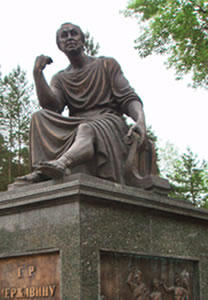
Monument voor Derzjavin in Kazan


De Amerikaanse schrijver, scenarioschrijver en regisseur Arthur Laurents is geboren in New York op 14 Juli 1918.Zie ook mijn blog van 14 juli 2007.

Uit: My Good Name

HARRY: Not in their class. Either class. You think they went down because they’re outsiders. I think because they were greedy. I wasn’t greedy, Rachel. I simply wanted to live well. I wanted to be sure that you and I and your child and my childr – child lived well. We do. We have everything we need and a bit more. But we don’t live in the land of Ferraris. I was neither gaudy nor greedy. When they caught up with me, what did they catch? Good name, good clubs, a personable, affable asset to be counted on and no threat to anyone. A gentleman. That’s an old fashioned concept, so they don’t say it. But they think it, and what they think is: you can believe him. In the case of the Feds: you can believe his testimony. That’s why they gave me the choice. I could help them and get immunity or I could be sent to jail. Why should I go to jail? What good would it do anyone if I went to jail? You and Becca would have to give up this room. Why should you? Why should I?

RACHEL: (After a moment.) This is ridiculous. I feel like I’m hyperventilating.

HARRY: Take some slow deep breaths.

RACHEL: I’m not hyperventilating. This is ridiculous! You know what it is? I know what it is. Everything in my head is jammed. all circuits closed down. I had it once before. Years ago, before you. Even before Becca. I was trying to get away from Mickey and wound up back-packing through Europe with him. In Paris, I spoke French – from college. In Madrid, Spanish – from high school. By the time we got to Italy, I had stopped thinking in English and was translating from either Spanish or French into Italian in the present tense. Until one night, in a bar in Positano. Out of season, just before Easter – the Buca di Bacco! I can see the carving over the door. all the languages seemed jammed in my head and I couldn’t speak anything for ten minutes. Nothing, not one word, not even English for ten minutes. The next day, I flew home alone. But Becca was already underway.”

ArthurLaurents

Arthur Laurents (New York, 14 Juli 1918)


De Amerikaanse schrijver Owen Wister werd geboren op 14 juli 1860 in  Germantown, Pennsylvania. Zie ook mijn blog van 14 juli 2007.

Uit: Red men and white (Little Big Horn Medicine)

“Something new was happening among the Crow Indians. A young pretender had appeared in the tribe. What this might lead to was unknown alike to white man and to red; but the old Crow chiefs discussed it in their councils, and the soldiers at Fort Custer, and the civilians at the agency twelve miles up the river, and all the white settlers in the valley discussed it also. Lieutenants Stirling and Haines, of the First Cavalry, were speculating upon it as they rode one afternoon.

“Can’t tell about Indians,” said Stirling. “But I think the Crows are too reasonable to go on the war-path.”

“Reasonable!” said Haines. He was young, and new to Indians.

“Just so. Until you come to his superstitions, the Indian can reason as straight as you or I. He’s perfectly logical.”

“Logical!” echoed Haines again. He held the regulation Eastern view that the Indian knows nothing but the three blind appetites.

“You’d know better,” remarked Stirling, “if you’d been fighting ’em for fifteen years. They’re as shrewd as Æsop’s fables.”

Just then two Indians appeared round a bluff—one [Pg 4]old and shabby, the other young and very gaudy—riding side by side.

“That’s Cheschapah,” said Stirling. “That’s the agitator in all his feathers. His father, you see, dresses more conservatively.”

The feathered dandy now did a singular thing. He galloped towards the two officers almost as if to bear them down, and, steering much too close, flashed by yelling, amid a clatter of gravel.
“Nice manners,” commented Haines. “Seems to have a chip on his shoulder.”

But Stirling looked thoughtful. “Yes,” he muttered, “he has a chip.”

wister

Owen Wister (14 juli 1860 – 21 juli 1938)


De Franse schrijfster van Belgische origine Béatrix Beck werd geboren in Villars-sur-Ollon op 14 juli 1914. Zij was de dochter van de Belgische dichter Christian Beck uit Verviers, die van Lets-Italiaanse afkomst was. Haar moeder was Ierse. Na haar rechtenstudie werd zij communiste en trouwde met de statenloze Jood, Naun Szapiro, die in de tweede wereldoorlog overleed. Na verschillende andere jobs werd zij secretaresse van André Gide, die haar aanmoedigde om over haar ervaringen te schrijven, zoals de zelfmoord van haar moeder, de oorlog, de armoede, enz. In 1955 werd zij Franse. De schrijfster kreeg in 1952 de Goncourtprijs voor Léon Morin, prêtre. Het boek omvat de dialoog tussen een oorlogsweduwe van een communistische Jood en een priester tijdens de bezetting. De roman werd nog beroemder door de verfilming in 1961 door Jean-Pierre Melville, met Jean-Paul Belmondo en Emmanuelle Riva.

Uit: Une

“- Pourquoi son geste vous a-t-il fait souffrir moralement ?

– C’était insolite, anormal, inavouable, pas du tout comme les exaltantes bagarres avec les garçons. Avant, à peine, savais-je que j’avais des seins (le mot m’est pénible à prononcer). J’ai d’abord cru avoir deux grains de beauté, curieusement symétriques, mais ils se sont développés et j’ai à peu près compris qu’il s’agissait d’un phénomène naturel.

– Et plus tard ?

– Suis tombée des nues en apprenant qu’ils pouvaient jouer un rôle dans les rapports sexuels. J’ai lu autrefois un récit où l’héroïne, atteinte d’un cancer, avait subi l’ablation des deux seins. Je l’enviais presque. Les Amazones, au moins, n’en avaient qu’un.

– Cette asymétrie ne vous gênait pas ?

Le bouclier rétablissait l’équilibre. Adolescente, j’ai écrit : “L’embryon rêve au creux de l’amazone. Le nouveau-né s’abreuve à l’unique sein de l’amazone.”

Beatrix_Beck


De Amerikaanse schrijver Willard Frances Motley werd geboren op 14 juli 1909 in Chicago. Hij thematiseerde in zijn sociaalkritische romans de slums van zijn geboortestad. Zijn eerste roman Knock on Any Door verscheen in 1947. Het boek werd goed ontvangen door de kritiek en er werden binnen drie weken 47.000 exemplaren van verkocht. Hoofdpersoon in het boek is Nick Romano, een jongen die opgroeit in de sloppen van de wereldstad Chicago. Ondanks zijn in wezen goed hart komt hij als slachtoffer van zijn milieu op pad der misdaad. Een weg die hij gedoemd is om te volgen

Uit: Knock On Any Door

“Tony pulled the rubberband from his fingers and threw it on the floor. It landed in the aisle, halfway between Tony and Nick. Nick reached out with his foot, remembering that Tony would be expelled. His toe barely reached it, the rubberband was stubborn and jelly-like beneath his toe as he tried to pull it under his desk. He stepped over and picked it up, palming it quickly. As he straightened Father Scott’s bony fingers closed on his collar.

‘Did you do that?’ It was an accusation.  Y-y-yes Father.’

Willard Motley (14 juli 1909 – 15 maart 1965)


Onafhankelijk van geboortedata:

De Duitse dichter en schrijver Steffen Popp werd geboren in 1978 in Greifswald. Hij groeide op in Dresden en volgde daar bijzonder natuurwetenschappelijk onderwijs. Hij studeerde aan het Literaturinstitut Leipzig en daarna kiteratuur en filosofie in Berlijn. In 2004 verscheen zijn bundel Wie Alpen en in 2008 volgde de bundel Kolonie Zur Sonne. Zijn roman Ohrenberg oder der Weg dorthin werd in 2006 genomineerd voor de Deutsche Buchpreis. Samen met Uljana Wolf vertaalde hij gedichten van de Amerikaan Christian Hawkey, die 2008 verschenen onder de titel “Reisen in Ziegengeschwindigkeit”.

Uit: Ohrenberg oder der Weg dorthin

“Ein schwaches Licht, das ihn hier noch erreicht, auf seinem Turm, im Eis: ein abgebrochener Jesuit, glatzköpfig, mit Bart, der, wenn er Holz einschlägt, mit Gott redet – einfach nur in diesen Schlägen, begreift er in diesem Moment, gegen das wimmernde Holz, rede ich wahrhaft mit Gott. Einmal dabei, will Ohrenberg weitere Gedanken zur Situation anfügen, Wahrheiten aussprechen, die seine Existenzleistung in dem Gebirge hier direkt betreffen – die Heizung seines Turms im Angesicht einer Welt, die mit der Sonne warm wird, die Bewältigung des lebendigen Augenblicks zwischen den Gegenständen – aber dann treibt ihn ein Anfall von Hunger von seinem Sitz: erst sucht er Schokolade auf dem Tisch, durchwühlt verschiedene Ablagen, dann gibt er auf, steigt aus dem astronomischen Kabinett in die Küche ab. Schwache Re¿exe in der Kühlschranktür, Ohrenberg klappt seinen Kiefer auf: keine Bewegung ist zu erkennen, Ohrenberg klappt seinen Kiefer wieder zu, betastet seinen Schädel – der Leninkomplex ist abgeheilt, lediglich Kopfschmerzen sind ihm geblieben. Graf Ohrenbergs physiognomische Bestandsaufnahme, vor der Tür seines Kühlschranks, Bilanz, nun ja, des zwanzigsten Jahrhunderts, das alles – ist zu vernachlässigen, im Hinblick auf den vereisten Innenraum, der leer ihn anstarrt. Ein aussichtsloses Unterfangen, hier irgendwelche Lebensmittel aufspüren zu wollen – auch unten im Dorf, Ohrenberg schaut auf seine Uhr: alle Verkaufsstellen haben geschlossen. Alle Verkaufsstellen, seit über zwanzig Jahren, geschlossen:”

Popp

Steffen Popp  (Greifswald, 1978 )


De Duitse dichteres en schrijfster Kerstin Preiwuß werd geboren in 1980 in Lübz en groeide op in Plau am See en Rostock. Zij studeerde filosofie en psychologie in Leipzig en Aix-en-Provence. Zij publiceerde o.a. in DIE ZEIT“, „F.A.Z.“, „Neue Rundschau“ , „plumbum. In 2006 verscheen haar eerste dichtbundel „nachricht von neuen sternen“. Sinds 2007 schrijft zij kitieken voor het tijdschrift EDIT.

später sommer

der see ist heute ganz verwaist
und wie benommen
legt die schwalbe ihre federn an,
das geht so herztonnah
wie es begann

mag sein
heut steht der hecht in seinem grund
und nach dem regen läuft der aal,
es kann die rohrdommel am ufer sein

frau spinne
leih sie mir ihr netz,
hab mich verloren im mückentanz,
die schwalben beschließen den sommer

kerstin-preiwuss

Kerstin Preiwuß (Lübz, 1980)