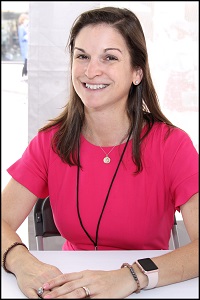
Marie Howe

Onafhankelijk van geboortedata

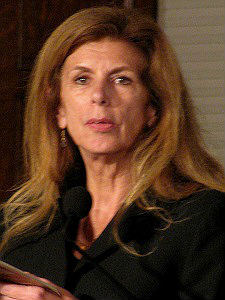
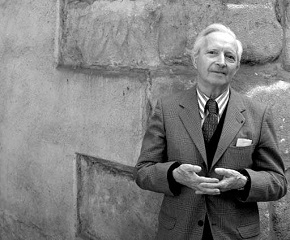
De Amerikaanse dichteres Marie Howe werd geboren in 1950 in Rochester, New York, als oudste meisje van negen kinderen. Ze ging naar de Sacred Heart Convent School en behaalde haar undergraduate degree aan de University of Windsor. Ze werkte kort als dagbladjournaliste in Rochester en als lerares Engels in het middelbaar onderwijs in Massachusetts. Howe besteedde geen serieuze aandacht aan het schrijven van poëzie totdat ze 30 werd. Op aanraden van een docent in een schrijversworkshop schreef Howe zich in aan de Columbia University, waar ze studeerde bij Stanley Kunitz en waar zij haar M.F.A. behaalde in 1983. Zij heeft gedoceerd aan de Tufts University en het Warren Wilson College. Ze is momenteel werkzaam aan de faculteiten schrijven van Columbia University, het Sarah Lawrence College en New York University. Haar eerste bundel “The Good Thief”, werd door Margaret Atwood geselecteerd als de winnaar van de Open Competition of the National Poetry Series 1987. In 1998 publiceerde ze haar bekendste gedichtenboek, “What the Living Do”; het titelgedicht in de verzameling is een beklemmende klaagzang om haar broer met het even openharige als eenvoudige laatste vers: “I am living, I remember you.” Howe’s broer John stierf aan een AIDS-gerelateerde ziekte in 1989. In 1995 gaf Howe, samen met Michael Klein een verzameling essays, brieven en verhalen uit, getiteld “In the Company of My Solitude: American Writing from the AIDS Pandemic”. Haar gedichten zijn verschenen in literaire tijdschriften en tijdschriften zoals The New Yorker, The Atlantic, Poetry, Agni, Plowshares en Harvard Review. Haar meest recente bundel heer “ Magdalene” (2017).


What the Living Do

Johnny, the kitchen sink has been clogged for days, some utensil probably fell down there.
And the Drano won’t work but smells dangerous, and the crusty dishes have piled up

waiting for the plumber I still haven’t called. This is the everyday we spoke of.
It’s winter again: the sky’s a deep, headstrong blue, and the sunlight pours through

the open living-room windows because the heat’s on too high in here and I can’t turn it off.
For weeks now, driving, or dropping a bag of groceries in the street, the bag breaking,

I’ve been thinking: This is what the living do. And yesterday, hurrying along those
wobbly bricks in the Cambridge sidewalk, spilling my coffee down my wrist and sleeve,

I thought it again, and again later, when buying a hairbrush: This is it.
Parking. Slamming the car door shut in the cold. What you called that yearning.

What you finally gave up. We want the spring to come and the winter to pass. We want
whoever to call or not call, a letter, a kiss—we want more and more and then more of it.

But there are moments, walking, when I catch a glimpse of myself in the window glass,
say, the window of the corner video store, and I’m gripped by a cherishing so deep

for my own blowing hair, chapped face, and unbuttoned coat that I’m speechless:
I am living. I remember you.


The Boy

My older brother is walking down the sidewalk into the suburban
summer night:
white T-shirt, blue jeans— to the field at the end of the street.

Hangers Hideout the boys called it, an undeveloped plot, a pit
overgrown
with weeds, some old furniture thrown down there,

and some metal hangers clinking in the trees like wind chimes.
He’s running away from home because our father wants to cut his hair.

And in two more days our father will convince me to go to him— you know
where he is— and talk to him: No reprisals. He promised. A small parade
of kids

in feet pajamas will accompany me, their voices like the first peepers
in spring.
And my brother will walk ahead of us home, and my father

will shave his head bald, and my brother will not speak to anyone the next
month, not a word, not pass the milk, nothing.

What happened in our house taught my brothers how to leave, how to walk
down a sidewalk without looking back.

I was the girl. What happened taught me to follow him, whoever he was,
calling and calling his name.


Marie Howe (Rochester, 1950)

Jaroslav Rudiš

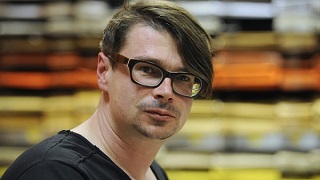
De Tsjechische schrijver, journalist en muzikant Jaroslav Rudiš werd geboren in Turnov op 8 juni 1972. Rudiš groeide op in Lomnice nad Popelkou en bezocht het gymnasium in Turnov. Hij studeerde eerst Duitse literatuur, geschiedenis en journalistiek in Liberec, Zürich en Praag, voordat hij naar Berlijn kwam met een studiebeurs voor journalistiek. Rudiš werd bekend door de publicatie van zijn eerste roman “Nebe pod Berlínem” (‘De hemel onder Berlijn’) in 2002, het verhaal van een Tsjechische leraar die stopt met zijn baan om een nieuw leven te beginnen in Berlijn, waar hij muziek speelt in de metro, die – samen met de geesten van ‘zelfmoordspringers’ – een soort mystieke betekenis voor hem krijgt, en sluit zich aan bij een indierockgroep (wat een semiautobiografisch motief is). Rudiš ontving voor deze roman de Jiří Ortenprijs. Hij werkte lange tijd als cultureel redacteur voor het dagblad Právo en woont sinds 2006 in Praag als freelance schrijver en journalist. In september 2006 werd zijn tweede roman “Grandhotel” uitgegeven; Parallel daaraan kwam de verfilming van het materiaal, waarin Rudiš zelf een ondergeschikte rol speelde, naar de Tsjechische bioscopen en werd ook getoond op de Berlinale. Bovendien werd in 2007 zijn derde roman “Potichu” (“De stilte”) gepubliceerd, die positieve recensies ontving van de Tsjechische critici.Samen met Petr Pýcha heeft Rudiš verschillende toneelstukken geschreven die o.a. in theaters in Praag en Ústí nad Labem te zien waren. De laatste tijd schrijft Rudiš ook in het Duits; Samen met de Leipziger schrijver Martin Becker schreef hij een libretto voor een opera over het jaar 1968, die in première ging in 2008 in Praag en Berlijn. Zijn samenwerking met tekenaar Jaromír 99 leidde tot de publicatie van drie nauw verbonden grafische romans, die zich afspelen onder de werknemers van de spoorwegen: Bílý potok (“Witte beek”, 2003), Hlavní nádra¸í (“Centraal station”, 2004) en Zlaté Hory (“Gouden bergen”). De trilogie is verfilmd tot een geanimeerde speelfilm, Alois Nebel, die werd uitgebracht in 2011. Rudiš’s werken zijn vertaald in het Duits, Frans, Engels, Nederlands, Spaans, Pools en Fins.

Uit: Die Stille in Prag (Vertaald door Eva Profousová)

„Ihre Körper berühren sich nicht. Sie liegen nebeneinander und blicken an die Decke. Hinter den Fenstern Prag, Stille und Dun-kelheit. Petr steckt sich eine letzte Zigarette an.
*Laut soll die Musik sein. Richtig laut. Das ist das Wichtigste. Damit alles andere untergeht. Aus der Welt verschwindet. Und endlos lang soll sie sein. Lang, heftig und ohne Ende. So laut wie möglich. So will ich es bei meiner Beerdigung haben«, sagt Vanda.
«Welche Band schwebt dir da vor?«
»Jeden Morgen ‘ne andere. «.
«Ich verstehe.. »
«Am wichtigsten ist die Lautstärke. Alles, was nicht laut ist, existiert nicht.«
«Jetzt ist es aber still. Stiller geht’s gar nicht.»
Petr fährt mit der Hand über Vandas Haar.
«Nur Stille allein gibt’s nicht. Irgendwo läuft immer was. Hörst du das nicht? »
«Nein.. »
«Wirklich nicht? »
Vanda stimmt stockend ein langsames Lied an, die Melodie fischt sie aus der schlafenden Stadt hinter den Fenstern heraus.
I feel like… feel like…
A little black cat…
I feel like… feel like…
I’m lost in no-man’s-land…
»Hörst du das wirklich nicht? «
«Nein»
«Ich schon. Ich höre dauernd Musik.«
«Aber jetzt ist es still«
»Ich hab doch gesagt, dass ich was höre. I feel like …«
»Ich hör nur dich.«
»Stille macht mich krank.«
»Vielleicht spielt die Musik in dir.«
Petr legt den Kopf auf Vandas Brust und lauscht. Ihr Herz schlägt. Sie riecht gut. Auch das, was sie heute Nacht miteinander gemacht haben, riecht gut an ihr.
»Hübsches Techno… 1000 Beats pro Minute. Dein Herz ist dein DJ. Ist wie bei der Loveparade. Nur ohne Gesang.«
»O Techno, hast du Techno gesagt? Techno ist tot, du Idiot.«
»Find ich nicht, man braucht nur an dir zu horchen.«
»Tot hab ich gesagt. Und tot bin ich noch lange nicht.«
Er küsst zuerst ihre linke Brust und dann die rechte, die etwas kleinere. Bei allen Frauen, mit denen er mal was gehabt hat, war die rechte Brust etwas kleiner. Dann küsst er das Muttermal dazwischen.“


Jaroslav Rudiš (Turnov, 8 juni 1972)

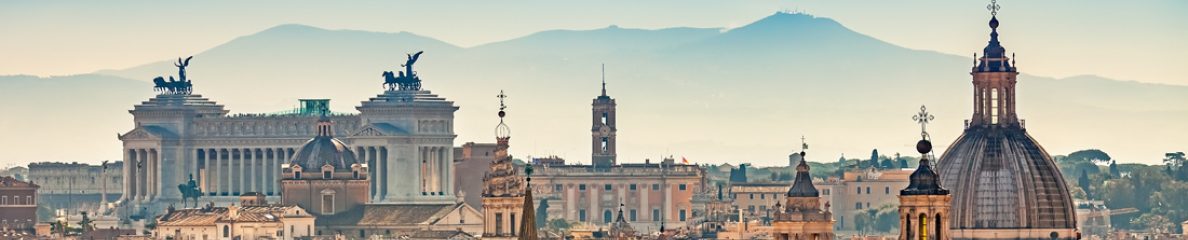
Het leven in juni (Marjoleine de Vos)


Dolce far niente


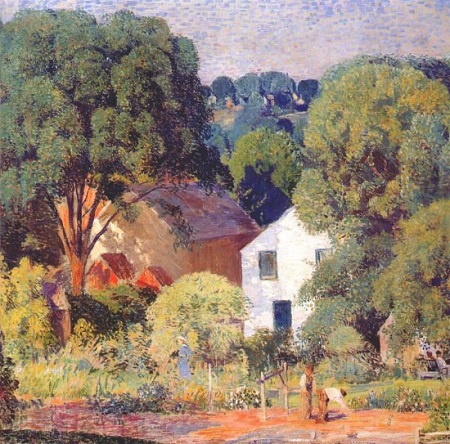
Day in June door Daniel Garber, 1937


Het leven in juni

Om mij heen is alles luidkeels in leven
de boer op zijn maaier, blatende schapen
in de esdoorn een zwartkop die roept
om een vrouwtje, uit bloemkelken klinkt
het geronk van een bij.

En ik leef ook maar moet dat zelf zeggen
want niets van al wat ik waarneem noemt mij.
Zoals je met vrienden wel praat over vroeger:
We waren aan zee, in een tent, heel gelukkig –
vraagt iemand: was jij daarbij?

Dus ben ik alleen in de tuin in de wereld
en om mij heen ademt alles en in huis
zit een man. Dit is het leven, schrijft hij,
deze ochtend in juni, de zwartkop zingt
en in de tuin zit zij. 


Marjoleine de Vos (Oosterbeek, 19 april 1957)
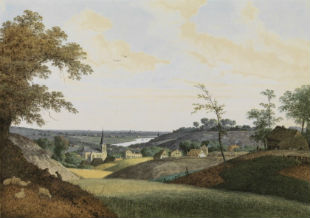
Landschap met gezicht op Oosterbeek met de Rijn in het verschiet – door Josephus Augustus Knip, ca. 1930. Marjoleine de Vos werd geboren in Oosterbeek.


Zie voor de schrijvers van de 7e juni ook mijn vorige blog van vandaag.

Orhan Pamuk, Monika Mann, Nikki Giovanni, Harry Crews, Louise Erdrich, Mascha Kaléko, Jan Engelman, Gwendolyn Brooks, Elizabeth Bowen

De Turkse schrijver Orhan Pamuk werd geboren op 7 juni 1952 in Istanbul. Zie ook alle tags voor Orhan Pamuk op dit blog.

Uit: The Red-Haired Woman (Vertaald door Ekin Oklap)

“The settlement was fifteen minutes on foot from our well. It was the town of Öngören, population 6,200, according to the blue sign with enormous white letters marking the entrance. After two days of ceaseless digging, two meters, we took a break on the second afternoon and went down to Öngören to acquire more supplies.
Ali took us to the town carpenter first. Having dug past two meters, we could no longer shovel out the earth by hand, so like all welldiggers, we had to build a windlass. Master Mahmut had brought some lumber in the landowner’s pickup, but it wasn’t enough. When he explained who we were and what we were up to, the inquisitive carpenter said, “Oh, you mean that land up there!”
Over the following days, whenever we went down to the town from “that land up there,” Master Mahmut made a point of dropping by the carpenter; the grocer, who sold cigarettes; the bespectacled tobacconist; and the ironmonger, who stayed open late. After digging all day, I relished going to Öngören with Master Mahmut for an evening stroll by his side, or to sit in the shade of the cypress and pine trees on some little bench, or at a table outside some coffeehouse, on the stoop of some shop, or in the train station.
It was Öngören’s misfortune to be overrun by soldiers. An infantry battalion had been stationed there during World War II to defend Istanbul against German attacks via the Balkans, and Russian attacks via Bulgaria. That purpose, like the battalion itself, was soon forgotten. But forty years later, the unit was still the town’s greatest source of income, and its curse.
Most of the shops in the town center sold postcards, socks, telephone tokens, and beer to soldiers on day passes. The stretch known among locals as Diners’ Lane was lined with various eateries and kebab shops, also catering to the military clientele. Surrounding them were pastry shops and coffeehouses that would be jammed with soldiers during the day—especially on weekends—but in the evenings, when these places emptied out, a completely different side of Öngören emerged. The gendarmes, who patrolled the area vigilantly, would have to pacify carousing infantrymen and break up fistfights among privates, in addition to restoring the peace disturbed by boisterous civilians or by the music halls when the entertainment got too loud.“



Orhan Pamuk (Istanbul, 7 juni 1952)


De Duitse schrijfster Monika Mann werd als vierde kind van Thomas Mann geboren op 7 juni 1910 in München. Zie ook alle tags voor Monika Mann op dit blog.

Uit: Das fahrende Haus

„Fast ohne Unterbrechung zwölf Jahre in einem Land gelebt zu haben – soll ich sagen, daß es die besten Jahre waren? –, reichen aus, ihm Treue und Verbundenheit zu bewahren fürs Leben.
Ein Gesetz der Vereinigten Staaten von Amerika jedoch erlaubt ihrem naturalisierten Bürger nicht mehr als fünf Jahre seiner ununterbrochenen Abwesenheit. Überschreitet er diese Frist, verliert er die Staatsbürgerschaft. Wer aber will den Kontinent so mir nichts, dir nichts wechseln, noch dazu um eines Gesetzes willen, das unserer Zeit entwachsen, nicht würdig scheint? Denn in Europa leben, heißt nicht, fern von Amerika leben, heißt nicht, das verlernen und vergessen, was man in der Neuen Welt gelernt und erfahren und sich errungen hat. Die Länder Europas, sind sie nicht so etwas wie amerikanische Provinzen (nicht zu ihrer Schande sei’s gefragt!), und sind die Vereinigten Staaten Amerikas nicht so etwas wie europäische Ableger? Leben wir nicht in einer Welt, die immer mehr zusammenrückt, die unvermeidlich, bei allem Zaudern und Widerstand sich vereinheitlicht und vereinigt? Während ich meine amerikanische Staatsbürgerschaft niederlege, lese ich Emerson und Whitman, schreibe ich meine «Amerikanische Novelle», denk’ ich an zwölf, wenn nicht immer leichte, so doch helle Jahre in New York und Los Angeles, New England, Vermont und Maine . . . Ja, es ist vor allem Amerikas Licht, das so unvergeßlich ist. Der Himmel der Neuen Welt ist heller als der Himmel der Alten Welt. (Ein grüner Baum wirkt dort dunkler als hier, zuweilen fast schwarz gegen das lichte Blau.)”
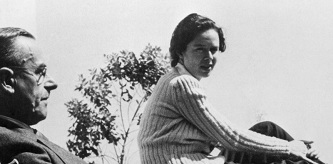


Monika Mann (7 juni 1910 – 17 maart 1992)
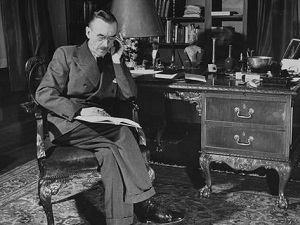
Thomas en Monika Mann, rond 1940


De Amerikaanse dichteres en schrijfster Nikki Giovanni werd geboren op 7 juni 1943 in Knoxville, Tennessee. Zie ook alle tags voor Nikki Giovanni op dit blog.


A Historical Footnote to Consider Only When All Else Fails
(For Barbara Crosby)

While it is true
(though only in a factual sense)
That in the wake of a
Her-I-can comes a
Shower
Surely I am not
The gravitating force
that keeps this house
full of panthers

Why, LBJ has made it
quite clear to me
He doesn’t give a
Good goddamn what I think
(else why would he continue to masterbate in public?)

Rhythm and Blues is not
The downfall of a great civilization
And I expect you to
Realize
That the Temptations
have no connection with
The CIA

We must move on to
the true issues of
Our time
like the mini-skirt
Rebellion
And perhaps take a
Closer look at
Flour power

It is for Us
to lead our people
out of the
Wein-Bars
into the streets
into the streets
(for safety reasons only)
Lord knows we don’t
Want to lose the
support
of our Jewish friends

So let us work
for our day of Presence
When Stokely is in
The Black House
And all will be right with
Our World
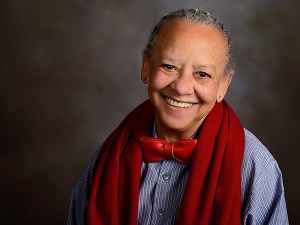


Nikki Giovanni (Knoxville, 7 juni 1943)


De Amerikaanse schrijver Harry Crews werd geboren op 7 juni 1935 in Bacon County, Georgia. Zie ook alle tags voor Harry Crews op dit blog.

Uit: Classic Crews: A Harry Crews Reader

“He was smiling, but he’d said it with just the finest edge of contempt, which is the way you are supposed to say it, and I scrambled to follow him, my heart lifting. Byron had heard me ask him much the same thing many times before, because if you change a couple of words, the question will serve in any number of circumstances. And now, in great high spirits, he was giving it back to me. …
“Dad, you remember about the time with the rain?”
“The time about the rain? Hell, son, we been in the rain a lot together.” I was wet and my feet hurt. I wanted to get the tent up and start a fire.
He cut his eyes toward me. Drops of rain hung on the ends of his fine lashes. He was suddenly very serious. What in the hell was coming down here? What was coming down was the past that is never past and, in this case, the past against which I had no defense except my own failed heart.
“We weren’t in it together,” he said. “You made me stand in it. Stand in it for a long time.”
Yes, I had done that, but I had not thought about it in years. It’s just not the sort of thing a man would want to think about. Byron’s mother had gone North for a while and left me to take care of him. He was seven years old and just starting in the second grade. I had told him that day to be home at six o’clock and we should go out to dinner. Truthfully, we’d been out to eat every night since Sally had been gone, because washing dishes is right up at the top of the list of things I won’t do. It had started misting rain at midday and had not stopped. Byron had not appeared at six, nor was he there at 6:45. That was back when I was bad to go to the bottle, and while I wasn’t drunk, I wasn’t sober, either. Lay it on the whiskey. A man will snatch at any straw to save himself from the responsibility of an ignoble action. When he did come home at 7:15, I asked him where he’d been.
“At Joe’s,” he said. But I had known that. I reminded him of when we had said we were going to dinner. But he had known that.
“It was raining,” he said.
I said, “Let’s go out and look at it.”
We went out into the carport and watched the warm spring rain.”
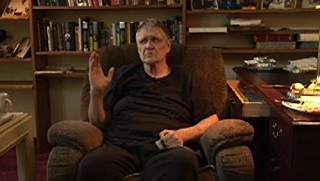


Harry Crews (7 juni 1935 – 28 maart 2012)


De Amerikaanse dichteres en schrijfster Louise Erdrich werd geboren op 7 juni 1954 in Little Falls, Minnesota. Zie ook alle tags voor Louise Erdrich op dit blog.


The King of Owls

It is said that playing cards were invented in 1392 to cure the French king, Charles VI, of madness. The suits in some of the first card packs consisted of Doves, Peacocks, Ravens, and Owls.

They say I am excitable! How could
I not scream? The Swiss monk’s tonsure
spun till it blurred yet his eyes were still.
I snapped my gaiter, hard, to stuff back

my mirth. Lords, he then began to speak.
Indus catarum, he said, presenting the game of cards
in which the state of the world is excellent described
and figured. He decked his mouth

as they do, a solemn stitch, and left cards
in my hands. I cast them down.
What need have I for amusement?
My brain’s a park. Yet your company

plucked them from the ground and began to play.
Lords, I wither. The monk spoke right,
the mealy wretch. The sorry patterns show
the deceiving constructions of your minds.

I have made the Deuce of Ravens my sword
falling through your pillows and rising,
the wing blades still running
with the jugular blood. Your bodies lurch

through the steps of an unpleasant dance.
No lutes play. I have silenced the lutes!
I keep watch in the clipped, convulsed garden.
I must have silence, to hear the messenger’s footfall

in my brain. For I am the King of Owls.
Where I float no shadow falls.
I have hungers, such terrible hungers, you cannot know.
Lords, I sharpen my talons on your bones.
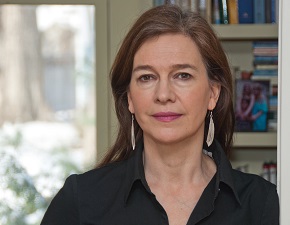


Louise Erdrich (Little Falls, 7 juni 1954)


De Duitstalige dichteres Mascha Kaléko (eig. Golda Malka Aufen) werd geboren op 7 juni 1907 in Krenau of Schidlow in Galicië in het toenmalige Oostenrijk-Hongarije, nu Polen. Zie ook alle tags voor Mascha Kaléko op dit blog.


Langschläfers Morgenlied

Der Wecker surrt. Das alberne Geknatter
Reißt mir das schönste Stück des Traums entzwei.
Ein fleißig Radio übt schon sein Geschnatter.
Pitt äußert, daß es Zeit zum Aufstehn sei.

Mir ist vor Frühaufstehern immer bange.
… Das können keine wackern Männer sein:
Ein guter Mensch schläft meistens gern und lange.
– Ich bild mir diesbezüglich etwas ein …

Das mit der goldgeschmückten Morgenstunde
Hat sicher nur das Lesebuch erdacht.
Ich ruhe sanft. – Aus einem kühlen Grunde:
Ich hab mir niemals was aus Gold gemacht.

Der Wecker surrt. Pitt malt in düstern Sätzen
Der Faulheit Wirkung auf den Lebenslauf.
Durchs Fenster hört man schon die Autos hetzen.
– Ein warmes Bett ist nicht zu unterschätzen.
… Und dennoch steht man alle Morgen auf.
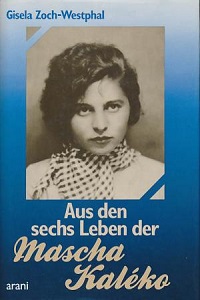


Mascha Kaléko (7 juni 1907 – 21 januari 1975)
Cover


De Nederlandse dichter Johannes Aloysius Antonius Engelman werd geboren in Utrecht op 7 juni 1900. Zie ook alle tags voor Jan Engelman op dit blog.


Gebed in ’t Duister

Heer, behoed haar in de wereld
die ik lang mijn eigen noem.
In haar ogen staat bepereld
met uw eigen dauw de bloem

van een onverwelkbaar minnen
uit de grond der ziel geteeld.
En geen stervling zal bezinnen
op het eeuwig Aanvangsbeeld

lijk uw knecht, die hare leden
in het schemerlicht onthult,
die zich, stamelend gebeden,
aan háár wil alleen vervult.

Lang voor ’t eerste dagegloren,
lang na Venus’ gouden schijn
kniel ik, uwe stem te horen
uit die weelde, uit die pijn,

uit die tuin, bedekt, bedwereld
met een bloesem van Voorheen.
Heer, behoed haar in de wereld,
doe uw mantel om ons heen!


Klein Air

Morgen drink ik rode wijn,
morgen zal mijn lief hier zijn.
In de warme lampeschijn
zal zij liggen, bleek en fijn.
Wilder dan een springfontein
breek ik uit, en ben weer klein
bij haar leden, zoet satijn,
diepe bedding, dieper pijn.
Morgen drink ik rode wijn,
morgen zal mijn lief hier zijn.
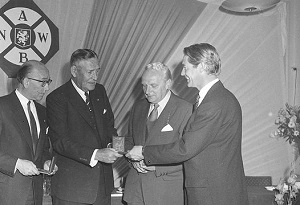


Jan Engelman (Utrecht 7 juni 1900 ;Amsterdam 20 maart 1972)
Engelman helemaal links tijdens de uitreiking van de ANWB-prijs 1958


De Amerikaanse dichteres Gwendolyn Brooks werd geboren op 7 juni 1917 in Topeka, Kansas. Zie ook alle tags voor Gwendolyn Brooks op dit blog.


Speech To The Young : Speech To The Progress-Toward

Say to them,
say to the down-keepers,
the sun-slappers,
the self-soilers,
the harmony-hushers,
“even if you are not ready for day
it cannot always be night.”
You will be right.
For that is the hard home-run.

Live not for battles won.
Live not for the-end-of-the-song.
Live in the along.


The Good Man

The good man.
He is still enhancer, renouncer.
In the time of detachment,
in the time of the vivid heather and affectionate evil,
in the time of oral
grave grave legalities of hate – all real
walks our prime registered reproach and seal.
Our successful moral.
The good man.

Watches our bogus roses, our rank wreath, our
love’s unreliable cement, the gray
jubilees of our demondom.
Coherent
Counsel! Good man.
Require of us our terribly excluded blue.
Constrain, repair a ripped, revolted land.
Put hand in hand land over.
Reprove
the abler droughts and manias of the day
and a felicity entreat.
Love.
Complete
your pledges, reinforce your aides, renew
stance, testament.
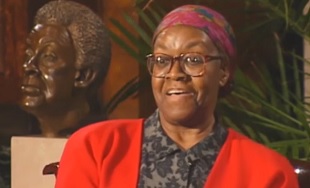


Gwendolyn Brooks (7 juni 1917 – 3 december 2000)
In 1996


De Ierse schrijfster Elizabeth Bowen werd geboren op 7 juni 1899 in Dublin. Zie ook alle tags voor Elizabeth Bowen op dit blog.

Uit: Friends and Relations

“Now the service was over the afternoon steadily brightened. The open-sided marquee was not, after all, to prove a fiasco. Laurel and Edward, obedient to Mrs Studdart’s instructions, took up their position in the morning-room. A playing-card, overlooked, lay face down on the carpet. Edward stooped for it – ‘Don’t!’ she cried, ‘leave it!’ her heart in her mouth. Better not – Finding themselves still alone Edward and she kissed hastily, with a feverish calm. They had all time, but only the moment. Then Laurel arranged her train in a pool, as she had seen brides do. Mrs Studdart, coming in shortly afterwards, re-arranged it.
‘You might hold your lilies,’ said Mrs Studdart, who had discovered the sheaf on a hall table specially cleared for the top-hats.
‘Oh, Mother, I can’t; they’re heavy.’
‘But don’t you think it would be nice, Edward, if she were to hold her lilies?’
‘I don’t know,’ said Edward. ‘Do people generally?’
‘They’d be such a strain on one arm all the time. You see I can’t change them; I must keep my right arm for shaking hands.’
‘And shake hands lightly,’ said Mrs Studdart, ‘don’t grip.’
‘Did I look …?’
‘Lovely, lovely,’ said Mrs Studdart. She was looking round distractedly for a vase and soon found one, a kind of Italian urn in which she arranged the lilies beside the bride.
The house might have been designed for such an occasion. The position of the morning-room was admirable; it had two doors so that the guests could circulate through a chain of rooms. Each, having saluted the bridal pair, was to pass on through the dining-room; through the French window and out by duck-boards into the open- sided marquee. (This was the best of a summer wedding; to make this possible he and she had devoured each other nervously throughout the endless winter of their engagement.) In the dining-room Cousin Richard was to be posted to head the guests off through the window. He would be shot, he said, if he let one past him into the hall.
‘I shall depend upon you, Richard,’ said Mrs Studdart. (He had been in the Colonies.) ‘For if the two streams mix in the hall and people get squeezed back into the drawing-room and have to pass Laurel all over again, there will be the most shocking confusion.’
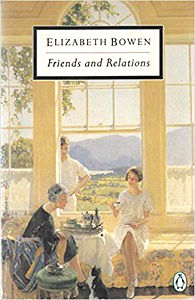


Elizabeth Bowen (7 juni 1899 – 22 februari 1973)
Cover


Zie voor nog meer schrijvers van de 7e juni ook mijn blog van 7 juni 2015 deel 2.
Thomas Mann, Aleksandr Poesjkin, Sarah Dessen, Jean Cayrol, Pierre Corneille, Hendrik van Teylingen, V. C. Andrews, Frank Gericke

De Duitse schrijver Thomas Mann werd geboren in Lübeck op 6 juni 1875. Zie ook alle tags voor Thomas Mann op dit blog.

Uit: Doktor Faustus

Ich breche aufs neue ab, indem ich mich daran erinnere, daß ich auf das Genie und seine jedenfalls dämonisch beeinflußte Natur nur zu sprechen kam, um meinen Zweifel zu erläutern, ob ich zu meiner Aufgabe die nötige Affinität besitze. Möge denn nun gegen den Gewissensskrupel geltend gemacht sein, was immer ich dagegen ins Feld zu führen habe. Es war mir beschieden, viele Jahre meines Lebens in der vertrauten Nähe eines genialen Menschen, des Helden dieser Blätter, zu verbringen, ihn seit Kinderzeiten zu kennen, Zeuge seines Werdens, seines Schicksals zu sein und an seinem Schaffen in bescheidener Helfersrolle teilzuhaben. Die librettistische Bearbeitung von Shakespeares Komödie »Verlorene Liebesmüh«, Leverkühns mutwilligem Jugendwerk, stammt von mir, und auch auf die textliche Zubereitung der grotesken Opernsuite »Gesta Romanorum« sowie des Oratoriums »Offenbarung S. Johannis des Theologen« durfte ich Einfluß nehmen. Das ist das eine, oder es ist bereits das eine und andere. Ich bin aber ferner im Besitz von Papieren, unschätzbaren Aufzeichnungen, die der Heimgegangene mir und keinem anderen in gesunden Tagen oder, wenn ich so nicht sagen darf, in vergleichsweise und legaliter gesunden Tagen letztwillig vermacht hat, und auf die ich mich bei meiner Darstellung stützen werde, ja, aus denen ich mit gebotener Auswahl einiges direkt in dieselbe einzuschalten gedenke. Letztens und erstens aber — und diese Rechtfertigung war noch immer die gültigste, wenn nicht vor den Menschen, so doch vor Gott: ich habe ihn geliebt — mit Entsetzen und Zärtlichkeit, mit Erbarmen und hingebender Bewunderung — und wenig dabei gefragt, ob er im mindesten mir das Gefühl zurückgäbe. Das hat er nicht getan, o nein.

 
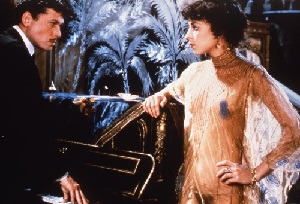
Jon Finch als Adrian Leverkühn en Marie-Hélène Breillat als Marie Godeau in de film uit 1982

In der Verschreibung der nachgelassenen Kompositionsskizzen und Tagebuchblätter drückt sich ein freundlich-sachliches, fast möchte ich sagen: gnädiges und sicherlich mich ehrendes Vertrauen in meine Gewissenhaftigkeit, Pietät und Korrektheit aus. Aber lieben? Wen hätte dieser Mann geliebt? Einst eine Frau — vielleicht. Ein Kind zuletzt — es mag sein. Einen leichtwiegenden, jeden gewinnenden Fant und Mann aller Stunden, den er dann, wahrscheinlich eben weil er ihm geneigt war, von sich schickte — und zwar in den Tod. Wem hätte er sein Herz eröffnet, wen jemals in sein Leben eingelassen? Das gab es bei Adrian nicht. Menschliche Ergebenheit nahm er hin — ich möchte schwören: oft ohne sie auch nur zu bemerken. Seine Gleichgültigkeit war so groß, daß er kaum jemals gewahr wurde, was um ihn her vorging, in welcher Gesellschaft er sich befand, und die Tatsache, daß er sehr selten einen Gesprächspartner mit Namen anredete, läßt mich vermuten, daß er den Namen nicht wußte, während doch der andere ein gutes Recht zur Annahme des Gegenteils hatte. Ich möchte seine Einsamkeit einem Abgrund vergleichen, in welchem Gefühle, die man ihm entgegenbrachte, lautlos und spurlos untergingen. Um ihn war Kälte — und wie wird mir zumute, indem ich dies Wort gebrauche, das auch er in einem ungeheuerlichen Zusammenhange einst niederschrieb! Einzelnen Vokabeln können Leben und Erfahrung einen Akzent verleihen, der sie ihrem alltäglichen Sinn völlig entfremdet und ihnen einen Schreckensnimbus verleiht, den niemand versteht, der sie nicht in ihrer fürchterlichsten Bedeutung kennengelernt hat.“


Thomas Mann (6 juni 1875 – 12 augustus 1955)


De Russische dichter en schrijver Aleksandr Poesjkin werd geboren in Moskou op 6 juni 1799. Zie ook alle tags voor Aleksandr Poesjkin op dit blog.

Uit: Evgeny Onegin (Vertaald door G. R. Ledger)

Book 5

I
That year the autumn weather lingered
Over the field and around the yards,
Winter held back, Nature awaited,
In January only snow fell at last
On the third, at night. And waking early
Tatyana saw through the window clearly
The yard all covered with morning whiteness,
The flower beds, roofs, and all the fences;
On the window glass the leaves of frost,
The trees in their winter silveriness,
And cheerful magpies in the snow.
The hills all covered with the soft glow
Of winter’s carpet glistening bright,
Around all was shining, all was white.
II
Winter ! The peasant breathes a sigh,
Renews his sledge, and makes his way.
His horse, snorting in the fresh snow
With a finicky trot gets along somehow.
And now the dashing kibitka flies,
In the powdery snow cutting feathery furrows.
The coachman sits huddled upon his box,
In a sheepskin coat and a scarlet sash.
A yard boy runs out, and on his sledge
His favourite ‘Dasher’ is the driver,
While he himself is the willing puller;
The rascal struggles with frozen hands;
What fun it is, but so painful too,
While his mother scolds him above at the window.
III
But perhaps recollection of winter’s scenes
Does not arouse you, gentle reader:
It is all base, lowly, and vulgar Nature,
But not much here of refinement breathes.
Warmed by the inspiration of the Muse,
Another poet, in luxuriant gloss,
Has painted for us the first fallen snow,
And all the shades of winter’s sloth.
I am sure that he more than ever enchants you,
Depicting in his flamboyant verse
The charm of a secret rendezvous,
On a sledge; yet to fight I am somewhat averse,
With him, or with that other minstrel
Of the Finnish maiden, as bright as tinsel.


Aleksandr Poesjkin (6 juni 1799- 10 februari 1837)
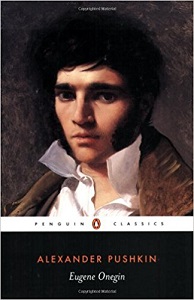
Cover


De Amerikaanse schrijfster Sarah Dessen werd geboren op 6 juni 1970 in Evanston, Illinois. Zie ook alle tags voor Sarah Dessen nop dit blog.

Uit: Just Listen

“I taped the commercial back in April, before anything had happened, and promptly forgot about it. A few weeks ago, it had started running, and suddenly, I was everywhere. On the rows of screens hanging over the ellipticals at the gym. On the monitor they have at the post office that’s supposed to distract you from how long you’ve been waiting in line. And now here, on the TV in my room, as I sat at the edge of my bed, fingers clenched into my palms, trying to make myself get up and leave. “It’s that time of year again….” I stared at myself on the screen as I was five months earlier, looking for any difference, some visible proof of what had happened to me. First, though, I was struck by the sheer oddness of seeing myself without benefit of a mirror or photograph. I had never gotten used to it, even after all this time. “Football games,” I watched myself say. I was wearing a baby-blue cheerleader uniform, hair pulled back tight into a ponytail, and clutching a huge megaphone, the kind nobody ever used anymore, emblazoned with a K. “Study hall.” Cut to me in a serious plaid skirt and brown cropped sweater, which I remembered feeling itchy and so wrong to be wearing just as it was getting warm, finally. “And, of course, social life.” I leaned in, staring at the me on-screen, now outfitted in jeans and a glittery tee and seated on a bench, turning to speak this line while a group of other girls chattered silently behind me. The director, fresh-faced and just out of film school, had explained to me the concept of this, his creation. “The girl who has everything,” he’d said, moving his hands in a tight, circular motion, as if that was all it took to encompass something so vast, not to mention vague. Clearly, it meant having a megaphone, some smarts, and a big group of friends. Now, I might have dwelled on the explicit irony of this last one, but the on-screen me was already moving on. “It’s all happening this year,” I said. Now I was in a pink gown, a sash reading HOMECOMING QUEEN stretched across my midsection as a boy in a tux stepped up beside me, extending his arm. I took it, giving him a wide smile. He was a sophomore at the local university and mostly kept to himself at the shooting, although later, as I was leaving, he’d asked for my number. How had I forgotten that?”


Sarah Dessen (Evanston, 6 juni 1970)


De Franse dichter en schrijver Jean Cayrol werd geboren op 6 juni 1911 in Bordeaux. Zie ook alle tags voor Jean Cayrol op dit blog.


Retour

À feu et à sang
belle fille qui se repent
les oiseaux sont dans le vent
à chercher qui vous attend

À feu et à sang
les villes tendres de la mort
les hauts jardins les fruits les corps
le désastre au premier rang

À feu et à sang
sans qu’on puisse dire une prière
un fleuve qui trouve la barque éphémère
un homme haletant

À feu et à sang
la guerre comme chevreau mort
sur tes épaules et tout ce qui dort
sur la rive d’Avant

À feu et à sang
j’ai de grands vergers qui hantent le soir
j’ai de grands amis qui peuvent me voir
des plaies qui s’en vont

À feu et à sang
la porte n’est jamais fermée
entends-tu au fond de l’année
l’écho, le démon

À feu et à sang
reviens mon enfant
inlassablement.


Jean Cayrol (6 juni 1911 – 10 februari 2005)


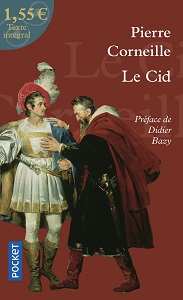
De Franse dichter en schrijver Pierre Corneille werd geboren in Rouen op 6 juni 1606. Zie ook alle tags voor Pierre Corneille op dit blog.

Uit: Le Cid

« LE COMTE
Je l’avoue entre nous, mon sang un peu trop chaud
S’est trop ému d’un mot, et l’a porté trop haut ;
Mais puisque c’en est fait, le coup est sans remède.
DON ARIAS
Qu’aux volontés du roi ce grand courage cède :
Il y prend grande part, et son cœur irrité
Agira contre vous de pleine autorité.
Aussi vous n’avez point de valable défense :
Le rang de l’offensé, la grandeur de l’offense,
Demandent des devoirs, et des soumissions
Qui passent le commun des satisfactions.
LE COMTE
Le roi peut à son gré disposer de ma vie.
DON ARIAS
De trop d’emportement votre faute est suivie.
Le roi vous aime encore ; apaisez son courroux.
Il a dit : « Je le veux ; » désobéirez-vous ?
LE COMTE
Monsieur, pour conserver tout ce que j’ai d’estime,
Désobéir un peu n’est pas un si grand crime ;
Et quelque grand qu’il soit, mes services présents
Pour le faire abolir sont plus que suffisants.
DON ARIAS
Quoi qu’on fasse d’illustre et de considérable,
Jamais à son sujet un roi n’est redevable.
Vous vous flattez beaucoup, et vous devez savoir
Que qui sert bien son roi ne fait que son devoir.
Vous vous perdrez, Monsieur, sur cette confiance. »


Pierre Corneille (6 juni 1606 – 1 oktober 1684)
Cover


De Nederlandse dichter en vertaler Hendrik van Teylingen werd geboren op 6 juni 1938 in IJmuiden. Zie ook alle tags voor Hendrik van Teylingen op ditt blog.


Antoine

In deze winternacht
is de gracht belegd
met een kruimige vacht
van bierschuim en licht.

Geëerde Stoffeerder,
zend thans uw borduurders.
Stuur uwe woerden
en eenden in horden.

Roep op uit de wakken.
Laat ze haast maken.
Dat al wat kan kwaken
guirlanden trappele

rondom de bijt
waarin Antoine, door de hik
van de wal gewipt,
allengs berijpt.


Hendrik van Teylingen (6 juni 1938 – 25 december 1998)
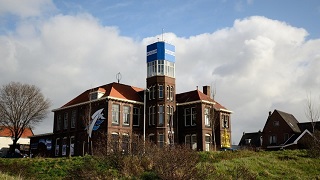
IJmuiden, Het Zee-en Havenmuseum


De Amerikaanse schrijfster V. C. Andrews (eig. Cleo Virginia Andrews) werd geboren in Portsmouth op 6 juni 1923. Zie ook alle tags voor V. C. Andrews op dit blog.

Uit:Petals on the Wind

“How young we were the day we escaped. How exuberantly alive we should have felt to be freed, at last, from such a grim, lonely and stifling place. How pitifully delighted we should have been to be riding on a bus that rumbled slowly southward. But if we felt joy, we didn’t show it. We sat, all three, pale, silent, staring out the windows, very frightened by all we saw.
Free. Was ever a word more wonderful than that one? No, even though the cold and bony hands of death would reach out and drag us back, if God wasn’t up there somewhere, or maybe down here on the bus, riding with us and looking out for us. At some time in our life we had to believe in someone.
The hours passed with the miles. Our nerves grew frazzled because the bus stopped often to pick up and let off passengers. It stopped for rest breaks, for breakfast, then to pick up a single huge black lady who stood alone where a dirt road met the concrete interstate. It took her forever to pull herself onto the bus, then lug inside the many bundles she carried with her. Just as she was finally seated, we passed over the state line between Virginia and North Carolina.
Oh! The relief to be gone from that state of our imprisonment! For the first time in years, I began to relax—a little.
We three were the youngest on the bus. Chris was seventeen years old and strikingly handsome with long, waving blond hair that just touched his shoulders, then curled upward. His darkly fringed blue eyes rivaled the color of a summer sky, and he was in personality like a warm sunny day—he put on a brave face despite the bleakness of our situation. His straight and finely shaped nose had just taken on the strength and maturity that promised to make him all that our father had been—the type of man to make every woman’s heart flutter when he looked her way, or even when he didn’t. His expression was confident; he almost looked happy. If he hadn’t looked at Carrie he might have even been happy. But when he saw her sickly, pale face, he frowned and worry darkened his eyes. He began to pluck on the strings of the guitar strapped to his shoulder.”


V. C. Andrews (6 juni 1923 – 19 december 1986)
Scene uit de gelijknamige film uit 2014 met Wyatt Nash (Christopher) en Rose McIver (Cathy)


De Nederlandse dichter en publicist Frank Gericke (pseudoniem van Derk Gerhardus Hoek) werd geboren in Hoogvliet op 6 juni 1887. Zie ook alle tags voor Frank Gericke op dit blog.De naaister

Weken na weken, jaren na jaar, met een duldenden glimlach,
Minzaam, bescheiden en oud, komt zij en zet zich aan ’t raam.
Kraaloogend volgde, uit mijn wieg, ik het bezig geheim van heur handen;
Morgen… Wie weet het hoe snel zij ook mijn doodslaken naait?
Wàt verzilvert heur taak, wàt doet haar, van ’t deemstren des morgens,
IJvrend tot Helios daalt, ’t zonnegoud zaamle’ in heur oog?
Dieper dan ’t staamrend verstand van den zinnenden dichter, den wijsgeer,
Weet zij hoe de eeuwigheid bloeit, bloeit uit een mensch en zijn taak.


Het renteniertje

Parkwaart stiert hij den tred: hij kiest, onder ’t loof der platanen,
‘T plekje dat, vroolijk en wijd, uitzicht en lommer hem biedt;
Volgt, met de baby, het meisje, en let hoe de wieletjes glijden; –
Krachtig stort de muziek volkwaart uit schaduw en tent.
Doet, in ’t grauw van zijn baard, u zijn blik geen monkellach raden?
Heimelijk loert hij, en lonkt, pinkoogt en monkellacht weêr…
De ure verstilt; de kilte doorhuivert zijn leden… Zoo keert hij
Schoorvoetend weder, en steels pinkt hij uit d’ ooghoek een traan.


Frank Gericke (6 juni 1887 − 14 december 1976)
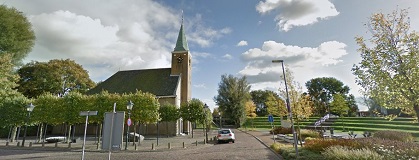
Hoogvliet, kerk


Zie voor nog meer schrijvers van de 6e juni ook mijn blog van 6 juni 2015 deel 2.
Dolce far niente, Groen-grijs gebied (Jesse Laport)


Dolce far niente


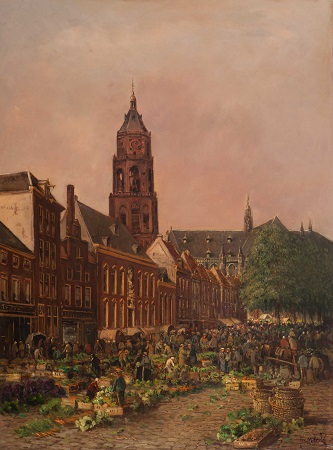
Gezicht op het Kerkplein en de Sint-Eusebiuskerk te Arnhem, z.j.
door Jurriaan Marinus Beek (5 april 1879 – 15 oktober 1965)


Groen-grijs gebied

Geen heuvels; bulten
geen monumenten; panden
geen gesprekken; praatjes
geen gedoe; gedonder;

aan de Rijn maakt niemand alles mooier
maar doet niet van iets of het niets is
aan de Rijn pas je in geen enkel hokje
dan het hokje dat je bouwt

ze kunnen gedichten schrijven
verhalen verzinnen
liederen zingen
video’s maken

maar plaatsen kunnen ze ons niet

wie hier woont
pást niet in je plaatje
wie hier wonen
voldoen niet aan stigmata

dit is geen Randstad
geen periferie
dit is de Rijnstad

we zijn een groen, we zijn een grijs gebied


Jesse Laport (Arnhem, 1991)
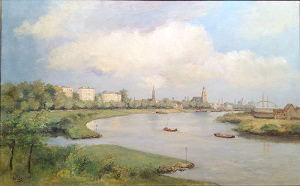
Arnhem gezien vanaf de Rijn door Abraham van der Zee (1882-1958)


Zie voor de schrijvers van de 5e juni ook mijn vorige blog van vandaag.

Federico García Lorca, Adriaan Morriën, Ken Follett, Paul Farley, Geoff Dyer

De Spaanse dichter en toneelschrijver Federico Garcia Lorca werd geboren op 5 juni 1898 in Fuente Vaqueros, Granada. Zie ook alle tags voor Federico Garcia Lorca op dit blog.


Ballad Of The Moon

The moon came into the forge
in her bustle of flowering nard.
The little boy stares at her, stares.
The boy is staring hard.
In the shaken air
the moon moves her amrs,
and shows lubricious and pure,
her breasts of hard tin.
“Moon, moon, moon, run!
If the gypsies come,
they will use your heart
to make white necklaces and rings.”
“Let me dance, my little one.
When the gypsies come,
they’ll find you on the anvil
with your lively eyes closed tight.
“Moon, moon, moon, run!
I can feelheir horses come.”
“Let me be, my little one,
don’t step on me, all starched and white!”

Closer comes the the horseman,
drumming on the plain.
The boy is in the forge;
his eyes are closed.
Through the olive grove
come the gypsies, dream and bronze,
their heads held high,
their hooded eyes.

Oh, how the night owl calls,
calling, calling from its tree!
The moon is climbing through the sky
with the child by the hand.

They are crying in the forge,
all the gypsies, shouting, crying.
The air is veiwing all, views all.
The air is at the viewing.


Vertaald door Will Kirkland


Arbolé, Arbolé

Tree, tree
dry and green.

The girl with the pretty face
is out picking olives.
The wind, playboy of towers,
grabs her around the waist.
Four riders passed by
on Andalusian ponies,
with blue and green jackets
and big, dark capes.
‘Come to Cordoba, muchacha.’
The girl won’t listen to them.
Three young bullfighters passed,
slender in the waist,
with jackets the color of oranges
and swords of ancient silver.
‘Come to Sevilla, muchacha.’
The girl won’t listen to them.
When the afternoon had turned
dark brown, with scattered light,
a young man passed by, wearing
roses and myrtle of the moon.
‘Come to Granada, inuchacha.’
And the girl won’t listen to him.
The girl with the pretty face
keeps on picking olives
with the grey arm of the wind
wrapped around her waist.
Tree, tree
dry and green.


Vertaald door William Logan


Federico García Lorca (5 juni 1898 – 19 augustus 1936)
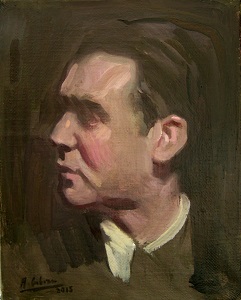
Portret door Alejandro Cabeze, 2015


De Nederlandse dichter en schrijver Adriaan Morriën werd geboren op 5 juni 1912 in Amsterdam. Zie ook alle tags voor Adriaan Morriën op dit blog.


Zomerwind

Nog voor zonsondergang valt reeds de wind,
het land wordt diep waarin de boomen zwijgen
en de gedachten ruimte en toekomst krijgen,
voor ’t open raam denkt menig moeder aan haar kind.

En in den nacht wordt ’t gouden haar ontbonden
en streelen vingers een bemind gelaat;
het spel is oud waarvoor wij namen vonden
zoo zoet dat geen herinnering geheel vergaat.

In vele kamers schijnt de glans der maan
over de lichamen die zich verstrenglen;
de liefde raakt ons in ’t voorbijgaan aan,
maakt ons één nacht haar uitverkoren englen.

Wie nu nog rond ziet in de leege straat
hoort hoe het loover nauwlijks leeft en fluistert,
de vogel onder maan en sterren klaagt,
de klimroos maakt het venster zoet en duister.

Straks gloort de morgen boven bosch en weiden,
het landschap waar het vee slaapt in het gras
wordt vochtig van den dauw, de vijver blinkt als glas
waarover schaduwen van wolken glijden.

Als de rivier zich rekt in ’t heldre licht
en langs de wegen menschen naar de dagtaak loopen,
begint de wind opnieuw en waait den hemel open,
de boomen ruischen in het vergezicht.


Adriaan Morriën (5 juni 1912 – 7 juni 2002) 


De Engelse schrijver Ken Follett werd geboren op 5 juni 1949 in Cardiff, Wales. Zie ook alle tags voor Ken Follett op dit blog.

Uit: Fall of Giants

„22 June 1911
On the day King George V was crowned at Westminster Abbey in London, Billy Williams went down the pit in Aberowen, South Wales.
The twenty-second of June, 1911, was Billy’s thirteenth birthday. He was woken by his father. Da’s technique for waking people was more effective than it was kind. He patted Billy’s cheek, in a regular rhythm, firmly and insistently. Billy was in a deep sleep, and for a second he tried to ignore it, but the patting went on relentlessly. Momentarily he felt angry; but then he remembered that he had to get up, he even wanted to get up, and he opened his eyes and sat upright with a jerk.
“Four o’clock,” Da said, then he left the room, his boots banging on the wooden staircase as he went down.
Today Billy would begin his working life by becoming an apprentice collier, as most of the men in town had done at his age. He wished he felt more like a miner. But he was determined not to make a fool of himself. David Crampton had cried on his first day down the pit, and they still called him Dai Crybaby, even though he was twenty-five and the star of the town’s rugby team.
It was the day after midsummer, and a bright early light came through the small window. Billy looked at his grandfather, lying beside him. Gramper’s eyes were open. He was always awake, whenever Billy got up; he said old people did not sleep much.
Billy got out of bed. He was wearing only his underdrawers. In cold weather he wore his shirt to bed, but Britain was enjoying a hot summer, and the nights were mild. He pulled the pot from under the bed and took off the lid.
There was no change in the size of his penis, which he called his peter. It was still the childish stub it had always been. He had hoped it might have started to grow on the night before his birthday, or perhaps that he might see just one black hair sprouting somewhere near it, but he was disappointed. His best friend, Tommy Griffiths, who had been born on the same day, was different: he had a cracked voice and a dark fuzz on his upper lip, and his peter was like a man’s. It was humiliating.
As Billy was using the pot, he looked out of the window. All he could see was the slag heap, a slate-grey mountain of tailings, waste from the coal mine, mostly shale and sandstone. This was how the world appeared on the second day of Creation, Billy thought, before God said: “Let the earth bring forth grass.” A gentle breeze wafted fine black dust off the slag on to the rows of houses.”


Ken Follett (Cardiff, 5 juni 1949)


De Britse dichter en schrijver Paul Farley werd geboren op 5 juni 1965 in Liverpool. Zie ook alle tags voor Paul Farley op dit blog.


For St Jerome

Guardian of the date-stamp and card catalogue,
keeper of knowledge, and a staff notice-board
pinned with drunks and men who lick the atlases,
go with me while I Tipp-Ex-out the bogies
and spray Glade in the newspaper section.
Curmudgeon, teach me how to smile while fining
the sinners who have lately been in hospital,
who were struck dumb by lightning, or forgot.
Teach me to bear their crumbs and bookmarks
with the fortitude for which you are not famous:
the bus tickets, postcards, rashers of bacon
and once – give me strength – a knotted condom.
Gatekeeper, watch over books on loan;
their months of purgatory spent in bath steam
or under beds. Watch over those abandoned
on bus seats or park benches. Heal the torn.
Take them back from houses with the measles.
Inform Environmental Health at once.
And teach me to work with an abrupt demeanour,
And the martyrdom of the index, which was yours;
to speak out in the silence of your feast day
whose widespread celebration is long overdue.


Paul Farley (Liverpool,. 5 juni 1965)


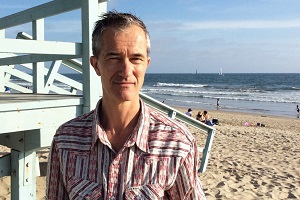
De Engelse schrijver Geoff Dyer werd op geboren 5 juni 1958 in Cheltenham. Zie ook alle tags voor Geoff Dyer op dit blog.

Uit: Jeff in Venice, Death in Varanasi

“On top of that he was supposed to make sure – at the very least – that she agreed to grant Kulchur exclusive rights to reproduce a drawing Morison had made of her, a drawing never previously published, and not even seen by anyone at Kulchur, but which, due to the fear that a rival publication might get hold of it, had acquired the status of a rare and valuable artefact. The value of any individual part of this arrangement was irrelevant. What mattered was that in marketing and publicity terms (or, from an editorial point of view, circulation and advertising) the planets were all in alignment. He had to interview her, had to come away with the picture and the right to reproduce it. Christ Almighty … A woman pushing an all-terrain pram glanced quickly at him and looked away even more quickly. He must have been doing that thing, not talking aloud to himself but forming words with his mouth, unconsciously lip-synching the torrent of grievances that tumbled constantly through his head. He held his mouth firmly shut. He had to stop doing that. Of all the things he had to stop doing or start doing, that was right at the top of the list. But how do you stop doing something when you are completely unaware that you’re doing it? Charlotte was the one who pointed it out to him, when they were still together, but he’d probably been doing it for years before that. Towards the end that’s how she would refer to this habit of muted karaoke. ‘That thing,’ she would say. ‘You’re doing that thing again.’ At first it had been a joke between them. Then, like everything else in a marriage, it stopped being a joke and became a bone of contention, an issue, a source of resentment, one of the many things that rendered life on Planet Jeff – as she termed the uninhabitable wasteland of their marriage – intolerable. What she never understood, he claimed, was that life on Planet Jeff was intolerable for him too, more so, in fact, than for anyone else. That, she claimed, was precisely her point.”


Geoff Dyer (Cheltenham, 5 juni 1958)


Zie voor nog meer schrijvers van de 5e juni ook mijn blog van 5 juni 2017 deel 1 en eveneens deel 2.
 

Ralf Thenior, Marie Ndiaye, Erasmus Schöfer, Buddy Wakefield, Yaak Karsunke, Charles Dickinson, Dana Bönisch, Elizabeth Jolley, Apollon Maykov

De Duitse dichter en schrijver Ralf Thenior werd geboren op 4 juni 1945 in Bad Kudowa. Zie ook alle tags voor Ralf Thenior op dit blog.

Uit: Das Gelächter der Sterne

“Wenn der Abend fällt, leeren sich die Strände; die Badegäste begeben sich in ihre Wohnungen, Zimmer und Appartements und bereiten sich auf das Nachtleben vor. Hochgewachsene Frauen mit tragischen Mienen schreiten in den Fußgängerzonen auf und ab, während aus den Lautsprechern leise Jacques Brels Ne me quitte pas erklingt, und durch die Fensterscheiben der Restaurants sieht man – wie in einem Aquarium – Menschen, die ihre Münder öffnen und schließen und mit kleinen silbernen Zangen Hummerscheren knacken.
Es war zweiundzwanzig Uhr siebenunddreißig. Claire und Albert tauchten in das Neongeflacker der Lange Straat ein.
– Wo ist meine Sonnenbrille?
Claire nahm ihre Brille ab und verstaute sie in ihrer Handtasche.
– Was siehst du ohne Brille?
– Die Leuchtreklamen an den Fassaden nur als undeutliche Lichtreflexe und die Gesichter der Passanten sind bis auf zwei Meter milchige Schemen, aber deine Nasenspitze sehe ich gestochen scharf.
Claire stupste mit der Faust seine Nase. Albert lachte.
Ohne sich anzufassen, aber auf Tuchfühlung, gingen sie schweigend weiter und überließen sich dem Rhythmus ihrer Schritte.
Sie konnten es beide kaum fassen; es war Donnerstagabend, schon Donnerstagabend, erst Donnerstagabend, und sie gingen zusammen durch die Lange Straat, mit vollen Augen und leerem Magen.
Claire ließ sich durch ein Neonschriftenspalier treiben, das für sie Ornamentbänder aus sich verwischenden, sich vermischenden farbigen Bogen und Linien bildete, die im Pulsschlag der Straße zuckten.
Albert konnte sich nicht losreißen von den Worten, die ihm von allen Seiten entgegenkamen; Wortkörper aus Glas, Plastik, Eisen, Messing, Blech, Holz und Farbe, Worte mit Pappnasen, die ihm zuzwinkerten, Worte mit ausgestopften Bäuchen, falschen Schnurrbärten, Buckeln, Rucksäcken, Perücken ausgeschlagenen Zähnen und blauen Augen
LUUNNAAPPAARRKK …
– Und dann diese riesige schwarze Wolke, die aussah wie ein Seeungeheuer.
– Wann war das? In Irland?
– In meinem Traum. Ariane hat ein Medium gekannt, das mit dem Geist von Jules Verne Kontakt aufgenommen hat.“


Ralf Thenior (Bad Kudowa, 4 juni 1945)


De Franse schrijfster Marie Ndiaye werd geboren op 4 juni 1967 in Pithiviers. Zie ook alle tags voor Marie Ndiaye op dit blog.

Uit: Ladivine (Vertaald door Jordan Stump)

« She was Malinka again the moment she got on the train, and she found it neither a pleasure nor a burden, having long since stopped noticing.
But it happened, she could tell, for no more could she answer without a second thought to “Clarisse” when, rarely, someone she knew took that same train and called to or greeted her as “Clarisse,” only to see her stare back in puzzled surprise, a hesitant smile on her lips, creating a mutual discomfort that the slightly flustered Clarisse never thought to dispel by simply echoing that “Hello,” that “How are you,” as offhandedly as she could.
It was this, her inability to answer to Clarisse, that told her she was Malinka the moment she got on the train to Bordeaux.
Had that been the name she was hailed by, she knew, she would immediately turn her head—­had someone spotted her face or recognized from afar her slender form, her always slightly unsteady walk, and called out: “Hey there, Malinka, hello.”Which couldn’t possibly happen—­but was she sure?
There was a time, now long gone, when, in another city, another part of France, girls and boys called her Malinka because they knew her by no other name, and she had yet to invent one.
It was not out of the question that a woman her age might one day accost her and ask in delighted surprise if she wasn’t that Malinka from her past, from that school and that city whose name and look she, Clarisse, had forgotten.
And a smile would come to Clarisse’s lips, not hesitant but bold and assured, and she would be neither puzzled nor surprised, though she would most certainly not recognize that woman who claimed to have known her when she was Malinka.”


Marie Ndiaye (Pithiviers, 4 juni 1967)


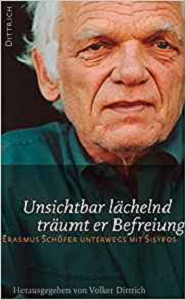
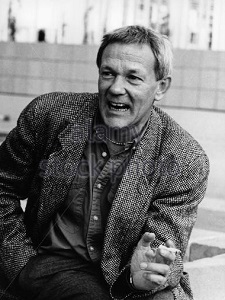
De Duitse schrijver Erasmus Schöfer werd geboren op 4 juni 1931 in Altlandsberg bij Berlijn. Zie ook alle tags voor Erasmus Schöfer op dit blog.

Uit: Unsichtbar lächelnd träumt er Befreiung

„Aber er hats gewusst, natürlich hat ers gewusst dass sie uns Reisholzer kaputt machen wolln, egal ob wir den besten Stahl in Deutschland schmieden, nur um aus Montan rauszukommen, kein Sterbenswort davon hat er uns wissen lassen, damit wir schön brav produzieren bis zur letzten Tonne und keinen Stunk machen und er, ihr werdets erleben, in der nächsten Regierung Arbeitsminister wird, egalb ob bei Schmidt oder Strauss, oder vielleicht wie der Leber Verteidigungsminister und die ganze IG Metall wird jubeln Einer von uns im Kabinett! Kein Wort mehr von Gegenmacht! Das ist die Konzertierte Aktion über die Hintertreppe meine Herrn, deshalb scheiß ich auf ihre Mitbestimmung, egal ob Montan oder nicht, mit der sie uns eingeseift haben, und ein ganzer stolzer betriebsrat, 14 Mann und eine Frau, nickts ab wenn ihm der Vorsitzende weggeschossen wird! Hab ich mir denn meine Bude renovieren lassen auf betriebskosten wie der Feckler von F&G? Hab ich unsre Ellie vernascht? Hab ich Lustreisen nach Brasilien gemacht mit Mannesmannknete wie der Loderer? Hab ich das? Wie?“
Anklam packte Willi mit beiden Fäusten an der Jacke, rüttelte ihn: Hab ich das? Oder was gibts noch im Angebot der Einkäufer? He Manni mach kein Scheiß jetzt. Frank und Jupp und ich haben gegen deine Entlassung gestimmt. Hans Wiedemann hielt ihm sein Glas unter die Nase dass er Willi loslassen musste: Weil du das Gegenteil von all dem gemacht hast, Herrgott weil du ihnen ihre Schweinerein versalzen hast, deshalb haben sie dich gefeuert! Das weißt dugenau. Und es gibt einen Haufen Kollegen bei uns die wissen das auch. Aber jetzt redst dun Haufen Schnapszeug und außerdem mussich —So! Schnapszeug nennst du das! Wenn ich mal die Wahrheit sag! Bist auch schon eingekauft wie? Mensch Manni siehst du noch klar? Das ist der Hans! Ja der Hans! Hans bist du mein Freund? Besorgst du mir eine Knarre? Weißt du wo der Overbeck der Obergauner wohnt? Wiedemann blickte zum Wirt: Heinz ruf uns ein Taxi! Taxi? Wozu das denn? Mein Fahrrad steht draußen! Klar Manni. Aber bis zu Overbeck isses zu weit. Komm, wir fahrn zusammen! Wiedemann zahlte ihren Deckel. Sie nahmen Anklam rechts und links unter die Arme, zogen ihn auf die Straße. Das Taxi war gleich da. Der braunhäutige Fahrer schaute misstrauisch auf den Betrunknen: Kotzt der mir in Wagen? Fahr langsam Mustafa, dann kotzt er nicht. Sind nur fünfhundert Meter. Ihr zahlen mir Reinigung! Sie verstauten Anklam auf dem Rücksitz, setzten sich neben ihn. Zerrten den Fluchenden raus vor seinem Haus und in den Fahrstuhl, holten ihm den Schlüssel aus der Tasche, schubsten ihn aufs Bett. Hast du ne Aspirin im Haus? fragte Willi als er ihm die Schuh auszog.“


Erasmus Schöfer (Altlandsberg, 4 juni 1931)
Cover


De Amerikaanse (slam) dichter Buddy Wakefield werd geboren op 4 juni 1974 in Shreveport, Louisiana. Zie ook alle tags voor Buddy Wakefield op dit blog.


A Hole In God

you appeared like a body bag
fulla hymnal books
unzipped in half I

never saw so many door jams fall
outta anyone’s mouth
into math like that when

Tennessee put its crooked smile
on a wadded up map
and sent you packin’

west

wood

gospel gospel got god
stuck to the rock he made and
and he mighta made it larger than us
or it mighta served to save this place
sure I coulda swore I heard you calling
for a shot at a grip on vice
doesn’t mean your mouth was moving
doesn’t mean I even heard you right

all I know is that your skin keeps calling
and I don’t care if it’s a busted flint
‘cause every time you pull your thumb down on it
I get [up up] back up to my feet

again

all of them

move move
like an offering plate
on’m one by one
it’s a penchant for a savior
a tendency to over – run
whatever shook do not get shook up

whatever’s lost you don’t get lost
even if they say you must give more than
everything you ever offered up

I know a voice does not come easy
I know the words fell out in bites
I know the moment when the
abandonment looked a lot like flight
you pulled whatever got left

inside

out right


Buddy Wakefield (Shreveport, 4 juni 1974)
Affiche


De Duitse dichter en schrijver Yaak Karsunke werd geboren op 4 juni 1934 in Berlijn. Zie ook alle tags voor Yaak Karsunke op dit blog.


Der Schakal

Der Schakal, der Schakal
ist viel kleiner als ein Wal
doch er sieht viel größer aus
als beispielsweise eine Maus.

Dem Schakal, dem Schakal
ist das allerdings egal
denn er liebt die Mittelgröße
& dazu Kartoffelklöße.


Das Zebra

Eins wird das Zebra nie begreifen:
Wie kommt man übern Zebrastreifen?
Es bleibt am Straßenrande stehn
& ist dort stundenlang zu sehn –
bis sein Anblick jemand rührt
ders dann übern Fahrdamm führt.


Yaak Karsunke (Berlijn, 4 juni 1934)


De Amerikaanse schrijver Charles Dickinson werd geboren op 4 juni 1951 in Detroit, Michigan. Zie ook alle tags voor Charles Dickinson op dit blog.

Uit: Shortcut in Time

“The police interviewed me just once, in our house at 1112 East Collier Street.
“The latch was held shut with a ballpoint pen,” I insisted.
The cop held up the pen he was using to take notes. “Like this?”
“It was blue.”
“You’re sure?”
“Yes.”
“Where is it then?”
“I had it and dropped it. Did you check the bottom of the pool?”
“We followed the drain all the way out to the street.”
“It had gold writing on it.”
“What did the writing say?”
“I don’t know.”
The incident was ruled an accident, the tragic consequence of two young men just goofing around. Nobody listened when I said that Kurt never goofed around.
* * *
Flo Garner stopped me in the hall on the first day of school.
“How’s your brother?” she asked.
I shrugged. “Not great. My dad’s already started complaining about the hospital bills.”
“Can I ask you something?”
“Sure.”
“Did you bring Kurt up first because he was your brother?”
“No. He was on top.”
She touched my arm. I thought she was going to thank me for at least trying.
“I wish I could believe that,” she said.”


Charles Dickinson (Detroit, 4 juni 1951)
Detroit, Michigan


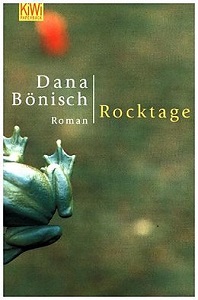
De Duitse schrijfster Dana Bönisch werd geboren op 4 juni 1982 in Frechen. Zie ook alle tags voor Dana Bönisch op dit blog.

Uit: Rocktage

„Er hoffte, sich sein Leben nicht einzubilden. In der U-Bahn hatte er aus Testgründen mal laut gesungen, aber niemand hatte wirklich hingesehen oder ihn angelacht oder Ähnliches. Sie saßen alle da wie vorher. All dies gab zu denken. Möglicherweise träumte er nur. Er konnte die Leute verstehen, die sich die Arme aufritzten, um zu spüren, dass sie da waren. Aber er selbst hatte viel zu viel Angst vor seinem eigenen Blut. Am Tag seines Rauswurfs fuhr Puck genauso still und tot U-Bahn wie die anderen auch. Es war eben einfacher. Allerdings saß an diesem Tag auch Johann Wolfgang neben ihm, der vor sich hin flüsterte: »Was zieht mir das Herz so? Was zieht mich hinaus?« Und Puck fühlte tatsächlich Ähnliches. Eine undefinierte Sehnsucht, vielleicht nach etwas, was er mal gekannt und dann verloren, oder nach etwas, was er nie gekannt und immer gesucht hatte. Schließlich stieg er an der Universitätsstraße aus und kaufte sich eine Brezel, und mit der Brezel im Mund rief er Mo an und bestellte sich Gras. Mo erwartete ihn dann schon am Weiher, saß auf den Steinen am Ufer und fütterte Enten. In einer H&M-Tüte hatte er altes Brot mitgebracht. Und blitzbildartig erinnerte sich Puck an anderes altes Brot, in einer Zeit, die ihm vorkam wie ein anderes Leben, Brot in einer Kaufring-Tüte, und an Regen, der sich in den Sommertag mischt. »Alter«, sagte Mo. »Alter«, sagte Puck. Er setzte sich neben ihn auf den kalten Stein. Später gingen sie im Biergarten noch was trinken, denn Mo hoffte, die Rothaarige aus der Meteorologie-Vorlesung wiederzusehen, die angeblich fast jeden Tag um diese Zeit hierherkam. Nach zwei Bier und einer Stunde wurde es jedoch langsam kalt für T-Shirt-Leute, und Mos Handy quäkte wegen wichtiger Geschäfte, und beide, Mo und Puck, gingen wieder ihrer Wege. »Alter«, sagte Puck. »Alter«, sagte Mo. Und verschwand Richtung U-Bahn, während Puck den Uni-Trampelpfad einschlug. Er mochte die Luft an Früh-Frühlingstagen, abends wenn schon ein paar Lichter brannten, hier eins, da eins, und wenn es plötzlich dämmrig geworden war, ohne dass man es bemerkt hatte, weil man sich unterhalten oder nachgedacht oder vom Gesicht eines Mädchens im folgenden Sommer geträumt hatte.“


Dana Bönisch (Frechen, 4 juni 1982)
Cover


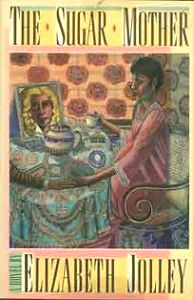
De Australische schrijfster Elizabeth Jolley werd geboren op 4 juni 1923 in Birmingham, Engeland. Zie ook alle tags voor Elizabeth Jolley op dit blog.

Uit: The Sugar Mother

“The Old Country!” Buffy said. They were still standing but would have risen if they had been sitting down.
“To Home. Here’s to Home. Down the hatch. The Old Country!”
“The Queen!” Buffy was inspired. “God bless the Queen.”
“I’ll drink to that,” Tuppy said. “God bless the Queen.” Edwin, in silence, drank his share. With toasts it was impossible not to. In a minute, he thought, he would slip out and fetch Leila from the very awkward position she was in. A stranger in the yard, yet familiar. He looked at his guests. They were very good-looking and very good-hearted people. They would never knowingly hurt anyone, but Leila would be frightened of them. They were toasting their old regiments now. It seemed inconceivable that he belonged with these people. He never spoke or thought of England as the Old Country. He never thought of it as Home as they apparently, after many years, did. He believed this was described as a migration syndrome; he had heard the phrase. What was home anyway other than a place you lived in and came back to every night?
“Leila dear,” Leila’s mother said, “we shall be running out of knickers. Remind me, dear, to do some washing tonight when we come home. Now, have we got everything? Got the tickets? Yes? Slam the door then, dear. We’ll wait by the gate for our taxi. He should be here any minute now.”
The two women negotiated, in single file, the red-slabbed path between wet lavender and rosemary bushes. In the misty, sweet-smelling dusk they stood close together, easing their feet, lifting one and then the other, their best shoes pinching rather. Leila’s mother, feeling the weight and the expense of her coat, said in a low voice, nudging her daughter with her thick shoulder, “You know, dear, I am certain that the people next door have separate bedrooms.”
“There’s only one light on now,” Leila said, turning with a ponderous movement to peer through thick leaves.
“It isn’t bedtime yet,” Leila’s mother said, “and I have the feeling that she has gone away. I’m pretty certain. I saw him wave to her from the edge of the veranda. Last evening, dear, last night she left.”
“She goes every day and he always waves,” Leila said. “She goes to work. I think she goes in the night too sometimes.”


Elizabeth Jolley (4 juni 1923 – 13 februari 2007)
Cover


De Russische dichter Apollon Nikolayevich Maykov werd geboren op 4 juni 1821 in Moskou. Zie ook alle tags voor Apollon Maykov op dit blog.


The Aeolian Harp

The land lies parched in sun,- to heaven the air is still,
Hushed now upon the harp the golden strings’ lost thrill;
Aeolian harps our native singers are,- and numb
Must be their heart, their dying life blood cease to flow,
Forever silent be their voice, if longer dumb
Their breath be suffocated in this sultry glow!
O if a Genius on tempest-pinions winging,
Stormed through our native land,- Spirit with freedom rife!
How jubilant would our Aeolian harps be ringing
To greet the Godly power that promises new life!


Mother And Child

‘Mother, why weepest thou ever
For my little sister fair?
She is now in heaven’s kingdom-
Ah, it must be wondrous there!’

‘Yes, she is in heaven’s glory,
But in heaven’s own land, alas!
There are no butterflies nor flowers-
Nor meadows of velvet grass!’

‘But mother, God’s blessed angels
There, rejoicing sing to Him!’
Forth from the sunset’s rosy fires
Now cometh the midnight dim.

Ah, the mother wants her baby-
That she watched from the window wide,
When ‘mid butterflies and blossoms
She played in the meadow’s pride!


Apollon Maykov (4 juni 1821 – 20 maart 1897)
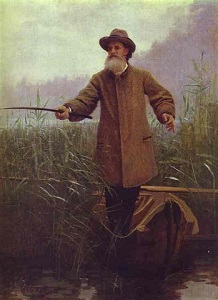
Portret van een vissende Maykov door Ivan Kramskoy, 1883


Zie voor nog meer schrijvers van de 4e juni ook mijn blog van 4 juni 2017 deel 2.
Frieda Jung

De Duitse dichteres en schrijfster Frieda Jung werd geboren op 4 juni 1865 in Kiaulkehmen bij Nemmersdorf, district Gumbinnen, als vijfde en jongste kind van de leraar Augustus Jung en zijn vrouw Wilhelmine Voulliéme. Daar ging ze naar de basisschool dioe acht klassen telde. Haar vader stierf in 1882. De moeder verhuisde toen met de kinderen naar Gumbinnen. Kort daarna stierf de vrouw van Frieda’s oudste broer, die in Königsberg woonde; Frieda Jung is daar een paar jaar gaan wonen om het huishouden te runnen en voor de twee kinderen te zorgen. Op negentienjarige leeftijd trouwde ze met de Gumbinner onderwijzer Brauer. Het huwelijk hield een jaar stand. Het kind, geboren uit het huwelijk (een dochtertje, die ze herdacht met een aantal liefdevolle gedichten) stierf in 1885 kort na haar geboorte. Door ziekte en mentaal lijden ook fysiek zwak, was het voor haar moeilijk om een ​​baan te vinden. Na een kleuterleidsters-opleiding vond zij uiteindelijk werk in een kleuterschool in Elk en in de daaropvolgende jaren kreeg ze aanstellingen als pedagoge en vanaf 1896 als gezelschapsdame in verschillende huizen. In 1896 stierf ook haar moeder. Jungs eerste gedichten verschenen in 1900. Jung besloot om te gaan werken als freelance schrijfster. In 1902 verhuisde ze naar Buddern, waar haar zus Martha woonde. In de volgende tien jaar, werd zij door lezingen en poëziebundels in Oost-Pruisen bekend en verdiende zij genoeg om eigen huis in Buddern te kunnen kopen. In 1916 verkocht ze haar huis in Buddern en verhuisde naar ze naar Insterburg. In de jaren twintig was Jung financieel slechter af door ziekten. De Goethe-Bund zamelde geld voor haar in. In 1925 kreeg ze het ereburgerschap van de stad Insterburg. Jung overleed op 14 december 1929 in het Insterburger ziekenhuis na een succesvolle operatie aan de stembanden en na een zware griep aan hartfalen.

Ihr Gärtchen

Und ist ihr Gärtchen noch so klein,
Platz hat darin der Sonnenschein
Und Platz der Maienregen,
Ein Rosenstock, ein Lilienreis
Und Tausendschönchen, rot und weiß
Und Veilchen allerwegen.

Und ist ihr Gärtchen noch so klein,
Es zwitschern doch die Vögelein
Drin ihre Frühlingslieder;
Auch hat es reichlich Platz genug
Für Bienen- und für Falterflug
Rings um den blauen Flieder.

Und ist ihr Gärtchen noch so klein,
Der Hans, der findet doch hinein
Zu seiner treuen Liese;
Und wenn sie ihm entgegenfliegt,
Meint er, das kleine Gärtchen liegt
Direkt am Paradiese.


Vor Tau und Tage

In fahles Grau gehüllt ist die Natur;
Es rüstet langsam sich die Nacht zum Scheiden,
Der Wind hält leise Zwiesprach’ mit den Weiden,
Und wie ein Schauern geht es durch die Flur;
Erwartungsvoll in selig banger Frage
Blickt sie zum Himmel auf vor Tau und Tage.

Ob heute wohl die Sonne kommen wird,
In flüss’ges Gold die weite Erde hüllend,
Mit Liebeswonne jeden Vogel füllend
Und jedes Mücklein, das im Luftmeer schwirrt,
Und jeden Rosenstrauch im wilden Hage?
Wer kann es wissen denn – vor Tau und Tage?

Vielleicht, daß hinter düstrer Wolkenschicht
Sie heute bleibt den ganzen Tag verborgen.
Vielleicht, daß auf den sehnsuchtsvollen Morgen
Nichts weiter folgt, als trübes, düstr’res Licht,
Hindämmernd nur wie eine graue Sage!
Wer kann es wissen denn – vor Tau und Tage?

Wer kann es wissen? Bleichen Angesichts
Sprech’ ich es zitternd nach in tiefem Sehnen.
Werd’ jauchzend ich im Arm der Liebe lehnen?
Bringt dieser Lenz an Glück mir wieder nichts?
Zum Himmel blick’ auch ich in banger Frage,
Ein harrend Menschenkind – vor Tau und Tage.

 
Frieda Jung (4 juni 1865 – 14 december 1929)

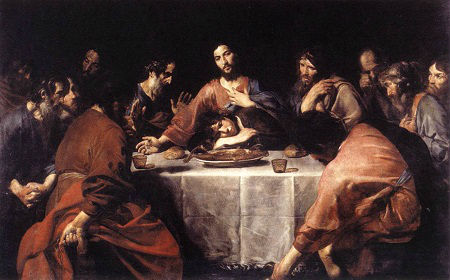
Het laatste avondmaal (Nicolaas Beets)


Bij de tweede zondag na Pinksteren (Feest van het H. Sacrament)


Laatste Avondmaal door Valentin de Boulogne, ca. 1625


Het laatste avondmaal
Mark. XIV v. 22-24.

Toen hij zijn bijzijn was ontvloden,
Wien Jezus, in den laatsten nacht,
De bittre bete had geboden.
Die al zijn bloed aan ’t gisten bracht;
Toen Judas, om, naar ’t woord des Heeren,
Met haast te doen hetgeen hij deed,
Zijn heilig aangezicht vermeed,
Om met dien kus terug te keeren!

Toen de ijslijke ure was gekomen,
Waarin de kampstrijd aan zou gaan,
Werd op zijn wezen niets vernomen.
Dat angst of droef heid kon verraân;
Hij zag in wat Hij zou beginnen,
In ieder foltring Hem bereid,
Al zijn aanstaande heerlijkheid,
En in zijn strijden ’t overwinnen.

Nog eens tot de Elve dan gesproken,
Van liefde en eendracht, moed en trouw!
Toen heeft Hij plechtig ’t brood gebroken,
Daar elk van hen van eten zou.
Toen heeft Hij, aan dien heilgen dissche,
Den laatsten beker om doen gaan,
Zoo als ’t nog heden wordt gedaan,
Ter maaltijd der gedachtenisse.

O Beeldspraak van de felste smart:
Gebroken brood, vergoten wijn!
Moet gij voor mijn geloovig harte
Van ’s Heilands dood de teeknen zijn!
Gewis; zijn lichaam werd verbroken,
Om mij te redden van ’t verderf,
Zijn hand doorgriefd, zijn zij’ doorstoken,
Opdat ik Gods gena verwerf.

Als ik ’t gebroken brood dan ete,
En proeve den vergoten wijn,
Mijn Heiland! dat ik nooit vergete
Hoe veel en groot mijn zonden zijn!
Opdat ik voor mijzelf mij schame,
Maar, overtuigd van Gods gena,
Van uw gewijde tafel ga,
Op nieuw versterkt in uwen name.


Nicolaas Beets (13 september 1814 – 13 maart 1903)
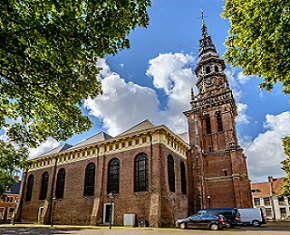
De Nieuwe Kerk in Haarlem, de geboortestad van Nicolaas Beets


Zie voor de schrijvers van de 3e juni ook mijn vorige twee blogs van vandaag.