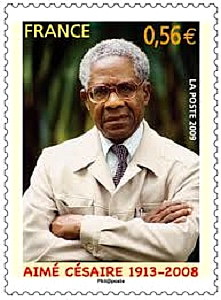
Aimé Césaire, Jacqueline van der Waals, Yves Beauchemin, Elisabeth Büchle, Laurie Lee, Pearl S. Buck, Stefan Andres, Martin Andersen-Nexø, Branwell Brontë

De Afrocaraïbische schrijver en politicus Aimé Césaire werd geboren op 26 juni 1913 in Basse-Pointe, Martinique. Zie ook alle tags voor Aimé Césaire op dit blog.


It is Myself, Terror, It is Myself

Stranded dried up dreams flush with the muzzles of rivers create
formidable piles of mute bones
the too swift hopes crawl scrupulously
like tamed snakes
one does not leave one never leaves
as for me I have halted, faithful, on the island
standing like Prester John slightly sideways to the sea
and sculptured at snout level by waves and bird droppings
things things it is to you that I give
my crazed violent face ripped open in the whirlpool’s depths
my face tender with fragile coves where lymphs are warming
it is myself terror it is myself
the brother of this volcano which certain without saying a word
ruminates an indefinable something that is sure
and passage as well for birds of the wind
which often stop to sleep for a season
it is thyself sweetness it is thyself
run through by the eternal sword
and the entire day advancing
branded with the red-hot iron of foundered things
and of recollected sun


. . . On the State of the Union

I imagine this message in Congress on the state of the Union:
situation tragic,

left underground only 75 years of iron
50 years of cobalt
but 55 years worth of sulfur and 20 of bauxite
in the heart what?
Nothing, zero,
mine without ore,
cavern in which nothing prowls,
of blood not a drop left.


Vertaald door Clayton Eshleman en Annette Smith


 Aimé Césaire (26 juni 1913 – 17 april 2008)

Lees verder “Aimé Césaire, Jacqueline van der Waals, Yves Beauchemin, Elisabeth Büchle, Laurie Lee, Pearl S. Buck, Stefan Andres, Martin Andersen-Nexø, Branwell Brontë”

Annie Salomons

De Nederlandse schrijfster, dichteres en vertaalster Annie Salomons (eigenlijk Anna Maria Francisca van Wageningen-Salomons) werd geboren in Rotterdam op 26 juni 1885. Annie Salomons haalde haar HBS-diploma in 1901. Als extraneus aan het Erasmiaans Gymnasium behaalde zij in 1905 het diploma gymnasium-alfa, waarna zij Nederlandse letteren studeerde, eerst in Leiden (1905-1907), later in Utrecht. Zij beëindigde in 1910 de studie voortijdig. Daarna woonde zij bij haar ouders tot aan haar huwelijk op 27 november 1924 met de jurist Henri (Han) van Wageningen. Van 1924 tot 1927 verbleven zij in Medan op Sumatra, in Nederlands-Indië. Han van Wageningen kon een goede carrière maken bij de Rechterlijke Macht, maar Annie Salomons verdroeg de hitte slecht. Na drie jaar keerden zij terug naar Nederland om zich in Den Haag te vestigen, waar Van Wageningen tot rechter was benoemd. Salomons werkte al vroeg mee aan tal van tijdschriften. Onder invloed van de Tachtigers en aangemoedigd door Johan de Meester sr. was zij aanvankelijk dichteres. Later maakte zij echter vooral naam door haar romans. Salomons heeft de vele groten van de generatie na Tachtig persoonlijk gekend: Lodewijk van Deyssel, Frederik van Eeden, Louis Couperus, J.H. Leopold, P.C. Boutens, Nico van Suchtelen, Carel Gerretson (Geerten Gossaert), Slauerhoff, J.C. Bloem en Adriaan Roland Holst. Van de schrijfsters kende zij vooral Top Naeff, Ina Boudier-Bakker, Carry van Bruggen en Margo Scharten-Antink. Verder de Vlamingen August Van Cauwelaert, Felix Timmermans, Karel van de Woestijne en Herman Teirlinck. Al deze ontmoetingen maakten indruk op Salomons en velen werden door haar bewonderd. In “Herinneringen uit de oude tijd aan schrijvers, die ik persoonlijk heb gekend” vertelt zij over deze kleurrijke mensen die haar leven en werken hebben beïnvloed en gevormd.


Zigeunerweisen van Sarasate

De klanken klagen door den zwaren nacht
Hun zoelen zang van ongetroost verlangen….

Ik bid je, leg je hand niet aan mijn wangen,
Ook ik heb jarenlang vergeefs gewacht,
En bij de eentonig-uitgehuilde klacht
Voel ik mijn ziel door ouden waan bevangen.

De klanken stijgen tot een sterken stroom,
Die zich een bres breekt door het steil berusten.
Ik wéét niet meer, met welken verren droom
Ik vroeger steeds mijn heet verlangen suste….
De stroom is niet te stuiten; – liefde kóóm’,
En néém mijn mond, die hunkert naar haar lusten.


Wreede liefde

III
Wij, die elkaar in droomen minden,
Buiten den dwang van ruimte en tijd,
Hoe zullen wij bevreed’ging vinden
In deze arme werklijkheid?

Uw hoofd, in mijnen arm gedoken,
Lijkt als een vrucht zoo broos en klein;
Gij houdt uw oogen vroom geloken;
Kan daar mijn hééle wereld zijn?

Er ligt een trots van troostend weten
In uwer handen vasten druk.
Maanden van hunkring, fel verbeten,
Heeft rustloos mij de drang bezeten
Naar dit onmogelijk geluk.

Maar, bang en blij tot u gekomen,
Zooals een kind naar ’t eerste feest,
Lijkt liefde’s liefste mij ontnomen:
Gij maakt een eind aan al mijn droomen….
Ik ben nog nooit zóó arm geweest.
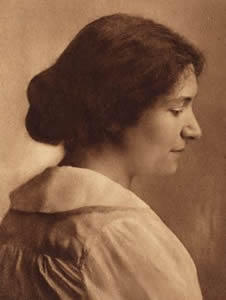


Annie Salomons (26 juni 1885 – 16 januari 1980)
George Orwell, Yann Martel, Rob van Essen, Michel Tremblay, Nicholas Mosley, Ingeborg Bachmann, Arseny Tarkovsky

De Britse schrijver George Orwell (pseudoniem van Eric Arthur Blair) werd op 25 juni 1903 geboren in Motihari, India. Zie ook alle tags voor George Orwell op dit blog.

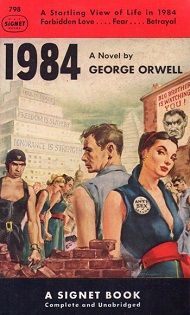
Uit: 1984

“On occasion he had even been entrusted with the rectification of The Times leading articles, which were written entirely in Newspeak. He unrolled the message that he had set aside earlier. It ran:
times 3.12.83 reporting bb dayorder doubleplusungood refs unpersons rewrite fullwise upsub antefiling
In Oldspeak (or standard English) this might be rendered:
The reporting of Big Brother’s Order for the Day in The Times of December 3rd 1983 is extremely unsatisfactory and makes references to non-existent persons. Rewrite it in full and submit your draft to higher authority before filing.
Winston read through the offending article. Big Brother’s Order for the Day, it seemed, had been chiefly devoted to praising the work of an organization known as FFCC, which supplied cigarettes and other comforts to the sailors in the Floating Fortresses. A certain Comrade Withers, a prominent member of the Inner Party, had been singled out for special mention and awarded a decoration, the Order of Conspicuous Merit, Second Class.
Three months later FFCC had suddenly been dissolved with no reasons given. One could assume that Withers and his associates were now in disgrace, but there had been no report of the matter in the Press or on the telescreen. That was to be expected, since it was unusual for political offenders to be put on trial or even publicly denounced. The great purges involving thousands of people, with public trials of traitors and thought-criminals who made abject confession of their crimes and were afterwards executed, were special show-pieces not occurring oftener than once in a couple of years. More commonly, people who had incurred the displeasure of the Party simply disappeared and were never heard of again. One never had the smallest clue as to what had happened to them. In some cases they might not even be dead. Perhaps thirty people personally known to Winston, not counting his parents, had disappeared at one time or another.”


George Orwell (25 juni 1903 – 21 januari 1950)
Cover

Lees verder “George Orwell, Yann Martel, Rob van Essen, Michel Tremblay, Nicholas Mosley, Ingeborg Bachmann, Arseny Tarkovsky”

Larry Kramer, Claude Seignolle, Ariel Gore, Heinrich Seidel, Hans Marchwitza, Georges Courteline, Friederike Kempner

De Amerikaanse schrijver, columnist en homoactivist  Larry Kramer werd geboren in Bridgeport, Connecticut op 25 juni 1935. Zie ook alle tags voor Larry Kramer op dit blog.

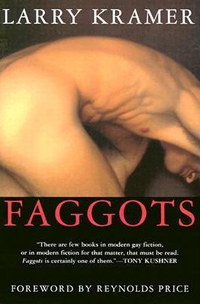
Uit: Faggots

“Winnie, or more correctly, Dunnie, as he was then called, didn’t know what a fairy was, such being the insularity of Main Line education even then. So calmly, that same night, with that quest for curiosity, that vigor for knowledge which deserted him at some point between Hill and U. Va., he asked one of his classmates, a cute Jewish scholarship student from Shreveport named Sammy Rosen, whom Dunnie had been spending a lot of time with because Sammy was well-versed and hence helpful in time of test and trial, and as luck would have it, Sammy knew, as Dunnie knew he would. Sammy also shivered as he dispensed the knowledge, so both of them realized, at precisely this moment in time, that they were about to learn even more comprehensively what a fairy was. “Want to come to my room and have some of my Mama’s brownies?” Sammy began haltingly. It was as simple as that. “What will you do when you finish college?” Sammy asked, trying to keep the conversation light, even though he’d been wet dreaming for several months about such an opportunity as was obviously now creeping up on both of them, as they sat on his bed munching away at Mrs. Rosen’s brown squares and waiting for whatever was going to happen to happen. “I think I’m very handsome,” Dunnie said quite matter-offactly, in response to the question. Was this not a Future Great Model in embryo even then? “Don’t you?” “… Yes …,” Sammy replied, wondering what one thing had to do with another. “I wish to do something that will allow the world to appreciate my handsomeness.” “Oh. Like be a movie star?” “Heavens, no. I don’t want to have to talk. I just want to be seen.” And to illustrate his point, he cast a long look at himself in Sammy’s bureau mirror, which was tilted just his way. “And, of course, to be talked about. And worshipped and adored.” “Oh.” “I guess that means I have to be a famous model, though even that’s less than perfect. I really don’t want to be associated with any product. But I guess that can’t be helped. But I’ll see to it that my picture is large and no one will pay any attention to whatever it is I’m selling.” This news hung in the air for moments as the two boys—like cute animals in Walt Disney cartoons, which, when confronted with anything intractable, simply engorge it whole—stuffed huge brownies into their mouths. Dunnie was pleased that his future was clear and Sammy was impressed with such direction. Then Dunnie prophesied again: “I’ll tell you something else. I don’t want to get married. Ever.” “How do you know that?” “I know it. My parents are married, so I just know it.” “I … I know it, too.”


Larry Kramer (Bridgeport, 25 juni 1935)
Cover

Lees verder “Larry Kramer, Claude Seignolle, Ariel Gore, Heinrich Seidel, Hans Marchwitza, Georges Courteline, Friederike Kempner”

Leendert Witvliet

De Nederlandse dichter en schrijver Leendert Witvliet werd geboren in Werkendam op 25 juni 1936. Witvliet begon op zijn zeventiende met het schrijven van cabaret-teksten en gedichten.¹ Hij bezocht de Rijkskweekschool en studeerde M.O-A en M.O-B Nederlands aan de Fryske Akademie te Groningen. Vanaf 1961, na zijn militaire dienstplicht, was hij tot zijn 56ste in het openbaar onderwijs werkzaam. Aan de HAVO en het VWO van het Heymanscollege te Groningen het langst, als conrector en leraar Nederlands. Witvliet werkte regelmatig mee aan de jeugdbijlage van Vrij Nederland, ‘De Blauw Geruite Kiel’, waar hij zowel verhalen als gedichten voor schreef. Voor het Nieuwsblad van het Noorden was hij enige jaren criticus voor de jeugdliteratuur. Ook publiceerde hij werk voor de middelbare school en schreef een boekje voor leraren Nederlands over poëzie in de klas. Witvliet was medewerker aan o.a. De Gids, NVT, Raster, Maatstaf, de Poëziekrant en Rottend Staal.


Klaproos

Even maar in bloei
langs de spoorlijn
de klaproos
met het kleine behaarde blad
de bloem
vuurrood en donker middenin.

Hoog boven het gras
wuift ze
naar wie langs haar komt.


December

Een middag met een laag zonnetje
met een vijver in december met alles
sneeuw, eenden, vastgevroren
en pas bij elkaar.
Je gezicht met een laag vermoeidheid.

Hoe alles om je heen
deed denken aan ziek,
je achtergebleven lieve zieke
in je en nog geen herinnering.

Hoe we zeggen hoe we zwijgen.


Leendert Witvliet (Werkendam, 25 juni 1936)

Wilfred Smit, Ernesto Sabato, Yves Bonnefoy, Scott Oden, John Ciardi, Matthijs Kleyn

De Nederlandse dichter Wilfred Smit werd geboren in Soerabaja (Java, Nederlands Indië) op 24 juni 1933. Zie ook alle tags voor Wilfred Smit op dit blog.


Brief

Het grotestadskind schrijvend
aan haar grootvader, zegt niet:

men noemt mij mager,
een klein kreng waar straks
madelieven in een kring
omheen zullen staan -, maar:

’t is erger met mijn pop
sinds u daarbuiten woont.

ach, nu is zij moegeschreven
aan grootvader – de enveloppe
omsluit haar liefderijk,
een pop onder een lila deken.


Rococo

Gracielijk en licht sterven,
een kleine zucht in de paniers
en ’t is niet meer.

dien avond heeft men ons
gekleed te bed gelegd,
als in een rose medaillon
voor iedereen te kijk –

en o bepoederde horreur,
het clavecimbel speelt door.


Wilfred Smit (24 juni 1933 -13 augustus 1972)
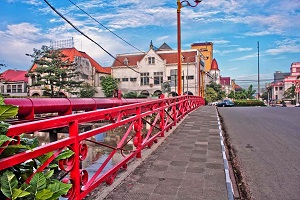
Soerabaja, Rode Brug

Lees verder “Wilfred Smit, Ernesto Sabato, Yves Bonnefoy, Scott Oden, John Ciardi, Matthijs Kleyn”

Madelon Székely-Lulofs, Johannes van het Kruis, Kurt Kusenberg, Ambrose Bierce, Jean-Baptiste Boyer d’Argens, Josse Kok

De Nederlandse schrijfster en journaliste Magdalena Hermina Székely-Lulofs werd geboren in Soerabaja op 24 juni 1899. Zie ook alle tags voor Madelon Székely-Lulofs op dit blog.

Uit: Rubber

“De chauffeur kroop weer achter het stuur. Het Fordje begon te reutelen en te puffen en langzaam reed de wagen de pont op.
Het water stond laag in de rivier; het had zes weken niet geregend. Er was haast geen stroom en de pont ging bijna onmerkbaar over. De veerman staarde in het water…. Wat kon het hém schelen of het lang duurde! Hij had immers toch niets te doen! En wat maakte het uit…. of je nu in een half uur over was of in tien minuten!
Uit verveling begon John een praatje met Pâ Karmo, die op de leuning van de pont zat.
‘Weinig water, Pâ Karmo.’
Pâ Karmo keek even over de rivier alsof hij haar vandaag nog niet gezien had. Dan knikte hij.
‘Weinig water, toewan.’
Een paar naakte inlandsche jongetjes baadden aan den oever.
‘Hoe staat het met de krokodillen…. zijn er véél?’
Pâ Karmo keek weer even over de rivier en knikte weer.
‘Veel krokodillen, toewan…. Als het zulk laag water is, zijn er altijd veel.’
‘En zijn die kinderen niet bang?’
Pâ Karmo hief zijn hoofd, keek even naar de badende jongens.
‘Nee, ze zijn niet bang,’ zei hij toen. En na een korte pauze liet hij er op volgen:
‘Ze zijn het al gewend om daar te baden.’
‘En gebeurt er nooit een ongeluk?’
‘Saja, toewan…. eergister is Si Pintjang van kampong Baroe meegetrokken door en krokodil.’
John ging wat rechter op zitten. Hij kende Si Pintjang…. een kleine, kreupel geboren maleische jongen, die wel eens water voor hem haalde om den motor bij te vullen.
‘En…. is hij dóód?’


Madelon Székely-Lulofs (24 juni 1899 – 22 mei 1958)
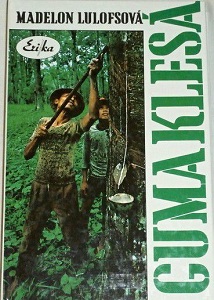
Cover Tsjechische vertaling

Lees verder “Madelon Székely-Lulofs, Johannes van het Kruis, Kurt Kusenberg, Ambrose Bierce, Jean-Baptiste Boyer d’Argens, Josse Kok”

David Leavitt, Jo Govaerts, Rafik Shami, Aart van der Leeuw, Pascal Mercier, Franca Treur, Jean Anouilh, Anna Achmatova, Hanneke van Eijken

De Amerikaanse schrijver David Leavitt werd geboren in Pittsburgh op 23 juni 1961. Zie ook alle tags voor David Leavitt op dit blog.

Uit:While England Sleeps

“To start with, at that time I’d gone to bed with probably three dozen boys, all of them either German or English; never with a woman. Nonetheless — and incredible thought it may seem — I still assumed that a day would come when I would fall in love with some lovely, intelligent girl, whom I would marry and who would bear me children. And what of my attraction to men? To tell the truth, I didn’t worry much about it. I pretended my homosexuality was a function of my youth, that when I “grew up” it would fall away, like baby teeth, to be replaced by something more mature and permanent. I, after all, was no pansy; the boy in Croydon who hanged himself after his father caught him in makeup and garters, he was a pansy, as was Oscar Wilde, my first-form Latin tutor, Channing’s friend Peter Lovesey’s brother. Pansies farted differently, and went to pubs where the barstools didn’t have seats, and had very little in common with my crowd, by which I meant Higel and Horst and our other homosexual friends, all of whom were aggressively, unreservedly masculine, reveled in all things male, and held no truck with sissies and fairies, the overrefined Rupert Halliwells of the world. To the untrained eye nothing distinguished us from “normal” men.
Though I must confess that by 1936 the majority of my friends had stopped deluding themselves into believing their homosexuality was merely a phase. They claimed, rather, to have sworn off women, by choice. For them, homosexuality was an act of rebellion, a way of flouting the rigid mores of Edwardian England, but they were also fundamentally misogynists who would have much preferred living in a world devoid of things feminine, where men bred parthenogenically. Women, according to these friends, were the “class enemy” in a sexual revolution. Infuriated by our indifference to them (and to the natural order), they schemed to trap and convert us*, thus foiling the challenge we presented to the invincible heterosexual bond.
Such thinking excited me – anything smacking of rebellion did – but it also frightened me. It seemed to me then that my friends’ misogyny blinded them to the fact that heterosexual men, not women, had been up until now, and would probably always be, their most relentless enemies. My friends didn’t like women, however, and therefore couldn’t acknowledge that women might be truer comrades to us than the John Northrops whose approval we so desperately craved. So I refused to make the same choice they did, although, crucially, I still believed it was a choice.”


David Leavitt (Pittsburgh, 23 juni 1961)
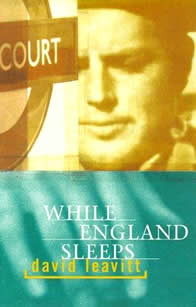
Cover

Lees verder “David Leavitt, Jo Govaerts, Rafik Shami, Aart van der Leeuw, Pascal Mercier, Franca Treur, Jean Anouilh, Anna Achmatova, Hanneke van Eijken”

Sommer (Ilse Kleberger), Nescio, Juliën Holtrigter, Jaap Robben


 Dolce far niente


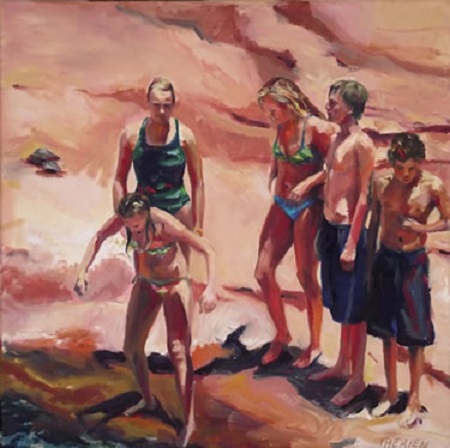
Phoenix Summer Heat door Joan Therien, 2010


Sommer

Weißt du, wie der Sommer riecht?
Nach Birnen und nach Nelken,
nach Äpfeln und Vergißmeinnicht,
die in der Sonne welken,
nach heißem Sand und kühler See
und nassen Badehosen,
nach Wasserball und Sonnenkrem,
nach Straßenstaub und Rosen.

Weißt du, wie der Sommer schmeckt?
Nach gelben Aprikosen
und Walderdbeeren, halb versteckt
zwischen Gras und Moosen,
nach Himbeereis, Vanilleeis
und Eis aus Schokolade,
nach Sauerklee vom Wiesenrand
und Brauselimonade.

Weißt du, wie der Sommer klingt?
Nach einer Flötenweise,
die durch die Mittagsstille dringt:
Ein Vogel zwitschert leise,
dumpf fällt ein Apfel in das Gras,
der Wind rauscht in den Bäumen.
Ein Kind lacht hell, dann schweigt es schnell
und möchte lieber träumen.


Ilse Kleberger (22 maart 1921 – 2 januari 2012)
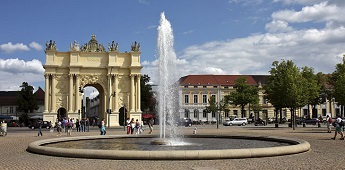
Potsdam, Brandenburger Tor en Luisenplatz. Ilse Kleberger werd in Potsdam geboren.

Lees verder “Sommer (Ilse Kleberger), Nescio, Juliën Holtrigter, Jaap Robben”

Summer Solstice (Stacie Cassarino), Ed Leeflang, Thomas Blondeau, Adam Zagajewski


Dolce far niente


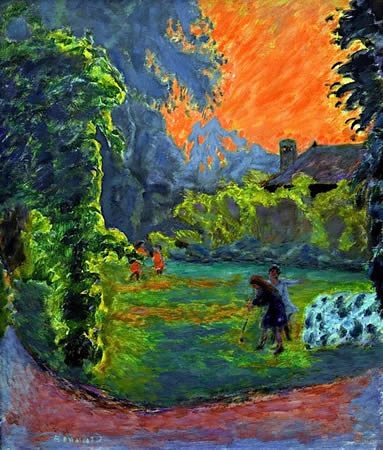
Soleil couchant door Pierre Bonnard, 1913


Summer Solstice

I wanted to see where beauty comes from
without you in the world, hauling my heart
across sixty acres of northeast meadow,
my pockets filling with flowers.
Then I remembered,
it’s you I miss in the brightness
and body of every living name:
rattlebox, yarrow, wild vetch.
You are the green wonder of June,
root and quasar, the thirst for salt.
When I finally understand that people fail
at love, what is left but cinquefoil, thistle,
the paper wings of the dragonfly
aeroplaning the soul with a sudden blue hilarity?
If I get the story right, desire is continuous,
equatorial. There is still so much
I want to know: what you believe
can never be removed from us,
what you dreamed on Walnut Street
in the unanswerable dark of your childhood,
learning pleasure on your own.
Tell me our story: are we impetuous,
are we kind to each other, do we surrender
to what the mind cannot think past?
Where is the evidence I will learn
to be good at loving?
The black dog orbits the horseshoe pond
for treefrogs in their plangent emergencies.
There are violet hills,
there is the covenant of duskbirds.
The moon comes over the mountain
like a big peach, and I want to tell you
what I couldn’t say the night we rushed
North, how I love the seriousness of your fingers
and the way you go into yourself,
calling my half-name like a secret.
I stand between taproot and treespire.
Here is the compass rose
to help me live through this.
Here are twelve ways of knowing
what blooms even in the blindness
of such longing. Yellow oxeye,
viper’s bugloss with its set of pink arms
pleading do not forget me.
We hunger for eloquence.
We measure the isopleths.
I am visiting my life with reckless plenitude.
The air is fragrant with tiny strawberries.
Fireflies turn on their electric wills:
an effulgence. Let me come back
whole, let me remember how to touch you
before it is too late.


Stacie Cassarino (Hartford, 15 februari 1975)
Hartford.

Lees verder “Summer Solstice (Stacie Cassarino), Ed Leeflang, Thomas Blondeau, Adam Zagajewski”