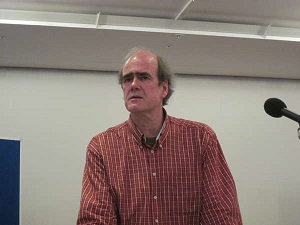
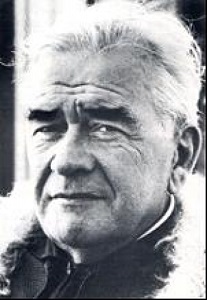
De Duitse dichter, schrijver, uitgever en vertaler Thomas Frahm werd geboren op 29 juni 1961 in Homberg.Hij woont sinds de vroege jaren 2000 in Bulgarije. Thomas Frahm studeerde geografie, stedenbouw en filosofie aan de universiteit van Bonn. Zijn eerste poëziebundels werden gepubliceerd in 1987 en 1991 bij de Verlag Irene Kuron, een uitgeverij van wetenschappelijke en culturele publicaties in Bonn. Frahm begon rond 1993 in Sankt Augustin bij Bonn een uitgeverij, de Avlos-Verlag. De kleine uitgeverij richt zich in het bijzonder op interculturele literatuur (migranten literatuur), literaire werken van schrijvers en dichters uit de Balkan, met name Bulgarije, evenals “regionale literatuur” uit de regio Niederrhein. Sinds 2000 werkt Frahm als freelance schrijver. Hij publiceert verhalen, essays en poëzie. Zie ook alle tags voor Thomas Frahm op dit blog.
Beim Warten
Mit welchem Durst du jagst zu deinen ungezählten Treffen, als wäre ich ein ausgetrocknet Brot, bei dessen Anblick du sofort nach Wasser fragst −
Mit welcher Gier du auswärts isst (als wäre ich der Inbegriff von Hungertod), derweil die Straßenköter schon wie Wölfe kläffen und meine Seele die Sekunden misst −
Zweiter Frühling
Der grüne Ausschlag, den man Frühling nennt. Das Leben, das in allen Knospen brennt. Die Ströme, die in müde Knochen fließen. Die Wünsche, die dir in die Zellen schießen.
Das alte Brot, das du nun nicht mehr isst. Das Wintergrau, das unwirsch du vergisst. Das Warten, das sich zur Erwartung wandelt. Das Kommende, das einfach an dir handelt.
“You looked distracted,” she said a little later. Feigning surprise, he put on a smile, as if to indicate that she was wrong: No, no, of course not. After all, he couldn’t very well admit to her that he had imagined the three of them in bed together, and that in his fantasy the third person looked like Sofia, the young Polish woman she’d introduced him to a few days before. This wasn’t the first time that he’d fantasized about other women while making love to Pauline. (He would close his eyes, as if afraid of being caught in the act of infidelity, and let the film play under his eyelids.) Besides, he probably wasn’t the only person ever to seek fresh stimulation in more or less fictional images. He vividly remembered the period when the world was excitement without release (those long years of adolescence when he looked at girls but couldn’t approach them), but now he dreaded the reverse, to be locked in a world of release without excitement (being in a couple). After two years of living together, he sometimes wondered if he and Pauline had reached the frontier of that peacefully settled world. No wonder his fantasy life was coming to the rescue of his daily lot. On the other hand, that he would include Pauline in the script was surprising. For better or for worse, she incarnated the antithesis of debauchery for him. He asked himself the question somberly that morning, while making coffee: would he like to go to bed with Pauline and another woman? The idea, which had excited him a moment earlier, now seemed unpleasant and crude. Here, a parallel with the Polish plumber must be drawn. For the previous month, an anti-European PR campaign in all the French media had been stigmatizing the Polish plumber, making him symbolically responsible for unemployment in France. How could you fight him? He worked hard and cost much less. It was scandalous! It was unfair competition! Remember, the European Union had been built around the Franco-German couple. These were two countries who felt powerful, and by and large they got along pretty well. But weren’t they taking a fatal risk, it was suggested, by blindly rushing into the endless process of enlarging the European Union? Let’s be even more concrete: if France and Germany welcome Poland into their bed, should they be surprised if Poland, which has a talent for plumbing, upsets their mutual balance?”
when I watch you
wrapped up like garbage
sitting, surrounded by the smell
of too old potato peels
or
when I watch you
in your old man’s shoes
with the little toe cut out
sitting, waiting for your mind
like next week’s grocery
I say
when I watch you
you wet brown bag of a woman
who used to be the best looking gal in Georgia
used to be called the Georgia Rose
I stand up
through your destruction
I stand up
Wishes For Sons
i wish them cramps. i wish them a strange town and the last tampon. I wish them no 7-11.
i wish them one week early and wearing a white skirt. i wish them one week late.
later i wish them hot flashes and clots like you wouldn’t believe. let the flashes come when they meet someone special. let the clots come when they want to.
let them think they have accepted arrogance in the universe, then bring them to gynecologists not unlike themselves.
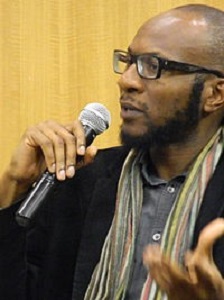
De Nigeriaans-Amerikaanse schrijver, fotograaf en kunsthistoricusTeju Colewerd geboren op 27 juni 1975 in Kalamazoo, Michigan. Cole en zijn moeder keerden kort na zijn geboorte terug naar Lagos, Nigeria, waar zijn vader zich na het behalen van zijn MBA aan de Western Michigan University bij hen voegde. Cole ging op 17-jarige leeftijd terug naar de VS om een jaar lang te studeren aan de Western Michigan University, waarna hij overstapte naar Kalamazoo College, waar hij in 1996 zijn bachelor behaalde. Een studie medicijnen aan de Universiteit van Michigan gaf hij op om zichin te schrijven voor een programma Afrikaanse kunstgeschiedenis aan de School of Oriental and African Studies en uiteindelijk behaalde hij een doctoraat in de kunstgeschiedenis aan de Columbia University. Cole schreef drie boeken: een novelle: “Every Day is for the Thief”, een roman, Open City en een verzameling van meer dan 40 essays: “Known and Strange Things”, gepubliceerd in 2016. Van juni tot november 2014 was hij ‘writer in residence’ van de Literaturhaus Zürich en de PWG Foundation in Zurich. “Open City” werd vertaald in tien talen en over het algemeen door de critici positief ontvangen. Cole levert regelmatig bijdragen aan The New York Times, Qarrtsiluni, Granta, The New Yorker, Transition, The New Inquiry, en A Public Space en hij is fotografie criticus van New York Times Magazine.
Uit:Open City
“And so when I began to go on evening walks last fall, I found Morningside Heights an easy place from which to set out into the city. The path that drops down from the Cathedral of St. John the Divine and crosses Morningside Park is only fifteen minutes from Central Park. In the other direction, going west, it is some ten minutes to Sakura Park, and walking northward from there brings you toward Harlem, along the Hudson, though traffic makes the river on the other side of the trees inaudible. These walks, a counterpoint to my busy days at the hospital, steadily lengthened, taking me farther and farther afield each time, so that I often found myself at quite a distance from home late at night, and was compelled to return home by subway. In this way, at the beginning of the final year of my psychiatry fellowship, New York City worked itself into my life at walking pace. Not long before this aimless wandering began, I had fallen into the habit of watching bird migrations from my apartment, and I wonder now if the two are connected. On the days when I was home early enough from the hospital, I used to look out the window like someone taking auspices, hoping to see the miracle of natural immigration. Each time I caught sight of geese swooping in formation across the sky, I wondered how our life below might look from their perspective, and imagined that, were they ever to indulge in such speculation, the high-rises might seem to them like firs massed in a grove. Often, as I searched the sky, all I saw was rain, or the faint contrail of an airplane bisecting the window, and I doubted in some part of myself whether these birds, with their dark wings and throats, their pale bodies and tireless little hearts, really did exist. So amazed was I by them that I couldn’t trust my memory when they weren’t there. Pigeons flew by from time to time, as did sparrows, wrens, orioles, tanagers, and swifts, though it was almost impossible to identify the birds from the tiny, solitary, and mostly colorless specks I saw fizzing across the sky. While I waited for the rare squadrons of geese, I would sometimes listen to the radio. I generally avoided American stations, which had too many commercials for my taste — Beethoven followed by ski jackets, Wagner after artisanal cheese — instead tuning to Internet stations from Canada, Germany, or the Netherlands. And though I often couldn’t understand the announcers, my comprehension of their languages being poor, the programming always met my evening mood with great exactness. Much of the music was familiar, as I had by this point been an avid listener to classical radio for more than fourteen years, but some of it was new. There were also rare moments of astonishment, like the first time I heard, on a station broadcasting from Hamburg, a bewitching piece for orchestra and alto solo by Shchedrin (or perhaps it was Ysaÿe) which, to this day, I have been unable to identify.
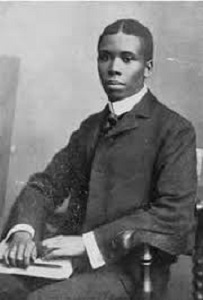
De Amerikaanse dichter en schrijver Paul Laurence Dunbarwerd geboren op 27 juni 1872 in Dayton, Ohio. Dunbar was de zoon van voormalige slaven uit Kentucky. Hij volgde de middelbare school in Dayton; daar was hij de enige Afro-Amerikaan in zijn klas. Een van zijn klasgenoten was Orville Wright, voor wiens familie Pauls moeder werkte. Al tijdens zijn schooltijd gaf hij voor het eerst blijk van zijn literaire talent. Hij was lid van de literaire kring en uitgever van de schoolkrant. Met de steun van de gebroeders Wright was hij in staat om zijn eerste krant “The Dayton Tattler” te publiceren. Na de middelbare school werkte hij, gedwongen door zijn financiële situatie, als liftboy. Op een bijeenkomst van de westerse Vereniging van Schrijvers in 1892 werd hij uitgenodigd door een vroegere leraar om gedichten voor te dragen en hij maakte daarmee zoveel indruk dat hij een aanbevelingsbrief van de beroemde dichter James Whitcomb Riley ontving. In hetzelfde jaar publiceerde hij zijn eerste dichtbundel “Oak and Ivy”. Nadat hij verhuisd was naar Chicago, ontmoette hij Frederick Douglass, die hem omschreef als “the most promising young colored man in America.” Dunbars gedichten verschenen in bekende kranten als The New York Times. Met zijn tweede dichtbundel “Majors and Minors” – Majors staat voor tekst in het standaard Engels en Minors voor teksten in dialect – was hij zo succesvol dat hij uitgenodigd werd voor een zes maanden durende lezingentour door Engeland. Na zijn terugkeer in Amerika kreeg hij een baan bij de Library of Congress in Washington. Daar ontmoette hij en trouwde hij met de schrijfster Alice Ruth Moore. In Washington ontstond een roman en twee dichtbundels. Ook schreef hij in deze tijd enkele libretti. Toen bij Dunbar in 1898 tuberculose geconstateerd werd keerde hij terug naar Dayton en wijdde zich uitsluitend aan het schrijven en aan lezingen. In 1902 scheidde hij van zijn vrouw. Dunbar was een van de eerste zwarte dichter die in de Verenigde Staten erkenning gekregen.
The Corn-Stalk Fiddle
When the corn’s all cut and the bright stalks shine Like the burnished spears of a field of gold; When the field-mice rich on the nubbins dine, And the frost comes white and the wind blows cold; Then its heigho fellows and hi-diddle-diddle, For the time is ripe for the corn-stalk fiddle.
And you take a stalk that is straight and long, With an expert eye to its worthy points, And you think of the bubbling strains of song That are bound between its pithy joints— Then you cut out strings, with a bridge in the middle, With a corn-stalk bow for a corn-stalk fiddle.
Then the strains that grow as you draw the bow O’er the yielding strings with a practiced hand! And the music’s flow never loud but low Is the concert note of a fairy band. Oh, your dainty songs are a misty riddle To the simple sweets of the corn-stalk fiddle.
When the eve comes on and our work is done And the sun drops down with a tender glance, With their hearts all prime for the harmless fun, Come the neighbor girls for the evening’s dance, And they wait for the well-known twist and twiddle, More time than tune—from the corn-stalk fiddle.
Then brother Jabez takes the bow, While Ned stands off with Susan Bland, Then Henry stops by Milly Snow And John takes Nellie Jones’s hand, While I pair off with Mandy Biddle, And scrape, scrape, scrape goes the corn-stalk fiddle.
“Salute your partners,” comes the call, “All join hands and circle round,” “Grand train back,” and “Balance all,” Footsteps lightly spurn the ground, “Take your lady and balance down the middle” To the merry strains of the corn-stalk fiddle.
So the night goes on and the dance is o’er, And the merry girls are homeward gone, But I see it all in my sleep once more, And I dream till the very break of dawn Of an impish dance on a red-hot griddle To the screech and scrape of a corn-stalk fiddle.
Paul Laurence Dunbar (27 juni 1872 – 9 februari 1906)
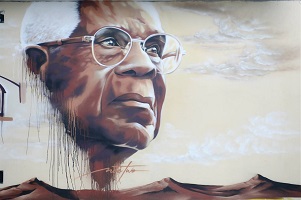
De Afrocaraïbische schrijver en politicus Aimé Césaire werd geboren op 26 juni 1913 in Basse-Pointe, Martinique. Zie ook alle tags voor Aimé Césaire op dit blog.
The Woman and the Flame
A bit of light that descends the springhead of a gaze twin shadow of the eyelash and the rainbow on a face and round about who goes there angelically ambling Woman the current weather the current weather matters little to me my life is always ahead of a hurricane you are the morning that swoops down on the lamp a night stone between its teeth you are the passage of seabirds as well you who are the wind through the salty ipomeas of consciousness insinuating yourself from another world Woman you are a dragon whose lovely color is dispersed and darkens so as to constitute the inevitable tenor of things I am used to brush fires I am used to ashen bush rats and the bronze ibis of the flame Woman binder of the foresail gorgeous ghost helmet of algae of eucalyptus dawn isn’t it and in the abandon of the ribbands very savory swimmer
Vertaald door Clayton Eshleman
Mississipi
Too bad for you men who don’t notice that my eyes remember slings and black flags which murder with each blink of my Mississipi lashes
Too bad for you men who do not see who do not see anything not even the gorgeous railway signals formed under my eyelids by the black and red discs of the coral snake that my munificence coils in my Mississipi tears
Too bad for you men who do not see that in the depth of the reticule where chance has deposited our Mississipi eyes
there waits a buffalo sunk to the very hilt of the swamp’s eyes Too bad for you men who do not see that you cannot stop me from building to his fill
egg-headed islands of flagrant sky under the calm ferocity of the immense geranium of our sun.
Vertaald door Clayton Eshleman en A. James Arnold
Aimé Césaire (26 juni 1913 – 17 april 2008) Muurschildering in Bagnolet, Frankrijk
“Die enge, düstere Gassenrinne fuhr der Wagen langsam dahin, wiewohl kein Mensch, weder Zivilist noch Soldat, ihm begegnete. Auf dem weiten, gleißenden Platz nahm er die Kehre, und im Schatten vor der Freitreppe der in ihrem starrenden Prunk unfreudig wirkenden Barockfassade des Karmeliterklosters stand er dann still. Unter der Pforte erschien auf das groblässige Signal des Wagens hin ein Offizier, von einem Sergeanten und einem Soldaten begleitet, welche die Ankömmlinge mit düster gleichmütigen Blicken empfingen. Die sechs Bajonette sprangen sofort auf das Pflaster, ein Kommando schnarrte, und die Lehmgestalten erhoben sich mühsam, traten ein paarmal hin und her und sprangen ebenfalls, nachdem sie die eingeschlafenen Füße zuvor möglichst tief hatten herabkommen lassen, vorsichtig auf das Pflaster. Es waren über zwanzig Gefangene, die im Karmeliterkloster untergebracht werden sollten. Seine Geräumigkeit und vergitterten Fenster machten den Bau für seine neue Bestimmung noch geeigneter; zudem lag das Kloster mit der Hinterfront an der Stadtmauer, und da ging es aus den Fenstern des ersten Stockes über fünfzehn Meter tief jäh hinunter. Das war ein weiterer Vorteil für die Wachhabenden, denn das etwa zweihundert Gefangene beherbergende Lager konnte so mit einer schwachen Besatzung auskommen, die in der Tat nur aus einem Leutnant, einem Sergeanten und zwei Soldaten bestand. Freilich lagen in der Stadt noch einige Fliegerabwehrbatterien und leichte Kraftfahrverbände, die auf den Einsatz warteten.“
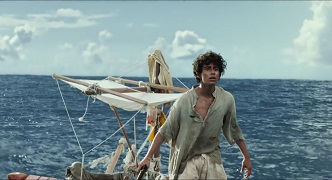
“My brother Ravi once told me that when Mamaji was born he didn’t want to give up on breathing water and so the doctor, to save his life, had to take him by the feet and swing him above his head round and round. “It did the trick!” said Ravi, wildly spinning his hand above his head. “He coughed out water and started breathing air, but it forced all his flesh and blood to his upper body. That’s why his chest is so thick and his legs are so skinny.” I believed him. (Ravi was a merciless teaser. The first time he called Mamaji “Mr. Push” to my face I left a banana peel in his bed.) Even in his sixties, when he was a little stooped and a lifetime of counter-obstetric gravity had begun to nudge his flesh downwards, Mamaji swam thirty lengths every morning at the pool of the Aurobindo Ashram.
Scene uit de film “Life of Pi” uit 2012
He tried to teach my parents to swim, but he never got them to go beyond wading up to their knees at the beach and making ludicrous round motions with their arms, which, if they were practising the breaststroke, made them look as if they were walking through a jungle, spreading the tall grass ahead of them, or, if it was the front crawl, as ifthey were running down a hill and flailing their arms so as not to fall. Ravi was just as unenthusiastic. Mamaji had to wait until I came into the picture to find a willing disciple. The day I came of swimming age, which, to Mother’s distress, Mamaji claimed was seven, he brought me down to the beach, spread his arms seaward and said, “This is my gift to you.” “And then he nearly drowned you,” claimed Mother.“
“J’appelai et tapai du poing sur une table bancale qui faillit s’effondrer sous mes coups. L’aubergiste devait être au cellier ou dans une des chambres de l’étage. Mais, malgré mon tapage, on ne se montra pas. J’étais seul, tressaillant d’attente, devant un âtre vide inutilisé depuis bien longtemps, à en juger par les toiles d’araignées qui bouchaient la cheminée. Quant à la longue chandelle, allumée depuis peu, et soudée à une étagère, sa présence, au lieu de me rassurer, me remplit plus d’inquiétude que si je n’avais trouvé en cet endroit que la nuit et l’abandon. Je cherchai un flacon d’eau-de-vie afin de me réconforter et chasser la crainte qui me retenait d’aller visiter les autres pièces de cette étrange auberge. Mais les bouteilles qui gisaient là, poussiéreuses, avaient depuis longtemps rendu l’âme. Toutes, de formes anciennes, étaient vides, les années assoiffées ayant effacé jusqu’aux traces des boissons qu’elles avaient contenues. Tout était si singulier qu’attentif au moindre bruit, je me questionnai sur l’étrangeté des lieux. Du bois sec traînait. Je le rassemblai dans le foyer, sur un lit d’herbes sèches trouvées sans peine, et, frottant mon briquet épargné par la pluie, j’en tirai des flammes rassurantes. Rencogné près de la cheminée, je me tendis à la chaleur, bien décidé à brûler le mobilier pour garder jusqu’à l’aube cette réconfortante compagnie. Les bouffées de résine me furent aussi revigorantes que des goulées d’alcool pur, mais, pensant à la perte de ma jument, je fus pris de tristesse, ne comptant plus que sur son instinct de bête pour qu’elle me revînt. Tout à coup un insidieux frisson me traversa, semblable à celui ressenti dehors et qui m’avait chassé jusqu’ici. “On” se trouvait à nouveau là, tout proche ! Les murs avaient beau me protéger de trois côtés ; éclairé par le foyer craquant, j’étais visible et vulnérable. On pouvait m’atteindre de face, en tirant de loin, à plomb. Je me dressai, les muscles prêts à une nouvelle fuite. Mais mon anxiété fit place à une vive angoisse qui m’oppressa jusqu’à m’étouffer. Maintenant “on” entourait l’auberge et, impitoyables dans leurs mystérieux desseins, d’invisibles regards, que je percevais, me fixaient par la fenêtre sans volets. “On” était attentif à ma personne et cela avec une telle violence que je suais, subitement terrifié. »
« Beneath his harshness, my father hid a more vulnerable side, a candid and generous heart. He had an amazing esthetic sense, and when the family moved to La Plata, he designed our house. Late in life, I became aware of his passion for plants, which he cared for with a tenderness that I had not seen before in his dealings with people. I have never known him to go back on his word, and with age, I was able to admire his fidelity to his friends. As in the case of Don Santiago, the town tailor who became ill with tuberculosis. When Doctor Helguera informed him that his only hope was to move to the mountains in Córdoba, my father accompanied him there in one of those tiny railway cabins in which contagion seemed guaranteed.
I always remember this attitude. It was an expression of his devotion for friendship, which I was only able to appreciate years after his death. Life can sometimes appear to be a long series of missed opportunities. One day, it was too late to tell him that we loved him despite everything and to thank him for his efforts to warn us of the inevitable misfortunes of life; these misfortunes teach us important lessons.
Not all my memories of my father are terrible; I remember with nostalgia some joys, like the evenings when I would sit on his knees and he would sing the songs from his home, or when, in the afternoon, after his card game at the Social Club, he would bring me a box of Mentolina, the mints that we all liked so much.
Unfortunately, he is gone now, and some fundamental things between us have remained unsaid. When love can no longer be expressed, and the old wounds are left untended, we discover the ultimate solitude: that of the lover without his beloved, the child without his parents, the father without his children.
Many years ago I went to that town, Paola de San Francesco, where my father fell in love with my mother. I caught a glimpse of his childhood in that eternally longed-for place, facing the Mediterranean, and my eyes clouded over.”