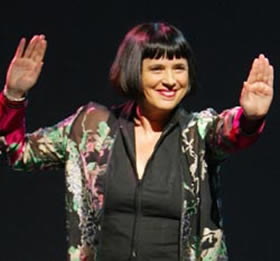
Marcel Reich-Ranicki, Jim Knipfel, Sibylle Berg, Carol Shields, Jean Nelissen, Markies De Sade, Dorothy West

De Duitse schrijver en literatuurcriticus Marcel Reich-Ranicki werd geboren op 2 juni 1920 in Włocławek, Polen. Zie ook alle tags voor Marcel Reich-Ranicki op dit blog.


Uit: Mein Leben


„Es war Ende Oktober 1958 auf einer Tagung der “Gruppe 47” in der Ortschaft Grosholzleute im Allgau. Von den hier versammelten Schriftstellern kannte ich nur wenige – kein Wunder, denn ich lebte erst seit drei Monaten wieder in dem Land, aus dem mich die deutschen Behörden im Herbst 1938 deportiert hatten. Jedenfalls fuhlte ich mich bei dieser Tagung isoliert; und so war es mir nicht unrecht, das in der Mittagspause ein jungerer deutscher Autor, mit dem ich mich im vergangenen Fruhjahr in Warschau unterhalten hatte, auf mich zukam. Noch wuste ich nicht, das schon am nachsten Tag, mit dem ihm verliehenen Preis der “Gruppe 47”, sein steiler Aufstieg zum Weltruhm beginnen sollte.

Dieser kraftige junge Mann, selbstsicher und etwas aufmupfig, verwickelte mich nun in ein Gesprach. Nach einem kurzen Wortwechsel bedrangte er mich plotzlich mit einer einfachen Frage. Noch niemand hatte mir, seit ich wieder in Deutschland war, diese Frage so direkt und so ungeniert gestellt.

Er, Gunter Grass aus Danzig, wollte namlich von mir wissen: “Was sind Sie denn nun eigentlich – ein Pole, ein Deutscher oder wie?” Die Worte “oder wie” deuteten wohl noch auf eine dritte Moglichkeit hin. Ich antwortete rasch: “Ich bin ein halber Pole, ein halber Deutscher und ein ganzer Jude.” Grass schien uberrascht, doch war er offensichtlich zufrieden, ja beinahe entzuckt: “Kein Wort mehr, Sie konnten dieses schone Bonmot nur verderben.” Auch ich fand meine spontane Auserung ganz hubsch, aber eben nur hubsch. Denn diese arithmetische Formel war so effektvoll wie unaufrichtig: Hier stimmte kein einziges Wort.

Nie war ich ein halber Pole, nie ein halber Deutscher – und ich hatte keinen Zweifel, das ich es nie werden wurde. Ich war auch nie in meinem Leben ein ganzer Jude, ich bin es auch heute nicht.“
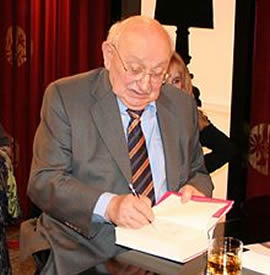
 

Marcel Reich-Ranicki (Włocławek, 2 juni 1920)
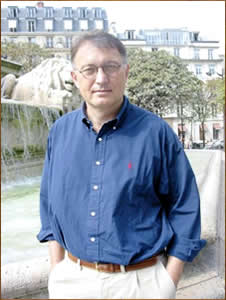
Lees verder “Marcel Reich-Ranicki, Jim Knipfel, Sibylle Berg, Carol Shields, Jean Nelissen, Markies De Sade, Dorothy West”

Patrick Besson, John Masefield, Ferdinand Raimund, Peter de Mendelssohn, Colleen McCullough

De Franse schrijver en journalist Patrick Besson werd geboren op 1 juni 1956 in Montreuil. Zie ook mijn blog van 1 juni 2009 en alle tags voor Patrick Besson op dit blog.


Uit: And The River Will Kill The White Man (Vertaald door Edward Gauvin)

„I recognized her in line at customs, though the only photo of her ever to appear in the papers was from 1985. She was dressed like a man, like when she’d been arrested last century. Her short hair was gray now. Behind round lenses in a steely, Trotskyesque frame, glasses all nearsighted girls of her generation wore—they’d stopped, why hadn’t she?—you saw the same big empty eyes, fearful, roving. Her line was moving faster than mine. She must have read the clothes, the carriage, the carry-ons, the faces of everyone waiting to pass customs. Gauged the chances each did or didn’t have of being detained by an official. Then made a quick mental reckoning and picked the right line. This bit of work had given her a few minutes’ lead. The minutes that sometimes save your life. I lost sight of her, then found her again in the lounge. She was traveling business class, like me. I was in oil. What was she in now?

When I realized we were on the same flight, I thought perhaps we’d be seated side by side. She’d get the vague and plaintive gaze of a famous person wondering if you knew who they were. When it came to notoriety from a shocking news story, an unspeakable political act, or a catastrophic military operation, such silent questioning grew tinged with fear and shame. Alas, the cabin crew gestured us to different rows. Why alas? It was better this way. If I’d been seated next to her for several hours, I would’ve wound up asking her questions she wouldn’t have answered. If she were even the same Blandine de Kergalec who’d once made the headlines. Hard as Breton granite, the editorialists had said in their usual style. She sat down on the other side of the plane, two rows back. She was by the window. For a few moments she kept her purse on her knees, as though she had doubts about wanting to reach her destination, then slipped it under her seat. She had no book, no IPod, no DVD player. She’d spend the six hours thinking, like anyone beset by an obsession. Had she noticed I was watching her? Her way of not seeing me made me think so.

A frail figure slipped past my knees, followed by a slight sigh to my right: the tiny wisp of a creature had sat down. A runny suit streamed down his nonexistent shoulders. He introduced himself. Passengers in business class introduce themselves, to do business. He was an advisor to African presidents. Advisors to African presidents are interested in oil men, and oil men in advisors to African presidents. They practice a single profession in Africa: bleeding it dry.[…] ’’


Patrick Besson (Montreuil, 1 juni 1956)

Lees verder “Patrick Besson, John Masefield, Ferdinand Raimund, Peter de Mendelssohn, Colleen McCullough”

Walt Whitman, Frank Goosen, Gabriel Barylli, Konstantin Paustovski

De Amerikaanse dichter Walt Whitman werd geboren op 31 mei 1819 in Westhills, Long Island, New York. Zie ook alle tags voor Whalt Whitman op dit blog.


Facing west from California’s shores

FACING west from California’s shores,

Inquiring, tireless, seeking what is yet unfound,

I, a child, very old, over waves, towards the house of maternity, the land of migrations, look afar,

Look off the shores of my Western sea, the circle almost circled;

For starting westward from Hindustan, from the vales of Kashmere,

From Asia, from the north, from the God, the sage, and the hero,

From the south, from the flowery peninsulas and the spice islands,

Long having wander’d since, round the earth having wander’d,

Now I face home again, very pleas’d and joyous,

(But where is what I started for so long ago? And why is it yet unfound?)


Uit: Calamus Poems (Fragment)


2.

Scented herbage of my breast,
Leaves from you I yield, I write, to be perused best afterwards,
Tomb-leaves, body leaves, growing up above me, above death,
Perennial roots, tall leaves — O the winter shall not freeze you, delicate leaves,
Every year shall you bloom again — Out from where you retired, you shall emerge again;
O I do not know whether many, passing by, will discover you, or inhale your faint odor — but I believe a few will;
O slender leaves! O blossoms of my blood! I permit you to tell, in your own way, of the heart that is under you,
O burning and throbbing — surely all will one day be accomplished;
O I do not know what mean, there underneath yourselves — you are not happiness,
You are often more bitter than I can bear — you burn and sting me,


3.


1.

Whoever you are holding me now in hand,
Without one thing all will be useless,
I give you fair warning, before you attempt me further,
I am not what you supposed, but far different.

2.

Who is he that would become my follower?
Who would sign himself a candidate for my affections? Are you he?

3.

The way is suspicious — the result slow, uncertain, may-be destructive;
You would have to give up all else — I alone would expect to be your God, sole and exclusive,
Your novitiate would even then be long and exhausting,
The whole past theory of your life, and all conformity to the lives around you, would have to be abandoned;
Therefore release me now, before troubling yourself any further — Let go your hand from my shoulders,
Put me down, and depart on your way.

4.

Or else, only by stealth, in some wood, for trial,
Or back of a rock, in open air,
(for in any roofed room of a house I emerge not — nor in company,
And in the libraries I lie as one dumb, a gawk, or unborn, or dead,)
But just possibly with you on a high hill — first watching lest any person, for miles around, approach unawares,
Or possibly with you sailing at sea, or on the beach of the sea, or some quiet island,
Here to put your lips upon mine I permit you,
With the comrade’s long-dwelling kiss, or the new husband’s kiss,
For I am the new husband, and I am the comrade


Walt Whitman (31 mei 1819 – 26 maart 1893)

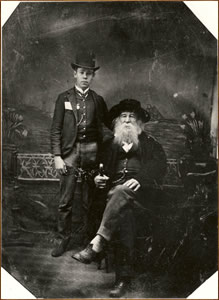
Hier met vriend Bill Duckett, rond 1886

Bewaren

Lees verder “Walt Whitman, Frank Goosen, Gabriel Barylli, Konstantin Paustovski”

Elizabeth Alexander, Countee Cullen, Emmanuel Hiel, Jan Geerts

De Amerikaanse dichteres en schrijfster Elizabeth Alexander werd geboren op 30 mei 1962 in New York. Zie ook alle tags voor Elizabeth Alexander op dit blog.


Autumn Passage


On suffering, which is real.
On the mouth that never closes,
the air that dries the mouth.


On the miraculous dying body,
its greens and purples.
On the beauty of hair itself.


On the dazzling toddler:
“Like eggplant,” he says,
when you say “Vegetable,”


“Chrysanthemum” to “Flower.”
On his grandmother’s suffering, larger
than vanished skyscrapers,


September zucchini,
other things too big. For her glory
that goes along with it,


glory of grown children’s vigil,
communal fealty, glory
of the body that operates


even as it falls apart, the body
that can no longer even make fever
but nonetheless burns


florid and bright and magnificent
as it dims, as it shrinks,
as it turns to something else.


Islands Number Four


1.


Agnes Martin, Islands Number Four,

Repeated ovals on a grid, what appears

To be perfect is handmade, disturbed.

Tobacco brown saturates canvas to burlap,

Clean form from a distance, up close, her hand.

All wrack and bramble to oval and grid.

Hollows in the body, containers for grief.

What looks to be perfect is not perfect.


Odd oval portholes that flood with light.


2.


Description of a Slave Ship, 1789:

Same imperfect ovals, calligraphic hand.

At a distance, pattern. Up close, bodies

Doubled and doubled, serried and stacked

In the manner of galleries in a church,

In full ships on their sides or on each other.

Isle of woe, two-by-two, spoon-fashion,

Not unfrequently found dead in the morning.

Slave ships, the not pure, imperfect ovals,

Portholes through which they would never see home,

The flesh rubbed off their shoulders, elbows, hips.

Barracoon, sarcophagus, indestructible grief

Nesting in the hollows of the abdomen.

The slave ship empty, its cargo landed

And sold for twelve ounces of gold apiece


Or gone overboard. Islands. Aftermath.


Elizabeth Alexander (New York, 30 mei 1962)

Lees verder “Elizabeth Alexander, Countee Cullen, Emmanuel Hiel, Jan Geerts”

Martin Jankowski

De Duitse dichter en schrijver Martin Jankowski werd op 29 mei 1965 in Greifswald geboren. Zie ook alle tags voor Martin Jankowski op dit blog.

anflug auf yogya

rechts das meer und links die grünen hügel
wir lachen und legen uns elegant in die kurve
eine kette rauchender vulkane taucht auf
eine armlänge vom flugzeugfenster entfernt
steck ich die hand in den dampf und lege
eine handvoll funkelnder rubine in deinen schoß

zwischen vulkankegeln wimmelt häuserschaum
wir zielen in seine schattige mitte

alles scheint fruchtbarer hier
der boden das lächeln die luft
und wenn ein erdbeben käme
oder die vulkane alle zugleich
in wildem übermut das flimmern
der stadt und das land auslöschten
hätten wir mühsam wie alle gelebt
doch näher am glück

sieh nur der mond
wird zornig rot spielt
schattenspiele mit den wolken

Martin Jankowski (Greifswald, 29 mei 1965)

André Brink, Eduard Escoffet, G. K. Chesterton

De Zuid-Afrikaanse schrijver André Brink werd geboren op 29 mei 1935 in Vrede. Zie ook alle tags voor André Brink op dit blog.


Uit: Surprise Visit


He never really learnt to cope with that. The only constant in those years was Mum. His father was always more of an absence than a presence. But Mum, yes, she made the difference. Which was why he finally had to make the effort to come all this way to see her. For the last time? Before he went to the States he had already paid her a number of visits, of which each could have been the last. But she held on. Not without some perversity, he sometimes thought. Always a contrary old bird.

He walks down the passage, his rubber soles squeaking on the green linoleum. Down to the end, Jolene has said, then sharp left. Into a small, undefined kind of space which may once have been a storeroom, when the old red-brick building was still a girls’ school. He had actually come here two or three times during his university years, when the girls put on the plays indefatigably penned and produced by the Welshman who taught English and with whom he’d struck up some kind of easy-going friendship. It was mainly cricket that had brought the two of them together. But for some time, at least a year or so, the prof’s daughter had provided an additional attraction. She was still at this school then and acted in a couple of her father’s plays. A fiery little thing, provocatively pretty. And the plays, invariably crackling with Gaelic magic, heightened her attraction. What was the last one? Of course: The Isles of the Blest, when after the show he and she slipped along some corridor into a secluded lobby at the end, which might have been this very space, and briefly wrought their own magic until they were interrupted, at the critical moment, by the avenging fury of a principal.

Three doors lead from here. The middle one must be the one he is looking for, if Jolene is to be believed. Opening into what resembles the waiting room of a railway station. Even smelling like one. Except that this one, large and lugubrious, has darker undertones. What must undoubtedly be the smell of death. When one ends up here there are no further shifts or moves to be expected. It is the ultimate Waiting Room. From here there are only the few steps to the hearse at the door. Abandon all hope, ye who enter. Or something to that effect.”


André Brink (Vrede, 29 mei 1935)

Lees verder “André Brink, Eduard Escoffet, G. K. Chesterton”

Derek Walcott, Adriaan Bontebal, Leo Pleysier, Frank Schätzing, Maeve Binchy

Prettige Pinksterdagen!


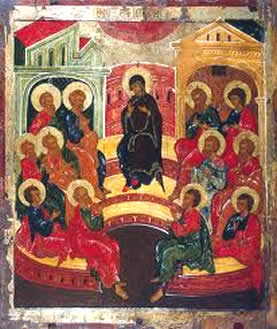
De Nederdaling van de Heilige Geest

Ikoon uit de Noordrussische School


Pentecost

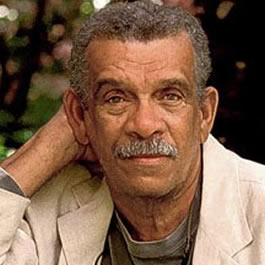
Better a jungle in the head
than rootless concrete.
Better to stand bewildered
by the fireflies’ crooked street;

winter lamps do not show
where the sidewalk is lost,
nor can these tongues of snow
speak for the Holy Ghost;

the self-increasing silence
of words dropped from a roof
points along iron railings,
direction, in not proof.

But best is this night surf
with slow scriptures of sand,
that sends, not quite a seraph,
but a late cormorant,

whose fading cry propels
through phosphorescent shoal
what, in my childhood gospels,
used to be called the Soul.


Derek Walcott (St. Lucia, 23 januari 1930)

Lees verder “Derek Walcott, Adriaan Bontebal, Leo Pleysier, Frank Schätzing, Maeve Binchy”

Annette von Droste-Hülshoff, Louis-Ferdinand Céline, Jan Blokker, Niels ’t Hooft

Prettige Pinksterdagen!


vandyk

The Descent of the Holy Spirit, Anthony van Dyck. 1618-1620


Am Pfingstsonntage

Still war der Tag, die Sonne stand
So klar an unbefleckten Domeshallen;
Die Luft in Orientes Brand
Wie ausgedorrt, ließ matt die Flügel fallen.
Ein Häuflein sieh, so Mann als Greis,
Auch Frauen knieend, keine Worte hallen,
Sie beten leis.
Wo bleibt der Tröster, treuer Hort,
Den scheidend doch verheißen du den Deinen?
Nicht zagen sie; fest steht dein Wort,
Doch bang und trübe muß die Zeit wohl scheinen.
Die Stunde schleicht; schon vierzig Tag’
Und Nächte harrten sie in stillem Weinen,
Und sahn dir nach.
Wo bleibt er? wo nur? Stund’ an Stund’,
Minute will sich reihen an Minuten.
Wo bleibt er denn? – und schweigt der Mund:
Die Seele spricht es unter leisem Bluten.
Der Wirbel stäubt, der Tiger ächzt
Und wälzt sich keuchend durch die sand’gen Fluten,
Die Schlange lechzt.
Da horch! ein Säuseln hebt sich leicht!
Es schwillt und schwillt und steigt zu Sturmes Rauschen.
Die Gräser stehen ungebeugt;
Die Palme starr und staunend scheint zu lauschen.
Was zittert durch die fromme Schar,
Was läßt sie bang’ und glühe Blicke tauschen?
Schaut auf! nehmt wahr!
Er ist’s, er ist’s; die Flamme zuckt
Ob jedem Haupt; welch wunderbares Kreisen,
Was durch die Adern quillt und ruckt!
Die Zukunft bricht, es öffnen sich die Schleusen,
Und unaufhaltsam strömt das Wort
Bald Heroldsruf und bald im flehend leisen
Geflüster fort.
O Licht, o Tröster, bist du, ach!
Nur jener Zeit, nur jener Schar verkündet?
Nicht uns, nicht überall, wo wach
Und trostesbar sich eine Seele findet?
Ich schmachte in der schwülen Nacht,
O leuchte, eh das Auge ganz erblindet;
Es weint und wacht!


Annette von Droste-Hülshoff (10 januari 1797 – 24 mei 1848)

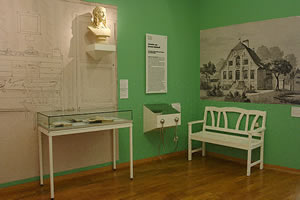
Het kabinet ‚Annette von Droste-Hülshoff’ in het Stadtmuseum, Münster

Lees verder “Annette von Droste-Hülshoff, Louis-Ferdinand Céline, Jan Blokker, Niels ’t Hooft”

Alan Hollinghurst, Radwa Ashour, Hugo Raes, Maxwell Bodenheim

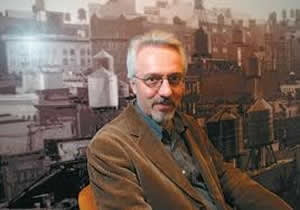
De Britse schrijver Alan Hollinghurst werd geboren op 26 mei 1954 in Stoud, Gloucestershire. Zie ook alle tags voor Alan Hollinghurst op dit blog.


Uit: The Stranger’s Child

„She’d been lying in the hammock reading poetry for over an hour. It wasn’t easy: she was thinking all the while about George coming back with Cecil, and she kept sliding down, in small half-willing surrenders, till she was in a heap, with the book held tiringly above her face. Now the light was going, and the words began to hide among themselves on the page. She wanted to get a look at Cecil, to drink him in for a minute before he saw her, and was introduced, and asked her what she was reading. But he must have missed his train, or at least his connection: she saw him pacing the long platform at Harrow and Wealdstone, and rather regretting he’d come. Five minutes later, as the sunset sky turned pink above the rockery, it began to seem possible that something worse had happened. With sudden grave excitement she pictured the arrival of a telegram, and the news being passed round; imagined weeping pretty wildly; then saw herself describing the occasion to someone, many years later, though still without quite deciding what the news had been.
In the sitting-room the lamps were being lit, and through the open window she could hear her mother talking to Mrs. Kalbeck, who had come to tea, and who tended to stay, having no one to get back for. The glow across the path made the garden suddenly lonelier. Daphne slipped out of the hammock, put on her shoes, and forgot about her books. She started towards the house, but something in the time of day held her, with its hint of a mystery she had so far overlooked: it drew her down the lawn, past the rockery, where the pond that reflected the trees in silhouette had grown as deep as the white sky. It was the long still moment when the hedges and borders turned dusky and vague, but anything she looked at closely, a rose, a begonia, a glossy laurel leaf, seemed to give itself back to the day with a secret throb of colour.“


Alan Hollinghurst (Stoud, 26 mei 1954)

Lees verder “Alan Hollinghurst, Radwa Ashour, Hugo Raes, Maxwell Bodenheim”

Eve Ensler, Friedrich Dieckmann, Egyd Gstättner, Claire Castillon, Raymond Carver

De Amerikaanse schrijfster en feminste Eve Ensler werd op 25 mei 1953 in New York geboren. Zie ook alle tags voor Eve Ensler op dit blog.


Uit: Insecure at Last

„All this striving for security has in fact made you much more insecure. Because now you have to watch out all the time. There are people not like you, people you now call enemies. You have places you cannot go, thoughts you cannot think, worlds you can no longer inhabit. So you spend your days fighting things off, defending your territory, and becoming more entrenched in your narrow thinking. Your days become devoted to protecting yourself. This becomes your mission. This is all you do. You collect canned goods or bottles of water. You ?nd ways to get as much money as you can, and food and oil, in spite of how much you have to take from other people or the methods you have to devise in order to take it. You submit to security systems to check your pockets and IDs and bags. Every object becomes a potential weapon. One week it’s tweezers, the next week it’s rubber bands.

Of course you can no longer feel what another person feels because that might shatter your heart, contradict your stereotype, destroy the whole structure. Ideas get shorter—they become sound bites. There are evildoers and saviors. Criminals and victims. There are those who, if they are not with us, are against us.

It gets easier to hurt people because you do not feel what’s inside them. It gets easier to lock them up, force them to be naked, humiliate them, occupy them, invade them, kill them—because they do not exist. They are merely obstacles to your security.

How did we, as Americans, come to be completely obsessed with our individual security and comfort above all else? What do we think we mean when we talk about security, and what do we really mean? Whose security are we talking about? Is it possible to live surrendering to the reality of insecurity, embracing it, allowing it to open us and transform us and be our teacher? What would we need in order to stop panicking, clinging, consuming, and start opening, giving— becoming more ourselves the less secure we realize we actually are? How has the so-called war on terrorism given rise to this mad national obsession for homeland security, which has actually made us much more insecure at home and in the world?“


Eve Ensler (New York, 25 mei 1953)

Lees verder “Eve Ensler, Friedrich Dieckmann, Egyd Gstättner, Claire Castillon, Raymond Carver”