Dolce far niente, Frank O’Hara, Tom Lanoye, Jeanette Winterson, Kristien Hemmerechts

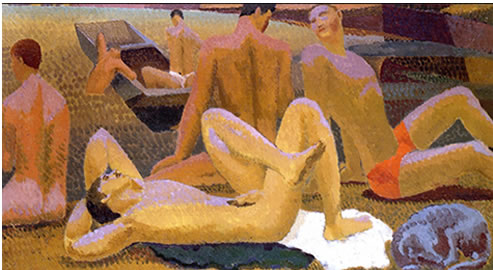
Dolce far niente


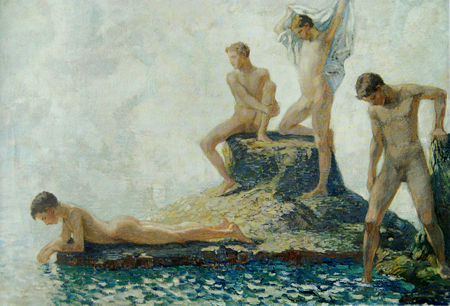
Badende Jünglinge door Ludwig von Hofman, 1905


The Bathers

After the immersion and the stance
how the blood bubbles like a firefly!
and the many flies come clipping through
the cumulus. Paradise melts its wings,

the shingle shows a red flag, lit,
incandescent, and chattering forth.
Crushing as always the pale leaves
of children’s feet, the shells crush,

the petals thrash, a lifeguard weeps
for his dead mother who has just sailed on.
Rumpling and rolling over, the rain
dumps its burden of restraint stonily,

without pressure from above. Be it killing
or caressing, the unhappy bathers moan
and remonstrate, hurtling through indifferences
and colors. On the sandbar lovers

hound each other to the salt, afraid of
neither running paralyzed nor trembling
hung, longing only to drift totally
in the garrulous frequency of their immanence.

Striding like statues the tremendous
arches, partially concealed by sunlight,
bounce. From barges grey with carrion
seem to rise the frenzied-whimpers of those

who are not thrusting their cheeks
against the wicker chests of heroes and
Desdemonas. Shall they drown that passion
they remember best? glinting and passing,

that discord scratching them a future
white-embossed and streaked? The delicacy
of birds eating fleas, so the sand may have
an eye at last, that crater and that sun.



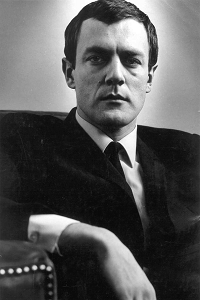
Frank O’Hara (27 juni 1926 – 25 juli 1966)
Baltimore Beach. Frank O’Hara werd geboren in Baltimore.

Bewaren

Lees verder “Dolce far niente, Frank O’Hara, Tom Lanoye, Jeanette Winterson, Kristien Hemmerechts”
Lolita Pille, David Rowbotham, Norah Lofts, Cecil Scott Forester, Lernert Engelberts

De Franse schrijfster Lolita Pille werd geboren op 27 augustus 1982 in Sèvres. Zie ook mijn blog van 27 augustus 2010 en eveneens alle tags voor Lolita Pille op dit blog.

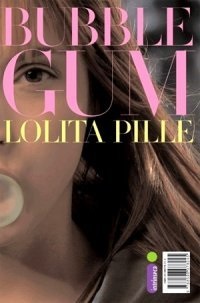
Uit:Bubble gum

“Celui-ci, je l avais nommé Bubble gum parce que tout y semblait creux, rose et gluant : decors, propos, sentiments, les personnages eux mêmes, moi compris, étaient creux, roses et gluants, au bord de l éclatement, et ce derrière quoi ils courraient, la sacro-sainte reconnaissance, la sacro-sainte célébrité, était devenue, a l époque où le non-film était supposé se dérouler, aussi creuse, rose, banale et brève qu une pauvre petite bulle de chewing-gum qui finissait inéluctablement par vous exploser a la gueule. »
(…)

Nous sommes rentrés pour démarrer cette promo et Mano s’y croyait à mort. Elle sy croyait à mort quand elle traversait Paris et qu’elle voyait sa gueule en 6 par 6 absolument partout, elle s’y croyait à mort pendant les interviews, elle virait ses attachés de presse, elle envoyait promener les types qui lui demandaient des autographes dans la rue, elle se sentait tellement unique, tellement privilégiée, elle avait l’impression d’être dans le secret de l’origine du monde, elle jubilait tout en faisant mine de se plaindre d’être trop exposée, son ego n’avait plus de limite.”

 
Lolita Pille (Sèvres, 27 augustus 1982)
Cover

Lees verder “Lolita Pille, David Rowbotham, Norah Lofts, Cecil Scott Forester, Lernert Engelberts”

Paul Verhuyck


De Vlaamse schrijver Paul Verhuyck werd op 27 augustus 1940 in Antwerpen geboren. Na Romaanse Filologie te hebben gestudeerd aan de Rijksuniversiteit te Gent werkte hij ondermeer aan de Hogeschool voor Vertalers & Tolken in Antwerpen. Daarna vertrok hij naar Nederland, waar hij gedurende 27 jaar als universitair hoofddocent aan de Rijksuniversiteit te Leiden verbonden was en oudere Franse en Occitaanse literatuur doceerde (1972-1999). Naast een reeks wetenschappelijke publicaties op vakgebied, publiceerde hij romans en verhalen. Zijn debuut “De doodbierenwerd in 1992 bekroond met de Anton Wachterprijs en de Vlaamse debuutprijs. Er volgden “Moord door geboorte”, (1993),”De binnendienst”(1995), “Hout en koper) (1999), “De elektrische man” (2003) en “Inmiddels op aarde (2014), genomineerd voor de Zeeuwse Boekenprijs 2014. In samenwerking met Corine Kisling publiceerde hij volgende romans onder de auteursnaam “Kisling & Verhuyck”: Verder is hij werkzaam als vertaler en publiceerde hij journalistieke bijdragen over literatuur in de Gazet van Antwerpen, K.C.L.B.-Boekengids, Nieuw Wereldtijdschrift (1994-1998), De Standaard, Standaard der Letteren en De Tijd.

Uit: Hout en koper

“Gustaaf Lamfreit ligt in zijn kist op het kerkhof. Hij wordt begraven, het is winter, bijna nieuwjaar. Maar de dode, de gekiste, hij kijkt. Hij kijkt intens en voor de laatste keer en door de borende kracht van zijn blik wordt het lente, wordt de wereld nieuw voor de eerste keer. Lamfreit is de heer der seizoenen. Iets wat hij bij leven en welzijn nooit geweest is. Misschien wordt het nu toch nog wel wat, het doodzijn. Want sinds zijn overlijden heeft hij alles maar vreemd gevonden, vooral die kist. Grenen, geen eik. Niet eens es of olm. Grenen. Tot nu toe is de dood zelf hem eerlijk gezegd een beetje tegengevallen, eerder een non-evenement zoals zijn trouwdag destijds, maar iets in hem blijft fluisteren dat deze lethargie van flauwe zweverigheid met amper kleuren of vormen niet zal blijven duren, dat het maar een overgangsfase is en dat er nog veel staat aan te komen.
Eerst had hij de indruk dat hij zich in een tunnel bevond, een donkere gang waarin vaag het geluid van een hobo weerklonk, een betoverde hobo die hem scheen te lokken naar zijn jongste lente, een betoverde melodie die hem de kracht gaf verder te gaan, nog verder de duisternis in.
Tot hij een lichtere zone meende te zien, misschien de uitgang van de tunnel. De ronde opening werd afgesloten door spinnenwebben. Duizenden webben evenwijdig achter elkaar op een rij, het ene op zo’n tien centimeter van het andere. Beestenkoppen. Er speelden regenbogen door de draden. Hij zou er wel doorkomen, dacht hij, die netten waren flinterdun. Hij dus moedig voorwaarts.
De eerste twintig, dertig gingen nog, met brede geestelijke armslagen baande hij zich een weg door de kleverige witte draden, maar daarna werd het ingewikkeld, werd hij duizenden keren ingewikkeld door de geduldige strategie van de spinnen, totdat ademnood en verstikkingsdood — alweer! — erop volgden, met — alweer! — uiteenknallende bloedbanen, adertjes, longblaasjes, buisjes, leidingen.”


Paul Verhuyck (Antwerpen, 27 augustus 1940)

Dolce far niente, Stefan George, Christopher Isherwood, Laura van der Haar, Joachim Helfer, Guillaume Apollinaire, Rashid Al-Daif

Dolce far niente


Bathers by the Pond door Duncan Grant,  circa 1920-1921


Südlicher Strand: Tänzer

Ihr wart am pinienhage ohne staunen
Ins gras gelagert · junge schwinger · beide
Mit gliedern zierlich regen kräftig braunen
Mit offner augen unbefangner weide.

Ihr hobet euch vom boden auf im takte
Ins volle licht getauchte lächelnd reine
Und schrittet vor und rückwärts – göttlich nackte
Die breite brust gewiegt auf schlankem beine.

Von welcher urne oder welchem friese
Stiegt ihr ins leben ab zum fest gerüstet
Die ihr euch leicht verneigtet und euch küsstet
Und tanzend schwangt auf weiss-gesternter wiese!


Stefan George (12 juli 1868 – 4 december 1933)
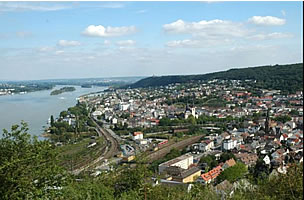
Büdesheim (Bingen). Stefan George werd in Büdesheim geboren.

Lees verder “Dolce far niente, Stefan George, Christopher Isherwood, Laura van der Haar, Joachim Helfer, Guillaume Apollinaire, Rashid Al-Daif”

C. B. Vaandrager


De Nederlandse schrijver en dichter Cornelis Bastiaan Vaandrager werd geboren in Rotterdam op 26 augustus 1935. Zijn vader was postbode, zijn moeder huisvrouw. Hij bleef enig kind. Na het gymnasium maakte Vaandrager met zijn schoolvriend Hans Sleutelaar deel uit van de redactie van het Rotterdamse literaire tijdschrift Proefschrift, dat halverwege de jaren vijftig verscheen. Later was Vaandrager met Sleutelaar, de dichter Hans Verhagen en schilder-dichter Armando redactielid van het Vlaams-Nederlandse literaire tijdschrift Gard Sivik en het tijdschrift De Nieuwe Stijl. In 1960 maakte Vaandrager zijn prozadebuut met de novelle “Leve Joop Massaker”, door critici vergeleken met romans van Gerard Reve en Hugo Claus. Een jaar later volgde zijn poëziedebuut “Met andere ogen”. Hiermee vestigde hij zijn naam als veelbelovend Rotterdams literair talent. Hij leek die faam te onderstrepen met de verhalenbundel “De avonturen van Cornelis Bastiaan Vaandrager” (1963), poëzie in “Gedichten” (1967) en de documentaire, sterk autobiografische romans “De reus van Rotterdam. Stadsgeheimen” (1971) en “De Hef” (1975). In de jaren zeventig ging het bergafwaarts met Vaandrager. Drugsgebruik begon zijn leven te beheersen. Hij verbleef met ernstige klinische depressies soms maanden achtereen in een psychiatrisch ziekenhuis. In 1981 werd hem de Anna Blaman Prijs van het Prins Bernhardfonds uitgereikt voor zijn gehele oeuvre. Daarna publiceerde hij nog slechts enkele dichtbundels, waaronder “Metalon” (1986) en “Sampleton” (1990). Vaandrager stierf vereenzaamd op 56-jarige leeftijd. In de 21e eeuw is de belangstelling voor Vaandrager enigszins opgeleefd. In 2005 verscheen de biografie “Vaan, Het bewogen bestaan van C.B. Vaandrager” van Menno Schenke. In 2008 volgde “Made in Rotterdam”, een uitgave van zijn verzamelde gedichten, bijeengebracht door Martin Bril en Hans Sleutelaar. Vier jaar daarna volgde de – postume – publicatie van de recent ontdekte, nooit eerder gepubliceerde novelle “Sleutels”.


Gelukkige dagen

Gisteravond naar Beckett geweest.
Dat gaf te denken..

Als je uren tot aan je oren
in een moeilijke materie zit,
is een pauze geen luxe.

Om kwart voor elf stonden we weer op straat.

Tot vier uur doorgezakt
en met een taxi naar huis.


A foggy day in Rotterdam

Je kent het wel: een middag wachten
tot het gaat misten. Wachten
tot het donker wordt. Of avond wordt. Hij
(ik heb het over hem) kijkt,
ziet lege bussen
die koppig starten, de stad in – op zoek naar meer mist?

Stemmen van mensen. Oproer? Bijval?
Hij herkent ze, de stemmen. De mensen
kent hij niet – nooit gekend.

Je kent het wel: pijnlijk nauwkeurig
kan hij je zeggen (maar hij doet het niet):
‘Nu gaat de telefoon.’
En dan gaat de telefoon. De angst
dit aan te voelen. En dan de angst (nog groter)
zich na tien, elf juiste voorspellingen te vergissen.

De mist is binnen.
Reeds zijn de radiatoren verkild.
Hij trekt zijn benen op. Wacht.
Het wordt donker. Of avond.
Hij trekt huiverend een haar uit zijn pols.


C. B. Vaandrager (26 augustus 1935 – 18 maart 1992)

Paula Hawkins


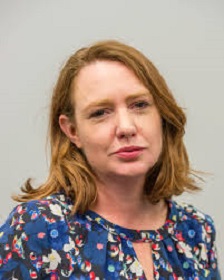
De Britse schrijfster Paula Hawkins werd geboren op 26 augustus 1972 en groeide op in Salisbury (het huidige Harare in Zimbabwe) in Rhodesië. Ze verhuisde in 1989 op 17-jarige leeftijd naar Londen waar ze filosofie, economie en politiek studeerde aan het Keble College van de universiteit van Oxford. Ze was journaliste voor The Times, werkte aan een aantal publicaties op freelancebasis en schreef ook een financieel adviesboek voor vrouwen, getiteld “The Money Goddess”. Hawkins schreef een aantal romantische komedieromans onder het pseudoniem Amy Silver en brak in 2015 door onder haar eigen naam met de psychologische thriller “The Girl on the Train”, waarin de huiselijk geweld, alcohol en drugsgebruik een rol spelen. Het boek werd in 2016 verfilmd met Emily Blunt in de rol van Rachel.. Het boek kwam op 1 februari 2015 op nummer één op de The New York Times Fiction Best Sellers of 2015 en stond 16 weken op de eerste plaats.

Uit:The Girl on the Train

“I want to run. I want to take a road trip, in a convertible, with the top down. I want to drive to the coast—any coast. I want to walk on a beach. Me and my big brother were going to be road trippers. We had such plans, Ben and I. Well, they were Ben’s plans mostly—he was such a dreamer. We were going to ride motorbikes from Paris to the Côte d’Azur, or all the way down the Pacific coast of the USA, from Seattle to Los Angeles; we were going to follow in Che Guevara’s tracks from Buenos Aires to Caracas. Maybe if I’d done all that, I wouldn’t have ended up here, not knowing what to do next. Or maybe, if I’d done all that, I’d have ended up exactly where I am and I would be perfectly contented. But I didn’t do all that, of course, because Ben never got as far as Paris, he never even made it as far as Cambridge. He died on the A10, his skull crushed beneath the wheels of an articulated lorry.
I miss him every day. More than anyone, I think. He’s the big hole in my life, in the middle of my soul. Or maybe he was just the beginning of it. I don’t know. I don’t even know whether all this is really about Ben, or whether it’s about everything that happened after that, and everything that’s happened since. All I know is, one minute I’m ticking along fine and life is sweet and I want for nothing, and the next I can’t wait to get away, I’m all over the place, slipping and sliding again.
So, I’m going to see a therapist! Which could be weird, but it could be a laugh, too. I’ve always thought that it might be fun to be Catholic, to be able to go to the confessional and unburden yourself and have someone tell you that they forgive you, to take all the sin away, wipe the slate clean.
This is not quite the same thing, of course. I’m a bit nervous, but I haven’t been able to get to sleep lately, and Scott’s been on my case to go. I told him I find it difficult enough talking to people I know about this stuff—I can barely even talk to him about it.
He said that’s the point, you can say anything to strangers. But that isn’t completely true. You can’t just say anything. Poor Scott. He doesn’t know the half of it. He loves me so much, it makes me ache. I don’t know how he does it. I would drive me mad.
But I have to do something, and at least this feels like action. All those plans I had—photography courses and cookery classes—when it comes down to it, they feel a bit pointless, as if I’m playing at real life instead of actually living it. I need to find something that I must do, something undeniable. I can’t do this, I can’t just be a wife. I don’t understand how anyone does it—there is literally nothing to do but wait. Wait for a man to come home and love you. Either that or look around for something to distract you.”


Paula Hawkins (Salisbury, 26 augustus 1972)

Dolce far niente, Albert Verwey, Kees Stip, Martin Amis, Howard Jacobson, Charles Wright, Maxim Biller

Dolce far niente


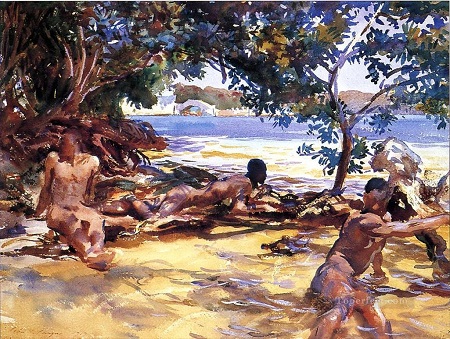
The Bathers door John Singer Sargent, 1917


Baders hartewens

Dwars door de tuinen
Van roos en ranken
Zich
‘t pad te banen,
Dan door de lanen
Van zand en dennen
Vluchtig te rennen
Tot waar de kruinen
Van hoge duinen
In
‘t blauwe blanken
En zo te naderen
Met zwellende aderen
In laatste loop
De harde golven
En, overdolven,
Hun koele doop.


Albert Verwey (15 mei 1865 – 8 maart 1937)
Amsterdam, 19e eeuw. Albert Verwey werd geboren in Amsterdam


Lees verder “Dolce far niente, Albert Verwey, Kees Stip, Martin Amis, Howard Jacobson, Charles Wright, Maxim Biller”

Dolce far niente, Bertolt Brecht, John Green, Drs. P, Marion Bloem, Pepijn Lanen, Stephen Fry

Dolce far niente


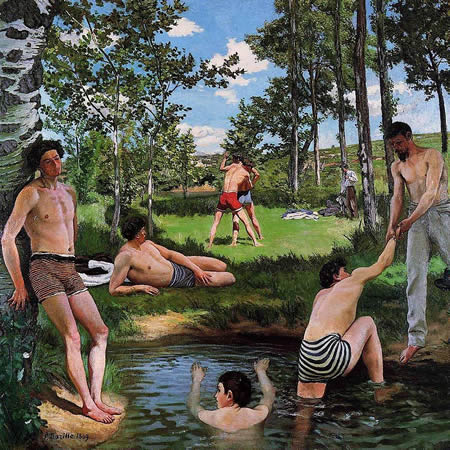
Scène d’été door Frédéric Bazille, 1869


Vom Schwimmen in Seen und Flüssen

Im bleichen Sommer, wenn die Winde oben
Nur in dem Laub der großen Bäume sausen
Muß man in Flüssen liegen oder Teichen
Wie die Gewächse, worin Hechte hausen.

Der Leib wird leicht im Wasser. Wenn der Arm
Leicht aus dem Wasser in den Himmel fällt
Wiegt ihn der kleine Wind vergessen
Weil er ihn wohl für braunes Astwerk hält.

Der Himmel bietet mittags große Stille.
Man macht die Augen zu, wenn Schwalben kommen.
Der Schlamm ist warm. Wenn kühle Blasen quellen
Weiß man: Ein Fisch ist jetzt durch uns geschwommen.

Mein Leib, die Schenkel und der stille Arm
Wir liegen still im Wasser, ganz geeint
Nur wenn die kühlen Fische durch uns schwimmen
Fühl ich, daß Sonne überm Tümpel scheint.

Wenn man am Abend von dem langen Liegen
Sehr faul wird, so, daß alle Glieder beißen
Muß man das alles, ohne Rücksicht, klatschend
In blaue Flüsse schmeißen, die sehr reißen.

Am besten ist´s, man hält´s bis Abend aus.
Weil dann der bleiche Haifischhimmel kommt
Bös und gefräßig über Fluß und Sträuchern
Und alle Dinge sind, wie´s ihnen frommt.

Natürlich muß man auf dem Rücken liegen
So wie gewöhnlich. Und sich treiben lassen.
Man muß nicht schwimmen, nein, nur so tun, als
Gehöre man einfach zu Schottermassen.

Man soll den Himmel anschauen und so tun
Als ob einen ein Weib trägt, und es stimmt.
Ganz ohne großen Umtrieb, wie der liebe Gott tut
Wenn er am Abend noch in seinen Flüssen schwimmt.


Bertolt Brecht (10 februari 1898 – 14 augustus 1956)
Augsburg. Bertolt Brecht werd geboren in Augsburg.

Lees verder “Dolce far niente, Bertolt Brecht, John Green, Drs. P, Marion Bloem, Pepijn Lanen, Stephen Fry”

Charles Busch, Albert Alberts, Ilija Trojanow, Willy Russell, Gustav Ernst, Ephraïm Kishon

De Amerikaanse schrijver en acteur Charles Busch werd geboren op 23 augustus 1954 in New York. Zie ook alle tags voor Charles Busch op dit blog.

Uit: Psycho Beach Party

„MRS. FORREST (Devastated) It’s all true. All of it true. I was so ashamed. l blamed myself for the death of my boy. But I always loved my little girl. ( To Chicklet) You must believe that. I did love you. I do. And when Chicklet lost her memory of that day, I took it as a blessing from God. I vowed to create a new life for us. I changed my name, moved to a new city. I suppose I tried too hard, went too far and now . . . now I see I’m doomed to failure.
CHICKLET Mother, hold me. (They embrace)
BERDINE (Sobbing) l was supposed to be her best friend but I never knew.
KANAKA How do you feel, Chicklet?
CHICKLET As if a thousand doors have been opened.
PROVOLONEY But what does this all mean?
STAR CAT It’s really very simple. Chicklet did her best to suppress this traumatic childhood episode by denying herself all normal human emotion, so she created various alter egos to express emotion for her. She associated the sex drive with her mother, so she in effect became her childhood vision of her mother, Ann Bowman, whenever placed in a potentially erotic situation.
KANAKA Is this condition contagious?
STAR CAT Indeed not. Over eighteen percent of all Americans suffer from some form of multiple personality disorder. It is not communicable and in most cases, treatable with medical care.
BETTINA (Energetically) This is the most exciting story I’ve ever heard. This is the project that’s going to win me an Oscar.
PROVOLONEY Huh?
BETTINA A surfer girl with a split personality. A prestige picture if I ever saw one. (To Chicklet) Honey, I want to option this property, and believe me I’ll pay top dollar. I can’t promise casting approval but you can trust my integrity.”


Charles Busch (New York, 23 augustus 1954)
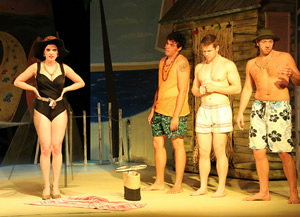
Scene uit een opvoering in Thousand Oaks, 2015

Lees verder “Charles Busch, Albert Alberts, Ilija Trojanow, Willy Russell, Gustav Ernst, Ephraïm Kishon”

Curtis Sittenfeld

De Amerikaanse schrijfster Elizabeth Curtis Sittenfeld werd geboren op 23 augustus 1975 in Cincinnati, Ohio. Zij bezocht de Seven Hills schook en vanaf de 8e klas Groton, een particuliere school in Groton (Massachusetts). Daarna studeerde ze eerst aan het Vassar College in Poughkeepsie, daarna aan de Stanford University in Stanford, Californië. Na de studie verhuisde Sittenfeld naar Charlotte (North Carolina), waar ze schreef voor de Charlotte Observer. Daarna werkte ze voor het Fast Comany tijdschrift in Boston en vervolgens nam zij deel aan de Writers Workshop aan de Universiteit van Iowa. Haar artikelen verschenen onder andere in The New York Times, The Washington Post en People. In 2005, publiceerde Curtis Sittenfeld haar debuutroman “Prep:” De roman vertelt de ervaringen van student Lee Fiora aan de fictieve Elite School Ault. The New York Times koos “Prep” tot de tien beste boeken van 2005. In haar roman “American Wife” uit 2008 schildert Sittenfeld een fictief portret van de voormalige first lady Laura Bush. In 2013 verscheen de roman “Sisterland” en in 2016 volgde “Eligible”. Sittenfelds boeken zijn vertaald in vijfentwintig talen.

Uit: Prep

“I think that everything, or at least the part of everything that happened to me, started with the Roman architecture mix-up. Ancient History was my first class of the day, occurring after morning chapel and roll call, which was not actually roll call but a series of announcements that took place in an enormous room with twenty-foot-high Palladian windows, rows and rows of desks with hinged tops that you lifted to store your books inside, and mahogany panels on the walls—one for each class since Ault’s founding in 1882—engraved with the name of every person who had graduated from the school. The two senior prefects led roll call, standing at a desk on a platform and calling on the people who’d signed up ahead of time to make announcements. My own desk, assigned alphabetically, was near the platform, and because I didn’t talk to my classmates who sat around me, I spent the lull before roll call listening to the prefects’ exchanges with teachers or other students or each other. The prefects’ names were Henry Thorpe and Gates Medkowski. It was my fourth week at the school, and I didn’t know much about Ault, but I did know that Gates was the first girl in Ault’s history to have been elected prefect.
The teachers’ announcements were straightforward and succinct: Please remember that your adviser request forms are due by noon on Thursday. The students’ announcements were lengthy—the longer roll call was, the shorter first period would be—and filled with double entendres: Boys’ soccer is practicing on Coates Field today, which, if you don’t know where it is, is behind the headmaster’s house, and if you still don’t know where it is, ask Fred. Where are you, Fred? You wanna raise your hand, man? There’s Fred, everyone see Fred? Okay, so Coates Field. And remember—bring your balls.
When the announcements were finished, Henry or Gates pressed a button on the side of the desk, like a doorbell, there was a ringing throughout the schoolhouse, and we all shuffled off to class. In Ancient History, we were making presentations on different topics, and I was one of the students presenting that day. From a library book, I had copied pictures of the Colosseum, the Pantheon, and the Baths of Diocletian, then glued the pictures onto a piece of poster board and outlined the edges with green and yellow markers. The night before, I’d stood in front of the mirror in the dorm bathroom practicing what I’d say, but then someone had come in, and I’d pretended I was washing my hands and left.”


Curtis Sittenfeld (Cincinnati, 23 augustus 1975)