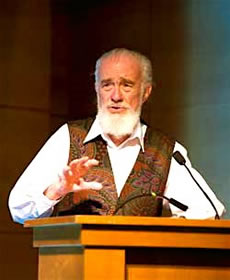
William Snodgrass, Pierre Seghers, Fred Wander, Humbert Wolfe, Stella Gibbons

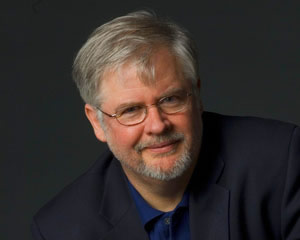
De Amerikaanse dichter William De Witt Snodgrass werd geboren op 5 januari 1926 in Wilkinsburg, Pennsylvania. Zie ook alle tags voor William Snodgrass op dit blog.

Pacemaker

I
‘One Snodgrass, two Snodgrass, three Snodgrass, four . . .
I took my own rollcall when I counted seconds;
‘One two three, Two two three, Three . . .,’ the drum score
Showed only long rests to the tympani’s entrance.

‘Oh-oh-oh leff; leff; leff-toh-righ-toh-leff,’
The sergeant cadenced us footsore recruits;
The heart, poor drummer, gone lame, deaf,
Then AWOL, gets frogmarched to the noose.

II
Old coots, at the Veterans’, might catch breath
If their cheeks got slapped by a nurse’s aide,
Then come back to life; just so, at their birth,
Young rumps had been tendered warm accolades.

The kick-ass rude attitude, smart-assed insult,
The acid-fueled book review just might shock
Us back to the brawl like smelling salts,
Might sting the lulled heart up off its blocks.

III
I thought I’d always favor rubato
Or syncopation, scorning fixed rhythms;
Thought my old heartthrobs could stand up to stress;
Believed one’s bloodpump should skip a few beats
If it fell into company with sleek young women;
Believed my own bruit could beat with the best.

Wrong again, Snodgrass! This new gold gadget,
Snug as the watch on my wife’s warm wrist,
Drives my pulsetempo near twice its old pace—
Go, nonstop startwatch! Go, clockwork rabbit,
Keeping this lame old dog synchronized,
Steady, sparked up, still in the race.
William Snodgrass (5 januari 1926 – 13 januari 2009)

Lees verder “William Snodgrass, Pierre Seghers, Fred Wander, Humbert Wolfe, Stella Gibbons”
Emil Zopfi, David Berman, Gao Xingjian, Fernand Handtpoorter, Doris Kearns Goodwin

De Zwitserse schrijver Emil Zopfi werd geboren op 4 januari 1943 in Wald. Zie ook alle tags voor Emil Zopfi op dit blog.


Uit: Schrot und Eis

“5. September 1839. Einen Streich auf den Mund

Jahrzehnte fliegen dahin. Johannes Hegetschweiler ist Politiker geworden, wider seine Natur und seine Neigung, Regierungsrat und Staatsrat des Kantons Zürich. Ein friedliebener Mensch im Streit der Zeit.

Es ist Donnerstag, der 5. September 1839. Nach regnerischen Tagen klart der Himmel auf gegen Abend. Die Nacht bricht an, eine Nacht der Entscheidung. Amtsbürgermeister Johann Jakob Hess hat die Regierung des Kantons Zürich zum Kriegsrat gerufen. Es mag gegen elf Uhr gehen, als Johannes Hegetschweiler an Schipfe der Limmat entlangeilt, den Hut tief in der Stirn. Beim Roten Turm am Weinplatz biegt er in die Storchengasse, hört Stimmenlärm im Café Litteraire, einem Treffpunkt der Radikalen. Sonst ist alles ruhig, da und dort flackert ein Öllicht hinter Vorhängen. Nichts deutet auf einen Bürgerkrieg hin, den Bruderkrieg zwischen Stadt und Land, den alle fürchten. Sein Stock klöppelt übers Pflaster, er überquert den Münsterhof zum Postgebäude, wo sich die Regierung versammelt. Man hält die Sitzungen in der neuen Post in der Kleinen Stadt ab, die eidgenössische Tagsatzung belegt das Rathaus auf dem rechten Limmatufer. Zürich ist in diesem Jahr Vorort der Eidgenossenschaft, die Zürcher Regierung eine Art Landesregierung, eine Landesregierung ohne eigene Truppen, ohne Staatskasse, ohne Macht. Die Staatskanzlei eine Truhe voller Akten, die man von Stadt zu Stadt schleppt, wenn der Vorort wechselt. Papierberge, nichts weiter. Die Schweiz ein Land ohne Zentrum, ein loser Bund von Kantonen, zerbrechlich und zerstritten. Alle kämpfen gegen alle, um Vorrechte, um Besitzstand, um Ämter und Pfründe und um die Macht schlechthin. Die Fronten trennen Stadt und Land, Katholisch und Reformiert, Konservativ und Liberal, Welsch und Deutsch. Eine chaotische Hinterlassenschaft von Napoleons Weltordnung, die längst untergegangen ist.

Ein Weibel öffnet die Pforte, Hegetschweiler tritt ins Sitzungszimmer. Heinrich Weiss, der härteste Radikale im Rat, Oberst im Militär, hält den Vorsitz des Kriegsrats. Hegetschweiler setzt sich lautlos, stellt sogleich fest, dass mehrere der 19 Ratskollegen fehlen. Weiss wendet sein rundes Bauerngesicht Hegetschweiler zu, stockt einen Augenblick in seiner Rede, kratzt sich im zerzausten Kraushaar, fährt dann weiter. Ein Bote sei vor kurzer Zeit eingetroffen, habe berichtet, ein Gewalthaufe nähere sich von Dübendorf her der Stadt, bewaffnet mit Stöcken, Mistgabeln, Dreschflegeln, eine Hundertschaft mit Stutzern und Jagdflinten an der Spitze.”


Emil Zopfi (Wald, 4 januari 1943)

Lees verder “Emil Zopfi, David Berman, Gao Xingjian, Fernand Handtpoorter, Doris Kearns Goodwin”

Andreas Altmann, Max Eastman, Daniel Mursa, Jacob Grimm, Markus Seidel

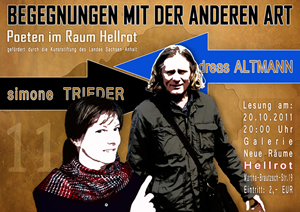
De Duitse dichter en schrijver Andreas Altmann werd geboren in Hainichen (Sachsen) op 4 januari 1963. Zie ook alle tags voor Andreas Altmann op dit blog. Zie ook mijn blog van 8 juni 2009.


engelsgeschichte

ich möchte im winter sterben,
wenn die asche des schnees beginnt,
hat mir der mann aus dem fenster erzählt,
der seine tage darin verbrachte.
er hatte sich alles vergeben und schlug
licht mit seinen flügeln zusammen,
und hielt sie offen im schnee.
ich stand oft darunter und roch
seine weiße stimme, die dann herabfiel.
in meinem schweigen nannte ich ihn
mit leeren händen den engel.
er hat mir oft von den lippen gelesen
und mit den worten verglichen.
ich hab ihm geglaubt. das war unser versteck.
was bleiben wird, ist nie gewesen.
zwischen seinen augen ging mein blick auseinander.
die straße wurde gesperrt, das haus entsteint.
ich liebe ruinen, sie haben geduld,
war das letzte, was ich von ihm hörte.
ohne beine trugen sie ihn.
er starb, ohne noch einmal zu sprechen.
ich ging aus dem haus, nahm ein zimmer
am see, sah kaum aus dem fenster,
nur im winter dem schnee nach,
wenn er im wasser verbrannte.


Andreas Altmann (Hainichen, 4 januari 1963)

Hier met Simone Trieder op een affiche

Lees verder “Andreas Altmann, Max Eastman, Daniel Mursa, Jacob Grimm, Markus Seidel”

J.R.R. Tolkien, Marie Darrieussecq, Alex Wheatle, Cicero, Drieu la Rochelle, Xavier Orville, Jacob Balde

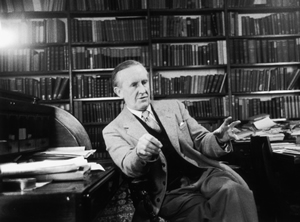
De Engelse schrijver J.R.R. Tolkien werd geboren op 3 januari 1892 in Bloemfontein, Zuid-Afrika. Zie ook alle tags voor J.R.R. Tolkien op dit blog.

Uit: The Lord of the Rings (The Hobbit)

“Not that Belladonna Took ever had any adventures after she became Mrs Bungo Baggins. Bungo, that was Bilbo’s father, built the most luxurious hobbit-hole for her (and partly with her money) that was to be found either under The Hill or over The Hill or across The Water, and there they remained to the end of their days. Still it is probable that Bilbo, her only son, although he looked and behaved exactly like a second edition of his solid and comfortable father, got something a bit queer in his make-up from the Took side, something that only waited for a chance to come out. The chance never arrived, until Bilbo Baggins was grown up, being about fifty years old or so, and living in the beautiful hobbit-hole built by his father, which I have just described for you, until he had in fact apparently settled down immovably.


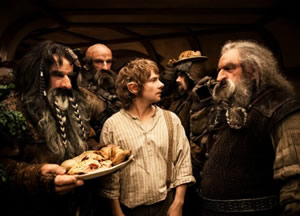
Scene uit de film “The Hobbit” van Peter Jackson, 2012

By some curious chance one morning long ago in the quiet of the world, when there was less noise and more green, and the hobbits were still numerous and prosperous, and Bilbo Baggins was standing at his door after breakfast smoking an enormous long wooden pipe that reached nearly down to his woolly toes (neatly brushed)—Gandalf came by. Gandalf! If you had heard only a quarter of what I have heard about him, and I have only heard very little of all there is to hear, you would be prepared for any sort of remarkable tale. Tales and adventures sprouted up all over the place wherever he went, in the most extraordinary fashion. He had not been down that way under The Hill for ages and ages, not since his friend the Old Took died, in fact, and the hobbits had almost forgotten what he looked like. He had been away over The Hill and across The Water on businesses of his own since they were all small hobbit-boys and hobbit-girls.
All that the unsuspecting Bilbo saw that morning was an old man with a staff. He had a tall pointed blue hat, a long grey cloak, a silver scarf over which his long white beard hung down below his waist, and immense black boots”


 J.R.R. Tolkien (3 januari 1892 – 2 september 1973)

Lees verder “J.R.R. Tolkien, Marie Darrieussecq, Alex Wheatle, Cicero, Drieu la Rochelle, Xavier Orville, Jacob Balde”

Peter Ghyssaert

De Vlaamse dichter Peter Ghyssaert werd geboren op 3 januari 1966 te Wilrijk. Zie ook alle tags voor Peter Ghyssaert op dit blog.

Marine

De avond tingelt als een theehuisje aan de horizon; maar de stormen
daarachter, het versplinteren van hout en de wrakken die elkaar
angstig opduwen in de haven.

Kom wij maken een wandeling langs dit troebele water vol wier dat
zinkt als lood; nu erven wij een rust die van de hele aarde schijnt te
komen. Maar de schreiende stem en de verre deur die open zwaait in
het landschap; en het trillen van de wind die ons naar het zandkas-
teel brengt.

En wij, luisterend als twee kinderen; kleiner wordend, verdwalend
met het koude, schitterende speelgoed van elkaars gezelschap.


Het museum van zoet en brak water

Vitrines vol met tranen;
kasteelvijvers en zoete vennen
in zaal drie.

Nauwelijks voelbaar schuift
branding onder het parket;
uit verstuivers drijft de zeemist

De Afrikaanse waterval
schuimt in een meubel van mahoniehout;
weer bij de uitgang koopt men

washandjes en de brochure
‘Geschiedenis der waterzucht’

Er zijn geen frisdranken te koop;
dit is geen recreatieoord.

Peter Ghyssaert (Wilrijk, 3 januari 1966)

Christopher Durang, David Shapiro, Jimmy Santiago Baca, André Aciman, Nyk de Vries, Hans Herbjørnsrud, Anton van Duinkerken

De Amerikaanse toneelschrijver Christopher Durang werd geboren op 2 januari 1949 in Montclair, New Jersey. Zie ook alle tags voor Christopher Durang op dit blog.

Uit: Laughing Wild

“Woman: I want to talk to you about life. It’s just too difficult to be alive, isn’t it, and try to function? There are all these people to deal with. I tried to buy a can of tuna fish in the supermarket, and there was this person standing right in front of where I wanted to reach out to get the tuna fish, and I waited a while, to see if they’d move, and they didn’t—they were looking at tuna fish too, but they were taking a real long time on it, reading the ingredients on each can like they were a book, a pretty boring book if you ask me, but nobody has; so I waited a long while, and they didn’t move, and I couldn’t get to the tuna fish cans; and I thought about asking them to move, but then they seemed so stupid not to have sensed that I needed to get by them that I had this awful fear that it would do no good, no good at all, to ask them, they’d probably say something like, “We’ll move when we’re goddam ready you nagging bitch” and then what would I do? And so then I started to cry out of frustration, quietly, so as not to disturb anyone, and still, even though I was softly sobbing, this stupid person didn’t grasp that I needed to get by them, and so I reached over with my fist, and I brought it down real hard on his head and screamed: “Would you kindly move asshole!!!”
And the person fell to the ground, and looked totally startled, and some child nearby started to cry, and I was still crying, and I couldn’t imagine making use of the tuna fish now anyway, and so I shouted at the child to stop crying—I mean, it was drawing too much attention to me—and I ran out of the supermarket, and I thought, I’ll take a taxi to the Metropolitan Museum of Art, I need to be surrounded with culture right now, not tuna fish.”


Christopher Durang (Montclair, 2 januari 1949)

Lees verder “Christopher Durang, David Shapiro, Jimmy Santiago Baca, André Aciman, Nyk de Vries, Hans Herbjørnsrud, Anton van Duinkerken”

Zum Neuen Jahr (Rainer Maria Rilke)

Aan alle bezoekers en mede-bloggers een gelukkig Nieuwjaar!


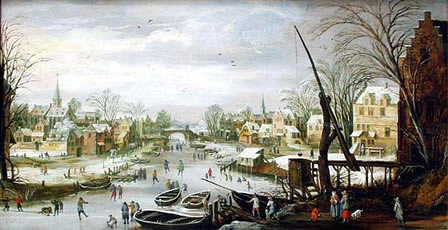
Dorp in de winter door Joos de Momper II (1564-1635)


Zum Neuen Jahr

Wir
wollen
glauben
an
ein langes Jahr,
das uns gegeben ist,
neu,
unberührt, voll nie gewesener Dinge,
voll nie getaner Arbeit,
voll Aufgabe,
Anspruch und Zumutung.
Wir wollen sehen,
dass wir’s nehmen lernen, ohne allzu viel fallen zu lassen
von dem
was es zu vergeben hat, an die, die Notwendiges, Ernstes und
Großes von ihm verlangen.


Rainer Maria Rilke (4 december 1875 – 29 december 1926)

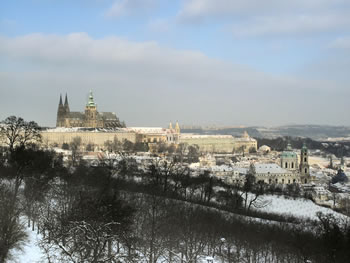
Rilke werd geboren in Praag


Zie voor de schrijvers van de 1e januari ook mijn vorige blog van vandaag.

J.D. Salinger, E. M. Forster, Douglas Kennedy, Rascha Peper, Sven Regener

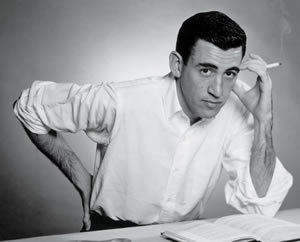
De Amerikaanse schrijver Jerome David Salinger werd in New York geboren op 1 januari 1919. Zie ook alle tags voor J. D. Salinger op dit blog.


Uit: The Catcher in the Rye

I didn’t say anything for about a minute. Then I said, “All right. What do they do, the fish and all, when that whole little lake’s a solid block of ice, people skating on it and all?”

Old Horwitz turned around again. “What the hellaya mean what do they do?” he yelled at me. “They stay right where they are, for Chrissake.”

“They can’t just ignore the ice. They can’t just ignore it.”

“Who’s ignoring it? Nobody’s ignoring it!” Horwitz said. He got so damn excited and all, I was afraid he was going to drive the cab right into a lamppost or something. “They live right in the goddam ice. It’s their nature, for Chrissake. They get frozen right in one position for the whole winter.”

“Yeah? What do they eat, then? I mean if they’re frozen solid, they can’t swim around looking for food and all.”

“Their bodies, for Chrissake–what’sa matter with ya? Their bodies take in nutrition and all, right through the goddam seaweed and crap that’s in the ice. They got their pores open the whole time. That’s their nature, for Chrissake. See what I mean?” He turned way the hell around again to look at me.

“Oh,” I said. I let it drop. I was afraid he was going to crack the damn taxi up or something. Besides, he was such a touchy guy, it wasn’t any pleasure discussing anything with him. “Would you care to stop off and have a drink with me somewhere?” I said.

He didn’t answer me, though. I guess he was still thinking. I asked him again, though. He was a pretty good guy. Quite amusing and all.

“I ain’t got no time for no liquor, bud,” he said. “How the hell old are you, anyways? Why ain’tcha home in bed?”


J.D. Salinger (1 januari 1919 – 27 januari 2010)

Lees verder “J.D. Salinger, E. M. Forster, Douglas Kennedy, Rascha Peper, Sven Regener”

Rüdiger Safranski, Carry van Bruggen, Joe Orton, Mariano Azuela, René de Ceccatty

De Duitse schrijver en filosoof Rüdiger Safranski werd geboren op 1 januari 1945 in Rottweil. Zie ook alle tags voor Rüdiger Safranski op dit blog.


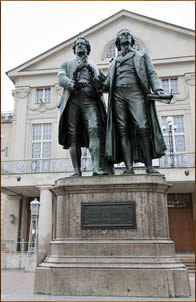
Uit: Goethe und Schiller. Geschichte einer Freundschaft

“Goethe und Schiller waren darauf gefaßt, daß man ihrer überdrüssig werden könnte, und übten sich beizeiten in der Kunst der Publikumsbeschimpfung. Ihren Freundschaftsbund verstanden sie auch als Trutzburg, von wo aus sie wohlgelaunt ihre Blitze gegen das zeitgenössische literarische Leben schleuderten.
Goethe und Schiller waren Konkurrenten, ehe sie zu Freunden wurden. Goethe fühlte sich vom Ruhm des Jüngeren bedrängt. Für ihn war Schiller zunächst nichts anderes als eine ungute Erinnerung an den eigenen, inzwischen überwundenen Sturm und Drang. Und Schiller sah in Goethe eine stolze Prüde, der man ein Kind machen muß, um sie vor der Welt zu demütigen. Es mußte einiges geschehen, ehe Schiller an Goethe schreiben konnte: Wie lebhaft habe ich … erfahren . . ., daß es dem Vortrefflichen gegenüber keine Freiheit gibt als die Liebe und Goethe Schiller gegenüber erklärte: Sie haben mir eine zweite Jugend verschafft und mich wieder zum Dichter gemacht, welches zu sein ich so gut als aufgehört hatte.
Was hier im einzelnen geschehen war, davon erzählt dieses Buch. Wie der junge Schiller den bewunderten Goethe bei der Preisverleihung an der Karlsschule als Gast des Herzogs zum ersten Mal erblickte. Wie es in den nächsten Jahren zu einer eigenartigen Parallelität der Lebensläufe kam: Zweimal Flucht und Verwandlung. Schiller flieht aus Stuttgart und dem Machtbereich des Herzogs. Goethe flieht nach Italien. Für beide ist es eine Befreiung zu neuem Künstlertum. Zweimal auch ein neuer Liebesbund. Schiller und Charlotte, Goethe und Christiane. Goethe verliebt und bindet sich sozial nach unten, Schiller nach oben. Dann die mühsame Annäherung, Schiller tastet sich zu Goethe vor, der aber hält auf Abstand. Im Sommer 1794 in Jena schließlich das glückliche Ereignis der gelungenen Begegnung. Von da an beginnt der Briefwechsel, wohl das bedeutendste gemeinsame Werk der beiden und die wichtigste Quelle dieses Buches. Von 1794 bis zum Tode Schillers im Mai 1805 währt die Freundschaft. Die Polarität der Temperamente und Charaktere bewirkt bei jedem eine Steigerung der schöpferischen Kräfte, bei Goethe vor allem in den ersten, bei Schiller in den letzten Jahren der Freundschaft.”


Rüdiger Safranski (Rottweil, 1 januari 1945)

Goethe en Schiller voor het Nationaltheater in Weimar

Lees verder “Rüdiger Safranski, Carry van Bruggen, Joe Orton, Mariano Azuela, René de Ceccatty”

Adonis

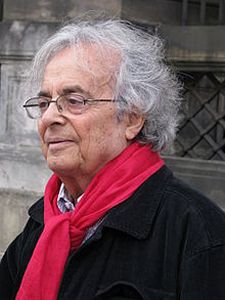
De Syrische schrijver Adonis (pseudoniem van Ali Ahmad Sa’id) werd geboren op 1 januari 1930 in Qassabin in het noorden van Syrië. Hij bezocht een Franstalige middelbare school in Tartu en studeerde in 1954 af aan de Universiteit van Damascus. In 1955 werd hij voor een half jaar gevangen gezet vanwege zijn lidmaatschap van de Syrische Sociale Nationalistische Partij (SSNP).  Daarna vestigde hij zich met zijn vrouw in Libanon, waar hij samen met Yusuf al-Khal en andere beroemde schrijvers het avant-garde literaire tijdschrift Schi’r (“Poëzie”) in 1957 uitgaf. In 1960 verwierf hij het Libanese staatsburgerschap. In 1973 studeerde hij af aan de Universite Saint-Joseph in Beiroet. In de volgende jaren doceerde hij, ondanks de beginnende Libanese burgeroorlog, zowel aan de Universite Saint-Joseph, alsmede aan de Staatsuniversiteit (Université Libanaise) in Beiroet. Sinds 1985 is hij in ballingschap en woont hij in Parijs.  In het academisch jaar was 1998/1999 en 2001/2002 Adonis een Fellow aan het Institute for Advanced Study in Berlijn. Gedurende deze periode werkte hij aan de gedichtencyclus “Al Kitab” (het boek). Adonis is waarschijnlijk de meest belangrijke Arabische dichter van onze tijd. Door toevlucht te nemen tot klassieke Arabisch dichters, die vaak geen taboes kenden en kritisch waren ten opzichte van religie, probeert hij deze openheid te laten herleven. Behalve door zijn gedichten, wekte hij ook door zijn kritische essays herhaaldelijk opzien in de Arabische wereld.

New Testament

He doesn’t speak this language.
He doesn’t know the voices of the wastes—
a soothsayer in stony sleep,
he is burdened with distant languages.
Here he comes from under the ruins
in the climate of new words,
offering his poems to grieving winds
unpolished but bewitching like brass.
He is a language glistening between the masts,
the knight of strange words


 In the City of the Partisans

I.
Open your arms
O city of Partisans.
Welcome him with thorns
or with stones.
Bind his arms above his head,
stretch them into an archway to the grave,
tattoo upon his head
graven images, brand him with glowing coals
and let the flames consume Mihyar.

II.
More than an olive tree, more
than a river, more than
a breeze
bounding and rebounding,
more than an island,
more than a forest,
a cloud
that skims across his leisurely path:
all and more
in their solitude
are reading his book.


Vertaald door Adnan Haydar en Michael Beard


Adonis (Qassabin, 1 januari 1930)