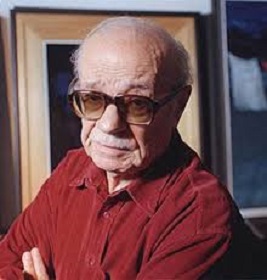
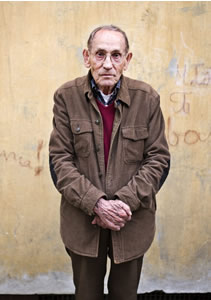
Jacqueline van der Waals, Aimé Césaire, Yves Beauchemin, Elisabeth Büchle, Laurie Lee, Pearl S. Buck, Branwell Brontë

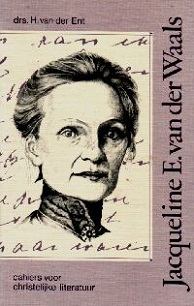
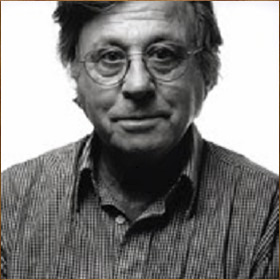
De Nederlandse dichteres Jacqueline Elisabeth van der Waals werd geboren op 26 juni 1868 in Den Haag. Zie ook alle tags voor Jacqueline van der Waals op dit blog.


Herfst

Vreemd, dat boom en tak zo stil staan
In het gouden licht vandaag,
Dat de bladertjes zo stil gaan,
’t Een na ’t ander, naar omlaag.

Dat het zonlicht zo voorzichtig
Door de ijlheid straalt van ’t lof,
En het groene blad doorzichtig
En veel eed’ler maakt van stof,

Dat het windje in de twijgen
Zo behoedzaam gaat te werk
En alleen wat blaadjes zijgen
Doet op ’t pad en ’t bloemenperk,

Zonder ’t wazig diep te raken
Waar de groene schemer blauwt,
Of de goudglans schuw te maken
In het ijlbebladerd hout,

Of te roeren aan de vijver,
Waar zeer statiglijk en traag
Twee voorname zwanen drijven
Met hun spiegelbeeld omlaag,

En wat late najaarsrozen,
Als bewasemend amethyst,
Al de weemoed van hun broze
Schoonheid heffen in de mist.


Moeder

Moeder naar wier liefde mijn verlangen
Sinds mijn kinderjaren heeft geschreid,
Ach, hoe zult gij mij zoo straks ontvangen
Na den langen scheidingstijd?

Zult gij me aanstonds als uw kind begroeten,
Als ‘k ontwaken zal uit mijnen dood?
Zal ik nederknielen mogen voor Uw voeten
Met mijn hoofd in uwen schoot……

Maar wat dan? Wat zult gij tot mij zeggen,
Bij het ver gegons van de engelenschaar,
Als ge uw jonge, blanke hand zult leggen
Op dit oude grijze haar.


Jacqueline van der Waals (26 juni 1868 – 29 april 1922)
Cover bloemlezing

Lees verder “Jacqueline van der Waals, Aimé Césaire, Yves Beauchemin, Elisabeth Büchle, Laurie Lee, Pearl S. Buck, Branwell Brontë”

Yann Martel, Michel Tremblay, Nicholas Mosley, Ingeborg Bachmann, Arseny Tarkovsky, George Orwell, Claude Seignolle

De Canadese schrijver Yann Martel werd op 25 juni 1963 geboren in Salamanca. Zie ook alle tags voor Yann Martel op dit blog.

Uit:Life of Pi

„I still smart a little at the slight. When you’ve suffered a great deal in life, each additional pain is both unbearable and trifling. My life is like a memento mori painting from European art: there is always a grinning skull at my side to remind me of the folly of human ambition. I mock this skull. I look at it and I say, “You’ve got the wrong fellow. You may not believe in life, but I don’t believe in death. Move on!” The skull snickers and moves ever closer, but that doesn’t surprise me. The reason death sticks so closely to life isn’t biological necessity—it’s envy. Life is so beautiful that death has fallen in love with it, a jealous, possessive love that grabs at what it can. But life leaps over oblivion lightly, losing only a thing or two of no importance, and gloom is but the passing shadow of a cloud. The pink boy also got the nod from the Rhodes Scholarship committee. I love him and I hope his time at Oxford was a rich experience. If Lakshmi, goddess of wealth, one day favours me bountifully, Oxford is fifth on the list of cities I would like to visit before I pass on, after Mecca, Varanasi, Jerusalem and Paris.


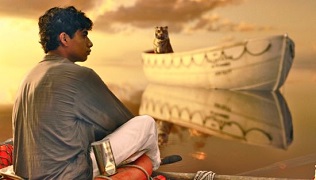
Scene uit de film “Life of Pi” uit 2012

I have nothing to say of my working life, only that a tie is a noose, and inverted though it is, it will hang a man nonetheless if he’s not careful.
I love Canada. I miss the heat of India, the food, the house lizards on the walls, the musicals on the silver screen, the cows wandering the streets, the crows cawing, even the talk of cricket matches, but I love Canada. It is a great country much too cold for good sense, inhabited by compassionate, intelligent people with bad hairdos. Anyway, I have nothing to go home to in Pondicherry.
Richard Parker has stayed with me. I’ve never forgotten him. Dare I say I miss him? I do. I miss him. I still see him in my dreams. They are nightmares mostly, but nightmares tinged with love. Such is the strangeness of the human heart. I still cannot understand how he could abandon me so unceremoniously, without any sort of goodbye, without looking back even once. That pain is like an axe that chops at my heart.”


Yann Martel (Salamanca, 25 juni 1963)

Lees verder “Yann Martel, Michel Tremblay, Nicholas Mosley, Ingeborg Bachmann, Arseny Tarkovsky, George Orwell, Claude Seignolle”

Rob van Essen

De Nederlandse schrijver en vertaler Rob van Essen werd op 25 juni 1963 geboren in Amstelveen en groeide op in Twente en op de Veluwe. Zijn eerste boek verscheen in 1996: “Reddend Zwemmen”. Daarna volgden: “Troje” (2000), “Kwade dagen” (2002), “Engeland is gesloten” (2004), “Het jaar waarin mijn vader stierf” (2006) en “Visser” (2008). Rob van Essen vertaalt vanuit het Engels, zowel fictie als non-fictie. Sinds 2005 maak t hij deel uit van de redactie van het Biografie Bulletin. Ook schrijft hij vanaf oktober 2007 voor NRC Boeken over Engelstalige literatuur.

Uit: In het restaurant (drie gangen)

“1. voorgerecht
Nadat hij mijn soep heeft neergezet, blijft de ober naast mijn tafeltje staan. Hij pakt het mes dat klaar ligt voor het hoofdgerecht en begint met de punt ervan in het tafellaken te tekenen. Hij trekt de lijnen van een slordige rechthoek, waarin hij her en der wat kleine vormen plaatst.
‘De woning van mijn grootmoeder,’ zegt hij zacht, en zonder mij aan te kijken trekt hij nog wat lijnen. Het tafellaken is dik, aan weerszijden van elke lijn bolt de stof een beetje op.
De kok komt naast hem staan en haalt zijn handen over zijn schort. ‘Kwam hij daar vandaan?’ Hij laat een dikke wijsvinger vlak boven de tekening zweven.
‘Nee, nee,’ zegt de ober. ‘Dat is de gang. Hij kwam via het balkon.’  Hij wijst met de punt van het mes.
De kok veegt met zijn hand over zijn ongeschoren kin en kijkt nadenkend naar de tekening.  ‘Soep goed, meneer?’ vraagt hij wanneer hij mijn blik vangt.
‘Ja, ja,’ zeg ik haastig, hoewel ik nog niet heb geproefd. Ik steek mijn hand uit naar de lepel.
De kok richt zich weer naar de ober. ‘En de balkondeuren?’
De ober haalt zijn schouders op. ‘Ze lag ik bed, wat kan ze nou…’
De kok knikt en kijkt weer naar de tekening, waarvan de lijnen langzaam vervagen. De ober ziet het ook en zet met de mespunt sommige lijnen  wat duidelijker aan.
Ik leg mijn lepel neer en strek mijn hand uit naar mijn glas rode wijn. Ik doe het niet goed, in plaats dat ik het glas oppak, gooi ik het om. De tekening van de ober wordt onmiddellijk bedekt door een grote paarsrode vlek.
De ober trekt wit weg. Hij keert zich naar mij, maar voor hij iets kan doen, pakt de kok hem vanachteren bij de schouders en trekt hem mee naar de keuken.
‘Alsof hij erbij was,’ sist de ober, ‘alsof hij erbij was.’ En hij blijft geagiteerd fluisteren. ‘Nee, nee, dat is onzin,’ zegt de kok, en hij blijft de ober kalmerend toespreken tot ze beiden achter de slappe klapdeuren naar de keuken zijn verdwenen.”

Rob van Essen (Amstelveen, 25 juni 1963)


Ernesto Sabato, Yves Bonnefoy, Scott Oden, Matthijs Kleyn, Madelon Székely-Lulofs, Josse Kok

De Argentijnse schrijver Ernesto Sabato werd op 24 juni 1911 geboren in Rojas, een dorp in de provincie Buenos Aires. Zie ook alle tags voor Ernesto Sabato op dit blog.

Uit: The Resistance (Vertaald door D. Ohmans)

“There are days when I arise with a demented hope, moments when I feel that the possibilities of a more human life are within reach of our hands. This is one of those days.
And then, I have set to writing almost groping in the dawn, with urgency, like one who might go into the street to ask for help against the threat of a fire, or like a ship that, at the point of disappearing, were to send a last and fervent signal towards a port it knows is near but deafened by the noise of the city and by the number of billboards that disturb the view.
I ask you that we pause to think of the greatness to which we can still aspire if we dare to value life in another way. I ask that courage of you which situates us on man’s true dimension. Everyone, at one time or another, yields. But there is something unfailing and it is the conviction that–only– spiritual values can save us from this earthquake that threatens the human condition.
While I write to you, I have lingered to touch a rustic statuette that the Tuobas gave to me and which reminded me, like a ray in my memory, of a virtual exposition that they showed me yesterday on a computer, which I should admit seemed to me like something from Mandingo. Because to the extent that we relate in an abstract manner, the further we move from the heart of things and a metaphysical indifference takes charge of us while entities without blood or proper names assume power. Tragically, man is losing dialogue with others and recognition of the world that surrounds him, given that it is there where encounters are made, where love is possible, the supreme gestures of life. Table talk, including the discussions or angers, already seem replaced by the hypnotic vision. Television tantalizes us, we remain almost captivated by it. This effect between magical and malevolent is due, I think, to the excess of its light that overcomes us with its intensity.”


Ernesto Sabato (24 juni 1911 – 30 april 2011)

Bewaren

Lees verder “Ernesto Sabato, Yves Bonnefoy, Scott Oden, Matthijs Kleyn, Madelon Székely-Lulofs, Josse Kok”

David Leavitt, Aart van der Leeuw, Pascal Mercier, Franca Treur, Jean Anouilh, Richard Bach, Anna Achmatova, Hanneke van Eijken

De Amerikaanse schrijver David Leavitt werd geboren in Pittsburgh op 23 juni 1961. Zie ook alle tags voor David Leavitt op dit blog.

Uit: The Two Hotel Francforts

“We met the Frelengs in Lisbon, at the Café Suiça. This was in June 1940, when we were all in Lisbon waiting for the ship that was coming to rescue us and take us to New York. By us I mean, of course, us Americans, expatriates of long standing mostly, for whom the prospect of returning home was a bitter one. Now it seems churlish to speak of our plight, which was as nothing compared with that of the real refugees – the Europeans, the Jews, the European Jews. Yet at the time we were too worried about what we were losing to care about those who were losing more.
Julia and I had been in Lisbon almost a week. I am from Indianapolis; she grew up on Central Park West but had dreamed, all through her youth, of a flat in Paris. Well, I made that dream come true for her — to a degree. That is to say, we had the flat. We had the furniture. Yet she was never satisfied, my Julia. I always supposed I was the piece that didn’t fit.
In any case, that summer, Hitler’s invasion of France had compelled us to abandon our Paris establishment and fly headlong to Lisbon, there to await the SS Manhattan, which the State Department had commandeered and dispatched to retrieve stranded Americans. At the time, only four steamships—the Excalibur, the Excambion, the Exeter, and the Exochorda—were making the regular crossing to New York. They were so named, it was joked, because they carried ex-Europeans into exile. Each had a capacity of something like 125 passengers, as opposed to the Manhattan’s 1, 20 0, and, like the Clipper flights that took offeach week from the Tag us, you couldn’t get a booking on one for love or money unless you were a diplomat or a VIP.
And so we had about a week to kill in Lisbon until the Manhattan arrived, which was fine by me, since we had had quite a time of it up until then, dodging shellfire and mortar fire all the way across France, then running the gantlet of the Spanish border crossing and contending with the Spanish customs agents, who in their interrogation tactics were determined to prove themselves more Nazi than the Nazis. And Lisbon was a city at peace, which meant that everything that was scarce in France and Spain was plentiful there: meat, cigarettes, gin. The only trouble was overcrowding.”


David Leavitt (Pittsburgh, 23 juni 1961)

Lees verder “David Leavitt, Aart van der Leeuw, Pascal Mercier, Franca Treur, Jean Anouilh, Richard Bach, Anna Achmatova, Hanneke van Eijken”

Nescio, Juliën Holtrigter, Jaap Robben, Willie Verhegghe, Henry Rider Haggard, Erich Maria Remarque, Dan Brown

De Nederlandse schrijver Nescio (pseudoniem van Jan Hendrik Frederik Grönloh) werd geboren in Amsterdam op 22 juni 1882. Zie ook alle tags voor Nescio op dit blog.

Uit: Dichtertje

“De duivel heeft altijd schik in lieve, jonge natuurlijke vrouwtjes, die veel van hun wettige man houden. Als ze een jaar of wat getrouwd zijn krijgen ze een vreemd heimwee naar een land, dat ze kennen. Maar ze zijn er toch nooit geweest. Hoe kunnen ze verlangen naar iets dat ze niet kennen? Hoe kun je iets kennen dat je toch niet kent? Vreemd, wat missen ze? En zingende zetten ze in den voorjaarsmorgen de balkondeuren open en ineens zijn ze weer vaag droevig. Waarom toch? C’est là, c’est là qu’il faut être.
Là? Waar? ‘’k Ben mal.’ En ze drukken hun kindje tegen zich aan en zoenen ’t erg.
(…)

Maar hij begreep zichzelf wel, akelig duidelijk en daarom gebeurde er niets. Hij zag haar aan en de dichter in hem aanbad haar en hief haar ten troon naast den God van hemel en aarde en durfde haar niet aanraken. En tegelijk zat diep in ’t dichtertje ’t beest gedoken voor den sprong, dat zich zat wilde vreten aan alles wat als een temptatie in onverschilligheid om hem heen had gestaan en langs hem was gelopen en hem niet erkend had. En haar eerst, ’t mooie, ’t beminde eerst, zoo dat er geen pardon meer zou zijn voor al ’t mindere. Haar te verheffen zoo hoog als de sterren in de winternacht en met haar ’t ergste te genieten en haar dan te laten vallen in ’t zwarte grondelooze. Op haar te wreken in het genot de tempteerende onverschilligheid. En wat zou een dichteresje ook beter verlangen, dan zóó te vallen.”


Nescio (22 juni 1882 – 25 juli 1961)

Lees verder “Nescio, Juliën Holtrigter, Jaap Robben, Willie Verhegghe, Henry Rider Haggard, Erich Maria Remarque, Dan Brown”

Tadeusz Konwicki, Xavier Grall, Anne Morrow Lindbergh, Johannes Baader, Ida von Hahn-Hahn, Jacques Delille

De Poolse schrijver en regisseur Tadeusz Konwicki werd geboren op 22 juni 1926 in Nowa Wilejka bij Vilnius. Zie ook alle tags voor Tadeusz Konwicki op dit blog.

Uit: The Calendar and the Hourglass (Vertaald door Daniel Bourne)

“But it would be even nicer if one could write the truth, the whole truth, about one’s times, one’s contemporaries, one’s self. But this is impossible for many reasons. I don’t know how to write for the drawer. To count on future generations takes either terrible humility or a crazed self-pride. I have no basis whatsoever to think that in ten years someone will want to reach for one of my books, much less want to rummage around in my house, which by then will have burned maybe three times. If I still have some desire or other to write, it’s only the desire to correspond with those of my own age, those whom I know like the back of my hand, those whom I despise and hate and still must love, because after all I know no others.
Thus, I can only manage to write about these times of ours in the broadest of terms, about people warily and without name, while to write about myself just isn’t worth it, for it is too easy to fall into the trap of a nasty self-preening egotism, in which studier literati than I have strangled themselves. My biggest regret is the matter of writing the truth about my contemporaries. I could have had a field day. All these levels of crap we carry around like the layers on an onion. Some even look like old artichokes. Truth is a basic instinct each one of us violates daily. Truth is our last sip of air, our deathbed absolution.
I realize the obligations I have towards my reader, which out of a false sense of pride I am going to call my confidant. I know what people like to read. I know that pages covered with small type, unfestooned with frequent breakages of paragraphs and unembellished with waterfalls of dialogue would scare off the most tenacious. I know that it is boring to wade through a bunch of thoughts when they are not all that golden. And when they are golden, one can still get stuffed, even at times to choke.”


Tadeusz Konwicki (Nowa Wilejka, 22 juni 1926)

Lees verder “Tadeusz Konwicki, Xavier Grall, Anne Morrow Lindbergh, Johannes Baader, Ida von Hahn-Hahn, Jacques Delille”

Aaro Hellaakoski


De Finse  dichter, criticus en geograaf Aaro Hellaakoski werd geboren op 22 juni 1893 in Oulu. Van beroep was hij een geograaf die onderzoek deed op het gebied van fysische geografie en geomorfologie en die werkzaam was als geografieleraar en als universitair docent. Als geograaf publiceerde hij wetenschappelijke studies over onderwerpen als de geologische geschiedenis van het Saimaa-meer en de geologische geschiedenis van het Puula-meer. Hellaakoski bracht jarenlang zijn zomers door met geomorfologisch veldwerk in het Finse merengebied. Hij schreef ook enkele schoolboeken over aardrijkskunde. Daarnaast werkte Hellaakoski, die zeer geïnteresseerd was in schilderkunst en erg vertouwd met de kunstgeschiedenis, als literatuur- en kunstcriticus. Zijn literaire werk bevat enkele van de vroegste voorbeelden van het modernisme in de Finse literatuur. Zijn eerste dichtbundel “Runoja” (Gedichten) verscheen in 1916 kreeg nog slechte recensies – Eino Leino deed hem af als onvolwassen, zowel qua inhoud als vorm. De volgende bundels “Nimettömiä lauluja” (Naamloze liederen) en “Me Kaksi” (Wij Twee) werden al beter ontvangen. De jaren 1920 waren een intens creatieve periode voor Hellaakoski, die zich ook waagde aan het maken van aquarellen. Hij publiceerde drie dichtbundels, studies over kunstenaars en een verzameling van korte verhalen “Iloinen yllätys” (Gelukkige verrassing) 1927). Met “Jääpeili” (1928, IJsspiegel) bereikte Hellaakoski het hoogtepunt van zijn vroege periode. De innovatieve picturale typografie in ‘Sade’ en ‘Dolce far niente’ herinnerde aan Apollinaires Calligrammes (1918). Andere inspiratiebronnen waren het kubisme en de Italiaanse, futuristische dichter FT Marinetti. Na deze bundel, die slecht werd verkocht, publiceerde Hellaakoski 12 jaar lang niets meer. Zijn eerstvolgende bundel “Vartiossa” (Eng: On guard) verscheen in 1941. Voor de Winteroorlog (1939-1940) had Hellaakoski gedacht dat de uitgave van zijn gedichten een “grafsteen voor een levend lichaam” zou zijn, maar de oorlog brak zijn mentale blokkade, Hij las Fröding, Rilke, Goethe en Verlaine en voelde dat hij nog dingen te zeggen had als dichter. “Uusi Runo” (1943) – de titel betekent ‘nieuw gedicht “- werd tijdens de vervolgoorlog ‘s nachts geschreven. Belangrijke werken uit deze latere periode zijn onder andere “Huojuvat keulat” (1946, Eng: The swaying prows) en Sarjoja (1952, Eng: Suites). Naast gedichten en geografische studies publiceerdep Hellaakoski essays, korte verhalen en aforismen.


Evening

How ranquilly the evening’s darkening,
dusk deepening beneath the trees.
Consult the long alleyways of the skies
for the gift of this evening
and the cause of your ease.

But the waste! the pain and stress –
those reachings into secrets of the dark –
quarrying endlessness,
plummeting bottomlessness,
quizzing every question mark.

Why this rummaging into whence and why?
Empty let’s be. Open and free.
Let secrets come, or let them fly
away, diffuse like cloudscapes
or whisperings through a tree.

Eyes must glow as your spirits peer
through a wakeful cranny in where you are.
Only the silent have ears to hear.
When the doorstep feels the touch of a toe
only the vigilant’s door is ajar.


Moonlight in the forest

Under the sleeping branches light
glimmers weirdly in the night,

through the wood the cryptic road
comes from nowhere, nowhere goes.

My shadow’s fled. And soon
my body’s gone. Dissolved in moon.

My footfall hovers ownerless.
Fingers touch on emptiness.


Vertaald door Herbert Lomas
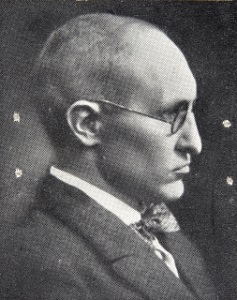


Aaro Hellaakoski (22 juni 1893 – 23 november 1952)
Ed Leeflang, Thomas Blondeau, Anne Carson, Adam Zagajewski, Ian McEwan, Alon Hilu, Robert Menasse

De Nederlandse dichter Ed Leeflang werd geboren op 21 juni 1929 in Amsterdam. Zie ook alle tags voor Ed Leeflang op dit blog.


Ze is zo groot

Ze is zo groot, zo warm, zo zonnig.
Ze haalt haar wijsheid uit een land
waar vuilnisbakken zijn beverfd met bloemen;
’s zomers zeilt zij op haar houten ledikant.

Haar lach vliegt zeer omslachtig
als een fazant bijvoorbeeld door het lokaal,
zo kleurig ook; zij houdt van allemaal
en niemand is alleen gelaten.
Ze kan niet haten.

Op het bord zij waaren en hij hete;
ze is er voor het zijn, niet voor het weten,
naar kennis heeft ze nooit gedorst.
Ze is zo groot, zo warm, zo zonnig;
ze geeft straks heel de klas de borst.


 Werkcoupé

Besneeuwde velden zijn de wereld zelf.
De zware hekken sluiten niets meer af.
Tot suikerbeesten eten paarden zich
waarna de bakker ze komt halen.
O palmen van de boerenkool.
Magere haas, golfplaat van eterniet,
contour die slingert, sierend niets
voorbijschiet en ontroert.
De reigers vasten, maraboes
mijn stiltes trouw gebleven
in menselijk teveel. Tellen
houdt op. Roestende emmer, halfbedoelven
steekt schuins zijn hengsel uit
naar het gewapend riet.
Houwdegens posten in de leegte
het liefste bij verdriet.


Kortenhoef

De avond komt over de kleine binnenplas.
Ik peddel niet meer, licht zuchtend loopt
de kano vast in de plompeblaren. Nog een
kleine opmerking van de wind
achter mij in het riet. De watermunt
geurt me met kracht achterna van het
licht aanvaren.

Een fuut komt haastig nog door de ban,
met watervrees zwemmend, alsof het zo weer
spertijd is, weer jeugd en oorlog worden kan.

Een bel ontploft zacht aan het oppervlak;
heeft ook het ongeborene al ontzetting?

Wat heb je toch met de stilte,
steeds minder beangste, verouderde man?
Je leven heb je onder de leden
en je wil toch niemand meer laten delen
in die besmetting?


Ed Leeflang (21 juni 1929 – 17 maart 2008)

Lees verder “Ed Leeflang, Thomas Blondeau, Anne Carson, Adam Zagajewski, Ian McEwan, Alon Hilu, Robert Menasse”

Jean-Paul Sartre, Machado de Assis, Georg Lentz, Chitra Gajadin, Helmut Heißenbüttel, Françoise Sagan

De Franse schrijver Jean Paul Sartre werd geboren op 21 juni 1905 in Parijs. Zie ook alle tags voor Jean-Paul Sartre op dit blog.

Uit: Nausea (Vertaald door Robert Baldick)

“I jump up: it would be much better if I could only stop thinking. Thoughts are the dullest things. Duller than flesh. They stretch out and there’s no end to them and they leave a funny taste in the mouth. Then there are words, inside the thoughts, unfinished words, a sketchy sentence which constantly returns: “I have to fi. . . I ex. . . Dead . . . M. de Roll is dead . . . I am not … I ex. . .” It goes, it goes . . . and there’s no end to it. It’s worse than the rest because I feel responsible and have complicity in it. For example, this sort of painful rumination: I exist, I am the one who keeps it up. I. The body lives by itself once it has begun. But though I am the one who continues it, unrolls it. I exist. How serpentine is this feeling of existing, I unwind it, slowly. … If I could keep myself from thinking! I try, and succeed: my head seems to fill with smoke . . . and then it starts again: “Smoke . . . not to think . . . don’t want to think … I think I don’t want to think. I mustn’t think that I don’t want to think. Because that’s still a thought.” Will there never be an end to it?
My thought is me: that’s why I can’t stop. I exist because I think . . . and I can’t stop myself from thinking. At this very moment, it’s frightful, if I exist, it is because I am horrified at existing. I am the one who pulls myself from the nothingness to which I aspire: the hatred, the disgust of existing, there are as many ways to make myself exist, to thrust myself into existence. Thoughts are born at the back of me, like sudden giddiness, I feel them being born behind my head … if I yield, they’re going to come round in front of me, between my eyes, and I always yield, the thought grows and grows and there it is, immense, filling me completely and renewing my existence.”

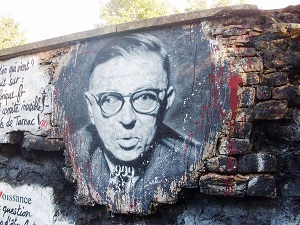
Jean-Paul Sartre (21 juni 1905 – 15 april 1980)
Portret op een muur in Saint-Romain-au-Mont-d’Or


Lees verder “Jean-Paul Sartre, Machado de Assis, Georg Lentz, Chitra Gajadin, Helmut Heißenbüttel, Françoise Sagan”