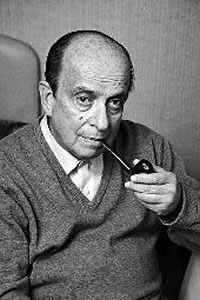
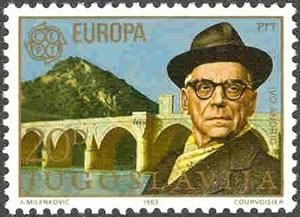
De Servisch-Kroatische schrijver Ivo Andrić werd geboren op 9 oktober 1892 in het dorpje Dolac in de buurt van Travnik, Bosnië. Zie ook alle tags voor Ivo Andrić op dit blog.
Uit: The Pasha’s Concubine (Vertaald door Joseph Hitrec e.a.)
„In the forenoon of the second day, as he was returning from the drill field, the Pasha and his escort found themselves in the bazaar. They rode cautiously over the thawing ice. It was a market day, and in front of the Garić Bakery their way was blocked by some peasants’ horses laden with wood. While the flustered farmers began to hop and skip around the stubborn horses, the Pasha cast a glance into the bakery. Next to the closed brick oven stood the old baker Ali, stoop-shouldered, with rheumy, wizened eyes out of which tears kept oozing on his great white mustache. At the wide-open shopwindow, among the bread loaves and pans of meat and pies, was his daughter Mara. On her knees and propped on the counter with one arm, she had stretched the other for a platter on a shelf underneath. When she heard the shouts of the soldiers and the stamping of the peasants’ horses, she lifted her head, and the Pasha, seeing her wrapped like this around the counter, fell in love with her round, childish face and her merry eyes.
When he rode that way again in the afternoon, the bakery was deserted, the window half-shuttered, and on the sill was a purring cat with signed white hair.
He gave orders that the girl be found and brought to him. The noncommissioned officers and town constables ran eagerly to carry them out. He stayed over till noon of the third day, when they reported that the matter could be arranged. The girl had no one except her father. Her mother had been well-known Jelka, named Hafizadić after the old Mustaybey Hafizadić, who had kept her for several years and then married her off to this Garić, a quiet and simple-minded young man, to whom he had also given money to open the bakery.
The Pasha left some money and entrusted the matter to his old acquaintance Teskeredžić. And toward the end of March, on another market day, they brought the girl to him at Sarajevo.
The Pasha had not been wring in his judgment. She was the kind of woman he had always sought and particularly esteemed, the only kind that still attracted him. She was not quite sixteen. She had big eyes of a dovelike shade and muted porcelain luster, which moved languidly. Her hair was quite fair, heavy, and thick, such as was seldom seen on women in this region. Both her face and her arms were covered with a fine, light down that was noticeable only in sunlight.“
Lees verder “Ivo Andrić, Johannes Theodor Baargeld, Christian Reuter, Holger Drachmann”