P. C. Boutens, Ellen Gilchrist, Julia Franck, Georges Bernanos, William Carleton, Cornelis Sweerts

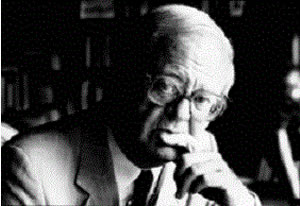
De Nederlandse dichter Pieter Cornelis Boutens werd geboren in Middelburg op 20 februari 1870. Zie ook alle tags voor P. C. Boutens op dit blog.


 Zooals een kind

Zooals een kind, dat trouw aan moeders knie
Zegt, vóor het slapen gaat, dezelfde beê,
Elk’ avond ’t eigen woord van troost en vreê,
Napratend z’n moeder de oude litanie,
En ’t legt zijn hoofd gerust neêr en gedwee,
Al weet het niet, wat het bidt of tot wien,
Maar bad het niet, dan zou ’t zijn oog misschien
Niet luiken uit vage angst voor komend wee; –

Zoo zal mijn hart het goede blijven doen
Zonder verwachting van loon, zonder doel,
Alleen om ’t goede zelf, omdat ik voel,
Dat ’t zóo zal kunnen slapen in den nacht,
En leven tevreden, als de zon lacht
Over de bloemen van den zomernoen.


 Uit:Strofen en andere verzen uit de nalatenschap van Andries de Hoghe

Vierde strofe

De dagen lengen ongeteld tot weken;
al maanden ligt mijn schip ter reede op stroom;
en al dien tijd verkeer ik in hun stad,
een stil en onopmerklijk vreemdeling
die niemand zoekt en niemand van zich weert
en niemand aanstoot geeft. Met reede penningen
koop ik het weinige wat ik behoef,
en ding niet op hun overvragen af:
zoo won ik onbedacht hun brave hebzucht,
en niets blijkt over dat ik winnen kan;
voetstoots heeft hun verwondering aanvaard
den vreemden dwaas die niet de waarde kent
van geld en goed, wiens onbegrepen luim
hun eng-verdaaglijkscht leven doelloos deelt…
En onderwijl, als staâg en ongerept
achter den schijn van ondiep dageblauw
de groote gang der sterren zich voltrekt,
neemt hemelhoog het stille wonder stand.
Welhaast, misschien dez’ eigen avond nog
(zoo zingt het voorgevoel van mijn geduld)
spreekt zich de trage bloode droomer uit,
de jongste broeder die mij nimmer moeit,
en dien ik nauwlijks op te merken lijk…
Hij vindt zijn moeder in het schemeruur,
met oogen als diepdonkre bloemen open,
en zucht dat hij niet langer leven kan
binnen de grenzen van het oude huis,
dat hij den broederen zijn erfdeel laat
en heen zal gaan den koelen einder in
vóordat de schaamte om onverdiend geluk
zijn liefde moordt tot onverschilligheid
zoodat hij haar niet meer beminnen zou…
Met de eerste sterren komt hij stil aan boord
en zet zich zwijgend op de bleeke plecht.
Dan gaat het breede witte zeil omhoog,
en met hem keer ik naar mijn verre land.
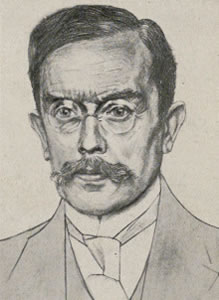


Pieter Cornelis Boutens (20 februari 1870 – 14 maart 1943)
Lees verder “P. C. Boutens, Ellen Gilchrist, Julia Franck, Georges Bernanos, William Carleton, Cornelis Sweerts”

Siri Hustvedt, Helen Fielding, Jaan Kross, Helene Hegemann, Dmitri Lipskerov, Björn Kuhligk, Wolfgang Fritz

De Amerikaanse schrijfster en essayiste Siri Hustvedt werd geboren op 19 februari 1955 in Northfield, Minnesota. Zie ook alle tags voor Siri Hustvedt op dit blog.

Uit: The Sorrows of an American

“The day Inga and I began working, the weather outside was heavy. Through the large window, I looked at the thin layer of snow under an iron-colored sky. I could feel Inga standing behind me and hear her breathing. Our mother, Marit, was sleeping, and my niece, Sonia, had curled up somewhere in the house with a book. As I pulled open a file drawer, I had the abrupt thought that we were about to ransack a man’s mind, dismantle an entire life, and without warning a picture of the cadaver I had dissected in medical school came to mind, its chest cavity gaping open as it lay on the table. One of my lab partners, Roger Abbot, had called the body Tweedledum, Dum Dum, or just Dum. “Erik, get a load of Dum’s ventricle. Hypertrophy, man.” For an instant I imagined my father’s collapsed lung inside him, and then I remembered his hand squeezing mine hard before I left his small room in the nursing home the last time I saw him alive. All at once, I felt relieved he had been cremated.
Lars Davidsen’s filing system was an elaborate code of letters, numbers, and colors devised to allow for a descending hierarchy within a single category. Initial notes were subordinate to first drafts, first drafts to final drafts, and so on. It wasn’t only his years of teaching and writing that were in those drawers, but every article he had written, every lecture he had given, the voluminous notes he had taken, and the letters he had received from colleagues and friends over the course of more than sixty years. My father had catalogued every tool that had ever hung in the garage, every receipt for the six used cars he had owned in his lifetime, every lawnmower, and every home appliance—the extensive documentation of a long and exceptionally frugal history. We discovered a list for itemized storage in the attic: children’s skates, baby clothes, knitting materials. In a small box, I found a bunch of keys. Attached to them was a label on which my father had written in his small neat hand: “Unknown Keys.”

 
Siri Hustvedt (Northfield, 19 februari 1955)

Lees verder “Siri Hustvedt, Helen Fielding, Jaan Kross, Helene Hegemann, Dmitri Lipskerov, Björn Kuhligk, Wolfgang Fritz”

Nick McDonell, Toni Morrison, Robbert Welagen, Bart FM Droog, Huub Beurskens, Gaston Burssens

De Amerikaanse schrijver Nick McDonell werd geboren op 18 februari 1984 in New York. Zie ook alle tags voor Nick McDonell op dit blog.

Uit: Twelve

“And White Mike ran after them, barking and howling, and Hunter ran after him, and White Mike let them get away after a couple blocks. Hunter put White Mike in a cab, but he had to convince the cabbie to take White Mike, and pay him in advance. The cabbie was jumpy and looked in the mirror at White Mike the whole ride. White Mike had his head out the window, staring at the pedestrians. When White Mike got home and collapsed in his bed with his shoes and clothes still on, his last thought before sleep was Why not? He had been awake for three days.
White Mike gets out of a cab on Seventy-sixth Street and Park Avenue. He looks at the number of the cab: 1F17. He memorizes the number every time he gets out of a cab, in case he leaves anything behind. This has never happened.
Down Park Avenue there are Christmas lights wrapped around all the trees and bushes, and the wires give the snow better purchase, so the frost hangs low from the branches. When the lights turn on at night the trees almost disappear between the bulbs, and the disembodied points of light outline jagged constellations in the dark air. It is getting past dusk, and White Mike remembers one night, years ago, when his mother was still alive and she sat on the edge of his bed, tucking him in for the night, and told him about Chaos Theory. White Mike remembers exactly what she said. The story she told him was about how if a butterfly died over a field in Brazil and fell to the ground and made a mouse move or a tiny shoot of grass bend, then everything might be different here, thousands and thousands of miles away.
“How come?”,he asked.
“Well, if one thing happens and changes something else, then that thing changes something else, right? And that change could come all the way around the world, right here to you in your bed.” She tweaked his nose.”Did a butterfly do that?”
“Did the butterfly die?”,he asked her back.
The lights on Park Avenue suddenly turn on. White Mike can feel his beeper vibrating again.”

 
Nick McDonell (New York, 18 februari 1984)
Chace Crawford als Mike in de film “Twelve” uit 2010

Lees verder “Nick McDonell, Toni Morrison, Robbert Welagen, Bart FM Droog, Huub Beurskens, Gaston Burssens”

Maarten Mourik

De Nederlandse dichter, publicist en diplomaat Maarten Mourik werd geboren in Streefkerk op 18 februari 1923 als zoon van een boer die later gemeenteambtenaar werd. In de Tweede Wereldoorlog verbleef hij als dwangarbeider in Bernau in Duitsland. In 1946 trad hij in dienst van het ministerie van Buitenlandse Zaken. Hij was van 1978 tot 1985 ambassadeur van Nederland bij de UNESCO. Hij ging in 1988 met pensioen. Na zijn pensionering richtte Mourik in 1990 het Nederlands-Vlaamse ‘Comité Buitenlands Cultureel Beleid’ mee op, dat zich inzette voor een meer actief buitenlands cultureel beleid. Mourik werd echter vooral bekend na zijn loopbaan toen hij in januari 2001 een aanklacht indiende tegen Jorge Zorreguieta wegens ‘misdaden tegen de menselijkheid’; hij had opdracht gegeven aan de Amsterdam International Law Clinic, later aan de advocaten Britta Böhler en Liesbeth Zegveld om te onderzoeken of aangifte mogelijk was. Het Nederlandse Openbaar Ministerie besloot na die aanklacht dat in Nederland niet tot vervolging kon worden overgegaan. Over zijn strijd tegen Zorreguieta publiceerde hij in het boek “Dubbelgevecht”, waar hij ook zijn eigen strijd na een beroerte beschreef. In dit boek onthulde hij dat toenmalig algemeen secretaris van Beatrix der Nederlanden, Philip de Heer, een poging had gedaan Mourik van aangifte tegen Zorreguieta af te houden.

Nomade

En elke keer opnieuw dan loopt
men in de val van eigen dromen;
hoe vaak al heb ik niet gehoopt
in de oase aan te komen
waar niets meer tot vertrekken noopt,
met altijd groenend gras en bomen,
en water dat men krijgt, niet koopt.
Maar aan het lot is niet te ontkomen.

Want men voert met zich mee de beesten
waarvan men dienaar is en heer,
maar ’t eerste altijd nog het meeste
en zo bevuilt men keer op keer
wat paradijs had kunnen zijn,
en drijft zichzelf in de woestijn.


Het Vijfde Seizoen

Boven onze hoofden zwenken 
de trekvogels terug naar ’t Noorden; 
onder onze voeten breken 
narcissen door het herfstig gras; 
hoewel de nachten langer worden 
lengen nu ook de dagen weer;
– er is absoluut geen twijfel mogelijk: 
dit jaar brengt ons een tweede lente.

 
Maarten Mourik (18 februari 1923 – 30 september 2002)

Shahrnush Parsipur, Sadegh Hedayat, Mo Yan,Yevgeni Grishkovetz, Frederik Hetmann, Emmy Hennings

De Iraanse schrijfster Shahrnush Parsipur werd geboren op 17 februari 1946 in Teheran. Zie ook alle tags voor Shahrnush Parsipur op dit blog.

Uit: Touba and the Meaning of Night (Vertaald door Kamran Talattof and Havva Houshmand)

“Haji Adib thought about the women, “They can think.” Something had been shaken in him again, just as the first time he had seen the globe. Haji Adib thought, “Very well, you know that the earth is round, you knew it very well. But then why so much anxiety?” This knowledge threw him rapidly into depths of thought. In his studies he had read that some of the Greek philosophers had hypothesized the roundness of the earth. He knew that the scientists of the east also had knowledge of this fact. At least, a few of them knew it. Then Galileo had come and proven it. Haji Adib knew all of this, yet he wanted to continue believing in the squareness of the earth.
He sat on the edge of the octagonal pool and leaned his head on his left arm. He needed to understand why he wanted the earth to remain square. Impatiently, he wanted to throw aside any thought of the sleeping lady earth. But the thought would not leave him, spinning in the sphere of his mind…. Who was it who said that slaves were merely tools that spoke? Haji Adib had at last found a thought to keep him from dwelling on the sleeping lady of the earth. Who said it? Perhaps it was a Roman. He raised his eyebrows, but it would not come to him. He could not remember.
Who was it who had said, “Let us shut the books and return to the school of nature?” Again, his memory failed him. What had been the use of all his reading, he thought.
On the ground, ants were coming and going in a straight line. Haji Adib placed his index finger in the way of one of the ants. The ant stopped, shook his antennae, then climbed up his finger. Now that the earth was round, everything took on a different meaning. The ant walked aimlessly up and down Haji Adib’s finger. Without doubt, Rumi had been right: Nature progressed, ascended, and was always becoming. But did an ant think? Perhaps it had some kind of thought process. Not everything could be Haji Adib’s sole possession, particularly thought.”

 
Shahrnush Parsipur (Teheran, 17 februari 1946)

Lees verder “Shahrnush Parsipur, Sadegh Hedayat, Mo Yan,Yevgeni Grishkovetz, Frederik Hetmann, Emmy Hennings”

Dolce far niente (Charles Simic), Elisabeth Eybers, Anil Ramdas, Ingmar Heytze


Dolce far niente (Bij een huwelijksjubileum)


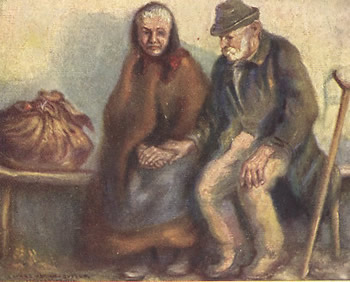
De ouderdom door Eduard Adrian Dussek, z.j.


Old Couple

They’re waiting to be murdered,  
Or evicted. Soon
They expect to have nothing to eat.  
In the meantime, they sit.

A violent pain is coming, they think.
It will start in the heart
And climb into the mouth.
They’ll be carried off in stretchers, howling.

Tonight they watch the window  
Without exchanging a word.  
It has rained, and now it looks  
Like it’s going to snow a little.

I see him get up to lower the shades.  
If their window stays dark,
I know his hand has reached hers
Just as she was about to turn on the lights.


Charles Simic (Belgrado, 9 mei 1938)

Lees verder “Dolce far niente (Charles Simic), Elisabeth Eybers, Anil Ramdas, Ingmar Heytze”

Dolce far niente (Ludwig August Frankl-Hochwart), Richard Blanco, Tobias Amslinger


Dolce far niente


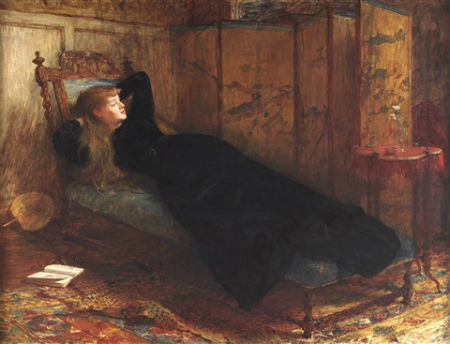
 sir-william-quiller-orchardson
Dolce far niente door Sir William Quiller Orchardson, 1872


Dolce far niente

Alller Sorgen leicht entbunden,
Hingestreckt im weichen Moose,
Fliehen ungezählt die Stunden,
Gleich den Düften einer Rose.

Glühende Orangen hängen
Sonnenmüd vom Baum herunter,
Vögel singen mit Gesängen
Eingeschlafne Lüftchen munter.

Faul sich dehmnd schlingt die Rebe
Sich von Stamme hin zu Stamme,
In dem grünenden Gewebe
Kocht des Weines süße Flamme.

Und in heißer Sonnenhelle
Liegt des Meeres blaue Fläche,
Ohne Rauschen, selbst die Welle
Träge ist sie zum Gespräche.

Bläulich war der Himmelsbogen
Und nun ist er roth geworden,
Wolken kommen angezogen
Mit gemalten, bunten Borden.

Und es treten goldne Sterne
Ueber mir in dunkle Räume, —
Alle Bilder, nah und ferne,
Sind sie wirklich, sind sie Träume?


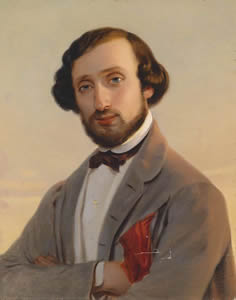
Ludwig August Frankl-Hochwart (3 februari 1810 – 12 maart 1894)
Portret door Leopold Pollack, 19e eeuw

Lees verder “Dolce far niente (Ludwig August Frankl-Hochwart), Richard Blanco, Tobias Amslinger”

Love and Friendship (Emily Brontë), Ischa Meijer, Alexander Kluge, Hanna Bervoets, Piet Paaltjens, Robert Shea, Frank Harris

Bij Valentijnsdag


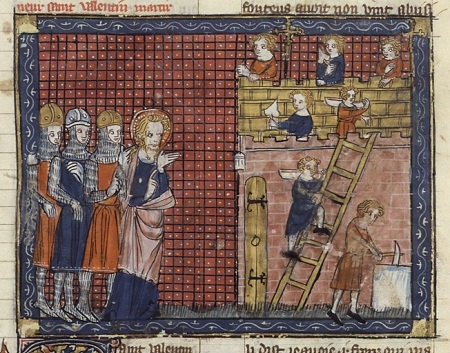
 valentine_montbaston
Illustratie uit:  Vies de saints door Richard de Montbaston et collaborateurs
Sint Valentijn en zijn leerlingen


Love and Friendship

Love is like the wild rose-briar,
Friendship like the holly-tree—
The holly is dark when the rose-briar blooms
But which will bloom most constantly?

The wild rose-briar is sweet in spring,
Its summer blossoms scent the air;
Yet wait till winter comes again
And who will call the wild-briar fair?

Then scorn the silly rose-wreath now
And deck thee with the holly’s sheen,
That when December blights thy brow
He still may leave thy garland green.


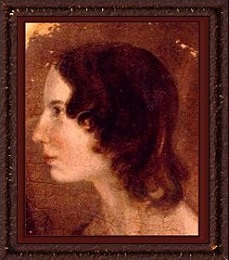
Emily Brontë (30 juli 1818 – 19 december 1848)

Lees verder “Love and Friendship (Emily Brontë), Ischa Meijer, Alexander Kluge, Hanna Bervoets, Piet Paaltjens, Robert Shea, Frank Harris”

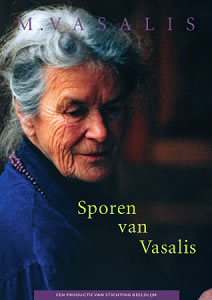
M. Vasalis, Jan Arend, Georges Simenon, Nynke van Hichtum, Urs Faes

De Nederlandse dichteres en psychiater M. Vasalis werd geboren in Den Haag op 13 februari 1909. Zie ook alle tags voor M. Vasalis op dit blog.

 Een witte ochtend

Een witte ochtend, eerste dooi
de lucht wit-grijs, egaal gespreid
en aan de lange horizon
welt nu een witte zon.
Geen wind, beweging of geluid.
Er botten waterdruppels uit;
aan iedre tak en iedre struik
zijn knoppen licht.

Een hartstochtsloze en totale aanwezigheid
maakt zich nu kenbaar en het is
of in een diepe adempauze van de tijd,
dichtbij, een pasgeboren kind
zich stil, volmaakt en ademend bevindt.


Eb

Ik trek mij terug en wacht.
Dit is de tijd die niet verloren gaat:
iedre minuut zet zich in toekomst om.
Ik ben een oceaan van wachten,
waterdun omhuld door ’t ogenblik.
Zuigende eb van het gemoed,
dat de minuten trekt en dat de vloed
diep in zijn duisternis bereidt.

Er is geen tijd. Of is er niets dan tijd?


Fanfare-corps

De lucht scheen blinkend door de blaren,
bleek en volmaakt als glas geslepen.
Met vaste manlijke gebaren
werden de horens aangegrepen,
en luidkeels, zonder enig schromen
spoot de muziek tussen de bomen;
heldhaftig, trots. Een onverbloemde
voor elk verstaanbare muziek,
die aan het ademloos publiek
ieder gevoel met name noemde.

En even plots werd dit geklater
gedempt, twee koopren kelen weenden…
– over het donkergroene water
gleden twee smalle witte eenden
geluidloos als een droombeeld voort –
De horens, smekend en gesmoord
schenen hen dringend iets te vragen,
hen volgend met haast menslijk klagen.

Een warm en onverwacht verdriet,
eerbied voor de gewoonste dingen,
neiging om hardop mee te zingen,
en dan te huilen om dit lied
ontstond in mijn verwend gemoed.
Ik voelde me bedroefd en goed.

 
M. Vasalis (13 februari 1909 – 6 oktober 1998)
Cover

Lees verder “M. Vasalis, Jan Arend, Georges Simenon, Nynke van Hichtum, Urs Faes”

Barbara Honigmann, Detlev Meyer, Lou Andreas-Salomé, Sabahattin Ali, Friedrich de la Motte-Fouqué, John Hennessy

De Duitse schrijfster Barbara Honigmann werd geboren op 12 februari 1949 in Oost-Berlijn. Zie ook alle tags voor Barbara Honigmann op dit blog.

Uit: Damals, dann und danach

„Frau Schulze wohnte im ersten Stock, und ich wohnte unter dem Dach. Ich war Studentin, und was Frau Schulze für einen Beruf hatte, weiß ich heute noch nicht. Wenn ich an ihrer Tür vorbeilief, hörte ich oft ein merkwürdiges Lärmen dahinter und manchmal eine merkwürdige Stille, und beides kam mir unheimlich vor, und manchmal hatte ich sogar das Gefühl, daß sie hinter der Tür stand und mir auflauerte. Abends und lange bis in die Nacht hörte man sie mit ihrer lauten Stimme durch das ganze Haus schreien und lallen. Ich hatte bald begriffen, daß sie eine Trinkerin war.
Deshalb schlich ich so leise, wie es mir nur irgend möglich war, an ihrer Tür vorbei, mehrmals jeden Tag.
An einem Abend aber riß sie tatsächlich, wie ich es schon immer befürchtet hatte, als ich vorbeischlich, die Tür auf, zerrte mich in ihre Wohnung hinein, mit Gewalt zog sie an mir und schubste und stieß mich, daß ich mich nicht wehren konnte, und brüllte auf mich ein, komm, Anne, komm rein, jetzt kommst du endlich rein, Anne, und dann drückte sie mich auf einen Stuhl in ihrer Küche, und da sah ich und roch den Alkohol, weil Frau Schulze mich gar nicht mehr losließ und heulte und grölte, bis ich endlich sagte:
»Was haben Sie denn, was ist denn los?«
Sie schrie immer mehr, warum ich nie gekommen sei, früher, was ich mir denn erlauben würde.
»Warum bist du nie wieder zu mir gekommen, Anne?«
Ich sagte, daß ich nicht Anne heiße und nicht Anne sei und daß sie mich wohl mit jemandem verwechseln müsse.
»Aber du bist eine Jüdin, ich habe dich sofort er- kannt!«
Ich habe »Ja« gesagt, »ich bin eine Jüdin«, sollte ich etwa nein sagen? Deswegen war ich noch lange nicht Anne! Doch nun ahnte ich es schon, woran es lag, daß sie so auf mich einschrie und mich nicht losließ.“

 
Barbara Honigmann (Oost-Berlijn, 12 februari 1949)

Lees verder “Barbara Honigmann, Detlev Meyer, Lou Andreas-Salomé, Sabahattin Ali, Friedrich de la Motte-Fouqué, John Hennessy”