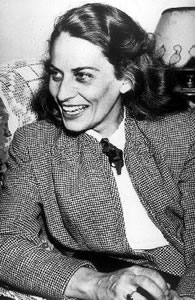
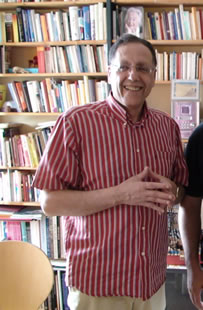
Pol Hoste, Jacques Audiberti, Filip De Pillecyn, Evliya Çelebi, Anne Fanshawe

De Vlaamse schrijver Pol Hoste werd geboren in Lokeren op 25 maart 1947. Zie ook alle tags voor Pol Hoste op dit blog.


Uit: Caran d’Ache


Goud


Zo droomt het televisiemeisje. Een windhoos is een

kleurenscherm, een watervlak draagt haar herinnering.

Men koopt ogen, een revue. Parfum van glanspapier.

Als ze door haar foto glijdt, is ze uit zichzelf

verdwenen.


Mauve


Tot in de diepste punten ben ik dagelijks veranderd,

dat is niet sterven, dat is uitspuwen of inslikken.

Ik ga bijvoorbeeld naar mijn zus, vertel haar van

mijn was. Vroeger wist ik ook wel alles en nu zelfs

meer en meer. Maar als ze kijken ben ik nog altijd

dezelfde. Ik durf me niet verroeren want dan huil je,

dan huil je. Een man heeft zijn eigen leven.


Pol Hoste (Lokeren, 25 maart 1947)


Lees verder “Pol Hoste, Jacques Audiberti, Filip De Pillecyn, Evliya Çelebi, Anne Fanshawe”

Antonio Fogazzaro, Daniel Schiebeler, Mary Webb, Erica Pedretti

De Italiaanse schrijver Antonio Fogazzaro werd geboren op 25 maart 1842 in Vicenza. Zie en ook mijn blog van 25 maart 2009 en ook mijn blog van 25 maart 2010.


Uit: The Saint


“Well,” said the girl, “I enjoy seeing Memling with Signor Carlino, playing classical music with him, discussing a Kempis with him, although this affection he has recently developed for a Kempis seems a

profanation, when you consider that he believes in nothing. _Je suis catholique autant qu’on peut l’etre lorsqu’on ne l’est pas_, but when I hear an unbeliever like your brother read a Kempis so feelingly, I very nearly lose my faith in Christianity as well. I like him for one other reason, dear, because he is your brother. But that is all! Oh! Jeanne Dessalle says such strange things sometimes–such strange things! I do not understand–I really do not understand. But _warte nur, du Raethsel_, as my governess used to say.”

“What am I to wait for?”

Noemi threw her arm round her friend’s neck, “I will drag your soul with so fine a net that it will bring beautiful great pearls to the surface, perhaps some sea-weed as well, and a little mud from the bottom, or even a very tiny _pioeuvre_.” “You do not know me,” answered Jeanne. “You are the only one of my friends who does not know me.”

“Of course. You imagine that only those who adore you really know you? Indeed, this belief that everybody adores you is a craze of yours.”

Jeanne made the little pouting grimace with which all her friends were familiar.

“What a foolish girl,” she said; but at once softened the expression with a kiss and a half-sad, half-quizzical smile.

“Women, as I have always told you, do adore me. Do you mean to say that you do not?”

“_Mais point du tout_,” exclaimed Noemi. Jeanne’s eyes sparkled with mischief and kindness.

“In Italian we say: _Si, di tutto cuore_,” she answered.“


Antonio Fogazzaro (25 maart 1842 – 7 maart 1911)

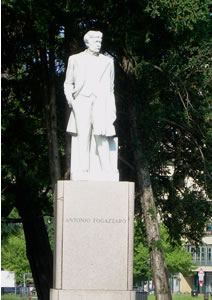
Standbeeld op de Campo Marzio in Vicenza


Lees verder “Antonio Fogazzaro, Daniel Schiebeler, Mary Webb, Erica Pedretti”

Martin Walser, Peter Bichsel, Dario Fo, Lawrence Ferlinghetti, Jacob van Lennep

De Duitse schrijver Martin Walser werd op 24 maart 1927 geboren in Wasserburg aan de Bodensee. Zie ook alle tags voor Martin Walser op dit blog.


Uit: Mein Jenseits


Je älter man wird, desto mehr empfiehlt es sich, darauf zu achten, wie man auf andere wirkt. Ich bin dreiundsechzig. Südlich der Donau sagt man zum Beispiel: Der und der wird auch allmählich komisch. Das merken alle, wissen alle, nur der, der allmählich komisch wird, merkt es nicht. Und sagen mag man’s ihm auch nicht. In Letzlingen – so heißt das Dorf, aus dem ich komme – in Letzlingen gab es – oder gibt es vielleicht sogar noch – eine Art Kultur des Umgangs mit solchen, die im Alter allmählich komisch wurden. Nirgends sonst habe ich von dieser Kultur auch nur noch einen Hauch verspürt. Ich will diese Art Kultur schildern, dann entscheide jeder selbst, ob es in seinem Dorf, seiner Stadt, seiner Gesellschaft dergleichen gebe. Ein Bauer heißt Peterer, ist eher siebzig als achtzig, sein Bruder Konrad ist immer Knecht auf dem Hof seines Bruders gewesen. Es hat sich dann herumgesprochen, dass er seit längerem nichts mehr sagt. Man kann ihn ansprechen, wie man will, er reagiert nicht. Er ist aber kein bisschen schwerhörig, das merkt man, wenn er das Vieh heimtreibt. Sobald eine Kuh stehen bleibt und nicht weiter will, geht er hin zu ihr und sagt ihr etwas ins Ohr. Wenn sie dann hinschaut zu ihm, sagt er: Jaa. Dann geht sie wieder. Auch wenn ihn ein Hund anbellt, sieht man, dass er das hört, genau hört.

Also zu Menschen keinen Kontakt mehr. Wenn man den Bauer fragt, was los sei mit Konrad, bohrt der Bauer mit dem Zeigefinger seine Schläfe an. Konrad schläft auch nicht mehr in seiner Kammer, sondern auf dem Heuboden. Wie und wo genau, ist nicht bekannt. Er ist allmählich komisch geworden. Zuerst hat man noch gefragt nach ihm, hat sich erkundigt, aber dann nicht mehr. Der Konrad ist allmählich komisch geworden.“


Martin Walser (Wasserburg, 24 maart 1927)

Lees verder “Martin Walser, Peter Bichsel, Dario Fo, Lawrence Ferlinghetti, Jacob van Lennep”

Harry Prenen, Top Naeff, Willem van Iependaal, Robert Hamerling, Fanny Lewald

De Nederlandse (gelegenheids)dichter, historicus, geschiedenisleraar, illustrator en journalist Harry Prenen werd geboren in Schoten op 24 maart 1915. Zie ook alle tags voor Harry Prenen op dit blog.


Uit: Het een en ander over Godfried Bomans


“Ze spraken over litteratuur, en achter mijn koffie gezeten sloeg ik het dispuut met een huivering van eerbied gade. Het waren studenten, poëten of essayisten, abonnées op ‘Podium’, vlijmscherpe critici die hun mes zo lang op de wetsteen van hun vernuft geslepen hadden, dat er nauwelijks iets mee te snijden viel. De scheppende talenten onder hen dronken zich dagelijks tot aan de nok toe vol met gedichten van Slauerhoff en essays van Vestdijk (..)

Het gesprek ging erover wie nu eigenlijk op het ogenblik onze beste prosateur mocht heten. Om mijn verlegenheid te verbergen en mijn pover zelfvertrouwen bij elkaar te schrapen, bestelde ik een taartje en keek wat naar buiten. En daar passeerde (..) mijn oude speelgenoot Bomans. Hij reed bedachtzaam op een motorfietsje en hield een karbiesje in de hand. Ik wenkte hem toe om naderbij te komen en aan de koffie met discussie deel te nemen. Doch hij had geen tijd en snelde verder om de trein te halen. Moest een lezing houden, vanavond. Blijkbaar deed hij weer ’n tocht naar de binnenlanden om hun de wereld te laten zien door het oog van een meikever.(..)

Toen ik mij weer omkeerde en mijn plaats zocht was de grootste prozaschrijver nog steeds niet gevonden. Vestdijk, die pas vijftig jaar was geworden, maakte echter een mooie kans. Tijdens het wikken en wegen begon er eentje:

 – ‘Tja, als ik het zeggen moet, de beste prozaïst in Holland is ….’

 – ‘Bomans!’  – Het was mijn stem die de twijfelende stilte brak. Ik had het gezegd voor ik het wist. De uitwerking was verrassend. Ze zetten alle twintig tegelijk hun glaasje neer en spalkten hun ogen open om te zien of ik in ernst sprak, – een van hen begon alvast te proesten -, maar toen de gloed der overtuiging mijn wangen kleurde barstte het ganse gezelschap in een bevrijdende schater los. Een springvloed van vrolijkheid stootte alle sluizen open, zoals zelfs de beste grap van Bomans zelf nooit te beurt was gevallen. Toen de vreugde wat bedaard was vroeg een ganse deputatie tegelijk: ‘Maar Vestdijk dan? En Slauerhoff, en du Perron en …..??’ ‘Bomans…. Nu ja, het moet dan maar: Bomans schrijft beter!’


Harry Prenen (24 maart 1915 – 20 oktober 1992)

Harry Prenen en Godfried Bomans


Lees verder “Harry Prenen, Top Naeff, Willem van Iependaal, Robert Hamerling, Fanny Lewald”

Richard Leising, Gabriele von Baumberg, Christian Schubart, Olive Schreiner, William Morris

De Duitse dichter Richard Leising werd geboren op 24 maart 1934 in Chemnitz. Zie ook mijn blog van 24 maart 2009 en ook mijn blog van 24 maart 2010.


Liebste


Hockt im Trauern, läuft im Singen

Hält sich auf in , weilt in Schliengen

Macht am Ende gar Gedichte

Gauklerflügel, Bleigewichte
Oder umgekehrte Lieder

Wackersteine, Lichtgefieder.


Die Bilder


Die Bilder bleiben nicht, wir bleiben heiter
Ein letztlich heiteres Geschlecht, weil diese gehen
Bis wir nicht mehr sie selbst, nur ihr Verschwinden sehen.
Gut, daß sie fliehn. Wir können sie nicht fliehen
Ihr einziger Weg ist: Weg von uns; das treibt sie weiter
Als wir mit unseren aufgeschlagnen Knien
Jetzt gehen sollten. Schon geht wunderbar
Anstatt des Bilds sein schnelles Fliehen uns an, noch schneller
(Das Bild wird dunkler und der Blick wird heller)
Bleibt uns nur wunderbar noch, daß es war.
Gut, daß es schwindet! Anders schwänden wir
Vor unseren Bildern hin und wären nicht mehr hier.


Richard Leising (24 maart 1934 – 20 mei 1997)

Lees verder “Richard Leising, Gabriele von Baumberg, Christian Schubart, Olive Schreiner, William Morris”

Mitch Cullin, Gary Whitehead, Yōko Tawada, Steven Saylor, Nils-Aslak Valkeapää

De Amerikaanse schrijver Mitch Cullin werd geboren op 23 maart 1968 in Santa Fe, New Mexico. Zie alle tags voor Mitch Cullin op dit blog.


Uit: The Post-War Dream 


„That serpentine formation of listless souls wound back into the darkness-the shapes of children, men and women, mothers cradling infants, the elderly-coming from where the cows had been headed, drawing nearer while never quite reaching him. But it was the gas mask each one wore which disturbed him the most-such cumbersome equipment obscuring their faces, too large for the heads of small children and practically consuming the entire bodies of the infants, giving the group a uniform, superficial appearance not unlike that of cattle. Even so, he perceived their determined movements as a kind of miserable retreat, a retrogression toward the past and, indeed, toward the living-where, upon arriving at their destination, he imagined the masks would be cast aside and all of them would inhale freely once more.

Yet every step of their bare feet was now preceded by labored breath, a collective exhalation delivered in unison and released as a muted, staccato gasp through chemical air filters-while their paper-thin skin contracted around pronounced rib cages, and many of their arms hung like broken branches at their sides. As the ragged column advanced steadily in the moonlight, he realized the physical condition of the people had deteriorated badly since he’d first seen them decades ago. Their clothing was either reduced to shreds or had fallen away, their ankles and feet were covered with sores, their hair was so long that it ran the length of their backsides, and the men’s thick beards jutted from beneath their masks. In that stream of pale, dirty bodies only their protruding bones shone clearly as they marched one after the other.

“Where are you going?” he had once asked them without speaking. “What is it you’re looking for? What do you want?”


Mitch Cullin (Santa Fe, 23 maart 1968)


Lees verder “Mitch Cullin, Gary Whitehead, Yōko Tawada, Steven Saylor, Nils-Aslak Valkeapää”

Federica de Cesco, Roger Martin du Gard, Hamvas Béla, Daniel Biga, Ceija Stojka

De Zwitserse schrijfster Federica de Cesco werd geboren op 23 maart 1938 in Pordenone, Zie alle tags voor Federica de Cesco op dit blog.


Uit: Muschelseide


Ricardo fühlte sich nicht wohl. Herzrhythmusstörungen. Die Anfälle traten gelegentlich auf, waren harmlos, aber unangenehm. Er nahm sie leider als Vorwand, um nicht in den Country-Club zu gehen, und wurde dabei immer blasser und dicker. Da er krank aussah und unsicher auf den Beinen war, sagte ich ihm, er solle sich ausruhen. Er schluckte seine Tabletten und zog sich früh zurück. Als ich später mit Francesca zu Abend aß, hätte ich sie gern gefragt, ob sie etwas über die japanische Gedenksäule wusste. Vielleicht hätte ich Glück: Es gab Momente, in denen ihr die Worte glatt von der Zunge rollten, ohne dass sie sich sehr anzustrengen brauchte. Und wiederum andere, in denen sie nur ihre Arbeit im Kopf hatte und ein Gespräch mit ihr wenig Sinn hatte. Letzteres war gerade der Fall: Sie war übel gelaunt.
Sie fand die Suppe zu salzig, beklagte sich über den Rinderbraten – der tatsächlich zäh war – und rauchte, bis es auch mir den Appetit verdarb. Ich ließ sie beim Portwein allein. Am Morgen erschien Ricardo wie gewohnt zum Frühstück und ließ sich die Zeitung bringen. Francesca erkundigte sich schnodderig nach seinen Befinden. Er antwortete freundlich. »Danke, Francesca. Mir geht es wieder gut.« Sie beließ es dabei. Ihr Leben schien erfüllt zu sein, erfüllt von Dingen, von denen sie nicht sprach. Ich kannte sie wirklich nicht gut. Sie war eine Fremde, von weither gekommen. Manchmal genügte eine Kleinigkeit, ein falsches Wort, dass sie zornig wurde.
Zorn begriff ich, was mir an ihr nicht gefiel, war, dass sie die Menschen so leichtfertig kränkte. Doch war ich nicht einmal sicher, dass sie es bewusst darauf angelegt hatte. Offen bar machte ihr die Malerei zu schaffen. Ihre Knochen womöglich auch. Ich fragte Ricardo, ob er seine Tabletten genommen hatte.“


Federica de Cesco (Pordenone, 23 maart 1938)


Lees verder “Federica de Cesco, Roger Martin du Gard, Hamvas Béla, Daniel Biga, Ceija Stojka”

Billy Collins, Arnold Sauwen, Albrecht Goes, Eveline Hasler, Wolfgang Bächler, Érik Orsenna

De Amerikaanse dichter en schrijver Billy Collins werd geboren in New York op 22 maart 1941. Zie ook alle tags voor Billy Collins op dit blog.


I Go Back To The House For A Book 


I turn around on the gravel and go back to the house for a book, something to read at the doctor’s office, and while I am inside, running the finger of inquisition along a shelf, another me that did not bother to go back to the house for a book heads out on his own, rolls down the driveway, and swings left toward town, a ghost in his ghost car, another knot in the string of time, a good three minutes ahead of me — a spacing that will now continue for the rest of my life.


Japan 


Today I pass the time reading

a favorite haiku,

saying the few words over and over.


It feels like eating

the same small, perfect grape

again and again.


I walk through the house reciting it

and leave its letters falling

through the air of every room.


I stand by the big silence of the piano and say it.

I say it in front of a painting of the sea.

I tap out its rhythm on an empty shelf.


I listen to myself saying it,

then I say it without listening,

then I hear it without saying it.


And when the dog looks up at me,

I kneel down on the floor

and whisper it into each of his long white ears.


It’s the one about the one-ton temple bell

with the moth sleeping on its surface,


and every time I say it, I feel the excruciating

pressure of the moth

on the surface of the iron bell.


When I say it at the window,

the bell is the world

and I am the moth resting there.


When I say it at the mirror,

I am the heavy bell

and the moth is life with its papery wings.


And later, when I say it to you in the dark,

you are the bell,

and I am the tongue of the bell, ringing you,


and the moth has flown

from its line

and moves like a hinge in the air above our bed.
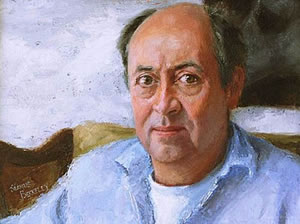


Billy Collins (New York, 22 maart 1941)

Portret door Seamus Berkeley


Lees verder “Billy Collins, Arnold Sauwen, Albrecht Goes, Eveline Hasler, Wolfgang Bächler, Érik Orsenna”

Gabrielle Roy, Ludvík Kundera, Léon Deubel, Edward Moore, Karel Poláček, Nicholas Monsarrat, Hans Grimm

De Canadese schrijfster Gabrielle Roy werd geboren op 22 maart 1909 in Saint Boniface, Manitoba. Zie ook mijn blog van 22 maart 2007 en ook mijn blog van 22 maart 2009 en ook mijn blog van 22 maart 2010. 


Uit: Children of My Heart


„Now I recognized him: an immigrant from the Abruzzi who had recently come to our town. As yet unable to find work in his own trade of upholsterer, he was doing odd jobs here and there. This was why I had seen him one day in our neighbourhood, digging up a patch of ground. I remembered that his little son has been with him, trying to help, that the two never stopped talking as they worked, no doubt spurring each other on, and that this murmur in a foreign tongue, at our fields’ edge, had seemed to have a special charm.

I went over to them with the very best smile I could muster. As I came near, the child cried out in terror and clung even more desperately to his father, who trembled on contact. I could see that he wouldn’t be much help. On the contrary, with his caresses and soft words he did nothing but keep alive the hope that he might weaken. And in fact the father began to plead with me. Since the boy was so unhappy, wouldn’t it be better to take him home just this once, and try again this afternoon or tomorrow morning, when he’d have time to explain what a school was.

I saw them hanging on my decision, and took my courage in my two hands: “No, when you have to make the break, it doesn’t help to wait.”

The father lowered his eyes, obliged to admit I was right. Even between the two of us we had trouble detaching the child; as soon as we loosened the grip of one hand it slipped away to grasp another handful of the father’s clothing. The odd thing was that while he continued to cling to his father he was furious with him for taking my side, and through his tears and hiccups was calling him a heartless wretch, or words to that effect.“


Gabrielle Roy (22 maart 1909 – 13 juli 1983)


Lees verder “Gabrielle Roy, Ludvík Kundera, Léon Deubel, Edward Moore, Karel Poláček, Nicholas Monsarrat, Hans Grimm”

Hamid Skif, Hubert Fichte, Peter Hacks, Michel Bartosik

De Algerijnse schrijver en journalist Hamid Skif werd geboren op 21 maart 1951 in Oran. Zie ook mijn blog van 21 maart 2009 en ook mijn blog van 21 maart 2010.


L‘ARBRE


J´étais venu me pendre à la plus haute branche

Mais l´arbre prit peur

Il s´est enfui en entendant mes pas

Je n´ai plus d´arbre

dans ce lieu ou l´homme n´habite que son ombre

Ôu les chiens n´habitent que l´ombre de l´homme


Ôu le vent est une blessure du ciel

Ôu la pluie mange les jours de fête


Je me suis assis sur le sable

De ma poche j´ai tiré une branche de papier

Je l´ai plantée à mon ombre

Et je suis devenu aussi grand


que l´arbre qui ferme l´horizon


O MEIN HERZ


O mein Herz

Sag nichts

Sag kein einziges Wort

Gib die Worte dem Honighändler

der durch die Straßen geht

die Hand über den Brauen, um seine grünen Augen zu

schützen

und bete

dass sie dich nie vergisst

dass sie jede Nacht deinen Namen schreit

und bete weiter

dass sie dir den Mondstrahl schenkt aus ihrem Körper

Bete für dich und für sie

Bete weiter, dass sie deine Wunden in sich behält

und mit dem Balsam reibt aus ihrer Seele


Vertaald door Andreas Münzer


Hamid Skif (Oran, 21 maart 1951)


Lees verder “Hamid Skif, Hubert Fichte, Peter Hacks, Michel Bartosik”