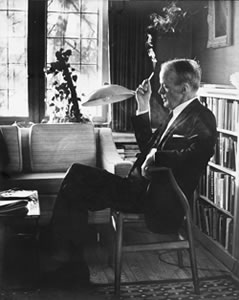
Selma Lagerlöf, Yevgenia Ginzburg, A.L. Snijders

De Zweedse schrijfster Selma Lagerlöf werd geboren op 20 november 1858 in Östra Emterwik in Zweden. Zie ook alle tags voor Selma Lagerlöf op dit blog.

Uit: Niels Holgersson’s wonderbare reis (Vertaald door Margaretha Meijboom) 

“Maar Vader en Moeder verheugden zich in ’t geheel niet; integendeel, ze waren heel bedroefd. Hij was een arme keuterboer, en hun hoeve was niet veel grooter dan een tuintje. Toen ze er in ’t begin kwamen wonen, konden zij daar niet meer dan een varken en een paar kippen houden; maar ze waren bizonder vlijtige en knappe menschen, en nu hadden ze èn koeien, èn ganzen. Het was hun buitengewoon goed gegaan, en ze zouden tevreden en blij naar de kerk zijn gewandeld, als ze

niet over hun zoon hadden hoeven denken. De vader klaagde er over, dat hij traag en lui was. In school had hij niets willen leeren, en hij was zoo onbruikbaar, dat men hem ternauwernood de ganzen kon laten hoeden. En Moeder kon niet ontkennen, dat dit waar was, maar zij was het meest bedroefd, omdat hij zoo wild en akelig was,–hard tegen de dieren en boosaardig tegenover de menschen.

“God moge zijn boozen wil breken, en hem een ander hart geven,” zei ze. “Anders wordt hij een ongeluk voor zichzelf en de onzen.”

De jongen stond er lang over na te denken of hij de preek zou lezen of niet. Toen was hij met zichzelf overeengekomen, dat het ’t beste was dezen keer gehoorzaam te zijn. Hij ging in den grooten leuningstoel zitten, en begon te lezen. Maar toen hij een poosje lang de woorden halfluid opgerabbeld had, was het alsof hij slaap kreeg van dat gerabbel, en hij merkte, dat hij knikkebolde.“
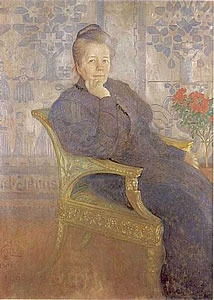


Selma Lagerlöf (20 november 1858 – 16 maart 1940)
Portret door Carl Larsson, 1908
Lees verder “Selma Lagerlöf, Yevgenia Ginzburg, A.L. Snijders”

Sharon Olds, Mark Harris, Christoph Wilhelm Aigner, Anna Seghers

De Amerikaanse dichteres Sharon Olds werd geboren op 19 november 1942 in San Francisco. Zie ook alle tags voor Sharon Olds op dit blog.


A Week Later 


A week later, I said to a friend: I don’t

think I could ever write about it.

Maybe in a year I could write something.

There is something in me maybe someday

to be written; now it is folded, and folded,

and folded, like a note in school. And in my dream

someone was playing jacks, and in the air there was a

huge, thrown, tilted jack

on fire. And when I woke up, I found myself

counting the days since I had last seen

my husband-only two years, and some weeks,

and hours. We had signed the papers and come down to the

ground floor of the Chrysler Building,

the intact beauty of its lobby around us

like a king’s tomb, on the ceiling the little

painted plane, in the mural, flying. And it

entered my strictured heart, this morning,

slightly, shyly as if warily,

untamed, a greater sense of the sweetness

and plenty of his ongoing life,

unknown to me, unseen by me,

unheard, untouched-but known, seen,

heard, touched. And it came to me,

for moments at a time, moment after moment,

to be glad for him that he is with the one

he feels was meant for him. And I thought of my

mother, minutes from her death, eighty-five

years from her birth, the almost warbler

bones of her shoulder under my hand, the

eggshell skull, as she lay in some peace

in the clean sheets, and I could tell her the best

of my poor, partial love, I could sing her

out with it, I saw the luck

and luxury of that hour.


The Unborn 


Sometimes I can almost see, around our heads,

Like gnats around a streetlight in summer,

The children we could have,

The glimmer of them.


Sometimes I feel them waiting, dozing

In some antechamber – servants, half-

Listening for the bell.


Sometimes I see them lying like love letters

In the Dead Letter Office


And sometimes, like tonight, by some black

Second sight I can feel just one of them

Standing on the edge of a cliff by the sea

In the dark, stretching its arms out

Desperately to me.


Sharon Olds (San Francisco, 19 november 1942)


Lees verder “Sharon Olds, Mark Harris, Christoph Wilhelm Aigner, Anna Seghers”

Allen Tate, Girolamo de Rada, Veronika Aydin

De Amerikaanse dichter Alan Tate werd geboren op 19 november 1899 in de buurt van Winchester, Kentucky. Zie ook alle tags voor Alan Tate op dit blog.


Light

Last night I fled until I came
To streets where leaking casements dripped
Stale lamplight from the corpse of flame;
A nervous window bled.

The moon swagged in the air.
Out of the mist a girl tossed
Spittle of song; a hoarse light
Spattered the fog with heavy hair.

Damp bells in a remote tower
Sharply released the throat of God,
I leaned to the erect night
Dead as stiff turf in winter sod.

Then with the careless energy
Of a dream, the forward curse
Of a cold particular eye
In the headlong hearse.


The Cross

There is a place that some men know,
I cannot see the whole of it
Nor how I came there. Long ago
Flame burst out of a secret pit
Crushing the world with such a light
The day-sky fell to moonless black,
The kingly sun to hateful night
For those, once seeing, turning back:
For love so hates mortality
Which is the providence of life
She will not let it blessed be
But curses it with mortal strife,
Until beside the blinding rood
Within that world-destroying pit
-Like young wolves that have tasted blood,
Of death, men taste no more of it.
So blind, in so severe a place
(All life before in the black grave)
The last alternatives they face
Of life, without the life to save,
Being from all salvation weaned-
A stag charged both at heel and head:
Who would come back is turned a fiend
Instructed by the fiery dead.


Allen Tate (19 november 1899 – 9 februari 1979)


Lees verder “Allen Tate, Girolamo de Rada, Veronika Aydin”

Joost Zwagerman, Toon Tellegen, Klaus Mann, Seán Mac Falls, Richard Dehmel

De Nederlandse dichter en schrijver Joost Zwagerman werd geboren in Alkmaar op 18 november 1963. Zie ook mijn blog van 18 november 2006 en ook mijn blog van 18 november 2007 en ook mijn blog van 18 november 2008 en ook mijn blog van 18 november 2009.


Uit: Chaos en Rumoer 


„Nadat Otto Vallei zich zes maanden lang iedere dag in zijn werkkamer had opgesloten om aan een roman te werken, biechtte hij zijn vrouw Karin op dat hij nauwelijks vorderingen had gemaakt. En zelfs dat was een zonnige voorstelling van zaken. In zekere zin was hij niet eens aan die roman begonnen.
Karin reageerde tamelijk laconiek op Otto’s bekentenis, wat hem eerst verbaasde, daarna opluchtte en uiteindelijk zachtjes kwetste. Hij kon natuurlijk niet van haar verlangen dat ze net als hij diep ontgoocheld was, maar een minimum van solidaire somberheid had hij toch wel van haar verwacht. In plaats daarvan was ze alleen maar nieuwsgierig. Waarschijnlijk kon ze het zich niet goed voorstellen dat iemand in zes maanden tijd zó weinig kon uitvoeren. Zelf kon Otto
het zich achteraf ook niet goed voorstellen.
‘Heb je echt niets op papier gekregen?’ vroeg ze. ‘Niet eens één zin, zoals Jack Nicholson in
The Shining
?’
Hij gaf haar tien a-viertjes waarop hij die ochtend iets schamels had uitgeprint. Hij had de computer het aantal woorden, regels en zelfs lettertekens laten berekenen.
‘Zesduizendwoordenennogiets.Vijfhonderdeenentwintigregels. Een gruwelijke oogst na een halfjaar. Vind je niet?’
De dagen na zijn bekentenis klaagde Otto dat hij niet aan het werk kwam, omdat hij allerlei verplichtingen had: lezingen, recensies schrijven, dat soort dingen. Bovendien ging iedere dag wel een paar keer de telefoon. Hij had geen leven zo.
De telefoon was sinds jaar en dag een van zijn ergste vijanden. Niets was funester voor het heilig vuur dan het ijzingwekkende gerinkel. Iedere keer dat de telefoon ging, trof het geluid hem als een
goed doordachte poging hem in een hoek te drijvenwaaruit niet viel te ontsnappen. Niet opnemen was onmogelijk; hoe langer het gerinkel aanhield, hoe meer dwang erin doorklonk. Je moest opnemen. Je móest. Anders was je slap en laf. Slap en laf en bang. Dus nam je op.“


Joost Zwagerman (Alkmaar, 18 november 1963)

Lees verder “Joost Zwagerman, Toon Tellegen, Klaus Mann, Seán Mac Falls, Richard Dehmel”

Eugenio Montejo, Jaap Meijer, Margaret Atwood, William Gilbert, Hans Reimann, Mireille Cottenjé

De  Venezolaanse dichter en schrijver Eugenio Montejo werd geboren in Caracas op 18 november 1938. Zie ook mijn blog van 18 november 2008 en ook mijn blog van 18 november 2009.


The earth turned to bring us closer


The earth turned to bring us closer,
it spun on itself and within us,
and finally joined us together in this dream
as written in the Symposium.
Nights passed by, snowfalls and solstices;
time passed in minutes and millennia.
An ox cart that was on its way to Nineveh
arrived in Nebraska.
A rooster was singing some distance from the world,
in one of the thousand pre-lives of our fathers.
The earth was spinning with its music
carrying us on board;
it didn’t stop turning a single moment
as if so much love, so much that’s miraculous
was only an adagio written long ago
in the Symposium’s score.


Life

To Vicente Gerbasi


Life boards planes and heads off into the distance;
by day, by night, at every instant
it¹s leaving for some remote airport.


Life goes away, disappears, comes back later on.
It¹s hard to follow life:
it keeps secretive unpredictable hours,
changes itinerary, sleeps right through the trip,
goes on flying.


Life could be arriving now, we don¹t know,
it might be in Nebraska or Istambul
or maybe it¹s that woman asleep opposite us
in the transit lounge.


Life¹s the unknown on the board of destinations,
the travellers who leave or return,
fear, adventure, weeping,
the clouds that wait for us beyond the good-byes
and the pure planes that lift
towards the high winds of desire.


Vertaald door Peter Boyle


Eugenio Montejo (18 november 1938 – 5 juni 2008)


Lees verder “Eugenio Montejo, Jaap Meijer, Margaret Atwood, William Gilbert, Hans Reimann, Mireille Cottenjé”

Auberon Waugh, Dahlia Ravikovitch, Rebecca Walker

De Britse schrijver journalist en polemist Auberon Alexander Waugh werd geboren op 17 november 1939 in Dulverton, Somerset. Hij is bekend geworden door zijn satirische essays en om zijn conservatieve opvattingen over politiek en religie. Met zijn provocerende snobisme keerde hij zich tegen de veramerikanisering van het Verenigd Koninkrijk en in het bijzonder tegen de gevaren van de hamburger. Auberon Waugh (bijnaam “Bron”) was het tweede kind en de oudste zoon van Evelyn Waugh en zijn tweede vrouw. Hij werd opgeleid aan het Benedictijner college van Downside en aan Christ Church (Oxford), waar hij zonder diploma vertrok om zijn heil te zoeken in de journalistiek en de literatuur. Zijn eerste roman, The Foxglove Saga, verscheen in 1960, toen hij net 20 jaar was geworden. Hij begon als verslaggever van de Daily Telegraph en in de lange en vruchtbare carrière die volgde schreef hij voor The Spectator, New Statesman en andere bladen, zoals de Daily Mirror, Daily Mail, de Evening Standard en The Independent. Van 1981 tot 1990 bekleedde hij een belangrijke post in de Sunday Telegraph. Zijn vaste column in Private Eye, vanaf het begin van de jaren 1970 tot 1986, maakte van hem een beroemdheid. Van 1986 tot aan zijn dood was hij redacteur van de Literary Review en stelde hij mede de Bad Sex in Fiction Award in om elk jaar de slechtste seksscène van de hedendaagse literaire fictie te belonen.

Uit: Will This Do? An Autobiography

„On one occasion, just after the war, every child in Britain was to be allowed one banana each from the first consignment to arrive here for years.
Neither I, nor Teresa, nor my sister Margaret who was born in 1942, had ever eaten a banana but we had heard all about them as the most delicious taste in the world.
The great day arrived when my mother came home with three bananas. All three were put on my father’s plate and, before the anguished eyes of his children, he poured on cream and sugar, which was heavily rationed, and ate all three.
It would be absurd to say that I never forgave him, but he was permanently marked down in my estimation from that moment in ways which no amount of sexual transgression would have achieved.
In light of our inability to amuse him, it was thought better that we should be sent away as much as possible.
My fate was to be left in a boarding school on January 28, 1946, two months after my sixth birthday.
During my first term there, when I was still very nervous, he played one of his best practical jokes on me.
He told me he proposed to change our family name and that, when he had done so, the headmaster would summon the school together and say: “Boys, the person you have hitherto called Waugh will in future be called Stinkbottom.”
I understood perfectly well that he was joking, but one never knew how far he would be prepared to go with his jokes.
Every morning at school assembly, I felt a slight tightening of the chest as the headmaster came forward to make his daily announcements.
Teresa was also at boarding school and my father’s undisguised glee at the prospect of getting rid of his children was apparent at the end-of-holiday dinner parties which became a rigid institution.
On these occasions, Papa would dress in white tie and tails with his military medals glittering on his chest – in a gallant war seeing action in four theatres and spending months behind enemy lines in Yugoslavia, he had acquired a fair display of them.
His speech was always some variation on the theme of how delighted he was that we were going back to school.


Auberon Waugh (17 november 1939 -16 januari 2001)


Lees verder “Auberon Waugh, Dahlia Ravikovitch, Rebecca Walker”

Joost van den Vondel, Christopher Paolini, Pierre Véry, Max Barthel

De Nederlandse dichter en schrijver Joost van den Vondel werd geboren op 17 november 1587 in Keulen. Zie ook Zie ook alle tags voor Joost van den Vondel op dit blog.

Uit: Lucifer 

Het Tweede Bedryf

LUCIFER.

Ghy, snelle Geesten, houdt nu stant met onzen wagen:
Al hoogh genoegh in top Godts Morgenstar gedragen;
Al hoogh genoegh gevoert: ’t is tijt, dat Lucifer
Nu duicke, voor de komst van deze dubble star,
Die van beneden rijst, en zoeckt den weg naer boven,
Om met een’ aertschen glans den hemel te verdooven.
Borduurt geen kroonen meet in Lucifers gewaet;
Vergult zijn voorhooft niet met eenen dageraet

Van morgenstarre en strael, waer voor d’ Aertsenglen nijgen;
Een andre klaerheit komt in ’t licht der Godtheit stijgen,
En schijnt ons glansen doot; gelijck de zon by daegh
De starren dooft, voor ’t oogh der schepselen, om laegh.
’t Is nacht met Engelen en alle hemelzonnen:
De menschen hebben ’t hart des Oppersten gewonnen,
In ’t nieuwe Paradijs: de mensch is ’s hemels vrient:
Ons slaverny gaet in. Gaet heene, viert en dient
En eert dit nieuw geslacht, als onderdane knapen:
De menschen zijn om Godt, en wy om hen geschapen.
’t Is tijt, dat ’s Engels neck hun voeten onderschraegh’,
Dat ieder op hun passe, en op de handen draegh’,
Of op de vleugels voere, in d’ allerhooghste troonen:
Onze erfenis komt hun, als uitverkore zoonen.
Ons eerstgeboorte leit nu achter, in dit Rijck.
De zoon des zesten daghs, den Vader zoo gelijck
Geschapen, strijckt de kroon. Met recht is hem gegeven
De groote staf, waer voor alle eerstgeboornen beven
En sidderen. Hier gelt geen tegenspraeck: ghy hoort
Wat Gabriël bazuint voor ’s hemels goude poort.


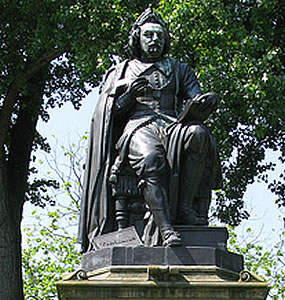
Joost van den Vondel (17 november 1587 – 5 februari 1679)
Standbeeld in het Vondelpark, Amsterdam

Lees verder “Joost van den Vondel, Christopher Paolini, Pierre Véry, Max Barthel”

José Saramago, Craig Arnold, Renate Rubinstein, Danny Wallace, Anton Koolhaas

De Portugese schrijver José Saramago werd geboren op 16 november 1922 in het dorpje Azinhaga in de provincie Ribatejo. Zie ook alle tags voor José Saramago op dit blog.


Uit: Blindness (Vertaald door Giovanni Pontier) 


„The amber light came on. Two of the cars ahead accelerated before the red light appeared. At the pedestrian crossing the sign of a green man lit up. The people who were waiting began to cross the road, stepping on the white stripes painted on the black surface of the asphalt, there is nothing less like a zebra, however, that is what it is called. The motorists kept an impatient foot on the clutch, leaving their cars at the ready, advancing, retreating like nervous horses that can sense the whiplash about to be inflicted. The pedestrians have just finished crossing but the sign allowing the cars to go will be delayed for some seconds, some people maintain that this delay, while apparently so insignificant, has only to be multiplied by the thousands of traffic lights that exist in the city and by the successive changes of their three colours to produce one of the most serious causes of traffic jams or bottlenecks, to use the more current term.

The green light came on at last, the cars moved off briskly, but then it became clear that not all of them were equally quick off the mark. The car at the head of the middle lane has stopped, there must be some mechanical fault, a loose accelerator pedal, a gear lever that has stuck, problem with the suspension, jammed brakes, breakdown in the electric circuit, unless he has simply run out of gas, it would not be the first time such a thing has happened. The next group of pedestrians to gather at the crossing see the driver of the stationary car wave his arms behind the windshield, while the cars behind him frantically sound their horns. Some drivers have already got out of their cars, prepared to push the stranded vehicle to a spot where it will not hold up the traffic, they beat furiously on the closed windows, the man inside turns his head in their direction, first to one side then the other, he is clearly shouting something, to judge by the movements of his mouth he appears to be repeating some words, not one word but three, as turns out to be the case when someone finally manages to open the door, I am blind.“


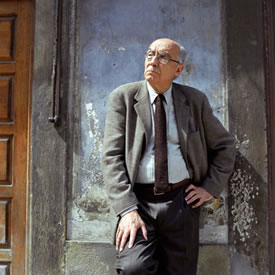
José Saramago (Azinhaga, 16 november 1922)


Lees verder “José Saramago, Craig Arnold, Renate Rubinstein, Danny Wallace, Anton Koolhaas”

Chinua Achebe, Hugo Dittberner, Andrea Barrett, Henri Charrière, Jónas Hallgrímsson, Max Zimmering, Birgitta Arens

De Nigeriaanse dichter en schrijver Chinua Achebe werd geboren op 16 november 1930 in Ogidi. Zie ook alle tags voor Chinua Achebe op dit blog.


Agostinho Neto


Agostinho, were you no more

Than the middle one favored by fortune

In children’s riddle; Kwame

Striding ahead to accost

Demons; behind you a laggard third

As yet unnamed, of twisted fingers?

No! Your secure strides

Were hard earned. Your feet

Learned their fierce balance

In violent slopes of humiliation;

Your delicate hands, patiently

Groomed for finest incisions,

Were commandeered brusquely to kill,

Your gentle voice to battle-cry.


Perhaps your family and friends

Knew a merry flash cracking the gloom

We see in pictures but I prefer

And will keep that sorrowful legend.

For I have seen how

Half a millennium of alien rape

And murder can stamp a smile

On the vacant face of the fool,

The sinister grin of Africa’s idiot-kings

Who oversee in obscene palaces of gold

The butchery of their own people.


Neto, I sing your passing, I,

Timid requisitioner of your vast

Armory’s most congenial supply.

What shall I sing? A dirge answering

The gloom? No, I will sing tearful songs

Of joy; I will celebrate

The man who rode a trinity

Of awesome fates to the cause

Of our trampled race!

Thou Healer, Soldier and Poet!


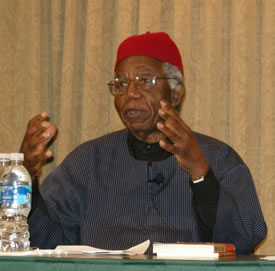
Chinua Achebe (Ogidi, 16 november 1930)


Lees verder “Chinua Achebe, Hugo Dittberner, Andrea Barrett, Henri Charrière, Jónas Hallgrímsson, Max Zimmering, Birgitta Arens”

Wolf Biermann, Gerhard Hauptmann, Heinz Piontek, J. G. Ballard, Liane Dirks

De Duitse zanger, dichter en schrijver Wolf Biermann werd geboren op 15 november 1936 in Hamburg. Zie ook alle tags voor Wolf Biermann op dit blog.


Und als wir ans Ufer kamen

Und als wir ans Ufer kamen
Und saßen noch lang im Kahn
Da war es, daß wir den Himmel
Am schönsten im Wasser sahn
Und durch den Birnbaum flogen
Paar Fischlein. Das Flugzeug schwamm
Quer durch den See und zerschellte
Sachte am Weidenstamm
– am Weidenstamm

Was wird bloß aus unseren Träumen
In diesem zerissnen Land
Die Wunden wollen nicht zugehn
Unter dem Dreckverband
Und was wird mit unsern Freunden
Und was noch aus dir, aus mir –
Ich möchte am liebsten weg sein
Und bleibe am liebsten hier
– am liebsten hier.


Noch

Ein kleiner Regen hat mich gewaschen
Am Himmel ziehn leere Brauseflaschen
Frabrikschlote wuchern drüben am Hang
Rauchnasen laufen den Windweg lang
Wälder sind das da, das nasse Blau
Das da sind Halden, das große Grau
Rot blühn paar Fahnen da auf dem Bau
Das Land ist still
Der Krieg genießt seinen Frieden
Still. Das Land ist still. Noch.

Die Schieferdächer schachteln sich wirr
Geklammert an Essen mit Eisengeschirr
Starrt das Antennengestrüpp nach West
Vom Sonnenball steht noch ein roter Rest
Krähen sind das da, was fällt und schreit
Blüten sind unter die Bäume geschneit
Was da jetzt einbricht, ist Dunkelheit
Das Land ist still
Wie Grabsteine stehen die Häuser
Still. Das Land ist still. Noch.

Dann hing ich im D-Zug am Fenster, und
Der Fahrtwind preßte mir Wind in’ Mund
Die Augen gesteinigt vom Kohlestaub
Ohren von kreischenden Rädern taub
Hörte ich schwingen im Schienenschlag
Lieder vom Frühling im roten Prag
Und die Gitarre im Kasten lag
Das Land ist still
Die Menschen noch immer wie tot
Still. Das Land ist still. Noch.


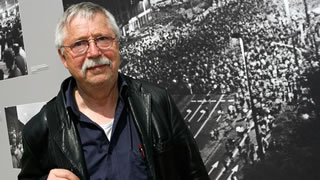
Wolf Biermann (Hamburg, 15 november 1936)


Lees verder “Wolf Biermann, Gerhard Hauptmann, Heinz Piontek, J. G. Ballard, Liane Dirks”