Dolce far niente, Ernst Stadler, William Saroyan, Éric Zemmour, Wolfgang Hilbig, Elizabeth von Arnim, Théophile Gautier, Raymond P. Hammond

Dolce far niente


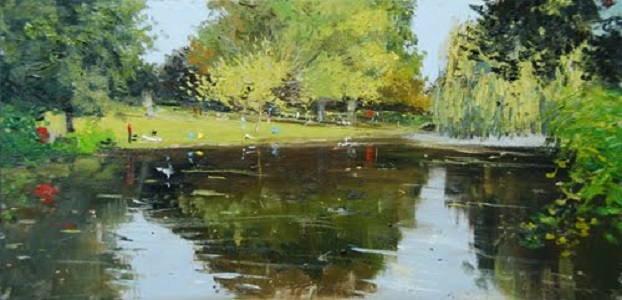
The Swan Pond Chiswick door Adebanji Alade, 2011


Die Efeulauben flimmern

Der Sommermittag lastet auf den weißen
Terrassen und den schlanken Marmortreppen
die Gitter und die goldnen Kuppeln gleißen
leis knirscht der Kies. Vom müden Garten schleppen
sich Rosendüfte her – wo längs der Hecken
der schlaffe Wind entschlief in roten Matten
und geisternd strahlen zwischen Laubverstecken
die Götterbilder über laue Schatten.
Die Efeulauben flimmern. Schwäne wiegen
und spiegeln sich in grundlos grünen Weihern
und große fremde Sonnenfalter fliegen
traumhaft und schillernd zwischen Düfteschleiern.


Ernst Stadler (11 augustus 1883 – 30 oktober 1914)
Colmar. Ernst Stadler werd geboren in Colmar

Lees verder “Dolce far niente, Ernst Stadler, William Saroyan, Éric Zemmour, Wolfgang Hilbig, Elizabeth von Arnim, Théophile Gautier, Raymond P. Hammond”

Charles Reznikoff, Jiři Orten, François Cheng, Libuše Moníková, Gisela von Arnim, Mary Wollstonecraft Shelley, Adam Kuckhoff, Michael Speier

De Amerikaanse dichter Charles Reznikoff werd op 30 augustus 1894 in New York geboren. Zie ook alle tags voor Charles Reznikoff op dit blog.


Depression

So proudly she came into the subway car
all who were not reading their newspapers saw
the head high and the slow tread—
coat wrinkled and her belongings in a paper bag,
face unwashed and the grey hair uncombed;

simple soul, who so early in the morning when only the
poorest go to work,
stood up in the subway and outshouting the noise:
‘Excuse me, ladies and gentlemen, I have a baby at home who
is sick,
and I have no money, no job;’ who did not have box or cap
to take coins—
only his hands,
and, seeing only faces turned away,
did not even go down the aisle as beggars do;

the fire had burnt through the floor:
machines and merchandise had fallen into
the great hole, this zero that had sucked away so many years
and now, seen at last, the shop itself;
the ceiling sloped until it almost touched the floor a strange curve
in the lines and oblongs of his life;
drops were falling
from the naked beams of the floor above,
from the soaked plaster, still the ceiling;
drops of dirty water were falling
on his clothes and hat and on his hands;
the thoughts of business
gathered in his bosom like black water

in footsteps through a swamp;
waiting for a job, she studied the dusty table at which she sat
and the floor which had been badly swept—
the office-boy had left the corners dirty;
a mouse ran in and out under the radiator
and she drew her feet away
and her skirt about her legs, but the mouse went in and out
about its business; and she sat waiting for a job
in an unfriendly world of men and mice;

walking along the drive by twos and threes,
talking about jobs,
jobs they might never get and jobs they had had,
never turning to look at the trees or the river
glistening in the sunlight or the automobiles
that went swiftly past them—
in twos and threes talking about jobs;

in the drizzle
four in a row
close to the curb
that passers-by might pass,
the squads stand
waiting for soup,
a slice of bread
and shelter—
grimy clothes
their uniform;
on a stoop
stiffly across the steps
a man
who has fainted;
each in that battalion
eyes him,
but does not move from his place,
well drilled in want.


Charles Reznikoff (30 augustus 1894 – 22 januari 1976)

Lees verder “Charles Reznikoff, Jiři Orten, François Cheng, Libuše Moníková, Gisela von Arnim, Mary Wollstonecraft Shelley, Adam Kuckhoff, Michael Speier”

Hugo Brandt Corstius, Elma van Haren, John Edward Williams, Maurice Maeterlinck, Thom Gunn, Frances Bellerby, Friedrich Treitschke

De Nederlandse schrijver en wetenschapper Hugo Brandt Corstius werd geboren in Eindhoven op 29 augustus 1935. Zie ook alle tags voor Hugo Brandt Cortius op dit blog.

Uit:Geniaal debuut (Over S. Vestdijk: Een moderne Antonius)

“De verschijning van een zwijn moeten we wel aan de traditie toeschrijven die de duivel zich in zwijnsgestalte tegen Antonius doet aanvlijen, hoewel Dr. John B. Knipping ons in de Winkler Prins verzekert dat het integendeel op de voorspraak duidt van de heilige tegen veeziekten, voornamelijk tegen een in de 11e en 12e eeuw veel heersende pestsoort. De rest van de verschijningen moet aan de fantasie van de auteur worden toegeschreven. Elke bladzij, elke regel Vestdijk is direct te herkennen aan de wijze waarop beschrijvingen, ideetjes en onbeduidende détails onmiddellijk tot mooie groteske gedachtenconstructies voeren. Deze grotesken zijn in Een moderne Antonius niet langer illustratie, amusant randversiersel, maar vormen de inhoud zelf. En dat is jammer. Want in de romans, waar Vestdijk al eerder hallucinaties buiten de beschrijvingen deed voorkomen (Else Böhler, Fré Bolderhey) hadden die voor een niet-hallucinerend lezer toch altijd een duidelijke betekenis. Deze strekking is hier onzichtbaar. Hij zal er wel zijn. In zijn testament zal Vestdijk ons ongetwijfeld duidelijk maken hoe slim het allemaal was, hoe de oneven woorden in de oneven hoofdstukken een epos vormen, hoe het hele verhaal correspondeert met een nog onontdekt manuscript, maar wat hebben wij daaraan? Moet een boek dan een strekking hebben? Deze vraag betekent meestal: moet een boek alleen maar een strekking hebben? en het antwoord is dan: nee. Maar bij Vestdijk kregen wij altijd een goed verhaal, goed geschreven, met goede grapjes en daarboven op nog een strekking.
Was behalve de flap ook nog de auteursnaam weggevallen, dan kwam er: Een moderne Antonius is de beste Nederlandse roman uit 1960. Het is het lichtvoetig vertelde verhaal van een modern man, die door de duivel, in de persoon van een geheimzinnige dokter, met beproevingen wordt overladen, die hij door zijn redelijkheid overwint. Er komen enige prachtige bijfiguren in voor. Moderne verschijnselen, als verkeersbrigadiertjes en nozems, worden fraai getypeerd. Enkele scènes zijn uiterst komisch. De bouw (drie delen, ieder deel tien hoofdstukken van gelijke lengte) doet aan Vestdijk denken. Maar een vergelijking met de meester zou onbillijk zijn. De debutant heeft ons met Een moderne Antonius een geniaal blijk van zijn talent gegeven. Wij zien met grote verwachting naar een nieuw werk van hem uit.”


Hugo Brandt Corstius (29 augustus 1935– 28 februari 2014)

Lees verder “Hugo Brandt Corstius, Elma van Haren, John Edward Williams, Maurice Maeterlinck, Thom Gunn, Frances Bellerby, Friedrich Treitschke”

Dolce far niente, Geerten Gossaert Johann Wolfgang von Goethe, A. Moonen, Maria Barnas, C. J. Kelk, Frederick Kesner

Dolce far niente


El bano del caballo door Joaquin Sorolla Y Bastida, 1909


De Centaur en de oceaan

Soms in den hoogen noen der heete zomerdagen
Ontspant de visschersknaap, die loom zijn leden baadt,
Half scherts, half medelij, ’t paard van den schelpenwagen,
Dat hinnikt van genot en wild de hoeven slaat.

Doch hij, met kalmen lach, grijpt onversaagd, sterkhandig,
Zijn ruige manen vast, bedwingt zijn drift, en, vlug,
Met eenen breeden zwaai bespringt hij, naakt, ’t stilstandig
Nu lijdzaam wachtend dier den breede’ en naakten rug!

Dan stuurt hij zeewaarts in. En waar, in lage reven,
De laffe branding breekt, blijft hij, uitdagend, staan
En machtig, brons op bruin, tot ééne leest verheven,
Bespot hij, een centaur, den machtlooze’ oceaan.

Wel ziet hij, diep in zee, uit de even waterwellen,
Een kleine spitse golf, al naar zij nader rent,
Gestaêg verkleurend tot een machtgen breker zwellen,
Al grommlende in zijn borst een duister dreigement …

Maar hij, met strak gelaat, wacht, schrap zich stellend, zonder
Ontroering, tot de golf, schijnwoedend, schuimverbleekt,
In éénen langgerekt-traagsidderenden donder
Zijn tuimlende overmacht aan ’t roerloos tarten wreekt …

En dan, uitbundig, barst het hoog gegier van ’t water,
En ’t brieschen van den hengst, die worstelt om een steê,
Met zijn’ metalen lach saam uit in één geschater
Dat opklimt uit het schuim en uitschalt over zee!

Geerten Gossaert (9 februari 1884 – 27 oktober 1958)
Kralingen. Geerten Gossaert werd geboren in Kralingen

Bewaren

Lees verder “Dolce far niente, Geerten Gossaert Johann Wolfgang von Goethe, A. Moonen, Maria Barnas, C. J. Kelk, Frederick Kesner”

Rita Dove, John Betjeman, Elmar Schenkel, Janet Frame, William Robertson Davies, Joeri Trifonov

De Amerikaanse schrijfster en dichteres Rita Frances Dove werd geboren op 28 augustus 1952 in Akron, Ohio. Zie ook alle tags voor Rita Dove op dit blog.


Lines Composed On The Body Politic

Less than the charting of each dawn’s resolutions,
less than each evening’s trickle of doubt,
less than a crown’s weight in silver, a diamond’s
scratch against glass, less than the touted

ill luck of my rich beginnings—and yet
more than Eve’s silence, my mute ingratitude.
More than music’s safe passage, its rapturous net,
more than this stockpile of words, their liquid solicitude;

more desired than praise (the least-prized of my dreams),
less real than dreaming (castle keep for my sins),
more than no more, which seems
much less than hoped-for, again—
one mutiny, quelled; one wish lost, a forgotten treasure:
to live without scrutiny, beyond constant measure.


“Teach Us To Number Our Days”

In the old neighborhood, each funeral parlor
is more elaborate than the last.
The alleys smell of cops, pistols bumping their thighs,
each chamber steeled with a slim blue bullet.

Low-rent balconies stacked to the sky.
A boy plays tic-tac-toe on a moon
crossed by TV antennae, dreams

he has swallowed a blue bean.
It takes root in his gut, sprouts
and twines upward, the vines curling
around the sockets and locking them shut.

And this sky, knotting like a dark tie?
The patroller, disinterested, holds all the beans.

 
Rita Dove (Akron, 28 augustus 1952)

Lees verder “Rita Dove, John Betjeman, Elmar Schenkel, Janet Frame, William Robertson Davies, Joeri Trifonov”

Dolce far niente, Frank O’Hara, Tom Lanoye, Jeanette Winterson, Kristien Hemmerechts

Dolce far niente


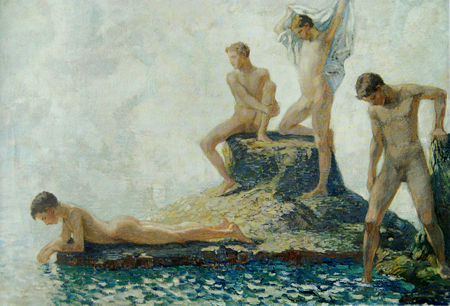
Badende Jünglinge door Ludwig von Hofman, 1905


The Bathers

After the immersion and the stance
how the blood bubbles like a firefly!
and the many flies come clipping through
the cumulus. Paradise melts its wings,

the shingle shows a red flag, lit,
incandescent, and chattering forth.
Crushing as always the pale leaves
of children’s feet, the shells crush,

the petals thrash, a lifeguard weeps
for his dead mother who has just sailed on.
Rumpling and rolling over, the rain
dumps its burden of restraint stonily,

without pressure from above. Be it killing
or caressing, the unhappy bathers moan
and remonstrate, hurtling through indifferences
and colors. On the sandbar lovers

hound each other to the salt, afraid of
neither running paralyzed nor trembling
hung, longing only to drift totally
in the garrulous frequency of their immanence.

Striding like statues the tremendous
arches, partially concealed by sunlight,
bounce. From barges grey with carrion
seem to rise the frenzied-whimpers of those

who are not thrusting their cheeks
against the wicker chests of heroes and
Desdemonas. Shall they drown that passion
they remember best? glinting and passing,

that discord scratching them a future
white-embossed and streaked? The delicacy
of birds eating fleas, so the sand may have
an eye at last, that crater and that sun.


Frank O’Hara (27 juni 1926 – 25 juli 1966)
Baltimore Beach. Frank O’Hara werd geboren in Baltimore.

Bewaren

Lees verder “Dolce far niente, Frank O’Hara, Tom Lanoye, Jeanette Winterson, Kristien Hemmerechts”

Lolita Pille, David Rowbotham, Norah Lofts, Cecil Scott Forester, Lernert Engelberts

De Franse schrijfster Lolita Pille werd geboren op 27 augustus 1982 in Sèvres. Zie ook mijn blog van 27 augustus 2010 en eveneens alle tags voor Lolita Pille op dit blog.

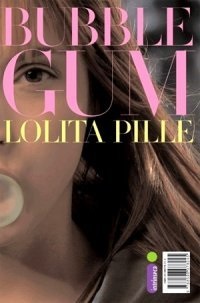
Uit:Bubble gum

“Celui-ci, je l avais nommé Bubble gum parce que tout y semblait creux, rose et gluant : decors, propos, sentiments, les personnages eux mêmes, moi compris, étaient creux, roses et gluants, au bord de l éclatement, et ce derrière quoi ils courraient, la sacro-sainte reconnaissance, la sacro-sainte célébrité, était devenue, a l époque où le non-film était supposé se dérouler, aussi creuse, rose, banale et brève qu une pauvre petite bulle de chewing-gum qui finissait inéluctablement par vous exploser a la gueule. »
(…)

Nous sommes rentrés pour démarrer cette promo et Mano s’y croyait à mort. Elle sy croyait à mort quand elle traversait Paris et qu’elle voyait sa gueule en 6 par 6 absolument partout, elle s’y croyait à mort pendant les interviews, elle virait ses attachés de presse, elle envoyait promener les types qui lui demandaient des autographes dans la rue, elle se sentait tellement unique, tellement privilégiée, elle avait l’impression d’être dans le secret de l’origine du monde, elle jubilait tout en faisant mine de se plaindre d’être trop exposée, son ego n’avait plus de limite.”

 
Lolita Pille (Sèvres, 27 augustus 1982)
Cover

Lees verder “Lolita Pille, David Rowbotham, Norah Lofts, Cecil Scott Forester, Lernert Engelberts”

Dolce far niente, Stefan George, Christopher Isherwood, Laura van der Haar, Joachim Helfer, Guillaume Apollinaire, Rashid Al-Daif

Dolce far niente


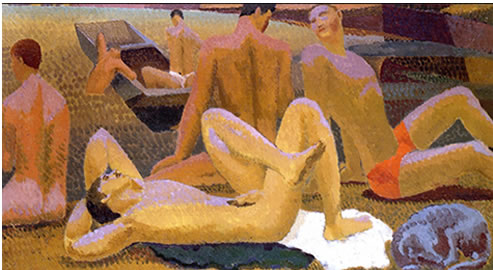
Bathers by the Pond door Duncan Grant,  circa 1920-1921


Südlicher Strand: Tänzer

Ihr wart am pinienhage ohne staunen
Ins gras gelagert · junge schwinger · beide
Mit gliedern zierlich regen kräftig braunen
Mit offner augen unbefangner weide.

Ihr hobet euch vom boden auf im takte
Ins volle licht getauchte lächelnd reine
Und schrittet vor und rückwärts – göttlich nackte
Die breite brust gewiegt auf schlankem beine.

Von welcher urne oder welchem friese
Stiegt ihr ins leben ab zum fest gerüstet
Die ihr euch leicht verneigtet und euch küsstet
Und tanzend schwangt auf weiss-gesternter wiese!


Stefan George (12 juli 1868 – 4 december 1933)
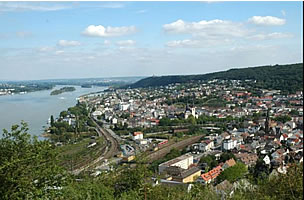
Büdesheim (Bingen). Stefan George werd in Büdesheim geboren.

Lees verder “Dolce far niente, Stefan George, Christopher Isherwood, Laura van der Haar, Joachim Helfer, Guillaume Apollinaire, Rashid Al-Daif”

Paula Hawkins


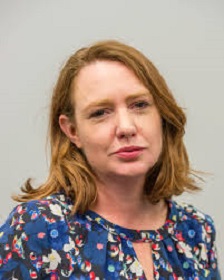
De Britse schrijfster Paula Hawkins werd geboren op 26 augustus 1972 en groeide op in Salisbury (het huidige Harare in Zimbabwe) in Rhodesië. Ze verhuisde in 1989 op 17-jarige leeftijd naar Londen waar ze filosofie, economie en politiek studeerde aan het Keble College van de universiteit van Oxford. Ze was journaliste voor The Times, werkte aan een aantal publicaties op freelancebasis en schreef ook een financieel adviesboek voor vrouwen, getiteld “The Money Goddess”. Hawkins schreef een aantal romantische komedieromans onder het pseudoniem Amy Silver en brak in 2015 door onder haar eigen naam met de psychologische thriller “The Girl on the Train”, waarin de huiselijk geweld, alcohol en drugsgebruik een rol spelen. Het boek werd in 2016 verfilmd met Emily Blunt in de rol van Rachel.. Het boek kwam op 1 februari 2015 op nummer één op de The New York Times Fiction Best Sellers of 2015 en stond 16 weken op de eerste plaats.

Uit:The Girl on the Train

“I want to run. I want to take a road trip, in a convertible, with the top down. I want to drive to the coast—any coast. I want to walk on a beach. Me and my big brother were going to be road trippers. We had such plans, Ben and I. Well, they were Ben’s plans mostly—he was such a dreamer. We were going to ride motorbikes from Paris to the Côte d’Azur, or all the way down the Pacific coast of the USA, from Seattle to Los Angeles; we were going to follow in Che Guevara’s tracks from Buenos Aires to Caracas. Maybe if I’d done all that, I wouldn’t have ended up here, not knowing what to do next. Or maybe, if I’d done all that, I’d have ended up exactly where I am and I would be perfectly contented. But I didn’t do all that, of course, because Ben never got as far as Paris, he never even made it as far as Cambridge. He died on the A10, his skull crushed beneath the wheels of an articulated lorry.
I miss him every day. More than anyone, I think. He’s the big hole in my life, in the middle of my soul. Or maybe he was just the beginning of it. I don’t know. I don’t even know whether all this is really about Ben, or whether it’s about everything that happened after that, and everything that’s happened since. All I know is, one minute I’m ticking along fine and life is sweet and I want for nothing, and the next I can’t wait to get away, I’m all over the place, slipping and sliding again.
So, I’m going to see a therapist! Which could be weird, but it could be a laugh, too. I’ve always thought that it might be fun to be Catholic, to be able to go to the confessional and unburden yourself and have someone tell you that they forgive you, to take all the sin away, wipe the slate clean.
This is not quite the same thing, of course. I’m a bit nervous, but I haven’t been able to get to sleep lately, and Scott’s been on my case to go. I told him I find it difficult enough talking to people I know about this stuff—I can barely even talk to him about it.
He said that’s the point, you can say anything to strangers. But that isn’t completely true. You can’t just say anything. Poor Scott. He doesn’t know the half of it. He loves me so much, it makes me ache. I don’t know how he does it. I would drive me mad.
But I have to do something, and at least this feels like action. All those plans I had—photography courses and cookery classes—when it comes down to it, they feel a bit pointless, as if I’m playing at real life instead of actually living it. I need to find something that I must do, something undeniable. I can’t do this, I can’t just be a wife. I don’t understand how anyone does it—there is literally nothing to do but wait. Wait for a man to come home and love you. Either that or look around for something to distract you.”


Paula Hawkins (Salisbury, 26 augustus 1972)

Dolce far niente, Albert Verwey, Kees Stip, Martin Amis, Howard Jacobson, Charles Wright, Maxim Biller

Dolce far niente


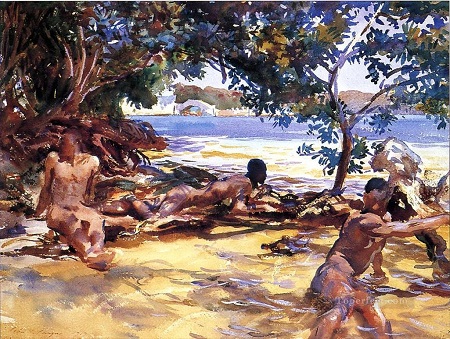
The Bathers door John Singer Sargent, 1917


Baders hartewens

Dwars door de tuinen
Van roos en ranken
Zich
‘t pad te banen,
Dan door de lanen
Van zand en dennen
Vluchtig te rennen
Tot waar de kruinen
Van hoge duinen
In
‘t blauwe blanken
En zo te naderen
Met zwellende aderen
In laatste loop
De harde golven
En, overdolven,
Hun koele doop.


Albert Verwey (15 mei 1865 – 8 maart 1937)
Amsterdam, 19e eeuw. Albert Verwey werd geboren in Amsterdam


Lees verder “Dolce far niente, Albert Verwey, Kees Stip, Martin Amis, Howard Jacobson, Charles Wright, Maxim Biller”