James Alan McPherson, Hans Arp, Andreas Neumeister, Anna Bosboom – Toussaint, Frans Eemil Sillanpää

De Amerikaanse schrijver James Alan McPherson werd geboren op 16 september 1943 in Savannah, Georgia. Zie ook mijn blog van 16 september 2010 en eveneens alle tags voor James Alan McPherson op dit blog.

Uit:A Region Not Home: Reflections from Exile

“I recall that in 1960, for example, something called the National Defense Student Loan Program went into effect, and I found out that by my agreeing to repay a loan plus some little interest, the federal government would back my enrollment in a small Negro college in Georgia. When I was a freshman at that college, disagreement over a seniority clause between the Hotel & Restaurant Employes and Bartenders Union and the Great Northern Railway Co., in St. Paul, Minn., caused management to begin recruiting temporary summer help. Before I was 19 I was encouraged to move from a segregated Negro college in the South and through that very beautiful part of the country that lies between Chicago and the Pacific Northwest. That year — 1962 — the World’s Fair was in Seattle, and it was a magnificently diverse panorama for a young man to see. Almost every nation on earth was represented in some way, and at the center of the fair was the Space Needle. The theme of the United States exhibit, as I recall, was drawn from Whitman’s “Leaves of Grass”: “Conquering, holding, daring, venturing as we go the unknown ways.”
When I returned to the South, in the midst of all the civil rights activity, I saw a poster advertising a creativewriting contest sponsored by Reader’s Digest and the United Negro College Fund. The first story I wrote was lost; but the second, written in 1965, was awarded first prize by Edward Weeks and his staff at The Atlantic Monthly. That same year I was offered the opportunity to enter Harvard Law School. During my second year at law school, a third-year man named Dave Marston (who was in a contest with Attorney General Griffin Bell [last] year) offered me, through a very conservative white fellow student from Texas, the opportunity to take over his old job as a janitor in one of the apartment buildings in Cambridge. There I had the solitude, and the encouragement, to begin writing seriously. Offering my services in that building was probably the best contract I ever made.
I HAVE NOT recalled all the above to sing my own praises or to evoke the black American version of the Horatio Alger myth. I have recited these facts as a way of indicating the haphazard nature of events during that 10-year period. I am the product of a contractual process. To put it simply, the 1960s were a crazy time. Opportunities seemed to materialize out of thin air; and if you were lucky, if you were in the right place at the right time, certain contractual benefits just naturally accrued. You were assured of a certain status; you could become a doctor, a lawyer, a dentist, an accountant, an engineer. Achieving these things was easy, if you applied yourself.”
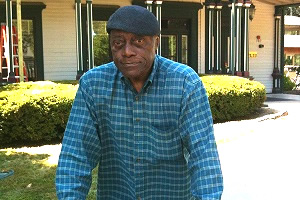


James Alan McPherson (Savannah, 16 september 1943)
Lees verder “James Alan McPherson, Hans Arp, Andreas Neumeister, Anna Bosboom – Toussaint, Frans Eemil Sillanpää”

Lucebert, Jan Slauerhoff, Sergio Esteban Vélez, Chimamanda Ngozi Adichie, Agatha Christie, Orhan Kemal, Gunnar Ekelöf, James Fenimore Cooper, Claude McKay

De Nederlandse dichter Lucebert werd in Amsterdam geboren op 15 september 1924 onder de naam Lubertus Swaanswijk. Zie ook mijn blog van 15 september 2010 en eveneens alle tags voor Lucebert op dit blog.

de rivier

uit al haar armen brandt de rivier onder de rotsen
en onder de kleine zon boven de bossen
spuwt naar tellurische wortels naar de staart van de wolk
en met gesperde muil dwars door deinende scherven zij zwermt
met grillige warmte over de wereld

de duisternis dicht bij haar buik buigen gulzige bloemen
en daar is een hol en een poel en het kraken en zoemen
van een paar draken in de avond niet veraf op een graf
staande een uil staart naar een glazen galg daar grof
gebouwde rotsen omringen de melodische afgrond

ach altijd en altijd hangen natte tongen aan de trieste bergen
gespleten tongen getande tongen en opgeblazen
ronkende tongen en in de dalen in de stenen en lemen cocons
academisch zingende mannen manmoedig wanhopig
zingende mannen en vrouwen vaag draperend de ruimte

maar een adder de lichtgeaderde rivier spartelt en
knaagt aan het wenende vlees van de wind
wat geeft dat klagen? sneeuw sneeuwt over vervaarlijke
en ook over bedaagde ogen en alles raakt los in de nacht
voort stromende argeloos tomeloos maar niet verlost
van de klagende nacht


lente-suite voor lilith

introductie:

als babies zijn de dichters niet genezen
van een eenzaam zoekend achterhoofd
velen hebben liefde uitgedoofd
om in duisternis haar licht te lezen

in duisternis is ieder even slecht
de buidel tederheid is spoedig leeg
alleen wat dichters brengen het te weeg
uit poelen worden lelies opgedregd

kappers slagers beterpraters
alles wat begraven is
godvergeten dovenetels laat es
aan uw zwarte vlekken merken dat het niet te laat is

wie wil stralen die moet branden
blijven branden als hij liefde meent
om in licht haar duisternis op handen
te dragen voor de hele goegemeent

1
o-o-oh
zo god van slanke lavendel te zien
en de beek koert naar de keel
en de keel is van de anemonen
is van de zee de monen zingende bovengekomen

kleine dokter jij drinkende huid van bezien
zie een mond met de torens luiden de tong
een wier van geluid de libbelen tillende klei

en jij
wassen jij klein en vingers in de la in de ven
lavendel in de lente love lied
laat zij geuren
pagodegeuren
lavendelgoden
geuren

 
Lucebert (15 september 1924 – 10 mei 1994)
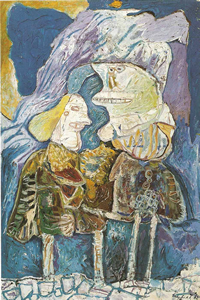
Lucebert: Prinsenpaar, 1962

Lees verder “Lucebert, Jan Slauerhoff, Sergio Esteban Vélez, Chimamanda Ngozi Adichie, Agatha Christie, Orhan Kemal, Gunnar Ekelöf, James Fenimore Cooper, Claude McKay”

Dolce far niente, Eugen Roth, Hans Faverey, Theodor Storm, Leo Ferrier, Corly Verlooghen, Bernard MacLaverty, Ivan Klíma

Dolce far niente


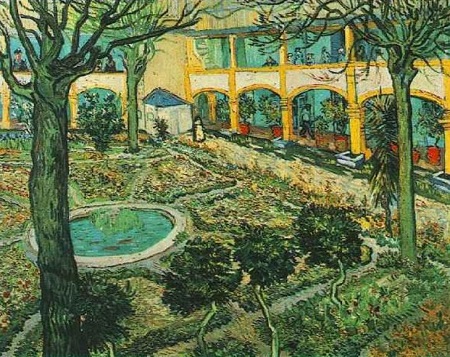
Binnenplaats van het ziekenhuis in Arles door Vincent van Gogh, 1889


Das ist der Krankenhäuser Sinn

Das ist der Krankenhäuser Sinn,
Dass man – wenn’s geht – gesund wird drin.
Doch wenn man’s ist: dann schnell heraus!
Ansteckend ist das Krankenhaus.


Eugen Roth (24 januari 1895 – 28 april 1976)
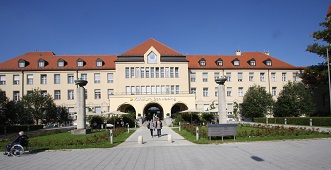
Städtisches Krankenhaus in München, de geboorteplaats van Eugen Roth

Lees verder “Dolce far niente, Eugen Roth, Hans Faverey, Theodor Storm, Leo Ferrier, Corly Verlooghen, Bernard MacLaverty, Ivan Klíma”

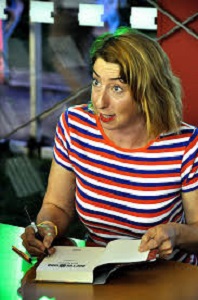
Jenny Colgan

De Schotse schrijfster Jenny Colgan werd geboren op 14 september 1972 in Prestwick, Ayrshire. Zij studeerde aan de universiteit van Edinburgh en werkte zes jaar in de gezondheidsdienst, bijklussend als cartooniste en als stand-up-comedian. Zij schrijft zowel onder haar eigen naam als onder de pseudoniemen Jane Beaton en J. T. Colgan.. Zij woont afwisselend in Frankrijk en Londen. In 2000 publiceerde ze haar eerste roman, de romantische komedie “Amanda’s Wedding”. In 2013 ontving zij voor haar roman “Welcome to Rosie Hopkins’ Sweetshop of Dreams” de Romantic Novel of the Year Award van de Romantic Novelists’ Association. In 2012 verscheen haar Doctor Who tie-in roman “Dark Horizons” onder de naam J. T. Colgan.

Uit: Amanda’s Wedding

“Most of the really messy things in life don’t actually have a beginning-they kind of bear down on you over years, like the consequences of not cleaning your bathroom floor (stickiness, cholera, etc.).
This one did, though. It definitely did, and I remember it extremely clearly. Well, in a fuzzy kind of way.
Thank God-it was my bed. So, one, I was actually in a bed; and two, it was mine. I was beating the odds already. I prized open one very sticky eye and attempted to focus it, to try to work out where the smell was coming from. I appeared to be jammed between the wall and an extremely large and unidentifiable chunk of flesh.
The chunk of flesh was connected to lots of other chunks, all in the right order: But I didn’t notice this until after I’d sat bolt upright in terror at a potential Godfather-type situation in my bed.
Everything seemed weirdly out of proportion. Maybe I was still drunk. I pawed at the sticky stuff at the corners of my eyes. No, something was still very wrong.
An inappropriate hand was slung across me. It appeared to be about the size of my stomach, and my stomach is not renowned for its tininess…. A thought began to worm its way into my head.
I knew that thought and tried to avoid it for as long as possible, but alongside my hangover voice that was howling, Fluid! Fluid! the thought whispered, Oh, my God … it’s Nicholas … again! I grimaced like I’d just swallowed something nasty, which, let’s face it, I probably had.
Slowly creeping my way off the end of the futon, and feeling worse and worse, I crawled into the kitchen in search of aspirin and Diet Coke. Fran, of course, was lying in wait. She didn’t live here, but she made herself more at home than I did. Her own place was a three-foot-square studio that induced immediate Colditz fever, so I’d got used to her wandering in and out.
“Good morning!” trilled Fran, bright and breezy. She must have been putting it on. Through a strange fog-which I supposed was the alcohol in my system filling me right up to the eyes-she actually looked quite good. I couldn’t focus on her mass of fuzzy hair, but I did notice that she was wearing one of my T-shirts, not quite covering thighs that didn’t even meet in the middle. I hated that.
I summoned all my energy to pipe, “Hello!”
“Hung over?”
“No, no, absolutely fine. I’ve just suddenly developed a taste for a half bottle of warm flat Coke, okay?”

 
Jenny Colgan (Prestwick, 14 september 1972)

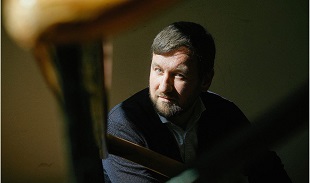
Alexander Schimmelbusch

De Oostenrijkse schrijver Alexander Schimmelbusch werd geboren op 14 september 1975 in Frankfurt am Main geboren en groeide op in Frankfurt am Main en New York. Na zijn studie economie en germanistiek aan de Georgetown University in Washington werkte hij vijf jaar als consultant voor fusies en overnames bij een investeringsbank in Londen. Tegenwoordig woont hij als auteur en journalist afwisselend in Berlijn en New York. Voor zijn roman “Blut im Wasser“ kreeg hij in de 2009 de Hotlist Award.

Uit: Blut im Wasser

„Als ich aufwache, habe ich einen trockenen Rieslinggeschmack im Mund. Ich liege reglos da, in einem leeren Raum, nackt unter einem dünnen Laken. Die gläsernen Wände, die mich umgeben, sind vereist, die kahlen Zweige hinter ihnen sind nur als graphische Strukturen sichtbar. Mein Haus ist nicht beheizt, aber mein Atem bildet keine Dampfwolken. Für einen Augenblick habe ich Angst, dass ich in der Nacht gestorben bin. Ich stehe auf und schleppe mich ins Badezimmer, wo ich den Spiegel mit einem Handtuch verhänge. Ich habe keine Pläne für den Tag, ich habe Nasenbluten und Sehstörungen und Schmerzen in meiner Brust, für die ich keine harmlose Erklärung habe. Ich drehe am Wasserhahn und beuge mich nach vorne, nehme behutsam drei tiefe Schlucke, bevor ich meinen Kopf unter den eiskalten Schwall strecke. Den Versuch, meine Zähne zu putzen, muss ich sofort wieder abbrechen, da die Vibrationen der elektrischen Bürste Kopfschmerzen wecken. Von meinem Schreibtisch aus habe ich einen unverbaubaren Blick über den Fluss hinweg auf die Bürostädte am gegenüberliegenden Ufer. Die Zimmer sind spärlich möbliert, einige stehen leer; die Böden sind mit Platten aus Travertin ausgelegt. Ich habe mir den Grundriss meines Hauses offenbar so gut eingeprägt, dass ich mich darin auch bei Finsternis in gewohnter Geschwindigkeit fortbewegen kann, ohne irgendwo anzustoßen. Diese Tatsache ist mir irgendwann einmal im Zuge eines Stromausfalls bewusst geworden, als ich, nachdem in derStadt die Lichter erloschen waren, meinen Ablauf fortsetzte, als wäre nichts geschehen. In der sprudelnden Hitze unter der Oberfläche wird mir schwarz vor Augen. In meinem Zustand schwimmen zu gehen ist zweifellos gefährlich, aber ich weiß: wenn ich nicht regelmäßig Sport treibe, vergreise ich. Stoisch beginne ich daher, meine Bahnen zu ziehen. Angst vor dem Ertrinken, denke ich mir, kann man mühelos verdrängen. Man kann in die Großstadt ziehen, sich eine Aufgabe suchen, sein Glück finden. Man kann, wie ich mir denke, während ich eine formvollendete Wende abschließe, sich ein Lächeln aufsetzen. Über die hintere Treppe gelange ich in meine aus Deutschland importierte Küche, die in ihrer Reduktion, wie es Amy formulierte, als sie vor Kurzem bei mir zum ersten Mal zu Gast war, an einen Obduktionssaal erinnert. Vor der offenen Tür des Kühlschranks beginne ich damit, eine Flasche fettarme Milch zu leeren. Ich konzentriere mich dabei auf die Schluckgeräusche, die in meinem Kopf zu hören sind, und spiele mit dem Gedanken, mir eine Zeitung auszudrucken, verwerfe diesen aber, da ich mich momentan noch nicht in der Lage fühle, mich für irgendetwas zu interessieren.“

 
Alexander Schimmelbusch (Frankfurt am Main, 14 september 1975)

Tõnu Õnnepalu, Roald Dahl, Janusz Glowacki, Jac. van Looy, Nicolaas Beets, Marie von Ebner-Eschenbach, Otokar Březina, Julian Tuwim, Muus Jacobse

De Estische dichter, schrijver en vertaler Tõnu Õnnepalu werd geboren op 13 september 1962 in Tallin. Zie ook mijn blog van 13 september 2010 en eveneens alle tags voor Tõnu Õnnepalu op dit blog.

Uit: Flanders Diary (Vertaald door Miriam McIlfatrick)

“This perfect world is strange, and a little awful. I went out on the bike yesterday, planning to stay out longer, to go further, I felt that I could not stand being here in this room or outside any longer. Curious, at home I hardly ever get that feeling. I can move between room and garden for a whole week, going no further and it never enters my head that I should. If I have to go somewhere, it is simply a bore. It would be nteresting to know how many of those writers whose pictures are hanging on the corridor wall have agonized here? Most of them, I suspect. This bed where I toss and turn must have been a similar nightly battleground for a fair few. A struggle with your chimera, a writhing consciousness which wants to become itself in the mirror, but does not dare. Dreams. I am already a little afraid of this room with its cold, damp smell, the constant whine of a gnat in some corner, the broad white bed. Only at midday when the sun shines in through the withered vine tendrils and scatters patches of light over everything, is it good to stretch out, not on the bed but on the hard wooden sofa.
A perfect world … It would be if we did not have such imperfect dreams. Yesterday I decided to do the 39-kilometre cycle route and it was good. It goes along backroads, in between fields. There is more land round there, less real estate development. There is not much development anywhere, the real estate is for the most part ready, completed earlier. The same goes for the roads. The smaller roads here are made of reinforced concrete, they seem to consist of slabs with little interstices, just like the Narva, or rather, the Leningrad road once was. It was built by German prisoners of war. In one place near Tollenbeek I saw this concreting, they were doing repair work. Apart from that there is no major road construction anywhere to be seen. Everything is ready. When this was all done, all this concrete laid down between the cornfields and grazing land, is impossible to guess. Earlier. And all these houses. If anything else is built on, it is garages. Not that there aren’t any garages, where would you find a house without a garage! You can always add another one, two or three, if the site is big enough of course. Cars seem to be multiplying here, as with us. Life is good. Could it be better? I do not think so, not significantly. Everyone could have slightly larger houses, but would anyone want that, especially when they are away from home all day. There is enough to do as it is.
The roads could be a little smoother, but what difference would it really make whether the road under you is very smooth or slightly less smooth if, on the way to work in the morning and back home in the evening, you have to sit in a traffic jam anyway?”

 
Tõnu Õnnepalu (Tallin, 13 september 1962)

Lees verder “Tõnu Õnnepalu, Roald Dahl, Janusz Glowacki, Jac. van Looy, Nicolaas Beets, Marie von Ebner-Eschenbach, Otokar Březina, Julian Tuwim, Muus Jacobse”

Michael Ondaatje, James Frey, Chris van Geel, Louis MacNeice, Hannes Meinkema, Eduard Elias, Jan Willem Schulte Nordholt, Werner Dürrson, Gust Van Brussel

De Canadese dichter en schrijver Philip Michael Ondaatje werd op 12 september 1943 geboren in Colombo, Ceylon (nu Sri Lanka). Zie ook alle tags voor Michael Ondaantje op dit blog.


Wells II

The last Sinhala word I lost
was vatura.
The word for water.
Forest water. The water in a kiss. The tears
I gave to my ayah Rosalin on leaving
the first home of my life.

More water for her than any other
that fled my eyes again
this year, remembering her,
a lost almost-mother in those years
of thirsty love.

No photograph of her, no meeting
since the age of eleven,
not even knowledge of her grave.

Who abandoned who, I wonder now.


What were the names of the towns

What were the names of the towns
we drove into and through

stunned lost

having drunk our way
up vineyards
and then Hot Springs
boiling out the drunkenness

What were the names
I slept through
my head
on your thigh
hundreds of miles
of blackness entering the car

All this
darkness and stars
but now
under the Napa Valley night
a star arch of dashboard
the ripe grape moon
we are together
and I love this muscle

I love this muscle
that tenses

and joins
the accelerator
to my cheek


Kissing the stomach

Kissing the stomach
kissing your scarred
skin boat. History
is what you’ve travelled on
and take with you

We’ve each had our stomachs
kissed by strangers
to the other

and as for me
I bless everyone
who kissed you here


Michael Ondaatje (Colombo, 12 september 1943)

Lees verder “Michael Ondaatje, James Frey, Chris van Geel, Louis MacNeice, Hannes Meinkema, Eduard Elias, Jan Willem Schulte Nordholt, Werner Dürrson, Gust Van Brussel”

Constantijn Huygens-prijs 2017 voor Hans Tentije


Constantijn Huygens-prijs 2017 voor Hans Tentije

Gisteravond werd de Constantijn Huygens-prijs toegekend aan dichter en schrijver Hans Tentije. De oeuvreprijs van 12 duizend euro wordt op 21 januari 2018 uitgereikt aan de 72-jarige Tentije voor zijn zestien dichtbundels en roman “De innerlijke bioscoop”. Hans Tentije (pseudoniem van Johann Krämer) werd geboren in Beverwijk op 23 december 1944. Zie ook alle tags voor Hans Tentije op dit blog.


Orvieto

Een slingerende weg en haarspeldscherpe
lussen tillen langs brokkelige, overgroeide weringen
het tufstenen plateau hoger en hoger, tot voor de poorten
van een later in de middag weer ontwaakte stad

voor de kathedraal sluit je vol ongeloof
je ogen even en over je oogleden strijkt zijn schittering
het goud van een heel verleden uit

getemperd, wijngeel licht valt
door wat marmeren triten lijken, met een nervatuur
van verkoolde bliksemschichten, van eeuwen terug geronnen
levenslopen, van vloedlijnen, opgestuwd
en onderaards nagolvend bloed dat in gebergten
strandde, zich daar begroef –

iemand brengt een grafstuk, vol overdadig
groen en aronskelken, naar de zijkapel, waar hardop, iets
te loslippig bidden zelfs verboden is

een lijkwagen draait met hangende vaantjes
het domplein op, verspilt zijn enorme motorvermogen
aan het vervoer van een simpele kist, het requiem
zal dadelijk worden opgedragen

vier pilasters laten, door druivenranken
en acanthusblad omlijst, een reeks uitgehouwen
bijbelse taferelen zien – bij de jongste dag zoek je je gezicht
tussen dat van de vele, vele verdoemden –
je vindt het niet, vooralsnog


l’Arbre de Jesse
Georges Braque – Kerkraam te Varengeville

Zoals het volmaakte het gebrekkige
nog gebrekkiger, erbarmelijker maakt, zo armzalig
voel je je naast het hoog op het krijt staande
zeekerkje van Varengeville

bijtende westenwinden hebben het klokkentouw gerafeld
en zout zet zich op de naar de afgrond
hellende grafstenen af, gebeier stort zich driest
over golven en rotskust uit en roept onweersluchten
aan en eenzame opvarenden –

gebrandschilderd, versplinterd valt de zon
op de plavuisgrauwe, zerkstenen vloer en stuwt
takken, mossen, bladeren, vogelnesten
naar het punt waar doorschijnende vingertoppen gothisch
bij elkaar komen en het allerbinnenste
zich met het buitenste vervlecht

met maangestalten, de oceaan
in al zijn schakeringen, met inzegeningen
en eerste communies, met het op drift
geraakte en het geborgene, het wisselend getij

een rijsje, uit een afgehouwen tronk
voortgekomen, een boom die, aan zichzelf ontgroeid
uit zijn omlijsting wil breken om het lood
van jaren van zich af te schudden en zijn kruin
tot de hemel te laten reiken –

zou je door dit glas heen ‘s avonds
de lichten van het reuzenrad, de schiettenten, het casino
kunnen zien, het getwinkel, daar, heel
in de verte, in Dieppe?

onbereikbare smalle stroken zand
tussen de golfslag en de steile kliffen, poreus
afbrokkelend krijt waarmee niet te schrijven is, de vloed
die ondermijnt en ontwortelt en tekeergaat
in de brandingsnissen en verstikt soms meehuilt
tijdens de engelenmissen

de zee beneden je, als keek je
door Braques glasscherven voor het eerst
naar zulke breekbare, onbestaanbare
tinten blauw en grijs

het sluike drenkelingenhaar van de wieren
wenkt de schaduwen die vergeefs tegen de dwarsstroom
proberen op te zwemmen, terwijl stenen
vonken in de diepte en een oorverdovend geruis
de schelpen, schelpenbanken spoelt

het kerkhofgrint is onberispelijk aangeharkt –


Hans Tentije (Beverwijk, 23 december 1944)

David van Reybrouck, Murat Isik, D.H. Lawrence, Eddy van Vliet, Andre Dubus III, Tomas Venclova, Merrill Moore, Barbara Bongartz, Adam Asnyk

De Vlaamse dichter, schrijver en wetenschapper David Van Reybrouck werd geboren in Brugge op 11 september 1971. Zie ook alle tags voor David van Reybrouck op dit blog.


Zink
in memoriam Lisbé Smuts-Smith

1
Veeg de sneeuw van de daken
vouw de vogels weer dicht
laat de winter nog slapen
doe iets aan het licht

Sluit de tuin en strooi kiezels
in het bord van het kind
pluk messen en wespen
plet van perziken de pit.

(Gordijnen wil men en aceton
en al wat de lente vertraagt.
Slavernij desnoods of spoorwegen
of ergens iets desolaats.)

2
Nu klotst het water zaagt men hout
blaffen honden brutaal

Nu zit ik hier in deze vlei
te roeien naar een taal

Papyrus zingt de ibis vliegt
de stilte hoort men niet

De boot valt stil wij stappen uit
en rillen met het riet

Onder het water zal mijn adem
trager woorden blazen

Dit machteloze schrijven
is een vroege vorm van zwijgen –


David van Reybrouck (Brugge, 11 september 1971)

Lees verder “David van Reybrouck, Murat Isik, D.H. Lawrence, Eddy van Vliet, Andre Dubus III, Tomas Venclova, Merrill Moore, Barbara Bongartz, Adam Asnyk”

Edmund de Waal, Andreï Makine, Franz Werfel, Paweł Huelle, Mary Oliver

De Britse schrijver, keramist en hoogleraar Edmund Arthur Lowndes de Waal werd geboren op 10 september 1964 in Nottingham. Zie ook alle tags voor Edmund de Waal op dit blog.

Uit: The Hare With Amber Eyes: A Hidden Inheritance

`I look up at the second-floor windows where Charles had his suite of rooms, some of which looked across the street to the more robustly classical house opposite, some across the courtyard into a busy roofscape of urns and gables and chimneypots. He had an antechamber, two salons — one of which he turned into his study – a dining-room, two bedrooms and a ‘petite’. I try to work it out; he and his older brother Ignace must have had neighbouring apartments on this floor, their elder brother Jules and their widowed mother Mina below, with the higher ceilings and grander windows and the balconies on which, on this April morning, there are now some rather leggy red geraniums in plastic pots. The courtyard of the house was glazed, according to the city records, though all that glass is long gone. And there were five horses and three carriages in these stables which are now a perfect bijou house. I wonder if that number of horses was appropriate for a large and social family wanting to make the right kind of impression.
It is a huge house, but the three brothers must have met every day on those black-and-gold winding stairs, or heard each other as the noise of the carriage being readied in the courtyard echoed from the glazed canopy. Or encountered friends going past their door on the way up to an apartment above. They must have developed a way of not seeing each other, and not hearing each other, too: to live so close to your family takes some doing, I think, reflecting on my own brothers. They must have got on well. Perhaps they had no choice in the matter. Paris was work, after all.
The Hôtel Ephrussi was a family house, but it was also the Parisian headquarters of a family in its ascendancy. It had its counterpart in Vienna, the vast Palais Ephrussi on the Ringstrasse. Both the Parisian and Viennese buildings share a sense of drama, of a public face to the world. They were both built in 1871 in new and fashionable areas: the rue de Monceau and the Ringstrasse were so of-the-minute that they were unfinished, untidy, loud and dusty building sites. They were still spaces that were inventing themselves, competitive with the older parts of town with their narrower streets, and spikily arriviste.
If this particular house in this particular streetscape seems a little stagey, it is because it is a staging of intent. These houses in Paris and Vienna were part of a family plan: the Ephrussi family was ‘doing a Rothschild’. Just as the Rothschilds had sent their sons and daughters out from Frankfurt at the start of the nineteenth century to colonise European capital cities, so the Abraham of my family, Charles Joachim Ephrussi, had masterminded this expansion from Odessa in the 1850s. A true patriarch, he had two sons from his first marriage, Ignace and Léon. And then when he remarried at fifty he had continued producing children: two more sons, Michel and Maurice, and two daughters, Thérèse and Marie. All of these six children were to be deployed as financiers or married into suitable Jewish dynasties.”


Edmund de Waal (Nottingham, 10 september 1964)

Lees verder “Edmund de Waal, Andreï Makine, Franz Werfel, Paweł Huelle, Mary Oliver”