Maria Janitschek, Oskar Maria Graf, Emma Lazarus, Per Hojholt, Jakob Lorber

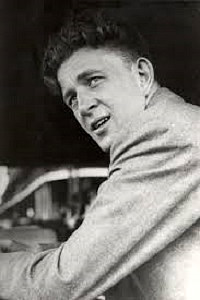
De Duitse schrijver Oskar Maria Graf werd geboren op 22 juli 1894 in Berg am Starnberger See. Zie ook alle tags voor Oskar Maria Graf op dit blog.

Uit: Das Leben meiner Mutter

„Nachdem mit der Zeit die Gesichtszüge des Kindes deutlicher geworden waren und insbesondere die breiten, stark hervortretenden Backenknochen mit den tief dahinterliegenden kleinen graugrünen Augen das Eigentümliche des Geschlechtes mehr und mehr sichtbar machten, meinte sein Vater mitunter, die Res’ sei durch und durch eine echte Heimrathische. Er sagte es sicherlich nicht aus irgendeiner besonderen Hinneigung, denn mit den Kindern machte man beim Heimrath kein großes Aufheben. Jedes Jahr wurde eins geboren. Starb es, so war es schade darum, blieb es am Leben, war es gut. Wahrscheinlich erinnerte das Gesicht der Resl den Bauern an seine Väter und Urväter und heimelte ihn an. Die Heimraths lebten seit Jahrhunderten auf dem einsamen Bauernhof in Aufhausen. Es gab dort nur noch das weit kleinere Lechnerhaus, und erst in den letzten Jahren nach dem Weltkrieg ist ein gräfliches Gut dazugekommen. Die alte, breite Fahrstraße, die vom hochgelegenen, weithin sichtbaren Aufkirchen in südöstlicher Richtung talabwärts läuft, führt am Hof vorbei, rinnt kurz darauf in einen weit ausgedehnten Fichtenwald und erreicht schließlich nach langen Windungen durch eine triste Moorgegend, in welcher nur wenige niedere, winklige Häuser armer Torfstecher stehen, den ansehnlichen Marktflecken Wolfratshausen. Aufhausen liegt in einer tellerflachen Mulde, die linkerseite sich aufschließt und schräg abfällt. Weite grüne Wiesen, fruchtbare Äcker und friedliche Wälder, die die fernen, leicht gewellten Hügel verdunkeln, breiten sich rundherum aus. Auf der einzigen Straße ächzen schwere Fuhrwerke dahin Wandernde Zigeuner ziehen am Hof vorüber und kampieren mitunter einige Tage am Waldrand. Fremde städtische Menschen tauchen ganz selten auf. Gleichgültig schauen sie die paar Häuser an und gehen weiter. Es mag vorkommen, daß einmal ein Hausierer nach langem Gerede in Aufhausen etwas von seiner Ware absetzt.“
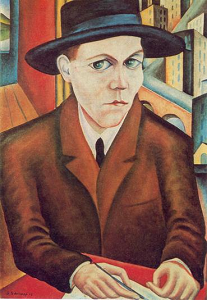


Oskar Maria Graf (22 juli 1894 – 28 juni 1967)
Portret door Georg Schrimpf, 1927
Lees verder “Maria Janitschek, Oskar Maria Graf, Emma Lazarus, Per Hojholt, Jakob Lorber”

Frouke Arns, Ernest Hemingway, Belcampo, Boris Dittrich , Hans Fallada, David Boerljoek


Dolce far niente – Bij de Nijmeegse Vierdaagse


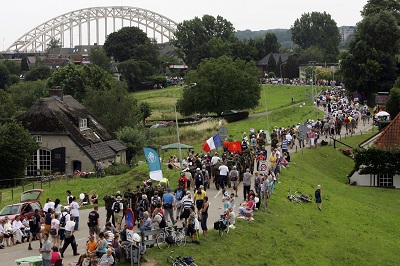
Wandelaars tijdens de Vierdaagse van Nijmegen


Roem en blaren

dit vallen in de voetstappen van hen
die voor je gingen gaat je goed af;
zwaaiend doe je voort, aangespoord door
duizend klanken langs de weg

als lava stroom je door de straten,
geeft je glimlach aan elk gezicht,
in iedere taal een nieuwe vriend

in de vroegte op de Wedren moedigt
de laatste lichting uit de kroeg je aan
twee werelden die elkaar hier raken –
ieder draagt zijn eigen kruis

in de maat van het legioen ga ook jij
de eindstreep halen; op de Via Gladiola
wachten zwaardlelies jouw komst

en de stad, zij heeft de tijd, deinend staat zij
aan haar kade middenin het feestgedruis
straks ga je naar huis, zijn haar straten vreemd
sereen, geeft je eeuwige roem en blaren mee.


Frouke Arns (Handorf, 1964)
Handorf. Frouke Arnswas in 2015 en 2016 stadsdichter van Nijmegen.

Lees verder “Frouke Arns, Ernest Hemingway, Belcampo, Boris Dittrich , Hans Fallada, David Boerljoek”

Ernest Farrés

De Catalaanse dichter Ernest Farrés i Junyent werd in Igualada geboren op 21 juli 1967 en woont in Barcelona. Hij werkt als journalist en redacteur voor het supplement van La Vanguardia, Farrés publiceerde zes dichtbundels: “Clavar-ne una al mall i l’altra a l’enclusa” (1996), “Mosquits” (1998), “Edward Hopper” (2006), “Els efectes imprevisibles dels camps magnètics” (2011), “Blitzkrieg” (2011) en “Los Angeles” (2015), met illustraties van Joan Longas. Elk gedicht in het tweetalige “Edward Hopper”, waarvoor hij de Englantina d’Or van de Jocs Florals van Barcelona ontving, is gebaseerd op een schilderij van de Amerikaanse kunstenaar. Farrés heeft ook een bloemlezing uitgegeven van de hedendaagse Catalaanse poëzie, “21 poetes del XXI”(2001). In Spanje is Edward Hopper zowel in het Catalaans als het Spaans bewerkt voor het toneel. Engelse vertalingen van Farrés ‘gedichten zijn verschenen in Calque, The Nation, PN Review, Two Lines, Words without Borders, World Literature Today en Zoland Poetry. Voor zijn blog “La República Poètica de l’Ernest Farrés” ontving hij in 2010 de Vila Martorell-prijs voor literatuurblogs in het Catalaans.


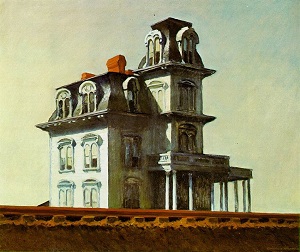
House by the Railroad door Edward Hopper, 1925


House by the Railroad, 1925

I fantasize that luck is placed
within my reach. Of course, there’s different kinds.
Take the kind that turns up ad hoc, for instance,
and the kind that unfolds
backwards. There are deficits and surpluses
of luck. By the same token, we have good luck,
everyday luck, luck-you-don’t-remember,
and bad luck, a.k.a. misfortune.
Luck that puts us on easy street and luck
that’s an asp, a scorpion fish, a wild boar, a starling.
I have a vision of train tracks half covered
with grass and rust, hurling themselves
—like a jagged line or a blade
with an iridescence that catches you by surprise—
against a tomorrow without an Achilles’ heel.
And I imagine who-knows-what plains
and mountains untouched by human hand
and still not weatherproofed
at the mercy of nor’easters, downpours, and heat.
But the fantasies don’t stop here.
Like the rip in a memory of a past life,
another jolts my mind:
I recognize myself holding vigil
inside a huge Victorian house,
vacant, foreboding, phantasmagorical,
without going crazy for what I can’t possess
yet cut off from the world, supreme example
of original innocence.


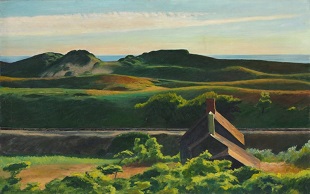
Hills South Truro door Edward Hopper 1930


Hills, South Truro, 1930

I climbed to the very top of the mountain
to speak to myself.
You know,
about the present, the future.
Bared to the sun,
I held the prerogative
of seeing many things coming to pass.
It must be due to the scent of earth
and distant sea, which were consoling.
It must be due to birdsong. It must be
due to trains. Is it due to the grandeur
of this vista?
As the sun
beat down I allowed my gaze to range
and understood my limits and that a slew
of pot-boilers hinders me. That I am diverted
by punk points of light. That I dedicate
no immortality to doing nothing.
That I hear a whisper from inside.

I utter not a word and the surrounding world
suddenly possesses me and bears me away.
I grow lighter. Become leaf-bearing
and even burst into bloom. From the peak
I delight in the superhuman
contemplation of dominions.

But thereafter my lot will be
to descend to the plain, returning
to my kind, and thus, as if I were such,
I shall resume an everyday likeness
squandering time and resources.


Vertaald door Lawrence Venuti

 
Ernest Farrés (Igualada, 21 juli 1967)

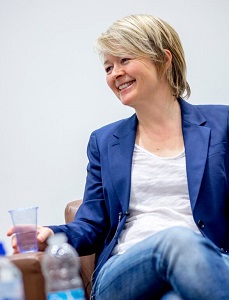
Sarah Waters

De Britse schrijfster Sarah Waters werd geboren in Neyland, Wales, op 21 juli 1966. Ze ging daar ook naar school en bezocht later de universiteit van Canterbury waar ze haar doctoraat in Engelse literatuur verkreeg. Haar specialisering was moderne homoliteratuur vanaf de negentiende eeuw. Zij deed voor haar proefschrift onderzoek naar lesbische historische romans. Door een bestudering van de negentiende-eeuwse seksuele onderwerelden toont zij onder meer aan dat de voorstellingen die men tegenwoordig van (homo)seksualiteit in de Victoriaanse periode heeft, in het beste geval stereotiep en in het slechtste geval onjuist zijn. Haar werk voor haar promotiethesis inspireerde haar tot het schrijven van haar eigen lesbische historische romans waarin ze het Victoriaanse tijdperk nieuw leven inblaast. Door haar stijl, de periode waarin haar romans zich afspelen en het feit dat haar hoofdpersonages uit de onderklasse afkomstig zijn, wordt zij vaak vergeleken met Dickens. Zij ontving o.a. de Betty Trask Award, Somerset Maugham award, de Lambda Literary Award for Lesbian Fiction, Young Writer of the Year Award en de CWA Historical Dagger prizee. Twee van haar boeken werden door de BBC tot miniseries bewerkt. In 2002 verscheen “Tipping the Velvet” met Rachael Stirling en Keeley Hawes in de hoofdrollen. De serie zorgde voor enige opschudding, omdat op de BBC nog nooit eerder zulke expliciet (lesbische) erotische scènes werden uitgezonden. In 2005 werd Waters’ derde boek “Fingersmith” verfilmd, met Sally Hawkins, Elaine Cassidy en Rupert Evans in de belangrijkste rollen. In het voorjaar van 2006 verscheen haar vierde roman getiteld “The Night Watch” die zich tijdens de Tweede Wereldoorlog afspeelt.    

 Uit: Tipping the Velvet

“Have you ever tasted a Whitstable oyster? If you have, you will remember it. Some quirk of the Kentish coastline makes Whitstable natives – as they are properly called – the largest and the juiciest, the savouriest yet the subtlest, oysters in the whole of England. Whitstable oysters are, quite rightly, famous. The French, who are known for their sensitive palates, regularly cross the Channel for them; they are shipped, in barrels of ice, to the dining-tables of Hamburg and Berlin. Why, the King himself, I heard, makes special trips to Whitstable with Mrs Keppel, to eat oyster suppers in a private hotel; and as for the old Queen – she dined on a native a day (or so they say) till the day she died.
Did you ever go to Whitstable, and see the oyster-parlours there? My father kept one; I was born in it – do you recall a narrow, weather-boarded house, painted a flaking blue, half-way between the High Street and the harbour? Do you remember the bulging sign that hung above the door, that said that Astley’s Oysters, the Best in Kent were to be had within? Did you, perhaps, push at that door, and step into the dim, low-ceilinged, fragrant room beyond it? Can you recall the tables with their chequered cloths – the bill of fare chalked on a board – the spirit-lamps, the sweating slabs of butter?
Were you served by a girl with a rosy cheek, and a saucy manner, and curls? That was my sister, Alice. Or was it a man, rather tall and stooping, with a snowy apron falling from the knot in his neck-tie to the bow in his boots? That was my father. Did you see, as the kitchen door swung to and fro, a lady stand frowning into the clouds of steam that rose from a pan of bubbling oyster soup, or a sizzling gridiron?
That was my mother.
And was there at her side a slender, white-faced, unremarkable- looking girl, with the sleeves of her dress rolled up to her elbows, and a lock of lank and colourless hair forever falling into her eye, and her lips continually moving to the words of some street-singer’s or music-hall song?
That was me.
Like Molly Malone in the old ballad, I was a fishmonger, because my parents were. They kept the restaurant, and the rooms above it: I was raised an oyster-girl, and steeped in all the flavours of the trade. My first few childish steps I took around vats of sleeping natives and barrels of ice; before I was ever given a piece of chalk and a slate, I was handed an oysterknife and instructed in its use; while I was still lisping out my alphabet at the schoolmaster’s knee, I could name you the contents of an oyster-cook’s kitchen – could sample fish with a blindfold on, and tell you their variety. Whitstable was all the world to me, Astley’s Parlour my own particular country, oyster-juice my medium. Although I didn’t long believe the story told to me by Mother – that they had found me as a baby in an oyster-shell, and a greedy customer had almost eaten me for lunch – for eighteen years I never doubted my own oysterish sympathies, never looked far beyond my father’s kitchen for occupation, or for love. »

 
Sarah Waters (Neyland, 21 juli 1966)

Hans Lodeizen, Henk Hofland, Arie Storm, Uwe Johnson, Simin Behbahāni, Francesco Petrarca, Maurice Gilliams, Erik Axel Karlfeldt, Cormac McCarthy

De Nederlandse dichter Hans Lodeizen werd geboren op 20 juli 1924 in Naarden. Zie ook alle tags voor Hans Lodeizen op dit blog.


Weet je nog…

Weet je nog…? – Toen de wind, de bomen
Tergde en hen de mantels, van het lichaam trok,
Dat wij samen – de regen kletterde bij stromen –
Schuilden onder ’t loof, en jij zó schrok

Toen ik je zei dat dit het eind was, en voorgoed
Onze wegen voortaan zouden scheiden.
‘Mijn arme kind ’t is droevig maar het moet;
Beter is het heen te gaan’ Ik zweeg en jij schreide.

Weet je nog? Toen mijn hand de jouwe
Zachtkens drukte, omdat jij spoedig zou zien
Dat ik niet de beste was. ‘zo zijn vrouwen!’
En dat jij door je tranen lachte, en zei; ‘Misschien…!”

Nu is het herfst opnieuw en regen, maar alleen
Schuil ik onder ’t lover, denk aan jou – en ween…


In de bedding van je heupen

In de bedding
van je heupen wil ik slapen
door de hemel van je
ogen bedekt

je voeten zijn ver
en toch behoren ze bij je als een
vlieger zijn ze opgelaten
in een zomerdag

ik woon
in een ander huis; soms
komen we elkander tegen
ik slaap altijd zonder jou
en wij zijn altijd samen


spinnenwebben van moeheid

spinnenwebben van
moeheid dragen over
grandioze zeeën zijn
ellendig hart. en toch
zal alles zo blijven


Hans Lodeizen (20 juli 1924 – 26 juli 1950)

Lees verder “Hans Lodeizen, Henk Hofland, Arie Storm, Uwe Johnson, Simin Behbahāni, Francesco Petrarca, Maurice Gilliams, Erik Axel Karlfeldt, Cormac McCarthy”

Paul Violi

De Amerikaanse dichter Paul Randolph Violi werd geboren op 20 juli 1944 in Brooklyn, New York. Violi was in de periode 1972-1974 redacteur van The Architectural Forum, werkte als freelancer bij Universal Limited Art Editions en als voorzitter van de Associate Council Poetry Committee organiseerde hij van 1974 tot 1983 een reeks lezingen in het Museum of Modern Art. Hij was ook mede-oprichter van de Swollen Magpie Press, die poëziebundels, anthologieën en een tijdschrift genaamd New York Times uitgaf en werkte samen met Dale Devereux Barker aan kunstboeken, zoals “Envoy; Life is Completely Interesting” en “Selected Accidents, Pointless Anecdotes, a collection of non-fiction prose”. Violi kreeg ook twee poëziebeurzen van het National Endowment for the Arts en ontving de John Ciardi Lifetime Achievement Award in Poetry, de the American Academy of Arts and Letters Morton Dauwen Zabel Award, en subsidies van The Foundation for Contemporary Arts Poetry, The Fund for Poetry, The New York Foundation for the Arts, The Ingram Merrill Foundation,en de New York Creative Artists Public Service Fund. Hij publiceerde elf poëziebundels, waaronder “Splurge” (1982), “Likewise” (1988), “The Curious Builder” (1993), “Fracas” (1998), en “Overnight” (2007).

Appeal to the Grammarians

We, the naturally hopeful,
Need a simple sign
For the myriad ways we’re capsized.
We who love precise language
Need a finer way to convey
Disappointment and perplexity.
For speechlessness and all its inflections,
For up-ended expectations,
For every time we’re ambushed
By trivial or stupefying irony,
For pure incredulity, we need
The inverted exclamation point.
For the dropped smile, the limp handshake,
For whoever has just unwrapped a dumb gift
Or taken the first sip of a flat beer,
Or felt love or pond ice
Give way underfoot, we deserve it.
We need it for the air pocket, the scratch shot,
The child whose ball doesn’t bounce back,
The flat tire at journey’s outset,
The odyssey that ends up in Weehawken.
But mainly because I need it—here and now
As I sit outside the Caffe Reggio
Staring at my espresso and cannoli
After this middle-aged couple
Came strolling by and he suddenly
Veered and sneezed all over my table
And she said to him, “See, that’s why
I don’t like to eat outside.


Midnight Shift

I listen to the crickets and hear
the machinery at the bottom of the night.

They are all made in Hong Kong
out of interchangeable parts.

They all rise and fall on the same wave,
the creaking, changeless sea
they made out of sound and the night air.

                I don’t surprise myself anymore:
a sense of motion but no advance, no shore
in sight other than sleep; and the usual
lines scribbled on the way, the notes
an alchemist hears adrift in the ordinary
with no symbol for the element of surprise.

 — But then to feel your hand instead, palm up
on the bed like a little boat in the dark,

with everything calm for an instant
before out of nowhere all of you lands
on me with a great laugh, a splash of hair.

 
Paul Violi (20 juli 1944 – 2 april 2011)

Otto Julius Bierbaum, Anna Enquist, Gottfried Keller, Lucas Malan, Miltos Sachtouris, Jean-Pierre Faye

Dolce far niente


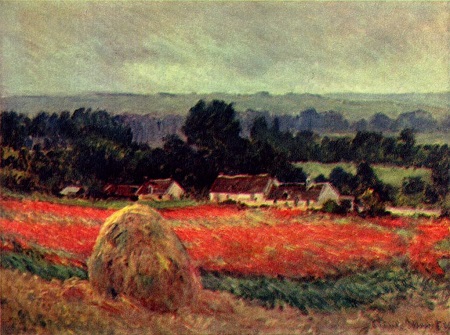
Champ de coquelicots door Claude Monet, 1885


Roter Mohn

Wenn im Sommer der rote Mohn
wieder glüht im gelben Korn,
wenn des Finken süßer Ton
wieder lockt im Hagedorn,
wenn es wieder weit und breit
feierklar und fruchtstill ist,
dann erfüllt sich uns die Zeit,
die mit vollen Massen misst.

Dann verebbt, was uns bedroht,
dann verweht, was uns bedrückt,
über dem Schlangenkopf der Not
ist das Sonnenschwert gezückt.
Glaube nur, es wird geschehn!
Wende nicht den Blick zurück!
Wenn die Sommerwinde wehn,
werden wir in Rosen gehn,
und die Sonne lacht uns Glück!


Otto Julius Bierbaum (28 juni 1865 – 1 februari 1910)
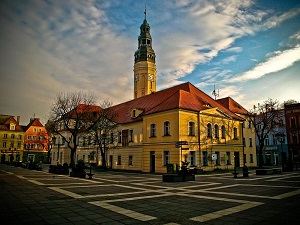
Raadhuis in Grünberg (Nu: Zielona Góra), de geboorteplaats van Otto Bierbaum

Lees verder “Otto Julius Bierbaum, Anna Enquist, Gottfried Keller, Lucas Malan, Miltos Sachtouris, Jean-Pierre Faye”

Ghayath Almadhoun

De Zweeds – Palestijnse dichter, toneelschrijver, journalist en literair criticus Ghayath Almadhoun werd geboren op 19 juli 1979 in het Palestijnse vluchtelingenkamp Yarmouk in Damascus als zoon van een Palestijnse vader en een Syrische moeder. Hij studeerde Arabische literatuur aan de Universiteit van Damascus en werkte als cultureel journalist. Hij woont nu in Stockholm. Hij richtte Bayt al-Qasid op, het Huis van de Poëzie, een ruimte voor vrije expressie in Damascus, samen met de Syrische dichter Lukman Derky. Hij publiceerde 3 dichtbundels, de laatste werd gepubliceerd in Beiroet in 2014. Hij publiceerde twee bundels in het Zweeds, “Asylansökan”, 2010 en “Till Damaskus” wat hij samen schreef met de Zweedse dichter Marie Silkeberg. Het boek was op de literaire kritieklijst van Dagens Nyheters voor de beste nieuwe boeken en werd ook bewerkt tot hoorspel op de Zweedse nationale radio. Met Marie Silkeberg heeft hij ook verschillende poëziefilms gemaakt. Zijn werk is vertaald in het Zweeds, Duits, Nederlands, Grieks, Sloveens, Italiaans, Engels, Frans, Deens en Chinees. De Nederlandse vertaling van zijn gedichten “Weg van Damascus” was een van de tien meest verkochte poëzieboeken in België gedurende enkele weken in 2015.

We

We, who are strewn about in fragments, whose flesh flies through the air like raindrops, offer our profound apologies to everyone in this civilised world, men, women and children, because we have unintentionally appeared in their peaceful homes without asking permission. We apologise for stamping our severed body parts into their snow-white memory, because we have violated the image of the normal, whole human being in their eyes, because we have had the impertinence to leap suddenly on to news bulletins and the pages of the internet and the press, naked except for our blood and charred remains.
We apologise to all those who did not have the courage to look directly at our injuries for fear they would be too horrified, and to those unable to finish their evening meals after they had unexpectedly seen fresh images of us on television.
We apologise for the suffering we caused to all who saw us like that, unembellished, with no attempt having been made to put us back together or reassemble our remains before we appeared on their screens. We also apologise to the Israeli soldiers who took the trouble to press the buttons in their aircraft and tanks to blow us to pieces, and we are sorry for how hideous we looked after they aimed their shells and bombs straight at our soft heads, and for the hours they are now going to spend in psychiatrists’ clinics, trying to become human again, like they were before our transformation into repulsive body parts that pursue them whenever they try to sleep.

We are the things you have seen on your screens and in the press, and if you made an effort to fit the pieces together, like a jigsaw, you would get a clear picture of us, so clear that you would be unable to do a thing.

Vertaald door Catherine Cobham

 
Ghayath Almadhoun (Damascus, 19 juli 1979)

Simon Vinkenoog, Steffen Popp, Per Petterson, Elizabeth Gilbert, Alicia Steimberg, Jevgeni Jevtoesjenko, Aad Nuis, William M. Thackeray, Nathalie Sarraute

De Nederlandse dichter en schrijver Simon Vinkenoog werd op 18 juli 1928 in Amsterdam geboren. Zie ook alle tags voor Simon Vinkenoog op dit blog.


Zuster

Er woont een zachte zuster in mijn huid
een vrijbuiter die in mijn lichaam bijt
ensoms haar handen op mijn zijde legt,
‘s nachts stelten loopt, of danst of rust.

Dan dringt zij ook haar dromen aan mij op
en ik leg mij huiverend naast haar:
een dode, een schamel geraamte,
knikkend en stamelend.


Tenzij de dingen uit zichzelf gaan spreken

een kraan het hoog geluid van liefde fluit
een waterstraal die onverslapte aandacht tikt
een dronken boodschap in de brievenbus
een onverwacht bezoek aan de deur gevonden

de zee die door de straten weifelt
de zon een onbeholpen minnaar op mijn huid
en de doofstomme takken van de bomen
in mijn ogen et cetera

Tenzij ik jaren op je wachten wil
en op je mond het stempel ongeopend druk

als met een zegelring die woorden bloed
en vlijt in de nagels drijft

de handen die niets meer weten
van het feest dat morgen
in de cijfers van het heden
wijdbeens staat geplant


Simon Vinkenoog (18 juli 1928 – 12 juli 2009)

Lees verder “Simon Vinkenoog, Steffen Popp, Per Petterson, Elizabeth Gilbert, Alicia Steimberg, Jevgeni Jevtoesjenko, Aad Nuis, William M. Thackeray, Nathalie Sarraute”

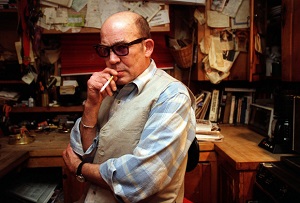
Hunter S. Thompson

De Amerikaanse schrijver en journalist Hunter Stockton Thompson werd geboren in Louisville (Kentucky). op 18 juli 1937. Hij groeide op in de Cherokee Triangle buurt in de Highlands en ging naar Louisville Male High School. Zijn ouders trouwden in 1935. Door de dood van de vader werden hun drie zoons: Hunter, Davison en James opgevoed door hun moeder, een alcoholiste. Na vroege aanrakingen met de politie meldde hij zich als onderdeel van zijn straf bij de Amerikaanse Luchtmacht. Op Eglin Air Force Base in Florida begon hij in 1956 als sportjournalist te schrijven voor het nieuwsblad van de basis. In 1958 werd hij weggestuurd bij de luchtmacht. Hierna werkte Thompson kort als redacteur voor Time Magazine in New York. Thompson reisde door Peru, Colombia en Brazilië. Hier schreef hij als freelance journalist artikelen voor meerdere Amerikaanse kranten. In Puerto Rico werd hij bevriend met journalist William Kennedy en werd Zuid-Amerika-correspondent voor onder andere het tijdschrift The National Observer. In 1966 trok hij een tijd op met een groep Californische Hells Angels. Hij schreef over hen een serie artikelen die in 1967 werd gebundeld onder de titel “Hell’s Angels: A Strange and Terrible Saga Of The Outlaw Motorcycle Gangs”. Aan het eind van de jaren zestig ging hij als een van de eersten voor het nieuwe tijdschrift Rolling Stone werken. Zijn excentrieke levensstijl en schrijfstijl was een van de factoren achter het succes van “Rolling Stone”. Thompson creëerde een geheel eigen journalistieke stijl met als voornaamste kenmerk dat hij niet zijn onderwerp maar zichzelf centraal stelde; hij noemde dit gonzojournalistiek, een in drugs gedrenkte variant van new journalism. Zijn bekendste werk uit deze periode is “Fear and Loathing in Las Vegas, and Other American Stories” (1971), dat in 1998 door Terry Gilliam zou worden verfilmd met Johnny Depp en Benicio Del Toro. In 1972 schreef hij voor Rolling Stone een serie reportages over de Amerikaanse presidentsverkiezingen van 1972, waarbij hij nauw betrokken raakte bij het kamp van presidentskandidaat George McGovern. Thompson schreef daarna uitvoerig over het Watergateschandaal en steunde bij de daarop volgende presidentsverkiezingen van 1976 al vroeg de toen nog onbekende Jimmy Carter. Als buitenlandcorrespondent berichtte Thompson in 1983 over de invasie van de Amerikaanse mariniers in Grenada. Op 67-jarige leeftijd werd hij door het hoofd geschoten aangetroffen door zijn zoon Juan Thompson op zijn Owl Farm in Woody Creek bij Aspen (Colorado). Op grond van de schotwond oordeelde de politie dat er sprake was van zelfmoord.

Uit: Fear and Loathing in Las Vegas

“We were somewhere around Barstow on the edge of the desert when the drugs began to take hold. I remember saying something like “I feel a bit lightheaded; maybe you should drive. …” And suddenly there was a terrible roar all around us and the sky was full of what looked like huge bats, all swooping and screeching and diving around the car, which was going about 100 miles an hour with the top down to Las Vegas. And a voice was screaming: “Holy Jesus! What are these goddamn animals?”
Then it was quiet again. My attorney had taken his shirt off and was pouring beer on his chest, to facilitate the tanning process. “What the hell are you yelling about?” he muttered, staring up at the sun with his eyes closed and covered with wraparound Spanish sunglasses. “Never mind,” I said. “It’s your turn to drive.” I hit the brakes and aimed the Great Red Shark toward the shoulder of the highway. No point mentioning those bats, I thought. The poor bastard will see them soon enough.
It was almost noon, and we still had more than 100 miles to go. They would be tough miles. Very soon, I knew, we would both be completely twisted. But there was no going back, and no time to rest. We would have to ride it out. Press registration for the fabulous Mint 400 was already underway, and we had to get there by four to claim our soundproof suite. A fashionable sporting magazine in New York had taken care of the reservations, along with this huge red Chevy convertible we’d just rented off a lot on the Sunset Strip … and I was, after all, a professional journalist; so I had an obligation to cover the story, for good or ill.
The sporting editors had also given me $300 in cash, most of which was already spent on extremely dangerous drugs. The trunk of the car looked like a mobile police narcotics lab. We had two bags of grass, 75 pellets of mescaline, five sheets of high-powered blotter acid, a salt shaker half full of cocaine, and a whole galaxy of multi-colored uppers, downers, screamers, laughers … and also a quart of tequila, a quart of rum, a case of Budweiser, a pint of raw ether and two dozen amyls.
All this had been rounded up the night before, in a frenzy of high-speed driving all over Los Angeles County – from Topanga to Watts, we picked up everything we could get our hands on. Not that we needed all that for the trip, but once you get locked into a serious drug collection, the tendency is to push it as far as you can.”

 
Hunter S. Thompson (18 juli 1937 – 20 februari 2005)