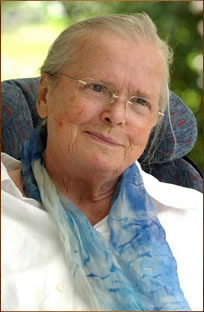
Yevgeni Popov, Luisa Futoransky, Forough Farokhzad

De Russische schrijver Yevgeni Anatoljewitsj Popov werd geboren op 5 januari 1946 in Krasnojarsk, Sibirië. Zie ook alle tags voor Yevgeni Popov op dit blog.


Uit: Mein Moskau


„Moskau besteht nicht nur aus den Stars der Klatschspalten, aus Bankern, Banditen, Herrschern und Abgeordneten. Vor allem besteht Moskau aus jenen einfachen Leuten, die auch heute noch schuften und schuften und ihren Urlaub keinesfalls auf den Kanarischen Inseln verbringen, sondern in bescheidenen Datschen und winzig kleinen Schrebergärten, um sich für den Winter mit Kartoffeln, Sauerkraut, Salzgurken und Marmelade einzudecken. «Wer leben will, muss rührig sein» – das trifft auf Moskau zu, in Moskau ist das Leben schwierig, in Moskau musste man schon immer «rührig sein», denn «Moskau glaubt den Tränen nicht», wie ein anderes russisches Sprichwort lautet, das zum Titel eines berühmten sowjetischen Kino-Melodramas wurde: Ein armes Aschenputtel kommt aus der Provinz in die Hauptstadt, und unter der Leitung einer allmächtigen Fee namens KPdSU hat es am Ende des Films sein Glück gemacht – die Dame ist Direktorin einer grossen Textilfabrik und Ehefrau eines anständigen Mannes ganz ohne schädliche Angewohnheiten . . .

In Moskau sind jedoch alle Zugereiste, einschliesslich des Stadtgründers, Fürst Juri Dolgoruki, der nach der Legende den Bojaren Stepan Kutschka erschlug, der an dem später «Moskau» genannten Ort ansässig war. Aber früher oder später arrangieren sich alle, weshalb ich hoffe, dass diese Fabrik nicht im Feuer der Perestroika verbrannt ist, dass die gescheite Dame beizeiten aus der KPdSU austrat, ihr Unternehmen privatisiert und «aktienisiert» hat und heute mit einem Mercedes 600 und Leibwache durch die Moskauer Strassen fährt – als anschauliche Illustration jenes Vergleichs von früher und heute, der noch unter der Sowjetmacht allen zum Hals heraushing und bis jetzt von Journalisten gern zur Beschreibung des neuen Moskau eingesetzt wird, wobei sie sich wie auf einer Schaukel von Verzweiflung zu Euphorie aufschwingen und wieder zurück.“
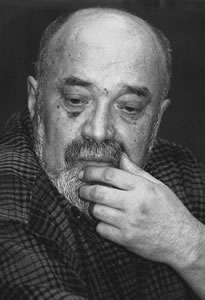


Yevgeni Popov (Krasnojarsk, 5 januari 1946)


Lees verder “Yevgeni Popov, Luisa Futoransky, Forough Farokhzad”
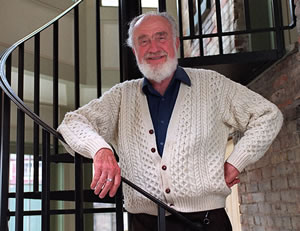
William Snodgrass, Pierre Seghers, Fred Wander, Humbert Wolfe, Stella Gibbons

De Amerikaanse dichter William De Witt Snodgrass werd geboren op 5 januari 1926 in Wilkinsburg, Pennsylvania. Zie ook alle tags voor William Snodgrass op dit blog.


Mementos, 1


Sorting out letters and piles of my old

Canceled checks, old clippings, and yellow note cards

That meant something once, I happened to find

Your picture. That picture. I stopped there cold,

Like a man raking piles of dead leaves in his yard

Who has turned up a severed hand.


Still, that first second, I was glad: you stand

Just as you stood—shy, delicate, slender,

In that long gown of green lace netting and daisies

That you wore to our first dance. The sight of you stunned

Us all. Well, our needs were different, then,

And our ideals came easy.


Then through the war and those two long years

Overseas, the Japanese dead in their shacks

Among dishes, dolls, and lost shoes; I carried

This glimpse of you, there, to choke down my fear,

Prove it had been, that it might come back.

That was before we got married.


—Before we drained out one another’s force

With lies, self-denial, unspoken regret

And the sick eyes that blame; before the divorce

And the treachery. Say it: before we met. Still,

I put back your picture. Someday, in due course,

I will find that it’s still there.


William Snodgrass (5 januari 1926 – 13 januari 2009)


Lees verder “William Snodgrass, Pierre Seghers, Fred Wander, Humbert Wolfe, Stella Gibbons”

In Memoriam Eva Strittmatter

De Duitse dichteres en schrijfster Eva Strittmatter is afgelopen maandag op 80-jarige leeftijd in Berlijn overleden. Eva Strittmatter werd op 8 februari 1930 in Neuruppin geboren als Eva Braun. Zie ook mijn blog van 8 februari 2007 en ook mijn blog van 8 februari 2008 en ook mijn blog van 8 februari 2009 en ook mijn blog van 8 februari 2010.


Finstere Stunde


Ich spüre, wie ich vereise.

Vom Alter, nicht vom Frost.

Ich rede verlegen und leise.

Mein Lachen ist brüchig von Rost.

Ich kann nicht mehr in mir leben.

Und aus mir kann ich nicht hinaus.

Kein Sturm, kein Stern, kein Streben.

Nur Finsternis, Stille das Haus.


Eva Strittmatter (8 februari 1930 – 3 januari 2011)


Emil Zopfi, Gao Xingjian, David Berman, Doris Kearns Goodwin, Andreas Altmann, Max Eastman

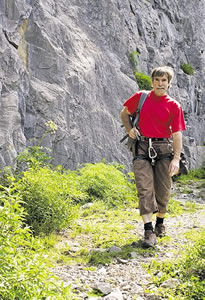
De Zwitserse schrijver Emil Zopfi werd geboren op 4 januari 1943 in Wald. Zie ook alle tags voor Emil Zopfi op dit blog.


Uit: Pfarrer Stähelis Geheimnis


Es war ein dunkler Nachmittag im Juni des Jahres 1753 in London. Lord Cotton liess sich mit einer Kutsche von Pall Mall nach Hammersmith fahren. Die Schatten der Menschen in den Strassen trieben im dicken Nebel vorbei wie schwarze Fische in einer Erbsensuppe. Bei der französischen Kirche von Hammersmith bezahlte er den Kutscher. Dann überquerte er mit langen, langsamen Schritten den Kichhof und betrat den Friedhof.

Das Begräbnis ging seinem Ende entgegen. Ein junger Prediger hielt die Andacht französischer Sprache. Als er Lord Cotton erblickte, stockte er für einen Augenblick. Die Trauernden drehten ihre Köpfe und starrten den Lord stumm an.

Nach dem Schlussgebet eilte der Prediger um das frisch aufgeworfene Grab und begrüsste Lord Cotton untertänigst. Er war bekannt als Berater von König Georg II in religiösen Fragen. Der Prediger verbeugte sich und fragte: “Darf ich Ihnen Mrs Stäheli vorstellen, Milord. Die arme Witwe.”

Cotton nickte flüchtig, drückte eine kalte Hand, blickte für einen Moment in ein stumpfes Gesicht hinter einem schwarzen Schleier und wünschte Beileid. Die Frau sagte kein Wort und blieb regungsslos stehen.

Lord Cotton wandte sich zum Prediger. “Ich bin beauftragt, im Namen seiner Majestät, des Königs, dieses Beileidsschreiben zu überreichen.” Er zog aus einer Tasche seines Mantel ein schmales Kuvert mit eingeprägter goldener Krone und reichte es dem Prediger. Die Frau stand noch immer reglos und stumm.

“Es tut mir leid, Milord. Mrs Stäheli versteht kein Englisch”, erklärte der Prediger mit gedämpfter Stimme.

“Vous parlez Francais?” wandte sich Lord Cotton and die Witwe. Aber der Prediger unterbrach ihn: “Mrs Stähelin spricht nur Deutsch. Sie und ihr verstorbener Gemahl, Pfarrer Stäheli, stammten aus der Schweiz. Aus dem deutschsprachigen Teil des Landes.”


Emil Zopfi (Wald, 4 januari 1943)


Lees verder “Emil Zopfi, Gao Xingjian, David Berman, Doris Kearns Goodwin, Andreas Altmann, Max Eastman”

Svend Fleuron, Maurice Mac-Nab, Jacob Grimm, Mite Kremnitz, Fernand Handtpoorter, Markus Seidel, Rajvinder Singh, Daniel Mursa

De Deense schrijver Svend Fleuron werd geboren op 4 januari 1874 op het landgoed Katrinedal bij Keldby. Zie ook alle tags voor Svend Fleuron op dit blog.

Uit: Kittens : A Family Chronicle (Vertaald door David Pritchard)


At the farthest end of the hedge loom three ancient willow stumps, like monster mushrooms springing from the ground.

For more than a century they have been regularly clipped, a process which has given them weirdly distorted heads. In each of their bowl-shaped tops is ample room for a couple of men.

Black ants live in the trunks beneath, and form paths up the furrowed, moss-covered bark; on the wind-dried branches and along the withered twigs the male ants assemble in swarming-time, giving the group of ancient trees an extraordinarily lifelike appearance.

But spiders spin their webs from every knot and curve, and in them ant corpses hang thickly in bunches. In one stump a redstart has built its nest; in another, which is big and full of touchwood, grow burdocks, mugworts, and nettles.

The old willow stumps are never at rest. . . . Hairy, yellow-speckled willow-moths wander all over them from top to root, devouring the leaves, until, later in the summer, only the stalks are left—then they spin their cocoons, and one day rise on their soft white wings to desert the stripped, maltreated larva-trees, the ground beneath carpeted with their filth.

The central stump, the one with fat, crooked stem, is hollow right down to the bottom.

Outside the entrance to the hole—a split in the top of the head—grows a large, thick gooseberry bush, which gives shelter from the wind and rain, and serves as a perfect door. Once upon a time the bush must have flown up here as a seed; now it has developed a long, thick aerial-root which runs down inside, clinging to the wooden wall until it reaches its mouldering base.

In the thorny branches a linnet has built its circular, down-lined nest—and here the bird has been sitting fearlessly for eight days and nights without caring in the least about the old grey cat, which at this very moment is squeezing its way through the narrow entrance.“


Svend Fleuron (4 januari 1874 – 5 april 1966)

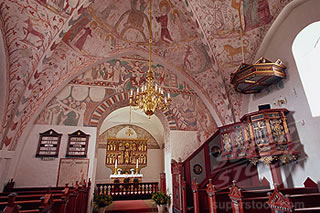
Het interieur met de beroemde fresco’s in de kerk van Keldby


Lees verder “Svend Fleuron, Maurice Mac-Nab, Jacob Grimm, Mite Kremnitz, Fernand Handtpoorter, Markus Seidel, Rajvinder Singh, Daniel Mursa”

J.R.R. Tolkien, Marie Darrieussecq, Alex Wheatle, Cicero, Drieu la Rochelle

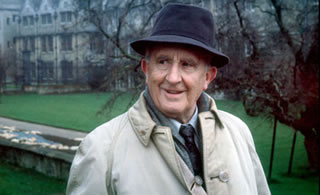
De Engelse schrijver J.R.R. Tolkien werd geboren op 3 januari 1892 in Bloemfontein, Zuid-Afrika. Zie ook alle tags voor J.R.R. Tolkien op dit blog.


Uit: The Lord of the Rings (The Hobbit)


„This hobbit was a very well-to-do hobbit, and his name was Baggins. The Bagginses had lived in the neighbourhood of The Hill for time out of mind, and people considered them very respectable, not only because most of them were rich, but also because they never had any adventures or did anything unexpected: you could tell what a Baggins would say on any question without the bother of asking him. This is a story of how a Baggins had an adventure, and found himself doing and saying things altogether unexpected. He may have lost the neighbours’ respect, but he gained-well, you will see whether he gained anything in the end.

The mother of our particular hobbit-what is a hobbit? I suppose hobbits need some description nowadays, since they have become rare and shy of the Big People, as they call us. They are (or were) a little people, about half our height, and smaller than the bearded dwarves. Hobbits have no beards. There is little or no magic about them, except the ordinary everyday sort which helps them to disappear quietly and quickly when large stupid folk like you and me come blundering along, making a noise like elephants which they can hear a mile off. They are inclined to be fat in the stomach; they dress in bright colours (chiefly green and yellow); wear no shoes, because their feet grow natural leathery soles and thick warm brown hair like the stuff on their heads (which is curly); have long clever brown fingers, good-natured faces, and laugh deep fruity laughs (especially after dinner, which they have twice a day when they can get it). Now you know enough to go on with. As I was saying, the mother of this hobbit-of Bilbo Baggins, that is-was the famous Belladonna Took, one of the three remarkable daughters of the Old Took, head of the hobbits who lived across The Water, the small river that ran at the foot of The Hill. It was often said (in other families) that long ago one of the Took ancestors must have taken a fairy wife. That was, of course, absurd, but certainly there was still something not entirely hobbitlike about them, and once in a while members of the Took-clan would go and have adventures. They discreetly disappeared, and the family hushed it up; but the fact remained that the Tooks were not as respectable as the Bagginses, though they were undoubtedly richer“.


J.R.R. Tolkien (3 januari 1892 – 2 september 1973)


Lees verder “J.R.R. Tolkien, Marie Darrieussecq, Alex Wheatle, Cicero, Drieu la Rochelle”

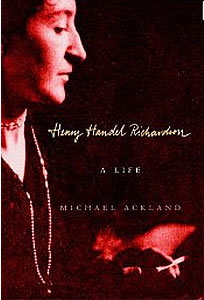
Henry Handel Richardson, Wolf von Aichelburg, Elsa Asenijeff, John Gould Fletcher, Charles Palissot de Montenoy

De Australische schrijfster Henry Handel Richardson (eig. Ethel Florence) werd geboren op 3 januari 1870 in Melbourne. Zie ook alle tags voor Henry Handel Richardson op dit blog.


Uit: The Way Home


When, having braved the bergs and cyclones of the desolate South Pacific, and rounded the Horn; having lain becalmed in the Doldrums, bartered Cross for Plough, and snatched a glimpse of the Western Isles: when the homeward-bound vessel is come level with Finisterre and begins to skirt the Bay, those aboard her get the impression of passing at one stroke into home waters. Gone alike are polar blasts and perfumed or desert-dry breezes; gone opalescent dawns, orange-green sunsets, and

nights when the very moon shines warm, the black mass of ocean sluggish as pitch. The region the homing wanderer now enters is quick with associations. These tumbling crested marbled seas, now slate-grey, now of a cold ultramarine, seem but the offings of those that wash his native shores; and they are peopled for him by the saltwater ghosts of his ancestors, the great navigators, who traced this road through the high seas on their voyages of adventure and discovery. The fair winds that belly the sails, or the head winds that thwart the vessel’s progress, are the romping south-west gales adrip with moisture, or the bleak north-easters which scour his island home and make it one of the windy corners of the world. Not a breath of balmy softness remains.

There is a rawness in the air, a keener, saltier tang; the sad-coloured sky broods low, or is swept by scud that flies before the wind; trailing mists blot out the horizon. And these and other indelible memories beginning to pull at his heartstrings, it is over with his long patience. After tranquilly enduring the passage of some fifteen thousand watery miles, he now falls to chafing, and to telling off the days that still divide him from port and home.“


Henry Handel Richardson (3 januari 1870 – 20 maart 1946)


Lees verder “Henry Handel Richardson, Wolf von Aichelburg, Elsa Asenijeff, John Gould Fletcher, Charles Palissot de Montenoy”

Douglas Jerrold, Heinrich Wilhelm von Gerstenberg, Hermann von Weinsberg, Jacob Balde S.J., Sven Kivisildnik, Xavier Orville

De Engelse schrijver Douglas William Jerrold werd geboren op 3 januari 1803 in Londen. Zie ook alle tags voor Douglas Jerrold op dit blog.


Uit: Mrs. Caudle’s Curtain Lectures 


„Your wife and children may all be burnt alive in their beds–as all of us to a certainty shall be, for the insurance MUST drop.  And after we’ve insured for so many years!  But how, I should like to know, are people to insure who make ducks and drakes of their five pounds?

“I did think we might go to Margate this summer.  There’s poor little Caroline, I’m sure she wants the sea.  But no, dear creature! She must stop at home–all of us must stop at home–she’ll go into a

consumption, there’s no doubt of that; yes–sweet little angel!–I’ve made up my mind to lose her, NOW.  The child might have been saved; but people can’t save their children and throw away their five pounds too.

“I wonder where poor little Mopsy is!  While you were lending that five pounds, the dog ran out of the shop.  You know, I never let it go into the street, for fear it should be bit by some mad dog, and come home and bite all the children.  It wouldn’t now at all astonish me if the animal was to come back with the hydrophobia, and give it to all the family.  However, what’s your family to you, so you can play the liberal creature with five pounds?

“Do you hear that shutter, how it’s banging to and fro?  Yes,–I know what it wants as well as you; it wants a new fastening.  I was going to send for the blacksmith to-day, but now it’s out of the question:

NOW it must bang of nights, since you’ve thrown away five pounds.

“Ha! there’s the soot falling down the chimney.  If I hate the smell of anything, it’s the smell of soot.  And you know it; but what are my feelings to you?  SWEEP THE CHIMNEY!  Yes, it’s all very fine to say sweep the chimney–but how are chimneys to be swept–how are they to be paid for by people who don’t take care of their five pounds?“


Douglas Jerrold (3 januari 1803 – 8 juni 1857)


Lees verder “Douglas Jerrold, Heinrich Wilhelm von Gerstenberg, Hermann von Weinsberg, Jacob Balde S.J., Sven Kivisildnik, Xavier Orville”

Christopher Durang, David Shapiro, Jimmy Santiago Baca, Hans Herbjørnsrud, Anton van Duinkerken, André Aciman

De Amerikaanse toneelschrijver Christopher Durang werd geboren op 2 januari 1949 in Montclair, New Jersey. Zie ook alle tags voor Christopher Durang op dit blog.


Uit: Sister Mary Ignatius Explains It All For You 


„SISTER. But are you living properly?

ALOYSIUS. Yes.

SISTER. And you’re married?

ALOYSIUS. Yes.

SISTER. And you don’t use birth control?

ALOYSIUS. No.

SISTER. But you only have two children. Why is that? You’re not spilling your seed like Onan, are you? That’s a sin, you know.

ALOYSIUS. No. It’s just chance that we haven’t had more.

SISTER. And you go to mass once a week, and communion at least once a year, and confession at least once a year? Right?

ALOYSIUS. Yes.

SISTER. Well, I’m very pleased then.

ALOYSIUS. I am an alcoholic. And recently I’ve started to hit my wife. And I keep thinking about suicide.

SISTER. (thinks for a moment) Within bounds, all those things are venial sins. (to audience) At least one of my students turned out well. (to Aloysius) Of course, I don’t know how hard you’re hitting your wife; but with prayer and God’s grace …

ALOYSIUS. My wife is very unhappy.

SISTER. Yes, but eventually there’s death. And then everlasting happiness in heaven. (with real feeling) Some days I long for heaven. (to Gary) And you? Have you turned out all right?

GARY. I’m okay.

SISTER. And you don’t use birth control?

GARY. Definitely not.

SISTER. That’s good. (looks at him) What do you mean, “Definitely not”?

GARY. I … don’t use it.

SISTER. And you’re not married. Have you not found the right girl?

GARY. In a manner of speaking.

SISTER. (grim, choosing not to pursue it) Okay. (walks away, but can’t leave it, comes back to him) You do that thing that makes Jesus puke, don’t you?“


Christopher Durang (Montclair, 2 januari 1949)


Lees verder “Christopher Durang, David Shapiro, Jimmy Santiago Baca, Hans Herbjørnsrud, Anton van Duinkerken, André Aciman”

Nyk de Vries, Peter Redgrove, Jean-Bernard Pouy, Isidoor Teirlinck, Gerhard Amanshauser, Luc Decaunes

De Nederlandse dichter Nyk de Vries werd geboren in Noordbergum op 2 januari 1971. Zie ook alle tags voor Nyk de Vries op dit blog.


België

Met veel bravoure verliet ik familie en vrienden
om het helemaal te gaan maken in België, samen
met mijn lieve Wendelien. Dat viel eerlijk gezegd
nogal tegen en binnen korte tijd verloor onze
liefde al haar glans. Op het laatst kwamen we
terecht op een kartonfabriek waar onze chef
het duidelijk had voorzien op mijn Wendelien.
Ik was niet meer mezelf daar in België en
tijdens een pauze sloeg ik hem keihard met een
hooivork op zijn rug. Sommige collega’s kwamen
later naar me toe en zeiden: ‘Die hooivork
had daar ook helemaal niet mogen staan.’


Kamp

Architecten verdedigen architecten. Advocaten verdedigen advocaten. Typisten verdedigen typisten. Kunstenaars verdedigen kunstenaars. Ik verdedigde jou, tot we uit elkaar gingen, je ervandoor ging met een stukadoor en we in verschillend kampen terechtkwamen. Ik voelde me ontwricht, maar ging ook de wereld zien. Ik zag verschillen en begreep plotseling waarom het land vol dezelfde huizen stond, de straten vol dezelfde auto’s. Ik verkoos het verdedigen te laten. Ik draaide de weg op en verliet het Friese subsidiecircuit.


Nyk de Vries (Noordbergum, 2 januari 1971)


Lees verder “Nyk de Vries, Peter Redgrove, Jean-Bernard Pouy, Isidoor Teirlinck, Gerhard Amanshauser, Luc Decaunes”