Jonge vrede (Leo Vroman)


Bij 5 mei


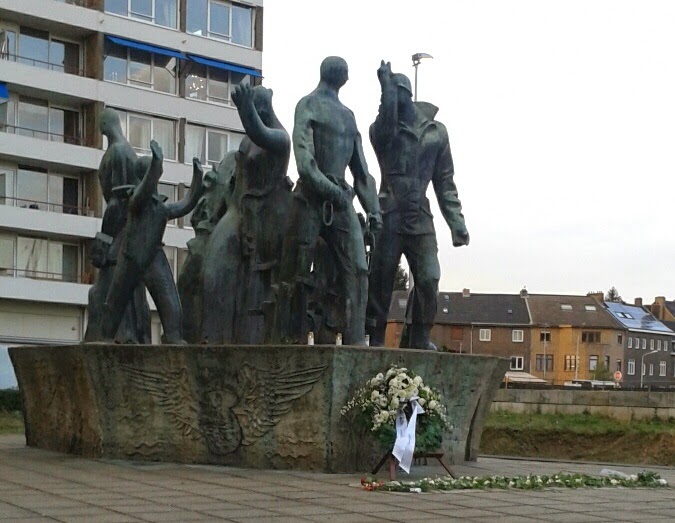
Bevrijdingsmonument in Maastricht, gemaakt door Charles Eyck


Jonge vrede

Kinderen!
Wie is klein en wie is groot?
Kinderen kunnen net zo dood
als grote mensen en die zijn niet eens zo groot
als ze elkaar verwensen
zonder een grote reden

Want zo was het
zestig jaar geleden.
Om elkaar beter te bezeren
en een goede les te leren
kochten ze betere geweren.
Maar wat kan een kapotte
en dode nog leren?
Niets dan te verrotten.

Dus houd van elkaar!
Want nijd of haat
komt altijd veel te vroeg
maar echte
liefde nooit te laat.
Er bestaat geen reden
om je stuk te vechten.

Zelfs in vrede
is er al pijn genoeg.


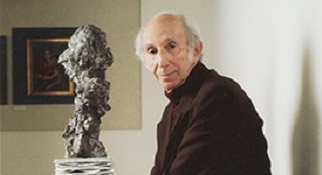
Leo Vroman (10 april 1915 – 22 februari 2014)


Zie voor de schrijvers van de 5e mei ook mijn vorige blog van vandaag.

Miklós Radnóti, Roni Margulies, Petra Else Jekel, Morton Rhue, Christopher Morley, George Albert Aurier, Henryk Sienkiewicz

De Hongaarse dichter en schrijver Miklós Radnóti werd geboren op 5 mei 1909 in Boedapest. Zie ook alle tags voor Miklós Radnóti op dit blog.


Portrait

I’m nearly twenty-two years old. Thus
Christ too might have appeared in the autumn
at the same age when he
still had no beard, he was blond and maidens
dreamt of him nightly!


The Bull

Hitherto, I lived the throbbing life of a youthful bull
bored in the noonday heat among pregnant cows in the field,
running around in unending circles declaring his powers
and waving amid his game a foaming flag of saliva.
He shakes his head and turns with the splitting, thick air on his horns
and behind his stamping hooves the tormented grass and earth
spatters widely about the terrified green pasture.

And still I live like a bull, but a bull that suddenly stops
in the heart of the meadow singing with crickets, stops nostrils lifted
and sniffing the air. For he senses that far in the mountain forests
the roebuck too stops and listens and lightly flees with the wind,
the hissing wind that carries the stench of a distant wolf pack —
thus the bull snorts, but he will not escape like the deer
and considers that when his time is to come, he will fight and fall
and his bones will be scattered about in the district by the horde —
and slowly and sadly the bull bellows through the fat air.

Thus I will struggle and thus I will fall when the hour is come,
and the district will treasure my bones for reminders to future ages


Vertaald door Thomas Land


Miklós Radnóti (5 mei 1909 – 9 november 1944)
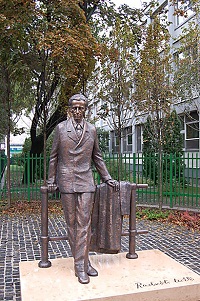
Standbeeld in Boedapest

Lees verder “Miklós Radnóti, Roni Margulies, Petra Else Jekel, Morton Rhue, Christopher Morley, George Albert Aurier, Henryk Sienkiewicz”

Dodenherdenking II (Gerrit Achterberg)


Bij 4 mei


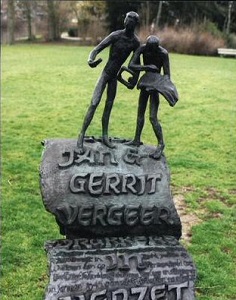
Oorlogsmonument in Woerden: Drukkers in verzet


Dodenherdenking II

De collaborateurs, de snorkers van vandaag,
allang weer aan de macht, op jacht naar geld en goed,
zouden uit winstbejag die dag van goed en bloed
het liefst verdonkeremanen, kregen zij hun zin.

Nooit ging de tijd tegen het volkgeweten in.
En wat de vreemdeling moest zeggen als hij zag
dat ere dierf en geen saluut verwierf de vloed
soldaten die in onze grond begraven lag?

Die rusten op de Holterberg en bij Margraten,
wit van de kruizen, duizelend in carré geschaard,
hebben deel aan deze nationale dag:

halfstok boven hun stof de Nederlandse vlag;
dat wij de vrouwen, waar ter wereld, niet vergaten,
door wie zij lang over de zee zijn nagestaard.


Gerrit Achterberg (20 mei 1905 – 17 januari 1962)


Zie voor de schrijvers van de 4e mei ook mijn vorige blog van vandaag.

Cola Debrot, Christiaan Weijts, Amos Oz, Monika van Paemel, Graham Swift, David Guterson, Jan Mulder, Werner Fritsch, Jacques Lanzmann

De Antilliaanse schrijver, dichter, arts, diplomaat, jurist, minister, filosoof en balletcriticus Cola Debrot werd geboren te Kralendijk (Bonaire) op 4 mei 1902. Zie ook alle tags voor Cola Debrot op dit blog.


Dachau
voor Ed. Hoornik

Als mensen met de mensenrechten spotten,
hoort men van de wanhopigen eerst het gillen,
maar weldra volgt de eeuwigheid der stilte,
die uitgaat van een veld bezaaid met botten.
 
En die hier verder aan een water rotten,
eens glansden hemelen in hun pupillen
en ook het voorjaar, dat de boom deed botten,
kon nooit het heimwee van hun harten stillen.
 
Op deze wijs, in ’t grauwe dal der zuchten,
zijn onze vrienden met een snik vergaan,
terwijl wij ’t enkel hoorden van geruchten
 
tegengesproken, nauwelijks verstaan,
uit kampen, ook na eeuwen niet te luchten
van ’t misdrijf aan onschuldigen begaan.


Jeroen Bosch

Dit is de kwaal der kwalen,
het hart wordt, schraal en guur,
behekst door manestralen,
spooklicht te elfder uur.

In web van manestralen
hangt de gekruisigde.
De schooiers, woeste, vale,
rondom verguizen hem.

O Christus, Man van Smarten,
bevrijd ons uit de hel,
behoed de mensenharten
voor duivels waanzin-spel,

waarin zij, kwaal der kwalen,
verteren in het vuur
der kille manestralen,
spooklicht te elfder uur.


Witte bloesems

Straks zie ik van haar avondjurk de slippen,
wanneer zij heenglijdt uit de schaduwplek.
Nu kijk ik naar de onrust van haar lippen
en naar het maanlicht aan haar wang en nek.

Wij zouden wel hartstochtlijk willen wenen,
getroffen door de gunst van het geluk
tot ik van de jasmijnen, maanbeschenen,
het takje witte bloesems voor haar pluk.

Blijken van liefde worden uitgewisseld,
ofschoon wij zwijgen in het licht der maan,
omdat met woordengalm slechts wordt bedisseld
de eenzaamheid van ons bewolkt bestaan.


Cola Debrot (4 mei 1902 – 3 december 1981)
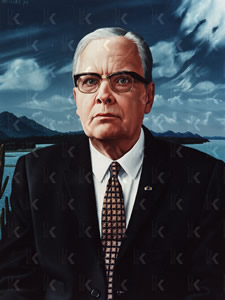
Portret door Carel Willink, 1972

Lees verder “Cola Debrot, Christiaan Weijts, Amos Oz, Monika van Paemel, Graham Swift, David Guterson, Jan Mulder, Werner Fritsch, Jacques Lanzmann”

Jehuda Amichai, Erik Lindner, Johan de Boose, Marc Dugain, Ben Elton, Jens Wonneberger, Paul Bogaert

De Duits-Israëlische dichter en schrijver Jehuda Amichai werd op 3 mei 1924 geboren in Würzburg. Zie ook alle tags voor Jehuda Amichai op dit blog.


God Has Pity On Kindergarten Children

God has pity on kindergarten children,
He pities school children — less.
But adults he pities not at all.

He abandons them,
And sometimes they have to crawl on all fours
In the scorching sand
To reach the dressing station,
Streaming with blood.

But perhaps
He will have pity on those who love truly
And take care of them
And shade them
Like a tree over the sleeper on the public bench.

Perhaps even we will spend on them
Our last pennies of kindness
Inherited from mother,

So that their own happiness will protect us
Now and on other days.


Endless Poem

In a modern museum
In an old synagogue
In the synagogue
I
Within me
My heart
Within my heart
A museum
Within a museum
A synagogue
Within it
I
Within me
My heart
Within my heart
A museum


Vertaald door Chana Bloch en Stephen Mitchell


Instructies voor de serveerster

Haal de glazen en de borden
niet van tafel, veeg
de vlek niet van het tafelkleed! Het is goed om te weten:
anderen gingen mij voor in de wereld.

Ik koop schoenen die door een ander gedragen zijn.
Mijn vriend heeft zijn eigen gedachten.
Mijn geliefde is de vrouw van een man.
Mijn nacht wordt gebruikt door dromen
Op mijn raam staan regendruppels getekend,
andermans krabbels in de kantlijn van mijn boek.
Op het bouwplan van het huis waar ik wil wonen
heeft de architect vreemden getekend bij de deur.
Op mijn bed ligt een kussen met een kuil erin
van een hoofd dat er niet is.

Haal daarom niets
van tafel.
Het is goed om te weten:
anderen gingen mij voor in de wereld.


Vertaald door Tamir Herzberg


Jehuda Amichai (3 mei 1924 – 22 september 2000)
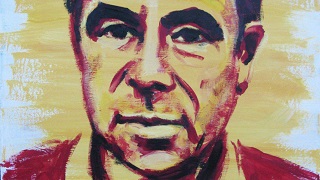
Portret door Eran Wolkowski, z.j.

Lees verder “Jehuda Amichai, Erik Lindner, Johan de Boose, Marc Dugain, Ben Elton, Jens Wonneberger, Paul Bogaert”

Esther Freud, Jef Last, Gottfried Benn, Rob Waumans, Tilman Rammstedt, James Holmes, Wytske Versteeg, Novalis

De Engelse schrijfster Esther Freud werd geboren in Londen op 2 mei 1963. Zie ook alle tags voor Esther Freud op dit blog.

Uit: Lucky Break

“When the Lindens arrived in Los Angeles it was raining. Not drizzling, or even pouring, but streaming down outside the glass doors of the arrivals lounge in thick, grey sideways slices. Water sluiced along the airport roads, tumbling in the gutters, spinning in the wheels of the taxis that splashed up to collect the lucky people at the head of the queue.
Dan and Jemma stood and stared out through the sheets of glass. ‘Blimey,’ they said, almost in unison and Dan put his hand up to his mouth and laughed.
‘I’m cold.’ Their eldest child, Honey, shivered in her pink T-shirt and Dan knelt down to rifle through the bags, removing as he did so numerous insubstantial outfits which they’d packed with the expectation that the five of them, lifted out of a grey London morning, would be enjoying an endless bright blue Californian afternoon.
Dan and Jemma had rented a house in the hills. The house had been recommended by a friend of Dan’s, although at the last minute his wife had interjected: They can’t stay up there! They’ve got to be by the ocean. In Santa Monica.
‘But Santa Monica’s extortionate, and you don’t even get a pool,’ Dan’s friend had told her, ‘and what’s the point of LA if there’s no pool?’
Jemma and Dan had listened nervously. They’d already said yes to the house in the hills, paid their deposit, filled in numerous forms for insurance, gas, electric and telephone, and so neither of them mentioned Santa Monica or the ocean again. Instead they talked about the pool. ‘The pool, the pool,’ they repeated like a charm and the children tugged on their swimming costumes, blew up their arm bands, and ran shrieking up and down the draughty, carpeted stairs of their north London home.
The higher they drove the more heavily it rained. It clattered on the roof of the taxi and washed in sheets over the windscreen, and occasionally when the driver stopped to call the number they gave him for directions they could see the water rushing past them down hill over the cobbled streets. ‘Got it, got it,’ he assured their landlord who was waiting with the key, but then almost immediately they became lost again, roaring along narrow roads, catching glimpses of lit-up Spanish villas and rain soaked ferns and the same few street names over and over again.”


Esther Freud (Londen, 2 mei 1963)

Lees verder “Esther Freud, Jef Last, Gottfried Benn, Rob Waumans, Tilman Rammstedt, James Holmes, Wytske Versteeg, Novalis”

Guido Gezelle, Johano Strasser, Yasmina Reza, Joseph Heller, Yánnis Rítsos

De Vlaamse dichter Guido Gezelle werd geboren in Brugge op 1 mei 1830. Zie ook alle tags voor Guido Gezelle op dit blog.


Peren

Gebogen hangt het perenhout,
bevallig, onder ‘t menigvoud
gedrag, dat hem bewonderen laat
alom, en op de bomen staat.

Zo druiven, in malkaâr geklist,
bij grote en dikke krabben is ‘t,
dat top en takken, scheefgelaân,
bezwijkend, van de peren staan.

Hoe schone, als ‘t lieve zonnelicht
daarop zijn mooie stralen zicht;
en, geluw-, groen- en grauwgeveld,
fijn goud op al die peren smelt!

Hoe spannen ze, in hun ronde glans,
vol zerpe en zoete zeupen gans;
die, borstgeeene en lijfgenoot,
nog wassen, bij de moederschoot!

Het staat er die, vol rode schijn,
bloedverwig als de kaken zijn
van menig menig mensenkind,
dat m’hier en daar ten boere vindt.

Het staat er, effenbruin van bast,
aan klene, tere takken vast;
die ‘k puilen zie, alhier, aldaar,
ter pelen uit en… ponden zwaar.

Vaarwel, die zulke giften laat,
o zonne, aleer gij henengaat,
en elders weunt, de lange tijd
dat ‘t wintert, en ge onzichtbaar zijt.

Dat ‘t donker is, dat ‘t waait en buist;
dat verre is al het groen verhuisd;
dat, naakt, of heel met ijs belaân,
onvriendelijk de bomen staan.

Vaarwel, o zonne!… Hij is groot,
diens hand u in de hemel schoot;
diens goedheid, die geen’ beurte en kent,
bij beurten, ons die zomer zendt.

o Eeuwig goede, om al het goed
dat ‘t bakelen van de zonne doet
onze onbeholpen schamelheid,
zij lof en ere u toegezeid!


Het kruis

Het kruis ontliet de mens
uit ’s vijands helse banden;
met ’t kruise wijden hem,
in ’t doopsel, ’s priesters handen;
gebiecht, gevormd, berecht,
getrouwd, gezalfd in ’t kruis,
nog wijst hem ’t kruis de weg
naar hier, zijn laatste thuis.
o kruise, dat daar staat,
och, of zij ’t allen wisten,
gij zijt het teken en
de hoop van elke christen:
zo Christus leefde en stierf,
in kruisen en verdriet,
zo zult gij, of ge en volgt
in Zijn triomf hem niet!


Ach licht en is het lot van al

Ach licht en is het lot van al,
zo menig band wordt keten;
zo menige en zo groot getal
die ’t blijzijn haast vergeten!
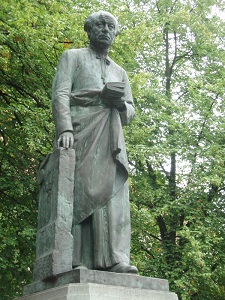


Guido Gezelle (1 mei 1830 – 27 november 1899)
Standbeeld in Brugge

Lees verder “Guido Gezelle, Johano Strasser, Yasmina Reza, Joseph Heller, Yánnis Rítsos”

Antal Szerb, Ignazio Silone, Aleksander Wat, Viktor Astafiev, Reinier van Genderen Stort

De Hongaarse schrijver Antal Szerb werd geboren op 1 mei 1901 in Boedapest. Zie ook alle tags voor Antal Szerb op dit blog.

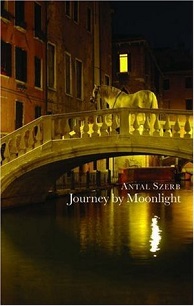
Uit: Journey by Moonlight (Vertaald door Len Rix)

“On the train everything seemed fine. The trouble began in Venice, with the back-alleys.
Mihály first noticed the back-alleys when the motor-ferry turned off the Grand Canal for a short cut and they began appearing to right and left. But at the time he paid them no attention, being caught up from the outset with the essential Veniceness of Venice: the water between the houses, the gondolas, the lagoon, and the pink-brick serenity of the city. For it was Mihály’s first visit to Italy, at the age of thirty-six, on his honeymoon.
During his protracted years of wandering he had travelled in many lands, and spent long periods in France and England. But Italy he had always avoided, feeling the time had not yet come, that he was not yet ready for it. Italy he associated with grown-up matters, such as the fathering of children, and he secretly feared it, with the same instinctive fear he had of strong sunlight, the scent of flowers, and extremely beautiful women.
The trip to Italy might well have been postponed forever, but for the fact that he was now married and they had decided on the conventional Italian holiday for their start to married life. Mihály had now come, not to Italy as such, but on his honeymoon, a different matter entirely. Indeed, it was his marriage that made the trip possible. Now, he reasoned, there was nothing to fear from the danger Italy represented.
Their first days were spent quietly enough, between the pleasures of honey-mooning and the gentler, less strenuous forms of sightseeing. Like all highly intelligent and self-critical people, Mihály and Erzsi strove to find the correct middle way between snobbery and its reverse. They did not weary themselves to death ‘doing’ everything prescribed by Baedeker; still less did they wish to be bracketed with those who return home to boast, “The museums? Never went near them,” and gaze triumphantly at one another.
One evening, returning to their hotel after the theatre, Mihály felt he somehow needed another drink. Quite what of he wasn’t yet sure, but he rather hankered after some sort of sweet wine and, remembering the somewhat special, classical, taste of Samian, and the many times he had tried it in Paris, in the little wine merchant’s at number seven rue des Petits Champs, he reasoned that, Venice being effectively Greece, here surely he might find some Samian, or perhaps Mavrodaphne, since he wasn’t yet quite au fait with the wines of Italy. He begged Erzsi to go up without him. He would follow straightaway. It would be just a quick drink, “really, just a glass” he solemnly insisted as she, with the same mock-seriousness, made a gesture urging moderation, as befits the young bride.”

 
Antal Szerb [1 mei 1901 – 27 januari 1945)
Cover

Lees verder “Antal Szerb, Ignazio Silone, Aleksander Wat, Viktor Astafiev, Reinier van Genderen Stort”

Alexej Chomjakov, Marcel Prévost, Konrad Weiß, Joseph Addison, José Martiniano de Alencar, Jean de Joinville

De Russische dichter, schrijver, filosoof en theoloog Alexej Stepanovitsj Chomjakov werd geboren op 1 mei 1804 in Moskou. Zie ook alle tags voor Alexej Chomjakov op dit blog en ook mijn blog van 1 mei 2010.


Russian Song

Hail, lovely land of Saint Vladimir!
Thy strength is vast, thy cities mighty;
Thou hast a host of faithful people!
On azure mountains firm thou leanest;
In azure seas thy feet thou bathest.
Thou dost not fear the cruel foe,
But thou dost fear the wrath of God!

Hail, lovely land of Saint Vladimir!
My fathers’ fathers gave thee service.
They won thee peace by fruitful reason,
Thy holy cities they embellisht,
Thy cruel foes they helpt to vanquish.
Recall the good deeds of my fathers.
They served thee with a faithful service,
And I with faithful heart have served thee.
On the steppes from my loins have peasants descended,
Have peasants descended, well-to-do little peasants;
Their place do they know, they know what is useful,
Their brethren they love, and God do they worship.
From me, in the courts, has justice been done
Has justice been done, unbought and impartial.
From me has gone forth to the whole world a rumor
That bluer skies are not to be seen,
That bluer seas are not to be plowed,
That beautiful is the land of Vladimir.
Admire her—thou wilt never sufficiently gaze;
Draw wisdom from her, thou ne’er wilt exhaust her.
Across the heavens the bright sun goes;
All the earth it warms, it lightens.
By night the crowded stars are shining,
And there is no counting the sand or the grass-blades,
And over the earth proceed the words of God—
It warms with life, with joy it shineth;
Bright gleam the churches’ golden cupolas,
And the servants of the Lord and the pilgrims
Are countless like the grass-blades on the steppes,
Are countless like the sands upon the sea-shore.


Vertaald door Nathan Haskell Dole


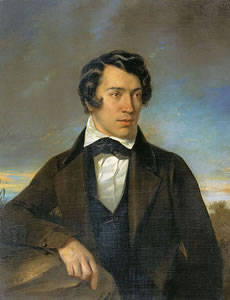
Alexej Chomjakov (1 mei 1804 – 5 oktober 1860)
Zelfportret, 1842

Lees verder “Alexej Chomjakov, Marcel Prévost, Konrad Weiß, Joseph Addison, José Martiniano de Alencar, Jean de Joinville”

Jeroen Brouwers, Alexander Osang, Ulla Hahn, Luise Rinser, John Boyne, Annie Dillard

De Nederlandse schrijver Jeroen Brouwers werd geboren op 30 april 1940 in Batavia, de hoofdstad van het voormalige Nederlands-Indië (tegenwoordig Djakarta, Indonesië). Zie ook alle tags voor Jeroen Brouwers op dit blog.

Uit: Het hout

“De pij irriteert mijn huid.
Het lompengewaad van Franciscus van Assisi die met wolven sprak.
Kloosterlingen die in zijn orde zijn getreden dragen zijn habijt dat de vorm van een kruis heeft. Voorzien van een capuchon hangt het zwaar aan de schouders, reikt tot de voeten en hult het hele lichaam in faecaal bruin, de stof is ruw en schrijnt. Men moet er kleding onder dragen om niet zinneloos te worden van jeuk, die het naakte vel teistert als termieten.
Wat draagt een kloosterling onder zijn pij? Een tot het middel reikende kiel, een trainingsbroek, een onderbroek, dit lijfgoed is voorzien van verstelbare elastieken.
Over de pij wordt het scapulier gedrapeerd. Dit is een baan stof van dezelfde lengte, materie en kleur als de pij met een gat erin om het hoofd door te steken. Te dragen over borst en rug, zoals een celebrant het kazuifel. Alles van uniforme snitloze makelij, alles in dezelfde forse maat, waardoor iedereen alles hoe dan ook past.
Op zaterdag moet alles in de was, het taakdomein van Plechelmus, die er schoon goed voor in de plaats levert. Wij ordebroeders houden er naar voorbeeld van onze stichter geen persoonlijke bezittingen op na, dus ook geen eigen kleren. Zo dragen wij al naar het toeval wil om beurten het hemd, de onderbroek, de hobbezak die een confrater een week tevoren aan zijn lijf heeft gehad. Ik overtreed de orderegel door nooit de gemeenschappelijke kloosteronderbroek te dragen.
De lompenjurk van Franciscus wordt rond het middel bijeengegord door een wit koord met drie knopen erin, die ons zijn leefmotieven in herinnering houden. Knoop een: armoede. Knoop twee: gehoorzaamheid. Knoop drie: onthouding of kuisheid. Ga er maar aan staan. Il poverello heeft er gedichten over nagelaten, ze hangen ingelijst in de kloosterrefter.
Begin april, dinsdag in de goede week. Omdat het eergisteren palmzondag was hangen er verse buxustakken achter alle kruisbeelden en wijwaterbakjes. Nauwelijks lente en het is al etmalen zo agressief heet alsof mijnheer broeder zon woede uitbraakt. Vlammende hitte als kokende kots, die overal doorheen dringt, zelfs door de muren van de gewoonlijk koele, zelfs kille kapel.”


Jeroen Brouwers (Batavia, 30 april 1940)

Lees verder “Jeroen Brouwers, Alexander Osang, Ulla Hahn, Luise Rinser, John Boyne, Annie Dillard”