Chris Kraus

Onafhankelijk van geboortedata

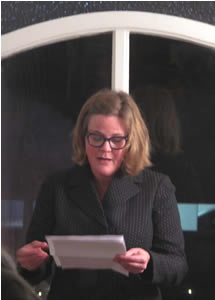
De Amerikaanse schrijfster en filmmaakster Chris Kraus werd geboren in 1955 in New York en bracht haar jeugd door in Connecticut en Nieuw-Zeeland. Na het behalen van een BA aan Victoria University of Wellington, Nieuw-Zeeland, werkte Kraus vijf jaar als journaliste en vervolgens verhuisde zij naar New York City. Kraus was 21 jaar oud toen ze aankwam in New York en begon te studeren bij acteur Ruth Maleczech en regisseur Lee Breuer, wiens studio in de East Village Recherchez werd genoemd. Zij maakte deel uit van de toenmalige groeiende kunstscène van de stad rn maakte films en videokunst, ensceneerde voorstellingen en speelde op vele podia. In de late jaren 1970 was zij lid van The Artists Project, een door de stad gefinancierde onderneming van schilders, dichters, schrijvers, filmmakers en dansers. In haar werk als performance- en videokunstenaar hekelde zij de gender politiek van de Downtown scene waarbij zij een voorkeur had voor literaire stijlfiguren en theatrale technieken mengde met Dada, literatuurkritiek, sociaal activisme, en performance art. Kraus bleef tot het midden van de jaren 1990 films maken. Tot haar romans behoren “I Love Dick”, “Aliens & Anorexia”, “Torpor” en “Summer of Hate”. In “Video Green”, Kraus ‘eerste non-fictie boek onderzoekt zij de explosie van de kunst van de late jaren 1990 door high-profile graduate programma’s, die Los Angeles in het centrum van de internationale kunstwereld gekatapulteerd hebben.

Uit: I Love Dick

“My love for you was absolutely groundless, as you’d pointed out that night in January in the company of my husband. It was about the only time you ventured an opinion past your sexy cryptic silence, the silence that I’d written on. But what does “groundless” really mean? My love for you was based upon a single meeting in December which you finally described in an exasperated letter to my husband as “genial but not particularly intimate or remarkable.” Yet this meeting had driven me to write more words to you than there were numbers on that EDL, 250 pages and still counting. Which in turn led to the rental car, this rainy drive along Route 126, this plan to visit you.
At that time in your life, you said, you were experimenting with never saying No.
I got off the plane at 7 buzzed with warm air, palms and jetlag serotonin, picked up a rental car and started north on 405. But I was nervous too, like walking through a script you know’s already been written except the outcome’s been withheld. Not giddy nervous. Nervous as in dark with dread. My outfit’s dreadful. I watch the road, smoke and fiddle with the radio. I’m wearing black Guess jeans, black boots, an iridescent silver shirt, the black bolero leather jacket that I bought in France. It’s what I planned but now it’s making me feel gaunt and middle-aged.
Eleven weeks ago I’d tailed your gorgeous car along 5 North en route to that “genial but not particularly intimate or remarkable meeting” at your house between my husband, you and I. And everything then seemed different: delicious, charged. The three of us got very drunk and there was all this strange coincidence. There were just three books in your living room. One was Gravity & Grace, the title of my film. I was wearing the snake pendant that I’d bought in Echo Park; you told a story about shooting a video outside your house when a snake magically appeared. All night I was playing Academic Wife, helping you and Sylvère Lotringer exchange ideas and then you mentioned David Rattray’s book and that was very weird. Because all night long I’d felt his ghost beside me and David had been dead almost two years. You looked at me and said: “You seem different than the last time that we met. As if you’re ready to come out.”
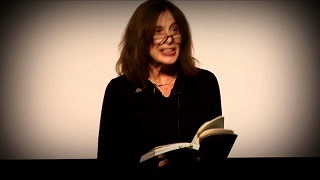
 
Chris Kraus (New York, 1955)
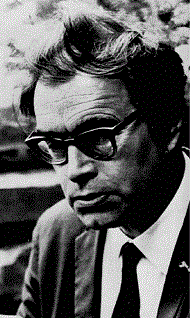
Godfried Bomans, Multatuli, John Irving, Thom Wolfe, Michael Salinger, János Arany

De Nederlandse schrijver Godfried Bomans werd geboren in Den Haag op 2 maart 1913. Zie ook alle tags voor Godfried Bomans op dit blog.

Uit:Moeder de gans
     Over sprookjes in het algemeen en over Charles Perrault in het bijzonder

“Wie herinnert zich niet haar wonderlijke stem, murmelend in onze verre, verre kinderjaren? Wie heeft niet gezucht van opwinding als de arme vrouw van Blauwbaard (was het zijn tiende? was het zijn twaalfde?) daar hoog op de toren roept: ‘Zuster Anna! Zuster Anna! Ziet gij nog niets komen?’ Nu, zolang zuster Anna nog niets ziet mogen wij opblijven, dat is zeker. Want zelfs uw oudste broer, die geheimzinnige bezigheden heeft op een groot kantoor ergens in de wereld, heeft zijn pijp laten uitgaan en luistert met een vreemde glimlach. Doch als hij zich betrapt ziet, schrikt hij en duikt weg achter zijn krant, want sprookjes vindt hij onzin.
Dat zijn ze ook. Maar we zijn ermee groot geworden en er is iets van die onzin diep in ons zelf blijven zitten. Op sommige zomeravonden komt dat nog wel eens naar boven en dan weten we zelf niet goed hoe we het hebben. Het kan dan gebeuren, dat een ernstig makelaar in effecten plotseling achter het rozenboompje in zijn tuin een kabouter meent te zien; hij wrijft zijn ogen uit en de kabouter is weg. Wat was dat? Het was veel meer van Moeder Gans in ons gebleven dan wij zelf wel weten. […]
Hoe oud ze precies zijn weet geen sterveling, evenmin als men de plaats kent waar ze vandaan komen. Hierover zijn boeken geschreven, veel dikker dan de sprookjes zelf, maar ik moet mijn lezers waarschuwen: ze zijn niet zo spannend. Het eerst hielden Duitse vorsers zich met deze vraag bezig en zij kwamen na veel nadenken tot de natuurlijke slotsom, dat de sprookjes uit Duitsland stamden. Zo zegt bijvoorbeeld Franz Linnig in zijn Deutsche Mythenmärchen (1883), over Roodkapje sprekend: ‘Das Märchen von der kleinen süssen Dirne, die alle Leute so lieb haben, ist den deutschen Kinderherzen so innig verwachsen, das mann an einen fremden Ursprung kaum zu denken wagt’ Niet treffender kan worden aangetoond dat de wens de vader van gedachte is! Een andere Duits geleerde Theodor Pletscher, tekent tegen deze doorzichtige inbeslagneming dan ook protest aan [en merkt op dat de bekendste sprookjes, ook die in Duitsland het bekendst zijn, al lang in Frankrijk hun definitieve vorm hadden gevonden voor zij in Duitsland als volkssprookjes werden opgeschreven].”

 
Godfried Bomans (2 maart 1913 – 22 december 1971)

Lees verder “Godfried Bomans, Multatuli, John Irving, Thom Wolfe, Michael Salinger, János Arany”

Rinske Kegel

Onafhankelijk van geboortedata

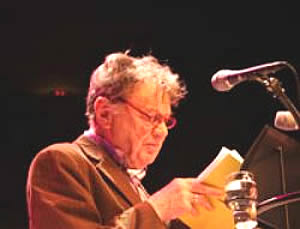
De Nederlandse dichteres, schrijfster en illustratrice Rinske Kegel werd geboren in Haren in 1973. Zij werkt als trainingsactrice en op het gebied van communicatie en groepswerk. Daarnaast geeft zij schrijf- en voordrachtworkshops. Kegel publiceerde onder andere bij literair tijdschrift Op Ruwe Planken, De Gids, Extaze, Het Liegend Konijn en De Uitvreters. Ze won de derde prijs van de Oostende Poëzieprijs 2013/2014 en de eerste prijs van de VUMC Poëzieprijs 2015.  Ze trad op bij onder andere Onbderf’lijk Vers en Dichters in de Prinsentuin. Ze bracht onlangs zelf een bundel uit met tien gedichten: “Als ik win verlies ik mijn reputatie als verliezer”.

Toen je al weg was

Bij de flessen water kon je niet kiezen welke
ik wilde zo graag dat ik niet hoefde te kiezen
toen we in het park aankwamen jij bij mij
achterop en er van dronken zaten er bubbels in

we kochten aardbeien
ik kocht aardbeien
ik kocht alles
ik betaalde alles en mijn fiets viel om
en die raapte ik zelf op
er vielen nog meer fietsen om
ik raapte alle fietsen op

jij wilde liggen je wilde in de aarde
zakken en ik wilde je hier houden
maar de zwaartekracht had zijn
werk al gedaan en je lachte naar me
als een vader naar een kind dat knoeit

Je deelde aardbeien uit aan andere mensen
in het Vondelpark
je zei zo doen ze dat in Berlijn


Slaap je 

als ze niet meer brabbelt en lege dromen
inademt, onder handen wordt genomen,
weg genomen terwijl ze nog een luier draagt
trekt de navelstreng zich om mijn moederhart

als ze wakker wordt, niet klaagt maar speelt
met slangetjes en stethoscoop klopt alles weer
harder dan daarvoor, wat zijn de ramen groot

we tekenen met pen haar lijfje vol
met littekens, nu valt dat ene het niet meer op

slaap je, je lijkt wel dood.

 
Rinske Kegel (Haren, 1973)

Jan Eijkelboom, Jim Crace, Franz Hohler, Lytton Strachey, Robert Lowell, Myrthe van der Meer

De Nederlandse dichter, vertaler en journalist Jan Eijkelboom werd op 1 maart 1926 in Ridderkerk geboren. Zie ook alle tags voor Jan Eijkelboom op dit blog.


De kunst

In die tijd trokken amateurs
met zwarte kastjes er op uit
om in een poortdoorgang
het tegenlicht te vangen

dat door de lindeblaadjes scheen.
Of ze betraden gretig het park
op de dag van de eerste sneeuw.
Vanaf meegenomen keukentrapjes

legden zij vast hoe ijzel of rijp
van takjes toverstokjes maakte.
Ook ik verbalisant betrapte

dat voortvluchtig licht en
sloot het op in een sonnet
waaruit het ijlings is ontsnapt.


Hij had geen talent

Hij had geen talent voor tragiek,
verdonkeremaande rampspoed
bij het leven, meanderde
door een landschap tot aan
een toevallige stad
waar hij plotseling zag:
hier kom ik vandaan.

Af en toe viel hem in
dat hij misschien wel bestond.
Ook zag hij een vrouw
van wie het bestaan
met geen pen
te ontkennen.

Ze paarden en hadden geluk.
Toen hij later tot zijn verbazing
het leven moest laten
liet hij één boodschap na:
als jullie mij gaan verstrooien
ga dan met je rug naar de wind toe staan.


Vox humana

In een klein dijkhuis staat,
ziet hij door ’t uitvergrote raam,
het oude orgel bijna naakt.
Over de toetsen ligt een loper.
Tussen de twee koop’ren kandelaars
staat een gezangboek open.
Hij hoort weer het asmatisch steunen:
loflied of klaagzang – eender zeurt
deze muziek, tot hij die deur
snel weer vergrendelt. En toch,
o mocht hij nog een keer,
geknield voor ’t orgelfront,
de trappers voor de vrouw bewegen
die boven hem haar psalmen zong.


Jan Eijkelboom (1 maart 1926 – 28 februari 2008)

Lees verder “Jan Eijkelboom, Jim Crace, Franz Hohler, Lytton Strachey, Robert Lowell, Myrthe van der Meer”

Delphine de Vigan

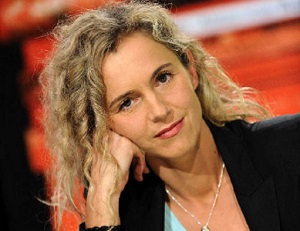
De Franse schrijfster en filmmaakster Delphine de Vigan werd geboren op 1 maart 1966 in Boulogne-Billancourt. Na haar studie letterkunde en toepaste wetenschappen werd ze directrice studies aan een instituut voor enquêtes. Onder het pseudoniem Lou Delvig, schreef ze haar eerste autobiografisch geïnspireerde “Jours sans faim” (2001), waarin de strijd van een jonge vrouw tegen anorexia vertelt wordt. Een verhalenbundel en een tweede roman volgden in 2005, gepubliceerd onder haar echte naam. In augustus 2007 publiceerde de Vigan “No et moi” waarvoor zij de Prix des Libraires en de Prix du Rotary kreeg en die bewerkt werd voor de film door Zabou Breitman. In “Les heures souterraines”, genomineerd voor de Goncourt, hekelt zij de intimidatie op de werkplek. In 2011 verscheen “Rien ne s’oppose à la nuit“, waarin zij vertelt over haar moeders lijden aan een bipolaire stoornis. Daarmee won zij de Prix du Roman Fnac, de Prix des lectrices de Elle, de Prix Roman France Télévisions en de Prix Renaudot des lycéens. In hetzelfde jaar schreef zij samen met Gilles Legrand het scenario voor “Tu seras mon fils”. In 2013 regisseerde Delphine de Vigan haar eerste film “A coup sûr”,waarvoor zij samen met Chris Esquerre het scenario schreef. In 2015 won ze de Prix Renaudot en de Prix Goncourt des lycéens voor haar roman « D’après une histoire vraie”.

Uit : D’après une histoire vraie

“Quelqucs mois après la parution de mon dernier roman, j’ai cessé d’écrire. Pendant presque trois années, je n’ai pas écrit une ligne. Les expressions figées doivent parfois s’entendre au pied de la lettre : je n’ai pas écrit une lettre administrative, pas un carton de remerciement, pas une carte postale de vacances, pas une liste de courses. Rien qui demande un quelconque effort de rédaction, qui obéisse à quelque préoccupation de forme. Pas une ligne, pas un mot. La vue d’un bloc, d’un carnet, d’une fiche bristol me donnait mal au cœur.
Peu à peu, le geste lui-même est devenu occasionnel, hésitant, ne s’exécutait plus sans appréhension. Le simple fait de tenir un stylo m’est apparu de plus en plus difficile.
Plus tard, j’ai été prise de panique dès que j’ouvmis un document Word.
Je cherchais la bonne position, l’orientation optimale de l’écran, i’e‘tirais mes jambes sous la table.
Et puis je restais là, immobile, des heures durant, les yeux rivés sur l’écran.
Plus tard encore, mes mains se sont mises à trembler dès que je les approchais du clavier.
J’ai refusé sans distinction toutes les propositions qui m’ont été adressées : articles, nouvelles de l’été, préfaces et autres participations à des ouvrages collectifs. Le simple mot écrire dans une lettre ou un message suffisait à me nouer l‘estomac.
Écrire, je ne pouvais plus.
Écrire, c’était non.
Je sais aujourd’hui que différentes rumeurs ont circulé dans mon entourage, dans le milieu littéraire et sur les réseaux sociaux. Je sais qu‘il a été dit que je n’écrirais plus, que j’étais parvenue au bout de quelque chose, que les feux de paille, ou de papier, toujours, finissent par s’éteindre. L‘homme que j’aime s’est imaginé qu’à son contact j’avais perdu l’élan, ou bien la faille nourricière. et que par conséquent je ne tarderais pas à le quitter.
Lorsque des amis, des relations, et parfois même des journalisres se sont aventurés à me poser des questions sur ce silence, j’ai évoqué différents motifs ou cmpêchements parmi lesquels figuraient la fatigue, les déplacements à l’étranger, la pression liée au succès, ou même la fin d’un cycle littéraire.”


Delphine de Vigan (Boulogne-Billancourt, 1 maart 1966)

Martin Suter, Yórgos Seféris, Marin Sorescu, Howard Nemerov, Saul Williams, John Byrom

De Zwitserse schrijver Martin Suter werd geboren op 29 februari 1948 in Zürich. Zie ook alle tags voor Martin Suter op dit blog.

Uit: Lila, Lila

“Marie hatte Weihnachten nicht immer gehast. Als ganz kleines Madchen hatte sie es fast nicht erwarten konnen, das nachste Fensterchen im Adventskalender öffnen zu durfen. Und am Abend, an dem dann endlich, endlich das Christkind kam, sas sie stumm vor Ergriffenheit unter dem Christbaum und muste von ihren Eltern dazu aufgefordert werden, die Geschenke zu öffnen.
Aber nach der Scheidung war Weihnachten nur noch dazu da, sie daran zu erinnern, das ihre Eltern nicht mehr zusammenwaren.
Sie muste jetzt zweimal feiern, einmal mit Myrtha und ihrem jeweiligen Freund, einmal mit ihrem Vater und seiner furchtbaren neuen Frau.
Mit zwolf gab sie bekannt, das sie nicht mehr Weihnachten feiern wolle. Bei ihrem Vater sties sie dabei auf keinerlei Widerstand. Bei Myrtha war es komplizierter. Wenn sie von ihrer Weihnachtsdepression heimgesucht wurde, was, je alter sie wurde, desto o∫er eintraf, brachte Marie es nicht ubers Herz, Weihnachten zu ignorieren.
Aber jetzt, wo Myrtha in Crans Montana war und Marie unbeschwerte Weihnachten mit ein paar Videos und Fertigpizzas verbringen konnte, hatte sie plotzlich das Bedürfnis nach Gesellschaft.. Deshalb verbrachte sie die letzten Abende des Weihnachts-Countdowns zu ihrer eigenen Verwunderung mit ihrer neuen Ersatzfamilie im Esquina. Und selbst in den Nachten blieb sie nicht immer allein.
Zwei davon verbrachte sie mit Ralph, auf den sie sich doch eigentlich gar nicht hatte einlassen wollen.
Fur jeden Abend nahm sie sich vor, nur kurz auf ein Glas hereinzuschauen und vor zwolf zu Hause zu sein. Aber jedesmal blieb sie hangen. Nicht, weil das Gesprach gerade so interessant war oder die Gesellscha∫ so angenehm oder die Nacht so schon. Es war die Vorstellung, allein in der Wohnung ihrer Mutter vor dem Fernseher zu sitzen, die sie im Esquina hielt.“


Martin Suter (Zürich, 29 februari 1948)

Lees verder “Martin Suter, Yórgos Seféris, Marin Sorescu, Howard Nemerov, Saul Williams, John Byrom”

Stephen Spender, Bart Koubaa, Luc Dellisse, John Montague, Marcel Pagnol, Raphaële Billetdoux, Bodo Morshäuser

De Engelse dichter, essayist en schrijver Stephen Spender werd geboren op 28 februari 1909 in Londen. Zie ook alle tags voor Stephen Spender op dit blog.


The Pylons

The secret of these hills was stone, and cottages
Of that stone made,
And crumbling roads
That turned on sudden hidden villages

Now over these small hills, they have built the concrete
That trails black wire
Pylons, those pillars
Bare like nude giant girls that have no secret-

The valley with its gilt and evening look
And the green chestnut
Of customary root,
Are mocked dry like the parched bed of a brook-

But far above and far as sight endures
Like whips of anger
With lightning’s danger
There runs the quick perspective of the future-

This dwarfs our emerald country by its trek
So tall with prophecy
Dreaming of cities
Where ofien clouds shall lean their swan-white neck.


A footnote to Marx’s chapter “The working day”

“Heard say that four times four is eight
“And the king is the man what has all the gold.”
“Our king is a queen and her son’s a princess
“And they live in a palace called London, I’m told.”

“Heard say that a man called God who’s a dog
“Made the world with us in it,” “And then I’ve heard
“There came a great flood and the world was all drownded
“Except for one man, and he was a bird.”

“So perhaps all the maple are dead, and we’re birds
“Shut in steel cages by the devil who’s good,
“Like the miners in their pit cages
“And us in our chimneys to climb, as we should.”


Farewell To My Student

For our farewell. we went down to the foot-path
Circling the lake. You stood there, looking up at
White egrets nesting in high branches.
And I, apart, stood silent. searching for
Images to recall this moment.
The first, I thought. must be that pine tree
Which, with slashed bark, climbs vertically
Across the lines of waves beyond.
Second. your face, a bronze medallion,
Greek or Roman, against the lake.
Perhaps Bellini
Delved from antiquity such an image
Of a twenty-year-old Triton lifting up a conch
Against a background of blown waves.
And Seurat, centuries later, in the profile
Of a holidaying boy, against the Seine.
And then you turned to me and said
With glance a third thing to remember:
“You are gone already, your thoughts are far from here
Three thousand miles away,
Where you will be tomorrow. And I
Here. remembering today.”

Then ten years passed till, today. i write these lines.


Stephen Spender (28 februari 1909 – 16 juli 1995)
 

Lees verder “Stephen Spender, Bart Koubaa, Luc Dellisse, John Montague, Marcel Pagnol, Raphaële Billetdoux, Bodo Morshäuser”

Daniel Handler, Dee Brown, Berthold Auerbach, José Vasconcelos, Sophie Tieck, Michel de Montaigne, Ernest Renan

De Amerikaanse schrijver Daniel Handler werd geboren op 28 februari 1970 in San Francisco, Californië Zie ook alle tags Daniel Handler op dit blog.

Uit: Why We Broke Up

„These are the caps from the bottles of Scarpia’s Bitter Black Ale that you and I drank in Al’s backyard that night. I can see the stars bright and prickly and our breathing steamy in the cold, you in your team jacket and me in that cardigan of Al’s I always borrow at his house.
He had it waiting, clean and folded, when I went upstairs with him to give him his present before the guests arrived.
“I told you I didn’t want a present,” Al said. “The party was enough I told you, without the obligatory-”
“It’s not obligatory,” I said, having used the same vocabulary flash cards with Al when we were freshmen. “I found something. It’s perfect. Open it.”
He took the bag from me, nervous.
“Come on, happy birthday.”
“What is it?”
“Your heart’s desire. I hope. Open it. You’re driving me crazy.”
Rustle rustle rip, and he sort of gasped. It was very satisfying.
“Where did you find this?”
“Does it not,” I said, “I mean exactly, look like what the guy wears in the party scene in Una settimana straordinaria?”
He smiled into the slender box. It was a necktie, dark green with modern diamond shapes stitched into it in a line. It’d been in my sock drawer for months, waiting. “Take it out,” I said. “Wear it tonight.
Does it not, exactly?”
“When he gets out of the Porcini XL 10,” he said, but he was looking at me.
“Your absolute favorite scene in any movie. I hope you love it.”


Daniel Handler (San Francisco, 28 februari 1970)

Lees verder “Daniel Handler, Dee Brown, Berthold Auerbach, José Vasconcelos, Sophie Tieck, Michel de Montaigne, Ernest Renan”

John Steinbeck, Lawrence Durrell, André Roy, Henry Longfellow, Elisabeth Borchers, James T. Farrell

De Amerikaanse schrijver John Steinbeck werd geboren in Salinas, Californië, op 27 februari 1902. Zie ook alle tags voor John Steinbeck op dit blog.

Uit: Cannery Row

“On the black earth on which the ice plants bloomed, hundreds of black stink bugs crawled. And many of them stuck their tails up in the air. “Look at all them stink bugs,” Hazel remarked, grateful to the bugs for being there.
“They’re interesting,” said Doc.
“Well, what they got their asses up in the air for?”
Doc rolled up his wool socks and put them in the rubber boots and from his pocket he brought out dry socks and a pair of thin moccasins. “I don’t know why,” he said. “I looked them up recently–they’re very common animals and one of the commonest things they do is put their tails up in the air. And in all the books there isn’t one mention of the fact that they put their tails up in the air or why.”
Hazel turned one of the stink bugs over with the toe of his wet tennis shoe and the shining black beetle strove madly with floundering legs to get upright again. “Well, why do you think they do it?”
“I think they’re praying,” said Doc.
“What!” Hazel was shocked.
“The remarkable thing,” said Doc, “isn’t that they put their tails up in the air–the really incredibly remarkable thing is that we find it remarkable. We can only use ourselves as yardsticks. If we did something as inexplicable and strange we’d probably be praying–so maybe they’re praying.”
“Let’s get the hell out of here,” said Hazel.”
(…)

“Hazel used his trick. “They got no starfish there?”
“They got no ocean there” said Doc.
“Oh!” said Hazel and he cast frantically about for a peg to hang a new question on. He hated to have a conversation die out like this. He wasn’t quick enough. While he was looking for a question Doc asked one. Hazel hated that, it meant casting about in his mind for an answer and casting about in Hazel’s mind was like wandering alone in a deserted museum. Hazel’s mind was choked with uncataloged exhibits. …”


John Steinbeck (27 februari 1902 – 20 december 1968)
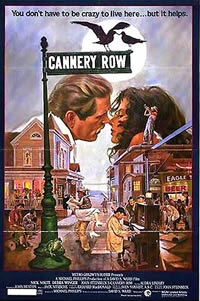
Affiche voor de film “Cannary Row” uit 1982

Lees verder “John Steinbeck, Lawrence Durrell, André Roy, Henry Longfellow, Elisabeth Borchers, James T. Farrell”

Irwin Shaw, Vera Friedlander, N. Scott Momaday, Peter De Vries, Johannes Meinhold, Traugott Vogel

De Amerikaanse schrijver Irwin Shaw werd geboren op 27 februari 1913 als Irwin Gilbert Shamforoff in New York. Zie alle tags voor Irwin Shaw op dit blog.

Uit: The Young Lions

“When I went into the Army, I made up my mind that I was putting myself at the Army’s disposal. I believe in the war. That doesn’t mean I believe in the Army. I don’t believe in any army. You don’t expect justice out of an army, if you’re a sensible, grown-up human being, you only expect victory. And if it comes to that, our Army is probably the most just one that ever existed. . . . I expected the Army to be corrupt, inefficient, cruel, wasteful, and it turned out to be all those things, just like all armies, only much less so than I thought before I got into it. It is much less corrupt, for example, than the German Army. Good for us. The victory we win will not be as good as it might be, if it were a different kind of army, but it will be the best kind of victory we can expect in this day and age, and I’m thankful for it.”
(…)

“This time it is not a simple, understandable war, within the same culture. This time it is an assault of the animal world upon the house of the human being. I don’t know what you saw in Africa and Italy, but I know what I saw in Russia and Poland. We made a cemetery a thousand miles long and a thousand miles wide. Men, women, children, Poles, Russians, Jews, it made no difference. It could not be compared to any human action. It could be compared to a weasel in a henhouse. It was as though we felt that if we left anything alive in the East, it would one day bear witness against us and condemn us. And, now, we have made the final mistake. We are losing the war.”


Irwin Shaw (27 februari 1913 – 16 mei 1984)
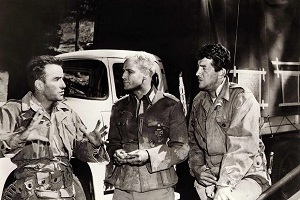
Scene uit de gelijknamige film uit 1958 met Montgomery Clift, Marlon Brando en Dean Martin

Lees verder “Irwin Shaw, Vera Friedlander, N. Scott Momaday, Peter De Vries, Johannes Meinhold, Traugott Vogel”