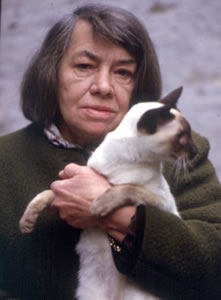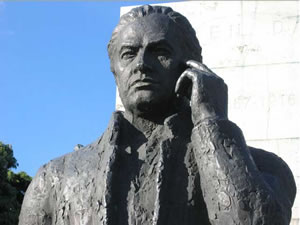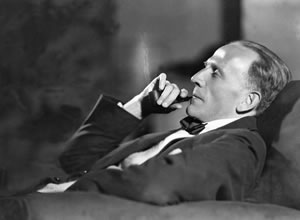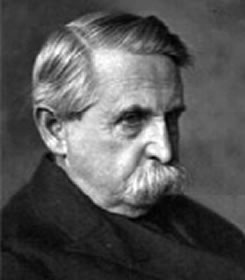
Louis Menand, Ludwig Thoma, Egon Friedell, Imre Madách

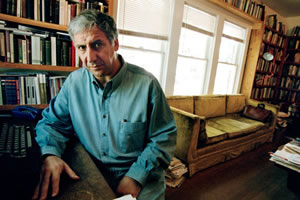
De Amerikaanse schrijver en letterkundige Louis Menand werd geboren op 21 januari 1952 in Syracuse, New York. Zie ook alle tags voor Louis Menand op dit blog.

 Uit: The Women Come And Go

 „T. S. Eliot’s sex life. Do we really want to go there? It is a sad and desolate place. Eliot was twenty-six and, almost certainly, a frustrated virgin when, in 1915, he married Vivienne Haigh-Wood, an Englishwoman he had known for three months. Haigh-Wood was a medically and emotionally vexed person. Her troubles included irregular and frequent menstruation, migraines, neuralgia, panic attacks, and, eventually, addiction to her medication, particularly to ether. She was pretty, ambitious, and (on her better days) vivacious. Eliot was handsome, ambitious, and the opposite of vivacious. “Exquisite and listless,” Bertrand Russell described him when he met the Eliots for dinner two weeks after the marriage. “She says she married him in order to stimulate him, but finds she can’t do it. Obviously he married in order to be stimulated. I think she will soon be tired of him.”

Russell was correct to intuit a tension. The Eliots seem to have discovered that they were sexually incompatible almost immediately. Mrs. Eliot reacted by having an affair with Russell, which her husband either tacitly condoned or was remarkably obtuse about. (Russell was a sexual predator who permitted himself to become temporarily infatuated with the women he seduced. He pretended, by way of self-justification, to believe that his intimacy with Vivienne provided a form of marital therapy to the Eliots.)

Eliot’s own medical and emotional condition was not exactly robust, and he was quickly worn down by the demands of caring for Vivienne. He was also a man whose sense of propriety was sometimes indistinguishable from squeamishness. He told his friends the Woolfs that he could not imagine shaving in his wife’s presence. He and Vivienne slept in separate rooms. She baited him in front of guests; he often responded by declining to respond; and (although it is impossible to be sure) they seem to have been, for much of their marriage, sexually estranged.“
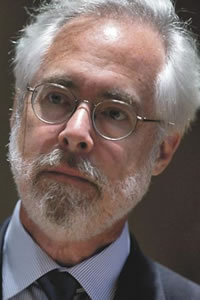
 

Louis Menand (Syracuse, 21 januari 1952)

Lees verder “Louis Menand, Ludwig Thoma, Egon Friedell, Imre Madách”
Ludwig Jacobowski, Joseph Méry, Kristín Marja Baldursdóttir, Roderich Benedix

De Duitse dichter en schrijver Ludwig Jacobowski werd geboren op 21 januari 1868 in Strzelno (Strelno). Zie ook alle tags voor Ludwig Jacobowski op dit blog.


Dem Auge fern, dem Herzen nah…

“Dem Auge fern, dem Herzen nah!”
Als ich die alte Grabschrift sah
Im eingesunknen Marmorstein,
Da fiel mein totes Lieb mir ein.

O Gott, ich schrieb schon tausendmal
Das gleiche Lied aus gleicher Qual,
Und war doch keins wie dieses da:
Dem Auge fern, dem Herzen nah!”


Jüngster Frühling

Nun kommt der Frühling doch Jahr für Jahr,
Dasselbe Blühen, wie’s immer war,
Von Kindern sind Plätze und Straßen voll,
Man weiß nicht mehr, wo man treten soll.

Die Mädchen glühen vor lauter Glück,
Heller die Kleider und heller der Blick,
Und blitzt wo ein Zöpflein im Sonnenschein,
Da fängt es sich wohl einen Knaben ein.
Und hoch aus des Himmels seligem Feld
Geht ein Leuchten über die Welt…

Wohl seh ich das alles in jedem Jahr,
Doch schwör ich, daß es nie schöner war,
Als gerade in diesem, in diesem Jahr.


Ludwig Jacobowski (21 januari 1868 – 2 december 1900)
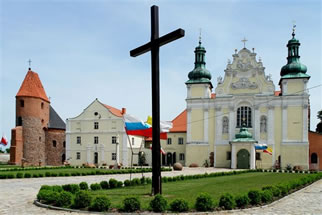
Strzelno

Lees verder “Ludwig Jacobowski, Joseph Méry, Kristín Marja Baldursdóttir, Roderich Benedix”

Edward Hirsch, Nazim Hikmet, Guy Helminger, Eugen Gomringer, Batya Gur

De Amerikaanse dichter en letterkundige Edward Hirsch werd geboren op 20 januari 1950 in Chicago. Zie ook alle tags voor Edward Hirsch op dit blog.


After a Long Insomniac Night

I walked down to the sea in the early morning
after a long insomniac night.

I climbed over the giant gull-colored rocks
and moved past the trees,
tall dancers stretching their limbs
and warming up in the blue light.

I entered the salty water, a penitent
whose body was stained,
and swam toward a red star rising
in the east—regal, purple-robed.

One shore disappeared behind me
and another beckoned.
                                     I confess
that I forgot the person I had been
as easily as the clouds drifting overhead.

My hands parted the water.
The wind pressed at my back, wings
and my soul floated over the whitecapped waves. 


Charades

We waited on two sides of the subway tracks:
you were riding uptown and I was heading downtown
to a different apartment, after all these years.

We were almost paralyzed, as anxious
travelers surged around us in waves,
and then you started to pantomime.

First, you touched your right eye.
Then you palmed your left knee.
Finally, you pointed at me.

I made of a sign of understanding
back to you but the train suddenly roared
into the station and you disappeared. 


Edward Hirsch (Chicago, 20 januari 1950)

Lees verder “Edward Hirsch, Nazim Hikmet, Guy Helminger, Eugen Gomringer, Batya Gur”

Egon Bondy, Sawako Ariyoshi, Axel Hacke, Robert Olen Butler Jr

De Tsjechische dichter, schrijver en filosoof Egon Bondy werd geboren op 20 januari 1930 in Praag. Zie ook alle tags voor Egon Bondy op dit blog.

 Uit: Die invaliden Geschwister (Vertaald door Mira Sonnenschein)

 „Als er weiterging und sich von der Mitte der Ebene entfernte, dachte er über die Leiche der Welt nach. Offensichtlich lag sie schon den ganzen Winter über dort. Es war nicht anzunehmen, daß man im Dorf nicht Bescheid wußte. Sie lag gleich hinter ihren Scheunen, direkt am Weg. Allem Anschein nach hatten sie ihr Schuhe und Mütze und bestimmt auch die Uhr abgenommen. Am Rande der Ebene, dort, wo es wieder abschüssig wurde, blieb er stehen. Durch den lichten Wald hindurch konnte er bei grauer, doch klarer Luft bis nach unten sehen. Der Wasserpegel schien wieder gestiegen zu sein. In den letzten Monaten war er unverändert geblieben, nur einige Meter Land hatte die Flut vorübergehend überschwemmt. Über Nacht waren die Wasser offensichtlich wieder gestiegen. Man konnte nur abwarten, ob sie wieder zum Stillstand kamen. Beinahe das gesamte Umland war auf diese Weise überschwemmt. Seltsam, denn der Hügel, auf dem er stand, war keinesfalls der höchste. Selbst hohe Berge wurden bereits vom Wasser überflutet. Es umhüllte sie wie ein wallender Umhang, der sich nicht ablegen ließ, und ihnen mit erstaunlicher Beständigkeit anhaftete und bis weit in die Ebene hinunter reichte. Vielleicht war dies hier das letzte Stück Festland. Drüben, unterhalb des Berges, lag eine Stadt. Dort wohnte er. In der Vorstadt standen schon einige Häuser unter Wasser. Aber sie standen ohnehin bereits leer. Einmal hatte er dort in der Nähe in einem Gasthof gesessen, der in einer Senke lag. Es war nicht auszuschließen, daß sie längst überschwemmt war. Deshalb entschied er sich für einen anderen Heimweg. So würde er es noch vor Einbruch der Dunkelheit schaffen. Diesseits des Hügels lagen unterhalb des Waldes noch zwei Dörfer, und in jedem gab es Bier.“ 


Egon Bondy (20 januari 1930 – 9 april 2007)


Lees verder “Egon Bondy, Sawako Ariyoshi, Axel Hacke, Robert Olen Butler Jr”

Qurratulain Hyder, Raymond Roussel, Michiel de Swaen, Edeltraud Eckert

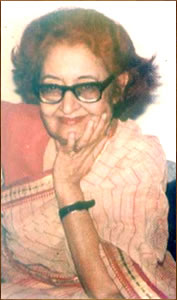
De Indiaase schrijfster Qurratulain Hyder werd geboren op 20 januari 1927 in Aligarh, Uttar Pradesh. Zie ook alle tags voor Qurratulain Hyder op dit blog.

Uit: Fireflies in the Mist

“The bearded skipper pricked his ears and moved a bit closer to hear the conversation.
“Isn’t he the ancient spirit of the river?” she whispered.
“Donít romanticise everything. He may be the Ancient Mariner and all that. What interests me right now is that he may be a staunch follower of the Muslim League, hoping that soon these Indian rivers would turn into Pakistani rivers. Geography is changed by human beings.
The shipmaster turned round and was greeted by an enthusiastic
Assalam Aleikum by the young man. He was now telling his companion,
“Bengal is a Muslim majority province and the Muslim masses are waiting for progressive leadership.”
“The nawabs of Bengal are Muslim League leaders. And they are so reactionary,” she hotly replied. With his keen river-eye the captain noticed that the heathen woman was very much in love with this upright follower of the Lord Prophet. But it distressed the Ole Man of the River when the fellow declared, “We, the communists, shall have to come close to the Muslim League. We shall provide progressive leadership to our masses.”
(…)

Arjumand Manzil was no Gothic castle. It was quite a normal household.
But why didn’t Jehan Ara ever mention him? Why didn’t he ever talk about her? This man is a double-crosser. A two-timing crook. Sudden tears filled her eyes. She bent over the railing and stared hard at the dark waves. She remembered the nightmare she had had in Santiniketan. On waking up she had decided never to meet him again. She had not answered his letters.
Still, he had chased her down the Ganges and here he was, smiling away so cheekily.”


Qurratulain Hyder (20 januari 1927 – 21 augustus 2007)


Lees verder “Qurratulain Hyder, Raymond Roussel, Michiel de Swaen, Edeltraud Eckert”

Edgar Allen Poe, Julian Barnes, Edwidge Danticat, Gustav Meyrink, Eugénio de Andrade

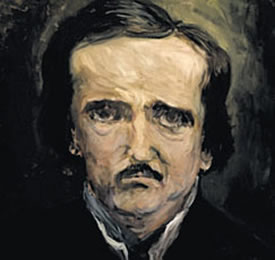
De Amerikaanse schrijver Edgar Allen Poe werd geboren op 19 januari 1809 in Boston. Zie ook mijn blog van 19 januari 2007 en ook mijn blog van 19 januari 2008 en ook mijn blog van 19 januari 2009 en ook mijn blog van 19 januari 2010.


Uit: The Black Cat


„For the most wild, yet most homely narrative which I am about to pen, I neither expect nor solicit belief. Mad indeed would I be to expect it, in a case where my very senses reject their own evidence. Yet, mad am I not –and very surely do I not dream. But to-morrow I die, and to-day I would unburden my soul. My immediate purpose is to place before the world, plainly, succinctly, and without comment, a series of mere household events. In their consequences, these events have terrified –have tortured –have destroyed me. Yet I will not attempt to expound them. To me, they have presented little but Horror –to many they will seem less terrible than baroques. Hereafter, perhaps, some intellect may be found which will reduce my phantasm to the common-place –some intellect more calm, more logical, and far less excitable than my own, which will perceive, in the circumstances I detail with awe, nothing more than an ordinary succession of very natural causes and effects.

From my infancy I was noted for the docility and humanity of my disposition. My tenderness of heart was even so conspicuous as to make me the jest of my companions. I was especially fond of animals, and was indulged by my parents with a great variety of pets. With these I spent most of my time, and never was so happy as when feeding and caressing them. This peculiar of character grew with my growth, and in my manhood, I derived from it one of my principal sources of pleasure. To those who have cherished an affection for a faithful and sagacious dog, I need hardly be at the trouble of explaining the nature or the intensity of the gratification thus derivable. There is something in the unselfish and self-sacrificing love of a brute, which goes directly to the heart of him who has had frequent occasion to test the paltry friendship and gossamer fidelity of mere Man.“


Edgar Allen Poe (19 januari 1809 – 7 oktober 1849)

Portret door de moderne Duitse schilder Anton Henning


Lees verder “Edgar Allen Poe, Julian Barnes, Edwidge Danticat, Gustav Meyrink, Eugénio de Andrade”

Patricia Highsmith, Thomas Gsella, Paul-Eerik Rummo, Marie Koenen

De Amerikaanse schrijfster Patricia Highsmith werd geboren als Mary Patricia Plangman in Fort Worth (Texas) op 19 januari 1921. Zie ook mijn blog van 19 januari 2008 en ook mijn blog van 19 januari 2009 en ook mijn blog van 19 januari 2010.


Uit: The Talented Miss Highsmith (Biografie door Joan Schenkar)


„On 16 November, 1973, a damp, coldish, breaking day in the tiny French village of Moncourt, France,  Patricia Highsmith, a fifty-two year old American writer living an apparently quiet life beside a branch of the Loing Canal, lit up another Gauloise jaune, tightened her grip on her favorite Parker fountain pen, hunched her shoulders  over her roll-top desk — her oddly-jointed arms and enormous hands were long enough to reach the back of the  roll while she was still seated –- and jotted down in her writer’s notebook a short list of helpful activites “which small children” might do “around the house.”

It’s a casual little list, the kind of list Pat liked to make when she was emptying out the  back pockets of her mind, and it has the tossed-off quality of an afterthought. But as any careful reader of Highsmith knows, the time to pay special attention to her is when she seems to be lounging, negligent, or (God forbid) mildly relaxed. There is a beast crouched in every “unconcerned” corner of her writing mind and, sure enough, it springs out at us in her list’s discomfiting title. “Little Crimes for Little Tots,” she called it.  And then for good measure she added a subtitle: “Things around the house which small children Can do…”

Pat had recently filled in another little list –- it was for the comics historian Jerry Bails back in the U.S. –- with some diversionary information about her work on the crime-busting comic book adventures of Black Terror and Sgt. Bill King, so perhaps she was  still counting up the ways in which small children could be slyly associated with crime. In her last writer’s journal, penned from the same perch in semi-suburban France, she had also spared a few thoughts for children.“


Patricia Highsmith (19 januari 1921 – 4 februari 1995)


Lees verder “Patricia Highsmith, Thomas Gsella, Paul-Eerik Rummo, Marie Koenen”

Rubén Darío, Peter Stamm, Robert Anton Wilson, Arno Schmidt, Franz Blei

De Nicaraguaanse schrijver Rubén Darío werd geboren in Metapa, tegenwoordig Ciudad Darío, op  18 januari 1867. Zie ook mijn blog van 18 januari 2007 en ook mijn blog van 18 januari 2008 en ook mijn blog van 18 januari 2009 en ook mijn blog van 18 januari 2010.


Lichtwärts die mysteriöse Rose


Lichtwärts die mysteriöse Rose,

Wo sie just begraben

Ist dies Tat dreizehn, welche große

Herkul hat zu wagen.


Mond, dein frohes Gleißen,

säumst, Fels, die Stunde.

Doch tausend Blanktopps reisen

Am Himmelsrunde.


Es trägt meine Schaluppe

achtern goldne Sonnen,

Erspäh auf Stieres Kruppe

Ich nun Europas Wonnen.


Rosen und Lilien


Wider alle Qualen, wider Traurigkeiten

Wenn auf bare Häupter schnei’n die rauhen Zeiten

Und die Ängste tosen:

Dies sind die Momente für die roten Rosen.


Doch für Augenblicke schwang’rer Illusionen,

Die sich müh’n dem Herzen Blumen einzuthronen

– Liebliche Delirien -:

Weiße, weiße Lilien.


Vertaald door Martin von Arndt


Rubén Darío (18 januari 1867 – 6 februari 1916) 

Standbeeld in Buenos Aires


Lees verder “Rubén Darío, Peter Stamm, Robert Anton Wilson, Arno Schmidt, Franz Blei”

Alan A. Milne, Paul Léautaud, Roger Bésus, Montesquieu, Jon Stallworthy

De Britse schrijver Alan Alexander Milne werd geboren op 18 januari 1882 in Londen. Zie ook mijn blog van 18 januari 2009 en ook mijn blog van 18 januari 2010. 


Uit: Pooh Goes Visiting


„Pooh always liked a little something at eleven o’clock in the morning, and he was very glad to see Rabbit getting out the plates and mugs; and when Rabbit said, ‘Honey or condensed milk with your bread?’ he was so exited that he said, ‘Both’ and then, so as not to seem greedy, he added, ‘But don’t bother about the bread, please.’

And for a long time after that he said nothing…until at last, humming to himself in a rather sticky voice, he got up, shook Rabbit lovingly by the paw, and said that he must be going on. ‘Must you?’ said Rabbit politely. ‘Well,’ said Pooh, ‘I could stay a little longer if it-if you-‘ and he tried very hard to look in the direction of the larder. ‘As a matter of fact,’ said Rabbit, ‘I was going out myself directly.’ ‘Oh well, then, I’ll be going on. Good bye.’ ‘Well good bye, if you’re sure you won’t have any more.’ ‘Is there any more?’ asked Pooh quickly. Rabbit took the covers of the dishes, and said ‘No, there wasn’t.’ ‘I thought not,’ said Pooh, nodding to himself. ‘Well Good-bye, I must be going on.’

So he started to climb out of the hole. He pulled with his front paws, and pushed with his back paws, and in a little while his nose was in the open again … and then his ears … and then his front paws … and then his shoulders … and then-‘Oh, help!’ said Pooh, ‘I’d better go back,’ ‘Oh bother!’ said Pooh, ‘I shall have to go on.’ ‘I can’t do either!’ said Pooh, ‘Oh help and bother!’ …


Alan Alexander Milne (18 januari 1882 – 31 januari 1956)


Lees verder “Alan A. Milne, Paul Léautaud, Roger Bésus, Montesquieu, Jon Stallworthy”

Henry A. Dobson, Ioan Slavici, Saint-Martin, Madame de Lafayette

De Engelse dichter en essayist Henry Austin Dobson werd geboren op 18 januari 1840 in Plymouth. Zie ook mijn blog van 18 januari 2009 en ook mijn blog van 18 januari 2010. 


Fame Is A Food That Dead Men Eat


Fame is a food that dead men eat,—

I have no stomach for such meat.

In little light and narrow room,

They eat it in the silent tomb,

With no kind voice of comrade near

To bid the banquet be of cheer.


But Friendship is a nobler thing,—

Of Friendship it is good to sing.

For truly, when a man shall end,

He lives in memory of his friend,

Who doth his better part recall,

And of his faults make funeral.


Henry Austin Dobson (18 januari 1840 – 2 september 1921)


Lees verder “Henry A. Dobson, Ioan Slavici, Saint-Martin, Madame de Lafayette”